

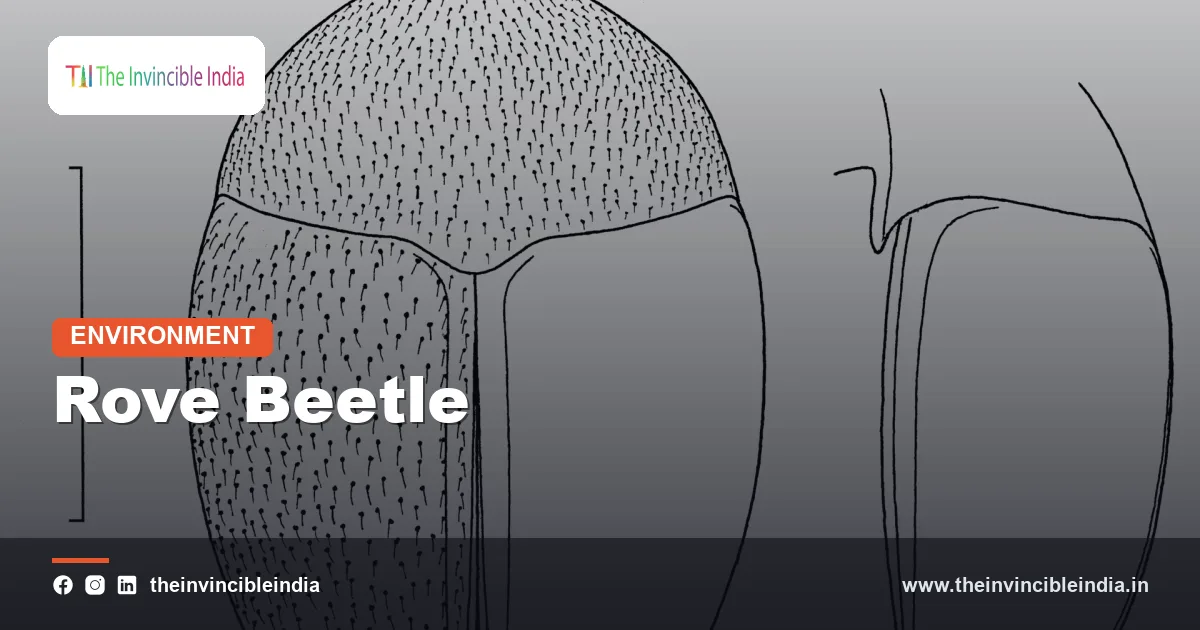
A rove beetle is a slender, fast-moving beetle of the family Staphylinidae, easily recognised by its very short wing covers that leave most of the flexible abdomen exposed. Staphylinidae is one of the largest families in the animal kingdom, with more than 60,000 described species worldwide, and many of them live in the soil, leaf litter, dung, compost and decaying matter of Indian farms, forests and gardens.
Most rove beetles are harmless and useful, because they hunt small insects, mites and fly maggots. One group, the Paederus beetles popularly called “Nairobi flies”, can cause painful skin blisters when crushed against the skin. This explainer separates the two facts clearly: what rove beetles are, how they live, and what is sensible to do about the blistering type.
Quick Facts
| Common name | Rove beetle |
|---|---|
| Scientific group | Family Staphylinidae (order Coleoptera); in India, genera such as Paederus, Stenus and Aleochara are represented |
| Size | Very variable: about 1 mm to over 2 cm; the common Paederus is roughly 6 to 10 mm |
| Habitat in India | Leaf litter, soil, compost, dung, rotting wood, stream banks, paddy fields, gardens and lit buildings during the rains |
| Diet | Mostly predatory on small insects, mites and fly larvae; some eat fungi, decaying matter or pollen |
| Life cycle | Complete metamorphosis: egg, larva, pupa, adult; a cycle often takes several weeks in warm conditions |
| Distinctive feature | Short elytra (wing covers) exposing a flexible, often upturned abdomen; hindwings folded beneath for flight |
| Role | Predator that helps keep pest and fly populations in check; decomposer-community member |
| Human concern | Paederus species release pederin, which can cause blistering dermatitis if the beetle is crushed on skin |
Key Takeaways
- A rove beetle belongs to the family Staphylinidae, which has more than 60,000 described species and is among the largest animal families.
- Rove beetles have short wing covers (elytra) that leave much of the abdomen visible, and the abdomen is flexible enough to curl upwards.
- Most rove beetles are beneficial predators that eat small insects, mites and fly maggots in soil, litter and dung.
- The so-called Nairobi fly is not a fly but a rove beetle of the genus Paederus, and it does not bite or sting.
- Paederus beetles cause skin blisters only when crushed or smeared, because their body fluid contains a vesicant chemical called pederin.
- The safe response to a Paederus beetle on the skin is to brush it off gently, never crush it, and wash the area promptly with soap and water.
What is a rove beetle?
A rove beetle is any member of the beetle family Staphylinidae, a vast group of mostly small, elongated beetles with short elytra and a long, flexible abdomen. The name “rove” suggests restless wandering, and these beetles indeed run quickly over soil, litter and plants in search of prey.
Ordinary beetles have hard, full-length wing covers that meet in a straight line down the back and hide the abdomen. Rove beetles are different. The elytra stop well short of the abdominal tip, so the last several segments are uncovered. Under the small covers, the hindwings are folded in an elaborate way, which allows many species to fly well in spite of their appearance.
Because the family is so large and varied, there is no single “typical” rove beetle. Some are tiny and pale, living in ants’ nests. Others are glossy black predators on the forest floor. A few are brightly coloured, like the orange-and-black Paederus beetles that people notice around lights during the monsoon. Entomologists classify them into many subfamilies, and a large number of Indian species remain poorly studied.
How can you recognise a rove beetle?
A rove beetle can be recognised by its narrow, parallel-sided body, short wing covers that expose the abdomen and its habit of running fast with the abdomen sometimes raised. These features separate rove beetles from most other beetles at a glance.
- Short elytra: The wing covers reach only the first few abdominal segments, giving the beetle a “half-dressed” look.
- Flexible abdomen: The abdomen can bend upwards or sideways, sometimes in a scorpion-like posture, although the beetle has no sting.
- Elongate body: Most species are slim and flattened, which suits life in cracks, litter and soil.
- Fast movement: Rove beetles run swiftly and often take off quickly when disturbed.
- Chewing mouthparts: Predatory species have strong, pointed mandibles for gripping small prey.
The Paederus beetle commonly seen near lights in India is about the size of a grain of rice, with a dark blue-black head, a bright orange-red thorax and abdomen base, and shining blue-black wing covers and abdomen tip. This colour pattern works as a warning to predators.
Where do rove beetles live in India?
Rove beetles live almost everywhere in India where there is moisture and shelter, from forest floors and river banks to paddy fields, vegetable plots, compost heaps and city gardens. Few beetle families have colonised so many micro-habitats.
Typical habitats include:
- Leaf litter and soil: The richest habitat, with dozens of small species hunting mites, springtails and insect larvae.
- Dung and carrion: Some species arrive to prey on fly eggs and maggots instead of eating the dung or carcass itself.
- Rotting wood, bark and fungi: Many species feed on fungi or hunt the small animals that live there.
- Stream banks and seashores: Certain rove beetles live in damp sand and mud at the edge of water.
- Ant and termite nests: Specialised species live as guests or predators in the colonies of social insects.
- Paddy fields and farmland: Paederus and other rove beetles patrol wet fields, where they prey on small pest insects.
During the monsoon, humid and warm conditions make rove beetle populations rise in the fields. Many then fly towards lit windows and lamps at night, which is why they appear indoors in large numbers in some seasons.
What do rove beetles eat?
Most rove beetles are predators that eat small insects, insect eggs and larvae, mites and fly maggots, although some feed on fungi, decaying plant matter or pollen. Their varied diet explains why the family has spread into so many habitats.
Predatory hunters
The large majority of rove beetles hunt actively. They seize prey with their mandibles and chew it. Paederus species hunt aphids, planthoppers, small caterpillars and other soft-bodied insects in crops. Because they are generalist feeders, they eat a range of prey instead of a single pest.
Specialists
Some groups have unusual methods. Beetles of the genus Stenus can shoot out a sticky, extendable mouthpart to catch springtails. Species of Aleochara lay eggs near fly pupae, and their larvae enter and feed on the pupae as parasitoids. Others eat fungal spores or live on pollen.
What is the life cycle of a rove beetle?
A rove beetle undergoes complete metamorphosis with four stages: egg, larva, pupa and adult. In warm, humid Indian conditions a cycle can be finished in a few weeks, although the exact time depends on the species, temperature and food.
- Egg: The female lays eggs in soil, litter, dung or other damp material close to prey.
- Larva: The larva is elongate with a hard head and chewing jaws, and in most predatory species it hunts like the adult. It moults several times.
- Pupa: The larva pupates, usually in a small cell in the soil or in litter.
- Adult: The adult emerges, hardens and begins to hunt and breed.
Rove beetles in tropical regions often breed repeatedly through the rainy months. Adults of some species survive the dry season in shelter, in soil or under debris, and emerge again with the first heavy rains.
What is the Nairobi fly and is it a rove beetle?
The Nairobi fly is the popular name for beetles of the genus Paederus, and it is indeed a rove beetle and not a true fly. The name arose after outbreaks of skin irritation in Nairobi, Kenya, in the 1990s that were linked to these beetles during a period of heavy rainfall.
Paederus beetles are found in many warm regions of the world, including India, where species such as Paederus fuscipes are widespread in wet farmland and around lights. The same type of skin condition is known under many local names, and it is described medically as Paederus dermatitis or dermatitis linearis, because the lesions often form in lines where the beetle was brushed across the skin.
Two facts are essential. First, Paederus beetles do not bite or sting in the usual sense. Second, the harm arises only when the beetle is pressed or crushed on the skin, releasing the body fluid. A beetle that walks over the skin and is left alone or gently brushed off generally causes no injury.
How does Paederus cause skin blisters?
Paederus causes skin blisters through a chemical called pederin, a strong vesicant (blister-causing substance) present in the beetle’s body fluid. When the beetle is crushed on the skin, pederin comes into contact with the skin surface and damages the cells.
Pederin is produced with the help of symbiotic bacteria that live inside the beetle, and it is considered a defence against predators such as spiders. The reaction in people usually follows a typical pattern:
- There is no immediate pain at the moment of contact, so many people do not realise what has happened.
- After a delay of around a day, the skin becomes red, itchy or burning.
- Blisters or pus-looking vesicles may appear, often in a linear streak or as paired “kissing” lesions where skin folds touch.
- The lesions typically dry up and heal over one to two weeks, sometimes leaving temporary darker marks.
Contact with the eyes, sometimes called Nairobi eye, can cause severe irritation, redness and swelling and needs prompt medical attention. The usual cause is touching the eyes after handling a beetle or its fluid.
What should you do if a Paederus beetle lands on your skin?
If a Paederus beetle lands on your skin, you should blow it off or brush it away gently without crushing it, then wash the area with soap and running water as soon as possible. Quick washing helps to remove pederin before it causes much damage.
- Do not slap, rub or squash the beetle on your body.
- Wash the skin and your hands with soap and plenty of water, and avoid touching your eyes in the meantime.
- Clean cloth soaked in cool water can soothe an irritated area.
- Do not burst blisters, and keep the area clean and dry.
- See a doctor if the rash is extensive, painful or infected, or if the eyes are affected, as medical treatment may include topical medicines.
This is general information and is not a substitute for medical advice. Anyone with a severe reaction, a child with a widespread rash, or any eye symptom should consult a health professional.
How do rove beetles help farmers and the ecosystem?
Rove beetles help farmers and the ecosystem by preying on pests and by taking part in the recycling of organic matter. A single field or compost heap can shelter many species, each controlling a different group of small animals.
| Role | What the rove beetle does | Example |
|---|---|---|
| Pest control | Eats aphids, planthoppers, mites and small caterpillars | Paederus in paddy fields |
| Fly control | Preys on fly eggs and maggots in dung and carrion | Many dung-living species |
| Parasitoid | Larvae feed inside fly pupae | Aleochara species |
| Soil food web | Hunts mites and springtails in litter | Small litter-dwelling species |
| Forensic and ecological indicator | Visits carrion to prey on fly larvae, helping investigators estimate time since death | Carrion-visiting species |
Because many species are sensitive to soil disturbance, drainage and chemical use, researchers sometimes use rove beetle diversity as a signal of the condition of a habitat. Heavy use of broad-spectrum insecticides kills these natural enemies together with the pests, which can cause pest numbers to rebound.
How is a rove beetle different from an earwig?
A rove beetle differs from an earwig mainly because the earwig carries a pair of pincer-like forceps at the tail end, while most rove beetles do not. The two are often confused because both have short wing covers and a long, flexible body.
| Feature | Rove beetle | Earwig |
|---|---|---|
| Order | Coleoptera (beetles) | Dermaptera |
| Tail end | Usually no pincers; some have small paired appendages | Prominent pincer-like forceps |
| Wing covers | Short, hard elytra | Short, leathery covers |
| Typical habit | Fast runner, active predator | Hides by day, active at night |
| Risk to humans | Only Paederus can cause blistering when crushed | Pinches can be felt but are not harmful |
The rove beetle’s raised-abdomen pose can also resemble a scorpion’s stance, but no rove beetle has a sting. Careful observation of the tail end and mouthparts usually settles the identification.
Bottom Line
The rove beetle is a vast and generally useful group of predatory beetles that keeps small pests and flies in check. Only the Paederus type needs care, and even then the risk is easily avoided by brushing the beetle away gently instead of crushing it.
Frequently Asked Questions
What is a rove beetle?
A rove beetle is a beetle of the family Staphylinidae, characterised by very short wing covers that leave most of the abdomen exposed. It is one of the largest animal families, with more than 60,000 described species, and most of them are small predators living in soil, litter and decaying matter.
Is the Nairobi fly a fly or a beetle?
The Nairobi fly is a beetle, not a fly. It is a rove beetle of the genus Paederus, which got its popular name after outbreaks of skin irritation in Nairobi, Kenya, during a period of heavy rain in the 1990s.
Do rove beetles bite or sting?
Rove beetles do not sting, and most never bite people. Larger species may nip if handled roughly, but the blistering caused by Paederus comes from a chemical released when the beetle is crushed on the skin and not from a bite or sting.
What should I do if a Paederus beetle touches my skin?
Gently blow or brush the beetle off without crushing it, and wash the area promptly with soap and running water. Avoid touching the eyes, and see a doctor if a blistering rash develops, spreads or becomes painful, or if the eyes are affected.
Are rove beetles useful or harmful?
Rove beetles are mostly useful. They prey on aphids, mites, small caterpillars and fly maggots, which helps to limit pests in fields, compost and dung. Only Paederus beetles pose a skin risk to people, and that risk arises only on crushing.
Why do rove beetles come indoors during the monsoon?
Rove beetles come indoors in the monsoon because they are attracted to artificial light at night, and wet weather increases their numbers in nearby fields and gardens. Screening windows, switching off unneeded lights and using mosquito nets help to keep them away.
{“@context”:”https://schema.org”,”@graph”:[{“@type”:”FAQPage”,”mainEntity”:[{“@type”:”Question”,”name”:”What is a rove beetle?”,”acceptedAnswer”:{“@type”:”Answer”,”text”:”A rove beetle is a beetle of the family Staphylinidae, characterised by very short wing covers that leave most of the abdomen exposed. It is one of the largest animal families, with more than 60,000 described species, and most of them are small predators living in soil, litter and decaying matter.”}},{“@type”:”Question”,”name”:”Is the Nairobi fly a fly or a beetle?”,”acceptedAnswer”:{“@type”:”Answer”,”text”:”The Nairobi fly is a beetle, not a fly. It is a rove beetle of the genus Paederus, which got its popular name after outbreaks of skin irritation in Nairobi, Kenya, during a period of heavy rain in the 1990s.”}},{“@type”:”Question”,”name”:”Do rove beetles bite or sting?”,”acceptedAnswer”:{“@type”:”Answer”,”text”:”Rove beetles do not sting, and most never bite people. Larger species may nip if handled roughly, but the blistering caused by Paederus comes from a chemical released when the beetle is crushed on the skin and not from a bite or sting.”}},{“@type”:”Question”,”name”:”What should I do if a Paederus beetle touches my skin?”,”acceptedAnswer”:{“@type”:”Answer”,”text”:”Gently blow or brush the beetle off without crushing it, and wash the area promptly with soap and running water. Avoid touching the eyes, and see a doctor if a blistering rash develops, spreads or becomes painful, or if the eyes are affected.”}},{“@type”:”Question”,”name”:”Are rove beetles useful or harmful?”,”acceptedAnswer”:{“@type”:”Answer”,”text”:”Rove beetles are mostly useful. They prey on aphids, mites, small caterpillars and fly maggots, which helps to limit pests in fields, compost and dung. Only Paederus beetles pose a skin risk to people, and that risk arises only on crushing.”}},{“@type”:”Question”,”name”:”Why do rove beetles come indoors during the monsoon?”,”acceptedAnswer”:{“@type”:”Answer”,”text”:”Rove beetles come indoors in the monsoon because they are attracted to artificial light at night, and wet weather increases their numbers in nearby fields and gardens. Screening windows, switching off unneeded lights and using mosquito nets help to keep them away.”}}]}]}


