

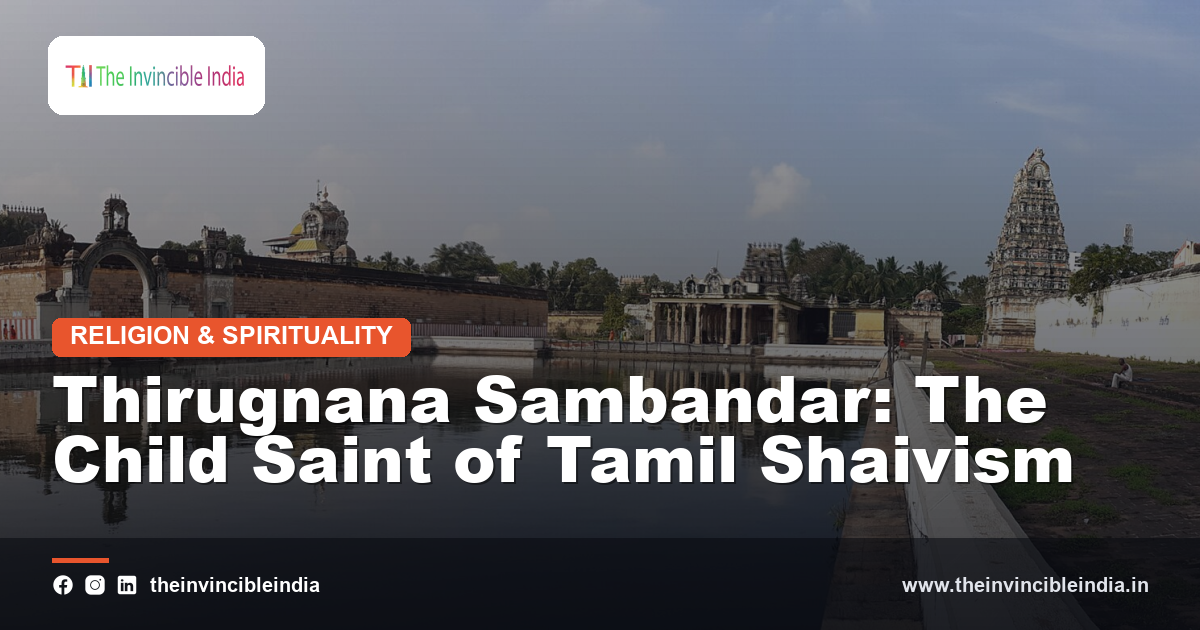
Thirugnana Sambandar, also called Campantar and Tirugnanasambandar, is one of the four principal Nayanar saints of Tamil Shaivism and one of the three poets whose hymns form the Tevaram. Traditionally dated to about the seventh century, he is revered above all as a child prodigy, a boy who is said to have begun singing the praise of Shiva while still very young. He is closely associated with the temple town of Sirkazhi in the Tamil country, and his hymns form the first three books of the sacred Shaiva collection known as the Tirumurai. His memory holds a central place in the worship of Shiva and in the wider tradition of Shaivism. Many events of his life are known through tradition, yet his standing among the Nayanars is secure.
Quick answer: Thirugnana Sambandar, also called Campantar, is one of the four principal Nayanar saints of Tamil Shaivism, generally placed in about the seventh century by tradition. He is revered as a child-prodigy saint who sang the praise of Shiva from a very young age, and he is closely linked with the temple town of Sirkazhi. His Tevaram hymns form the first three books of the Tirumurai, the sacred Tamil Shaiva canon, and are sung in temple worship to this day.
Key Takeaways
- Thirugnana Sambandar, also called Campantar, is one of the four principal Nayanar saints of Tamil Shaivism.
- He is generally placed in about the seventh century according to tradition.
- He is revered as a child-prodigy saint who sang of Shiva from a very young age.
- His hymns form the first three books of the Tirumurai, the sacred Shaiva Tamil canon.
- He is one of the three Tevaram poets, alongside Appar and Sundarar.
- He is closely associated with the temple town of Sirkazhi in the Tamil country.
The sections below explain his life as told by tradition, his Tevaram hymns, his link with Sirkazhi and his continuing place in Tamil Shaiva worship.
Quick Facts
| Detail | Information |
|---|---|
| Also known as | Campantar, Tirugnanasambandar |
| Tradition | Nayanars of Tamil Shaivism, Bhakti movement |
| Era | About the seventh century, traditionally dated |
| Region | Tamil country, associated with Sirkazhi |
| Language of works | Tamil |
| Principal works | Tevaram hymns, first three Tirumurai |
| Deity | Shiva |
| Principal shrine | Sirkazhi, Tamil Nadu |
Who Was Thirugnana Sambandar?
Thirugnana Sambandar was one of the great Nayanar saints of Tamil Shaivism, a poet and devotee who sang the praise of Shiva in Tamil and who is honoured among the four principal teachers of the tradition. His hymns form a major part of the sacred Shaiva canon of the Tamil land.
He is remembered above all as a child prodigy, a boy of extraordinary devotion who, according to tradition, began composing hymns while still very young. His affectionate name Campantar links him to the tradition that he received his gift through divine grace. Although many episodes of his life come from sacred biography rather than documented record, his hymns survive and reveal a devotion of remarkable tenderness and power that has endeared him to generations of worshippers.
What Do the Names Sambandar and Campantar Mean?
The saint is known by several closely related names that help readers recognise the same figure across texts and temples. The Tamil form Campantar and the fuller Tirugnanasambandar express the tradition that he was joined, or had a sacred connection, with divine knowledge and grace from his earliest years.
The word gnana within his name is often understood to mean sacred knowledge or wisdom, marking him as a saint whose insight was a gift rather than a thing learned. In Tamil Shaiva writing and in temple tradition he appears under these names, and keeping them in mind helps a reader follow his story and distinguish him from the other Nayanar poets of the Tevaram. The variety of names reflects the honour in which the saints were held.
When and Where Did Sambandar Live?
Sambandar is generally placed in about the seventh century, though the exact dates are given differently in various accounts, so it is wise to describe his era in general terms rather than fix a precise year. He lived and travelled in the Tamil country, a region rich in Shiva temples and devotional life.
His memory is bound above all to Sirkazhi, a famous temple town, and tradition also links him with many other shrines that he is said to have visited and sung of across the Tamil land. He is remembered as a saint who journeyed from temple to temple composing hymns in praise of the Lord. Because his life is handed down chiefly through tradition, careful writers speak of his region and the places of his devotion with confidence while leaving precise chronology open.
Who Were the Nayanars?
The Nayanars were the saints of Tamil Shaivism, traditionally numbered as sixty-three, who expressed devotion to Shiva and helped shape the bhakti movement of southern India. They came from many backgrounds, showing that the worship of Shiva was open to all people.
Their lives and legends were later gathered into a famous collection that tells the story of each saint, and the hymns of three among them, Sambandar, Appar and Sundarar, form the Tevaram. The Nayanars are honoured together in temple shrines and in the devotional life of the Tamil land. Sambandar holds a special place among them as the youngest of the great singers and one of the four Samayacharyas, the chief teachers of the tradition whose example guides devotees to this day.
Why Is Sambandar Called a Child Saint?
Sambandar is called a child saint because tradition remembers him as a boy of extraordinary devotion who began to sing the praise of Shiva while still very young, long before the usual age of learning. This image of the divinely gifted child lies at the heart of his memory.
Tradition tells that his gift of sacred song came to him as grace rather than through study, and that even as a child he moved audiences and kings by the power of his hymns. The figure of the holy child, wise beyond his years and wholly given to God, is cherished in the tradition as a sign of the freedom of divine grace. It teaches that devotion is not bound by age and that the Lord may choose the youngest and simplest as his singer.
Why Is Sambandar One of the Four Chief Nayanars?
Sambandar is counted among the four chief Nayanars, sometimes called the Samayacharyas or teachers of the tradition, because of the greatness of his hymns and the depth of his devotion. These four are honoured above the rest as the principal guides of Tamil Shaivism.
Three of them, Sambandar, Appar and Sundarar, composed the Tevaram, while the teacher Manikkavacakar is counted in a related group. Sambandar’s place among them rests on the large body of hymns attributed to him and on his memory as the inspired child singer. His standing is not only literary but devotional, for the tradition sees in him a model of grace-given devotion, and his verses are recited in temple worship across the Tamil land to this day.
What Is the Tevaram?
The Tevaram is the great body of Tamil Shaiva devotional hymns composed by three of the Nayanar saints, Sambandar, Appar and Sundarar, and it holds a central place in the worship of Shiva in the Tamil land. The hymns praise Shiva at the many temples the saints visited.
Arranged into several books, the Tevaram forms part of a larger Shaiva canon of sacred Tamil texts known as the Tirumurai. Its verses are sung in temples by trained singers and are learned by devotees across generations. Sambandar’s portion of the Tevaram is distinguished by its musicality and its tender, radiant tone. The collection as a whole is both a treasury of Tamil poetry and a living part of worship, linking the saints of long ago with the devotion of the present day.
Why Do Sambandar's Hymns Form the First Three Tirumurai?
Sambandar’s hymns form the first three books of the Tirumurai, the great collection of sacred Tamil Shaiva texts, a place of honour that reflects the esteem in which his poetry is held. The Tirumurai gathers the hymns of the Nayanar saints into an ordered canon.
By tradition his hymns open the collection, followed by those of Appar and Sundarar and then by other sacred works. This arrangement gives his verses a foundational place in the worship of Shiva. The naming of his hymns as the first Tirumurai is both a mark of reverence and a reflection of their central role in temple singing. For devotees, to begin with Sambandar is to begin with the voice of the inspired child whose song opened the treasury of Tamil Shaiva devotion.
What Are the Themes of Sambandar's Hymns?
Sambandar’s hymns are marked by radiant praise of Shiva, by a sense of the beauty and holiness of the temples, and by a confident, joyful devotion that reflects the tradition of his divine gift. The tone is bright, musical and full of wonder at the greatness of the Lord.
He sings of Shiva in his many forms and at his many shrines, calling on the Lord with tender and glorious names and inviting devotees to seek his grace. His verses celebrate the presence of God in the sacred places of the Tamil land and often close with a signature naming himself as the singer. For worshippers these hymns are both beautiful poetry and a guide to a devotion that is joyful, trusting and rooted in the love of Shiva.
How Is Sambandar Linked to the Saint Appar?
Sambandar is closely linked with the older Nayanar saint Appar, and tradition tells of a warm friendship between the two poets, who are said to have travelled and sung together on pilgrimages to Shiva temples. It was Sambandar who is said to have given Appar the loving name meaning father.
Their companionship, across a difference of age, is a cherished part of Nayanar tradition and shows the unity and affection among the saints. Though they are remembered as distinct voices, with Appar known for his humility and Sambandar for his inspired gift, their friendship symbolises the shared devotion of the Shaiva community. The stories of their journeys together bring warmth and colour to the sacred biography and underline the bonds of fellowship within the tradition.
What Role Does Sirkazhi Play in Sambandar's Story?
Sirkazhi plays a central part in the story of Sambandar, for the temple town is the place with which his memory is most closely bound and where tradition places the beginnings of his sacred song. The town is one of the honoured centres of Tamil Shaiva worship.
The temple at Sirkazhi, dedicated to a form of Shiva, is connected above all with the child saint, and his life is recalled in its festivals and daily worship. Pilgrims who come to the town honour the memory of the boy whose devotion became a model for all worshippers. Sirkazhi remains a living centre of Shaiva devotion, keeping alive the memory of the saint whose hymns opened the Tirumurai and whose song is celebrated there with special love.
How Is Sambandar Depicted in Art?
Sambandar is depicted in Tamil art, especially in bronze and stone, as a young child, often shown dancing or pointing upward, in keeping with the tradition of his divine gift received in infancy. His images are found in many Shiva temples alongside those of the other saints.
The figure of the child saint, radiant and joyful, is honoured in temple shrines where devotees pay their respects. The art expresses his innocence and his inspired devotion rather than any worldly rank. Such representations help worshippers remember the saints as living models of the devotional life. The tender care given to Sambandar in sacred art reflects the deep reverence in which the inspired child of Tamil Shaivism is held across the tradition.
How Do the Nayanars Compare With the Alvars?
The Nayanars, including Sambandar, are the Shaiva counterparts of the Alvars, who were the poet-saints of Tamil Vaishnavism, and the two groups together shaped the great bhakti movement of the Tamil land. Both sang in Tamil and expressed intense personal love for God.
Where the Nayanars sang the praise of Shiva, the Alvars sang the praise of Vishnu, yet the two movements shared a common devotional spirit and a common language of feeling. Comparing them helps readers see how the bhakti path flowered across different traditions in the same region and age. Sambandar stands within this wider flowering as one of the leading voices of Shaiva devotion, whose radiant hymns continue to move worshippers today.
How Is Sambandar Celebrated in Worship?
Sambandar is celebrated in worship through the daily and festive singing of his Tevaram hymns in Shiva temples across the Tamil country, where his verses open the treasury of sacred song. Trained singers keep his hymns alive in the rhythm of temple ritual.
His life, and especially the tradition of his inspired childhood, is recalled in festivals at Sirkazhi and at other shrines where he is venerated. Processions, recitation and the singing of his hymns bring his story alive for new generations. These celebrations keep his memory fresh and pass his poetry to those who come after, ensuring that the child saint of Tamil Shaivism remains a present and beloved figure in the worship of Shiva.
Why Does Sambandar Still Matter Today?
Thirugnana Sambandar still matters today because his hymns remain central to Tamil Shaiva worship and because his memory offers a lasting image of devotion given freely by grace. His verses are sung in temples and treasured as both poetry and prayer.
The figure of the inspired child, wholly devoted to God, speaks to worshippers who see in him the freedom and tenderness of the divine gift. Scholars value his hymns as landmarks of Tamil literature, while devotees find in them a guide to joyful devotion. Careful readers honour the context of his tradition and treat the sacred stories of his life as devotional belief, while recognising the enduring beauty of the hymns that bear his name.
Thirugnana Sambandar Today
Thirugnana Sambandar today is remembered as one of the four principal Nayanar saints of Tamil Shaivism and as the inspired child singer whose hymns open the Tirumurai, honoured at Sirkazhi and in temples across the Tamil country. His verses continue to form part of the living worship of Shiva.
Through his poetry he gave the tradition a voice of radiant and joyful devotion, and through his memory he offered an image of grace freely given to the youngest of souls. Many details of his story are tradition, yet the survival and daily use of his hymns give a clear and constant portrait of a saint of extraordinary devotion. His legacy endures as a reminder that love and song, received as grace, lie at the heart of the Shaiva devotional path.
Sources & Further Reading
- Ministry of Culture, Government of India (indiaculture.gov.in).
- Sahitya Akademi general references on Tamil devotional literature.
Frequently Asked Questions
Who was Thirugnana Sambandar?
Thirugnana Sambandar, also called Campantar, was one of the four principal Nayanar saints of Tamil Shaivism, traditionally dated to about the seventh century. He is revered as a child-prodigy saint and as one of the three poets of the Tevaram.
Why is Sambandar called a child saint?
Sambandar is called a child saint because tradition remembers him as a boy who began to sing the praise of Shiva while still very young. His gift of sacred song is held to have come through divine grace rather than study.
What is the Tevaram?
The Tevaram is the great body of Tamil Shaiva devotional hymns composed by three Nayanar saints, Sambandar, Appar and Sundarar. It holds a central place in the worship of Shiva and is sung in temples to this day.
Why do Sambandar's hymns form the first Tirumurai?
Sambandar’s hymns form the first three books of the Tirumurai, the sacred Tamil Shaiva canon, a place of honour that reflects the esteem in which his poetry is held. They open the ordered collection of the Nayanar hymns.
Where is Sambandar venerated?
Sambandar is venerated above all at the temple town of Sirkazhi in Tamil Nadu, and also in Shiva temples across the Tamil country where his hymns are sung. His inspired childhood is recalled in festivals there.
Who were the Nayanars?
The Nayanars were the saints of Tamil Shaivism, traditionally numbered as sixty-three, who expressed devotion to Shiva and helped shape the bhakti movement. Sambandar is counted among the four most honoured of them.


