

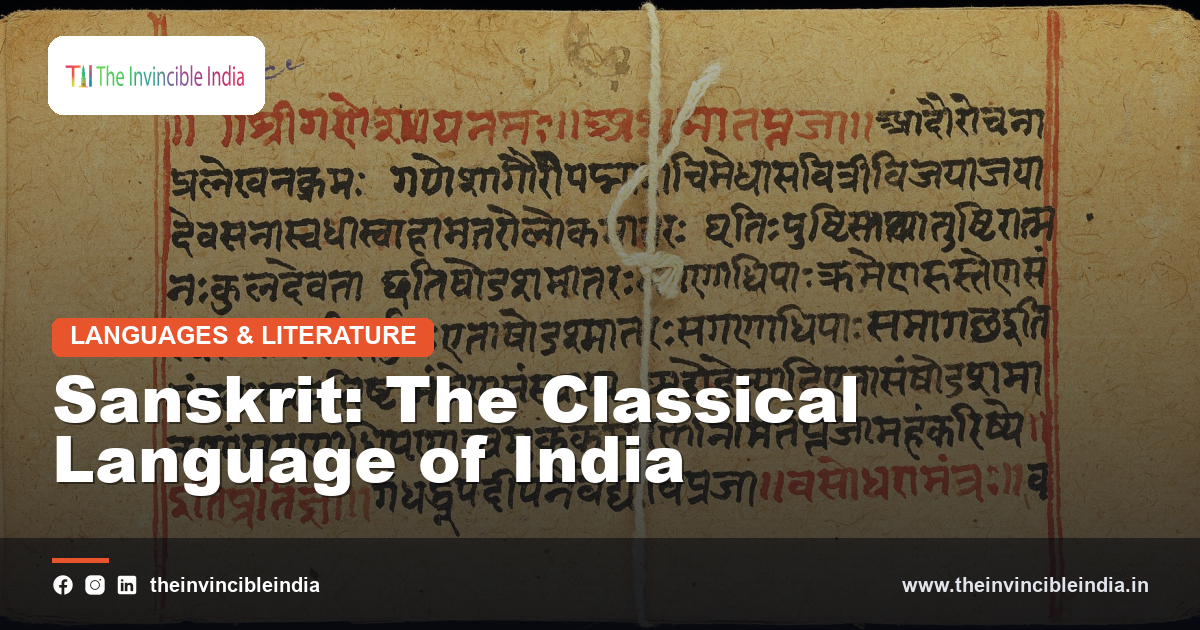
Sanskrit is the great classical language of India, one of the oldest and most influential languages in the world and the vehicle of an extraordinary heritage of literature, religion, philosophy and science. The language of the Vedas, the epics and a vast body of learning, it has shaped the culture and languages of the Indian subcontinent for thousands of years and is revered as a sacred and scholarly tongue. Renowned for its precise and sophisticated grammar and its beauty, Sanskrit is one of India’s officially recognised classical languages. This guide explores its history, its famous grammar, its vast literature, its role in religion and learning, its influence on other languages, and its living presence today.
Quick Facts
| Detail | Information |
|---|---|
| Type | Ancient classical Indo-Aryan language |
| Status | One of India’s officially recognised classical languages |
| Famous grammar | Panini’s Ashtadhyayi, a masterpiece of linguistic analysis |
| Literature | The Vedas, the epics, poetry, drama, philosophy and science |
| Script | Commonly written in Devanagari, among other scripts |
| Role | A sacred and scholarly language across religions |
The Language of the Gods
Sanskrit holds a place of unique reverence in Indian culture, often called the language of the gods and regarded as sacred and refined. Its very name means refined, polished or perfected, reflecting the esteem in which it has always been held. For thousands of years it has been the language of sacred scripture, learned discourse and high literature across the Indian subcontinent, a tongue associated with wisdom, spirituality and scholarship. Though no longer an everyday spoken language for most people, Sanskrit remains deeply venerated and continues to be used in religion, learning and ceremony. Its extraordinary heritage and its influence make it one of the great classical languages of humanity.
Ancient Origins
Sanskrit is one of the most ancient languages in the world, belonging to the Indo-European family and, more specifically, standing as the classical form of the ancient Indo-Aryan languages. Its earliest form, known as Vedic Sanskrit, is the language of the Vedas, the oldest sacred texts of Hinduism, whose composition reaches back into remote antiquity. Over time this ancient language developed into the more standardised Classical Sanskrit. The great age of Sanskrit, and its close relationship to other ancient languages of the wider Indo-European family, has long fascinated scholars and made the study of Sanskrit central to the understanding of the history of languages and of ancient civilisation.
Vedic and Classical Sanskrit
Scholars distinguish two great stages in the history of the language. The older, Vedic Sanskrit, is the archaic form found in the Vedas and related ancient texts, with its own distinctive features of sound, grammar and vocabulary. The later, Classical Sanskrit, is the more standardised form codified by the great grammarians, in which the vast bulk of later literature, the epics, poetry, drama, philosophy and science, was composed. The transition from the Vedic to the Classical language reflects the long development of Sanskrit over the centuries. This distinction between the ancient sacred language of the Vedas and the refined classical language of later literature is fundamental to the study of Sanskrit.
Panini and the Ashtadhyayi
One of the greatest achievements associated with Sanskrit is the extraordinary grammar composed by the ancient grammarian Panini, known as the Ashtadhyayi. In this work, Panini analysed and codified the Sanskrit language with astonishing precision and economy, setting out its grammar in a system of concise rules of remarkable sophistication. So rigorous and systematic is this grammar that it has been admired by modern linguists and even compared to the formal systems of mathematics and computer science. Panini’s work standardised Classical Sanskrit and stands as one of the greatest achievements of the human intellect in the analysis of language, a monument of ancient Indian learning that continues to be studied and admired today.
A Precise and Sophisticated Language
Sanskrit is renowned for the precision, richness and sophistication of its structure. It has an elaborate and highly regular grammar, with a complex system of noun and verb forms that allows meaning to be expressed with great exactness, and a vast and expressive vocabulary capable of fine shades of meaning and the coining of new compound words. This precision and richness made Sanskrit an ideal vehicle for philosophy, science, law and subtle poetry, allowing thinkers and writers to express complex and exact ideas. The beauty and logical structure of the language have been admired for centuries, and its sophistication is one of the reasons for its enduring prestige as a language of learning.
The Vedas and Sacred Texts
Sanskrit is above all the language of the sacred, and its oldest and most revered texts are the Vedas, the foundational scriptures of Hinduism, composed in the ancient Vedic form of the language. Beyond the Vedas, an immense body of religious literature was composed in Sanskrit, including the Upanishads, the great philosophical texts, and countless works of religious teaching, ritual and devotion. Sanskrit is also a sacred and scholarly language of Buddhism and Jainism, in which important texts were composed. This central role as the language of sacred scripture across the religions of India gives Sanskrit its profound spiritual importance and its enduring reverence in Indian culture.
The Great Epics
Among the crowning glories of Sanskrit literature are the two great epics, the Ramayana and the Mahabharata, composed in the language and counted among the greatest works of world literature. These vast poems, telling the stories of gods, heroes and the great moral and spiritual questions of life, have shaped the culture, values and imagination of the Indian subcontinent for millennia and remain beloved to this day. The Mahabharata, one of the longest poems ever composed, contains within it the Bhagavad Gita, one of the most revered of all spiritual texts. Through these epics, Sanskrit gave India some of its most enduring and influential literature, cherished across the ages.
Poetry and Drama
Classical Sanskrit is rich in exquisite poetry and drama, and its literary heritage includes some of the finest works of the ancient world. The greatest of the classical poets and dramatists is Kalidasa, celebrated for his beautiful poems and plays, whose works are considered masterpieces of world literature. Sanskrit drama flourished as a sophisticated art, and Sanskrit poetry attained great refinement, with elaborate conventions of imagery, metre and ornament. Alongside these were fables, tales and other literary forms of enduring appeal. This rich tradition of poetry, drama and storytelling represents the height of Sanskrit as a literary language and has influenced literature across India and beyond.
A Language of Science and Learning
Sanskrit was not only a language of religion and literature but the great vehicle of learning and science in ancient and classical India. In Sanskrit were composed important works on mathematics, astronomy, medicine, grammar, logic, law, philosophy, statecraft, architecture and many other fields, embodying the scientific and scholarly achievements of Indian civilisation. Scholars used the precision of the language to express complex ideas and to develop and transmit knowledge across generations. This vast body of learning in Sanskrit represents a major part of the intellectual heritage of humanity, and the study of these texts continues to reveal the depth and range of ancient Indian scholarship and science.
The Six Systems of Philosophy
Sanskrit is the language of India’s rich and profound philosophical traditions, above all the classical schools of Hindu philosophy, whose foundational texts were composed in it. These systems of thought explored deep questions of reality, knowledge, the self, consciousness and liberation, developing sophisticated philosophies over the centuries in a rich tradition of debate and commentary. The Upanishads, composed in Sanskrit, are among the greatest sources of Indian philosophy and mysticism. This immense philosophical heritage, expressed with the precision of the Sanskrit language, is one of the great contributions of India to world thought, and it continues to be studied and revered by scholars and seekers around the world.
Influence on Indian Languages
Sanskrit has had an immense influence on the languages of India, shaping their vocabulary, literature and culture over thousands of years. Many of the modern languages of India, especially the Indo-Aryan languages of the north, are descended from or deeply influenced by Sanskrit, and even the Dravidian languages of the south have absorbed a great deal of Sanskrit vocabulary. Countless words in the modern Indian languages derive from Sanskrit, and its literature and ideas have shaped the literary and cultural traditions of the whole subcontinent. This profound and pervasive influence makes Sanskrit a foundational language for the linguistic and cultural heritage of India as a whole.
The Script of Sanskrit
Sanskrit has been written in various scripts over its long history, but it is most commonly written today in the Devanagari script, the same script used for Hindi and several other Indian languages. Historically, Sanskrit was written in many regional scripts across India, so that the same language appeared in different scripts in different regions. The sounds of Sanskrit, systematically organised by ancient scholars, are well suited to the phonetic scripts of India, in which each sound has its own sign. This adaptability to many scripts reflects the way Sanskrit served as a shared classical language across a subcontinent of diverse regional writing systems, uniting them through a common learned tongue.
A Classical Language of India
In recognition of its antiquity, its rich literature and its profound cultural importance, Sanskrit has been officially designated one of the classical languages of India. This status recognises languages with an ancient and independent literary tradition of great value, and Sanskrit, as the fountainhead of so much of Indian civilisation, is pre-eminent among them. The recognition affirms the importance of preserving and promoting the language and its vast heritage. As a classical language, Sanskrit is the object of scholarly study, government support and efforts at preservation and revival, ensuring that this ancient and venerable tongue and its treasures continue to be studied, honoured and kept alive.
Sanskrit and Ceremony
Although Sanskrit is not commonly spoken in daily life today, it remains a living language of ceremony, ritual and religion across India. Sanskrit hymns, prayers and chants are recited in Hindu worship and rituals, from daily prayers to weddings and the great ceremonies of life, and the language is heard in temples and homes throughout the country. This ritual use keeps Sanskrit a living presence in the spiritual life of India, its ancient words continuing to carry sacred meaning and power for millions. This enduring ceremonial role, connecting the present to the most ancient traditions, is one of the most important ways in which Sanskrit remains alive in the modern world.
Revival and Study Today
In modern times there have been dedicated efforts to preserve, study and revive Sanskrit, recognising its immense cultural and intellectual value. It is taught in schools and universities in India and around the world, studied by scholars in fields from linguistics to philosophy, and promoted through institutions devoted to its preservation. There are even communities and initiatives that encourage the speaking of Sanskrit as a living language, and its vast literature continues to be studied, translated and admired. These efforts at revival and study reflect a growing appreciation of the value of Sanskrit and a determination to ensure that this ancient language and its extraordinary heritage are preserved for future generations.
Sanskrit Today
Today Sanskrit endures as one of the world’s great classical languages, revered for its antiquity, its beauty and its incomparable heritage of literature, religion, philosophy and science. Though no longer an everyday spoken tongue for most, it remains a living language of ritual, learning and ceremony, studied and honoured in India and around the world, and the object of dedicated efforts at preservation and revival. Its influence lives on in the languages, literature and culture of the whole subcontinent. As the fountainhead of so much of Indian civilisation, Sanskrit remains a treasure of humanity, its ancient words still resonant with wisdom, beauty and sacred meaning.
Sources & Further Reading
- Ministry of Culture, Government of India, on the classical languages of India (indiaculture.gov.in).
- Sahitya Akademi, national academy of letters, on Sanskrit literature (sahitya-akademi.gov.in).
- Central Sanskrit University and other institutions devoted to Sanskrit study and preservation.
Frequently Asked Questions
What is Sanskrit?
Sanskrit is the ancient classical language of India, one of the oldest languages in the world and the vehicle of a vast heritage of literature, religion, philosophy and science. It is the language of the Vedas and the epics and one of India’s officially recognised classical languages.
Who was Panini?
Panini was the ancient grammarian who composed the Ashtadhyayi, an extraordinary grammar of Sanskrit that analysed and codified the language with remarkable precision in a concise system of rules, admired by modern linguists as one of the great achievements of the human intellect.
What is the difference between Vedic and Classical Sanskrit?
Vedic Sanskrit is the older, archaic form of the language found in the Vedas, with its own distinctive features, while Classical Sanskrit is the later, standardised form codified by the grammarians, in which most later literature, poetry, drama and philosophy was composed.
What script is Sanskrit written in?
Sanskrit is most commonly written today in the Devanagari script, though historically it has been written in many regional scripts across India, so the same language appeared in different scripts in different regions.
Is Sanskrit still used today?
Yes. Although Sanskrit is not an everyday spoken language for most people, it remains a living language of ritual, ceremony and religion, is taught and studied in India and around the world, and is the object of dedicated efforts at preservation and revival.


