

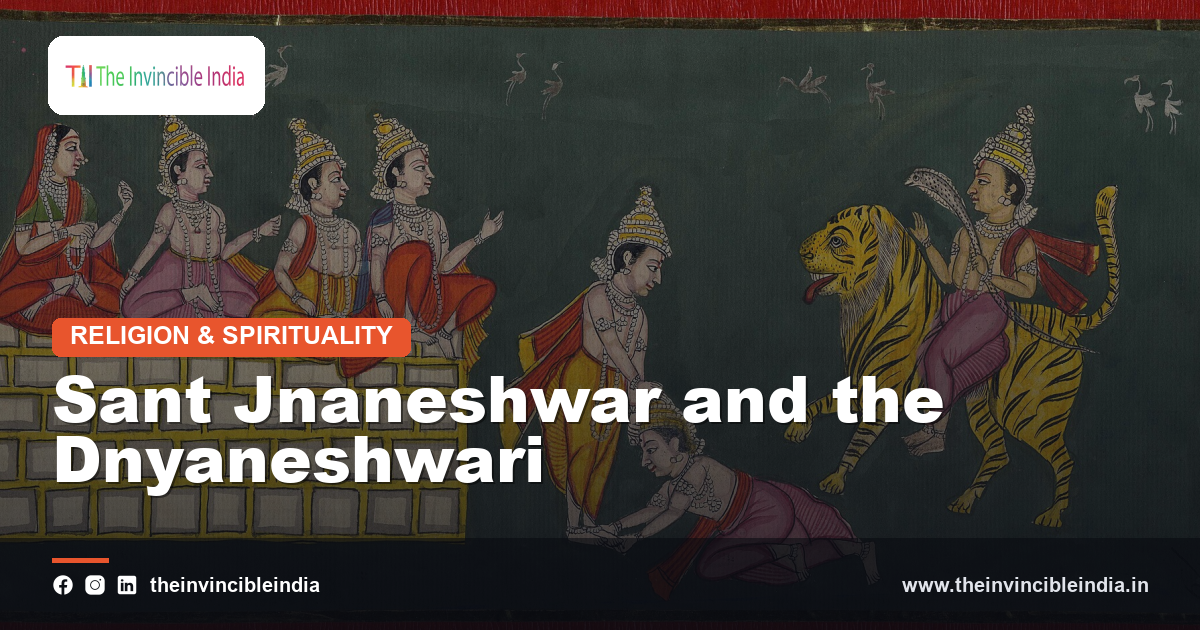
Among the saint-poets who shaped devotional religion in Maharashtra, Sant Jnaneshwar holds a foundational place as an early and profoundly influential voice of the Varkari tradition. Writing in Marathi rather than Sanskrit, he made classical philosophical teaching accessible to ordinary people, most famously through his commentary on the Bhagavad Gita known as the Dnyaneshwari. His life and work are closely tied to the broader devotional current later carried forward by saints such as those celebrated in the Varkari tradition, including Sant Tukaram, who looked back to Jnaneshwar as a spiritual forerunner. This overview surveys his life, his major literary contribution, and his continuing place in Maharashtra’s religious culture.
Quick Facts
| Detail | Information |
|---|---|
| Tradition | Varkari (Bhakti movement) |
| Era | 13th century, Maharashtra |
| Major work | Dnyaneshwari (commentary on Bhagavad Gita) |
| Language | Marathi |
| Samadhi site | Alandi, near Pune |
| Associated pilgrimage | Alandi-Pandharpur wari |
Historical and Regional Context
Sant Jnaneshwar lived in the region of present-day Maharashtra during the thirteenth century, a period when devotional religious movements were beginning to take distinctive regional forms across the Indian subcontinent. In Maharashtra, this took shape as what would become known as the Varkari tradition, a devotional current centered on the worship of Vitthal, a form of Vishnu enshrined at Pandharpur. Jnaneshwar’s lifetime coincided with a broader flowering of vernacular religious literature across India, as saint-poets in different regions began composing devotional and philosophical works in local languages rather than Sanskrit alone. This context shaped his own decision to render deep philosophical teaching in Marathi, making it accessible to audiences who might not have had access to Sanskrit learning. His life and work are best understood against this backdrop of regional devotional awakening, which he both drew upon and profoundly shaped for later generations.
Early Life
Details of Jnaneshwar’s early life are known primarily through devotional tradition and later hagiographical accounts, which describe a childhood marked by hardship and social difficulty. He is remembered as one of several siblings in a family that faced social exclusion of a kind common in accounts of saints who challenged prevailing religious and social norms of their time. Despite these circumstances, tradition holds that Jnaneshwar showed exceptional spiritual and intellectual gifts from a young age, receiving instruction in philosophy and scripture that prepared him for the literary and spiritual work he would later undertake. Because these accounts blend historical memory with devotional storytelling built up over centuries, exact biographical details are difficult to verify with precision. What remains clear is that Jnaneshwar emerged from this early life as a figure of remarkable learning, composing his major philosophical work while still very young by later report.
Family and Spiritual Formation
Jnaneshwar is traditionally described as one of four siblings, all of whom are remembered within the Varkari tradition as figures of spiritual significance in their own right. His family is said to have faced social difficulties connected to their father’s earlier life as a renunciate who later returned to householder life, a background that tradition holds exposed the children to exclusion from some aspects of orthodox religious society. This formative experience is often cited in devotional accounts as shaping Jnaneshwar’s later emphasis on a form of spiritual teaching accessible to all, regardless of social standing. His siblings, particularly his sister Muktabai, are also remembered as spiritually accomplished figures within Varkari devotional memory. Together, the family is regarded within the tradition as an early and formative circle from which the broader Varkari devotional movement drew inspiration and legitimacy.
The Varkari Tradition
The Varkari tradition, with which Jnaneshwar is closely associated, centers on devotion to Vitthal, worshipped at the temple town of Pandharpur in Maharashtra, and on regular pilgrimage to that shrine. The tradition emphasizes accessible, egalitarian devotion expressed through communal singing of devotional songs known as abhangs, congregational chanting of the divine name, and periodic mass pilgrimages called wari. Jnaneshwar is regarded as one of the tradition’s earliest and most important figures, providing much of its philosophical grounding through his Marathi rendering of classical teaching. The Varkari movement subsequently produced a long line of saint-poets across succeeding centuries, each contributing devotional compositions in Marathi that built on the foundation Jnaneshwar had established. This continuity of devotional literature and practice, sustained across centuries, is one of the most distinctive features of Maharashtra’s religious culture, and Jnaneshwar’s place at its historical foundation is widely acknowledged.
Composition of the Dnyaneshwari
Jnaneshwar’s most celebrated work is a detailed commentary on the Bhagavad Gita, composed in Marathi verse and known today as the Dnyaneshwari, or alternatively as the Bhavartha Deepika. Tradition holds that he composed this extensive work while still a young man, an achievement regarded within the tradition as remarkable both for its scale and its philosophical depth. Rather than offering a literal translation of the Sanskrit text, Jnaneshwar expanded on the Gita’s teachings with extensive commentary, illustration, and poetic elaboration intended to make its philosophical content vivid and comprehensible to a Marathi-speaking audience unfamiliar with Sanskrit. The work is considered a landmark not only in Maharashtra’s religious history but in the broader history of Marathi literature, marking an early and highly accomplished example of philosophical writing in a regional Indian language rather than in Sanskrit.
Structure and Content of the Dnyaneshwari
The Dnyaneshwari follows the structure of the Bhagavad Gita, moving chapter by chapter through the dialogue between Krishna and Arjuna, but it expands considerably on the original text through extended commentary, illustrative analogy, and devotional reflection. Composed in the ovi meter traditional to Marathi devotional poetry, the work blends philosophical exposition with lyrical and often vivid imagery drawn from everyday life, nature, and regional culture, making abstract concepts more approachable for its audience. Jnaneshwar’s commentary addresses the Gita’s central themes, including the nature of duty, the discipline of devotion, and the path to spiritual liberation, interpreting them in a manner consistent with the broader Vedantic philosophical tradition while giving them a distinctly devotional emphasis. The scale and literary quality of the work have led generations of readers and scholars to regard it as one of the most significant philosophical and literary achievements in the Marathi language.
Philosophy and Teaching
Philosophically, the Dnyaneshwari is generally understood as presenting a devotional interpretation of Advaita Vedanta, the school of thought that emphasizes the fundamental oneness of the individual soul and ultimate reality. Jnaneshwar’s commentary weaves this non-dual philosophical framework together with an emphasis on bhakti, or loving devotion, presenting knowledge and devotion not as opposed paths but as complementary aspects of a single spiritual journey. This synthesis of rigorous philosophy with accessible devotional practice is often cited as one of the most distinctive features of his teaching, allowing readers without formal philosophical training to engage meaningfully with the Gita’s deeper themes. The emphasis on the equal spiritual capacity of all people, regardless of social position, is also a recurring theme in his teaching, consistent with the broader egalitarian ethos of the Varkari tradition he helped to establish.
Use of Marathi Language
Jnaneshwar’s choice to compose his major philosophical work in Marathi rather than Sanskrit represented a significant and, for its time, unconventional decision, since Sanskrit had long been the primary language of serious philosophical and theological writing in India. By rendering the Bhagavad Gita’s teaching in the vernacular, he made sophisticated philosophical content available to a far wider audience, including those without access to Sanskrit education, which in practice meant most of the general population. This choice is often highlighted by scholars of Marathi literature as a pivotal moment in the language’s development, elevating Marathi to a vehicle capable of expressing the most demanding philosophical and spiritual ideas. The decision also reflected the broader devotional ethos of accessibility that characterized the Varkari movement, reinforcing the idea that spiritual knowledge should not be restricted by language, education, or social status.
Other Attributed Works
Beyond the Dnyaneshwari, Jnaneshwar is traditionally credited with several other devotional and philosophical compositions in Marathi, including shorter devotional poems, or abhangs, that continue to be sung within Varkari worship. Another significant work attributed to him is a philosophical treatise sometimes referred to by the title Amrutanubhav, which explores themes of spiritual experience and non-dual realization in a more concentrated and independently structured composition than the expansive Dnyaneshwari. These additional works, while generally shorter than his central commentary, are valued within the tradition for the depth of their philosophical and devotional content. Together with the Dnyaneshwari, they form the core literary legacy attributed to Jnaneshwar, and they continue to be studied, recited, and sung within Varkari religious practice as expressions of his broader spiritual teaching.
Samadhi at Alandi
According to tradition, Jnaneshwar took samadhi, a voluntary conclusion of his earthly life through deep meditative absorption, at a young age in the town of Alandi, near present-day Pune. Alandi subsequently became one of the most important pilgrimage sites within the Varkari tradition, housing a shrine that continues to attract devotees from across Maharashtra and beyond. The samadhi shrine at Alandi is maintained as a place of active worship, with regular rituals and a continuous stream of pilgrims who come to pay respect to the saint’s memory. The town’s association with Jnaneshwar has made it a central node in the broader geography of Varkari devotion, alongside Pandharpur, and it remains a focal point for annual pilgrimages that commemorate his life and teaching.
Pandharpur and the Wari Pilgrimage
The town of Pandharpur, home to the principal shrine of Vitthal, stands at the heart of Varkari devotional geography, and the annual pilgrimage known as the wari connects it closely to Jnaneshwar’s memory at Alandi. During this pilgrimage, devotees carry palanquins, or palkhis, bearing symbolic representations associated with revered saints, including one specifically associated with Jnaneshwar, on a journey covering many days on foot from Alandi to Pandharpur. Pilgrims walk together in organized groups, singing devotional songs and observing a shared discipline along the route, in a practice that has continued for generations and draws large numbers of participants each year. This pilgrimage embodies many of the core values associated with Jnaneshwar and the Varkari tradition more broadly, including communal devotion, physical discipline, and the accessibility of spiritual practice to people from all walks of life.
Influence on Later Saint-Poets
Jnaneshwar’s influence extended well beyond his own lifetime, shaping the work of numerous later Varkari saint-poets who looked to him as a founding figure of their shared tradition. Saints such as Sant Namdev, Sant Eknath, and Sant Tukaram, each writing in subsequent centuries, engaged with themes, philosophical positions, and devotional practices that trace back in part to Jnaneshwar’s foundational contributions. These later poets frequently referenced Jnaneshwar directly in their own compositions, acknowledging his role in establishing the philosophical and literary foundation of Marathi devotional poetry. The continuity between Jnaneshwar and these later figures illustrates how a single influential voice can shape a devotional tradition across many generations, sustaining shared themes, vocabulary, and practice even as individual poets brought their own distinct perspectives and historical circumstances to their work.
Place in Marathi Literature
Within the history of Marathi literature, Jnaneshwar occupies a position of exceptional importance, regarded by scholars as one of the earliest and most accomplished authors to have composed sophisticated philosophical literature in the language. The Dnyaneshwari is frequently cited as a foundational text in the development of Marathi as a literary and philosophical medium, demonstrating the language’s capacity for nuanced abstract expression at a very early stage in its literary history. Literary historians also point to the poetic craftsmanship of the work, including its imagery, rhythm, and structural sophistication, as evidence of a mature and highly developed literary sensibility. This standing has ensured Jnaneshwar’s continued inclusion in academic study of Marathi literature, alongside his broader religious significance, situating him as a figure of importance to literary historians and religious practitioners alike.
Religious and Cultural Symbolism
Jnaneshwar occupies a symbolic place within Maharashtra’s religious and cultural imagination that extends beyond his specific literary and philosophical contributions. He is often invoked as an emblem of the union between deep philosophical learning and accessible popular devotion, a combination widely regarded as central to the distinctive character of the Varkari tradition. His life story, as remembered in devotional tradition, is also frequently cited as an example of spiritual attainment achieved despite social hardship, reinforcing the tradition’s broader emphasis on the equal spiritual potential of all people regardless of social circumstance. This symbolic significance has made Jnaneshwar a figure referenced not only in strictly religious contexts but also in broader discussions of Maharashtra’s cultural identity, language, and history, reflecting the depth and breadth of his continuing influence.
Commemoration and Festivals
Jnaneshwar’s memory is actively commemorated through a number of festivals and observances that continue to draw large numbers of participants in present-day Maharashtra. The annual palkhi procession from Alandi to Pandharpur, timed to coincide with a significant point in the Hindu calendar, remains the most prominent of these observances, drawing pilgrims from across the state who walk the route while singing devotional songs associated with Jnaneshwar and other Varkari saints. Alandi itself hosts regular rituals and larger annual observances connected to the saint’s memory, drawing visitors throughout the year in addition to the major pilgrimage season. These continuing observances demonstrate the living character of Jnaneshwar’s legacy, sustained not simply as a matter of historical or literary interest but as an active devotional practice observed by large communities across generations.
Scholarly and Popular Interest
Jnaneshwar and his principal work continue to attract sustained scholarly attention, with researchers in religious studies, philosophy, and Marathi literature examining the Dnyaneshwari’s philosophical content, literary style, and historical context. Popular interest in his life and teaching also remains strong, reflected in the continued publication of translations, commentaries, and devotional retellings of his story intended for general audiences as well as specialists. Educational institutions in Maharashtra frequently include his work within literature and philosophy curricula, ensuring that new generations continue to encounter his writing directly. This combination of sustained scholarly engagement and enduring popular devotion reflects the dual character of Jnaneshwar’s legacy, as both a figure of serious intellectual interest and a living object of religious reverence within the Varkari tradition and Maharashtra’s broader cultural life.
Sant Jnaneshwar's Legacy Today
Sant Jnaneshwar’s legacy remains vividly present in Maharashtra today, sustained through the continuing observance of the Alandi to Pandharpur pilgrimage, the ongoing recitation and study of the Dnyaneshwari, and his enduring symbolic association with the Varkari tradition’s values of accessible, egalitarian devotion. His shrine at Alandi continues to receive a steady flow of pilgrims and visitors, while his literary work remains a subject of active study within Marathi literary and religious scholarship. The philosophical synthesis he articulated, joining rigorous non-dual philosophy with heartfelt devotional practice, continues to inform Varkari religious life and to influence broader currents of Hindu devotional thought associated with the wider Bhakti movement. Centuries after his lifetime, Jnaneshwar remains one of the most revered and studied figures in the religious and literary history of Maharashtra, his name inseparable from the Varkari tradition he helped to found.
Sources & Further Reading
- Sahitya Akademi (sahitya-akademi.gov.in).
- Ministry of Culture, Government of India (indiaculture.gov.in).
Frequently Asked Questions
Who was Sant Jnaneshwar?
Sant Jnaneshwar was a thirteenth-century Marathi saint-poet regarded as a founding figure of the Varkari devotional tradition, best known for his commentary on the Bhagavad Gita.
What is the Dnyaneshwari?
The Dnyaneshwari is Jnaneshwar’s extensive Marathi commentary on the Bhagavad Gita, blending philosophical exposition with devotional poetry, and is considered a landmark of Marathi literature.
What is the Varkari tradition?
The Varkari tradition is a Maharashtra-based devotional movement centered on worship of Vitthal at Pandharpur, marked by communal singing and pilgrimage, in which Jnaneshwar is a foundational figure.
Where is Sant Jnaneshwar's samadhi shrine located?
Tradition holds that Jnaneshwar took samadhi at Alandi, near Pune, which remains an important Varkari pilgrimage site to this day.
How did Sant Jnaneshwar influence later saints?
Later Varkari saint-poets such as Namdev, Eknath, and Tukaram drew on the philosophical and devotional foundation Jnaneshwar established, extending his influence across succeeding centuries.


