

Saraswati Puja honours Saraswati, the goddess of knowledge, learning, music and the arts, worshipped by students, artists and households across India. Celebrated on Vasant Panchami, the day traditionally marking the arrival of spring, the festival is especially prominent in Bengal, Odisha, Assam and Bihar, while also being widely observed in schools and colleges nationwide. Falling in a season of renewal much like Holi, which arrives later in spring, Saraswati Puja carries its own distinct focus on learning and creative pursuit. This guide surveys its meaning, rituals and regional character.
Quick Facts
| Detail | Information |
|---|---|
| Also Known As | Vasant Panchami puja |
| Dedicated To | Goddess Saraswati |
| Type of Observance | Hindu festival honouring knowledge and the arts |
| General Timing | Magh Shukla Panchami (January-February) |
| Key Practices | Idol worship, hatekhari, blessing of books and instruments |
| Region of Prominence | Bengal, Odisha, Assam, Bihar, and schools nationwide |
Meaning and Significance
Saraswati Puja is dedicated to Saraswati, revered in Hindu tradition as the goddess of knowledge, wisdom, music and the arts. The festival is regarded as an occasion to seek her blessings for learning and creative endeavour, making it especially meaningful to students, teachers, musicians and artists across the country.
Unlike festivals centred on grand public spectacle, Saraswati Puja often carries a gentler, more reflective tone, focused on intellectual and artistic pursuits rather than boisterous celebration. This distinct character has made it a widely cherished occasion within homes, schools and cultural institutions alike.
Saraswati as Goddess of Knowledge and Arts
Saraswati is traditionally depicted seated on a lotus or a swan, holding a veena, a stringed musical instrument, along with a book and a strand of prayer beads, symbols closely tied to her association with music, learning and disciplined study. Her iconography consistently emphasises purity, wisdom and creative expression.
As part of the wider group of goddesses in Hindu tradition, Saraswati occupies a distinct role centred specifically on intellect and artistic ability, complementing other goddesses associated with wealth or power. This specific association has made her puja particularly significant to those engaged in education and the arts.
Position in the Hindu Calendar: Vasant Panchami
Saraswati Puja is observed on Vasant Panchami, the fifth day of the bright fortnight of the lunar month of Magh, generally corresponding to late January or February in the Gregorian calendar. The day is traditionally regarded as marking the early arrival of spring across much of India.
As with other festivals based on the lunar calendar, the precise Gregorian date shifts each year, and regional almanacs are consulted to confirm the exact day of observance. This placement at the threshold of spring gives the festival an added association with renewal and fresh beginnings.
Association with the Arrival of Spring
Vasant Panchami is widely regarded as heralding the change of season from winter to spring, a transition celebrated with the customary wearing of yellow clothing and the use of yellow flowers in worship. Mustard fields blooming in parts of North India are often associated with this seasonal moment.
This seasonal dimension gives Saraswati Puja a dual identity, functioning both as a specific goddess-focused observance and as part of a broader cultural welcome to spring. The pairing of intellectual devotion with seasonal celebration is one of the distinctive features of this festival.
Idol-Making Traditions
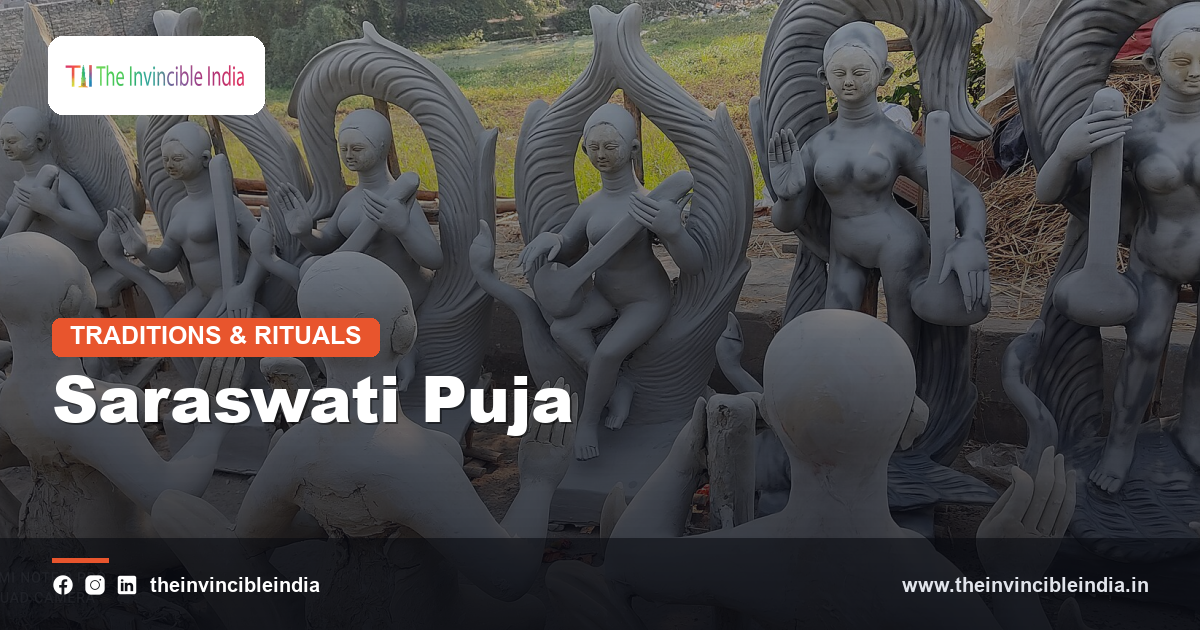
In regions where Saraswati Puja is celebrated with clay idols, particularly in Bengal, Odisha and Assam, skilled artisans craft images of the goddess in the weeks leading up to the festival, following techniques passed down through generations. These idols are typically modest in scale compared to those made for larger festivals.
The idol-making process itself is treated with care and reverence, reflecting the broader association between artistic craftsmanship and the goddess who is believed to preside over creative skill. This connection between the goddess of the arts and the artisans who fashion her image is often noted as fitting.
Rituals of Puja and Offerings
On the day of the festival, the goddess is worshipped with offerings of flowers, particularly yellow marigolds, along with fruits, sweets and other traditional items placed before her image or picture. Priests or family elders typically lead the recitation of hymns and prayers dedicated to Saraswati.
Many households and institutions also observe a custom of not reading or writing on the day itself, out of respect for the goddess of learning, resuming study only after her blessings have been formally sought. This temporary pause is regarded as a mark of devotion rather than mere superstition.
The Significance of Yellow
Yellow holds particular symbolic importance during Saraswati Puja, associated with the blossoming of mustard flowers and the general spirit of vibrancy linked to the arrival of spring. Devotees commonly wear yellow clothing, and yellow flowers and sweets, such as those made with saffron, are prominent in the day’s offerings.
This emphasis on a single unifying colour gives the festival a distinct visual identity, setting it apart from other Hindu observances that may favour different symbolic hues. The colour’s association with brightness and freshness aligns naturally with the festival’s broader themes of renewal and intellectual awakening.
Hatekhari: Initiation into Learning
In Bengal and neighbouring regions, Saraswati Puja is closely associated with hatekhari, a ceremony marking a young child’s first formal introduction to writing and learning. Children are guided to trace their first letters, often in rice grains or on a slate, under the blessing of the goddess.
This ceremony is regarded as an important milestone in a child’s early life, symbolically linking the beginning of formal education to the goddess of knowledge. Families often treat the day as an occasion for modest celebration, inviting relatives to witness this early educational rite of passage.
Placing Books and Instruments for Blessing
A widely observed custom during Saraswati Puja involves placing books, pens, musical instruments and other tools of study or artistic practice before the goddess’s image, seeking her blessings upon them. Students in particular set aside their textbooks for this purpose in the days before the festival.
This practice reflects the festival’s practical dimension, connecting everyday tools of learning and creativity directly to the devotional occasion. Many students and artists regard the ritual as a meaningful way of expressing gratitude and seeking encouragement for the academic or artistic year ahead.
Saraswati Puja in Schools and Educational Institutions
Saraswati Puja is widely observed in schools, colleges and universities across India, regardless of region, reflecting the festival’s close association with education. Institutions often organise their own celebrations, with students and staff jointly arranging the idol, offerings and rituals.
These institutional celebrations frequently double as cultural events, featuring music, recitation and art competitions alongside the religious observance. This broad adoption within educational settings has made Saraswati Puja one of the most universally recognised festivals among students throughout the country.
Regional Prominence in Bengal, Odisha, Assam and Bihar
While observed nationwide, Saraswati Puja holds especially strong cultural prominence in Bengal, Odisha, Assam and Bihar, where community celebrations with clay idols and public pandals are common. In these regions, the festival often rivals other major goddess festivals in terms of local enthusiasm and preparation.
Local variations in ritual detail and the scale of celebration exist across these states, though the core elements of idol worship, offerings and the blessing of books remain broadly consistent. This regional intensity reflects the deep cultural roots the festival has developed in eastern India in particular.
Community Pandals and Public Celebration
In cities and towns across eastern India, neighbourhood associations and student groups erect temporary pandals housing Saraswati idols for public worship during the festival. These community celebrations often extend over the puja day and the following one, drawing local residents for collective prayer and cultural programmes.
Such public pandals complement household worship, offering a shared communal space where neighbours and friends gather to participate in the festival together. The atmosphere in these pandals, marked by music, offerings and gathering, adds a lively public dimension to what is otherwise a fairly contemplative festival.
Saraswati Puja and the Craftsmen of Kumartuli
The traditional potter’s quarter of Kumartuli in Kolkata, well known for crafting idols for major Bengali festivals, also produces a significant number of Saraswati idols each year ahead of the festival. Artisans here apply the same skill and attention used for larger festival idols to these smaller, seasonal commissions.
This connection between Saraswati Puja and the wider idol-making economy of Bengal situates the festival within a broader annual cycle of artisanal craft and religious observance, linking the goddess of the arts directly to the livelihoods of the artists who shape her image.
Immersion Rituals
Following the days of worship, clay idols of Saraswati are ceremonially immersed in rivers, ponds or other water bodies, typically a day or two after the puja itself. This immersion, accompanied by processions and devotional chanting in many communities, marks the formal conclusion of the festival.
The practice of immersion reflects a broader pattern common to many Hindu festivals involving clay idols, in which the material image is returned to nature once its ritual purpose has been fulfilled. This act is understood as symbolic rather than final, with devotion to the goddess continuing beyond the physical idol.
Saraswati Puja Beyond Eastern India
Outside its traditional strongholds, Saraswati Puja is observed in a somewhat quieter form across much of India, often centred on household worship, school celebrations or gatherings at cultural and educational institutions rather than large public idols. Temples dedicated to Saraswati, though fewer in number than those for other deities, also host special observances on this day.
This wider, more understated observance reflects the festival’s broad appeal across linguistic and regional lines, uniting communities through a shared reverence for knowledge and artistic ability rather than through a single dominant regional style of celebration.
Saraswati Puja and Classical Music Traditions
Musicians and dancers trained in classical Indian traditions hold Saraswati Puja in particular regard, often treating the day as an occasion to seek the goddess’s blessing upon their instruments and their practice. Many music schools and gharanas organise special observances, with senior teachers leading prayers before students begin the day’s lessons.
This close association between Saraswati and the performing arts extends the festival’s significance beyond formal education into the world of classical music and dance more broadly. Instruments such as the veena, harmonium and tabla are commonly placed before the goddess’s image, reflecting the belief that artistic skill itself is a gift deserving of gratitude and renewed devotion each year.
Saraswati Puja Today
In contemporary India, Saraswati Puja continues to be marked by its familiar combination of idol worship, the blessing of books and instruments, and community celebration, even as some practices adapt to modern educational settings. Digital learning tools are sometimes symbolically included alongside traditional books in student offerings.
Despite these small adaptations, the festival’s essential focus, honouring knowledge, music and the arts through devotion to Saraswati, remains unchanged, continuing to resonate strongly with students and artists across generations throughout the country.
Sources & Further Reading
- Ministry of Culture, Government of India (indiaculture.gov.in).
- Sahitya Akademi.
Frequently Asked Questions
What is Saraswati Puja?
Saraswati Puja is a Hindu festival honouring Saraswati, the goddess of knowledge, music and the arts, celebrated on Vasant Panchami.
When is Saraswati Puja celebrated?
It falls on Vasant Panchami, the fifth day of the bright fortnight of the lunar month of Magh, generally in late January or February.
What is hatekhari?
Hatekhari is a ceremony, especially observed in Bengal, marking a young child’s first formal introduction to writing under the blessing of Saraswati.
Why is yellow important during the festival?
Yellow symbolises the blossoming of mustard flowers and the arrival of spring, and is worn and used in offerings throughout the festival.
Where is Saraswati Puja most prominently celebrated?
It holds particular cultural prominence in Bengal, Odisha, Assam and Bihar, while also being widely observed in schools and colleges nationwide.


