


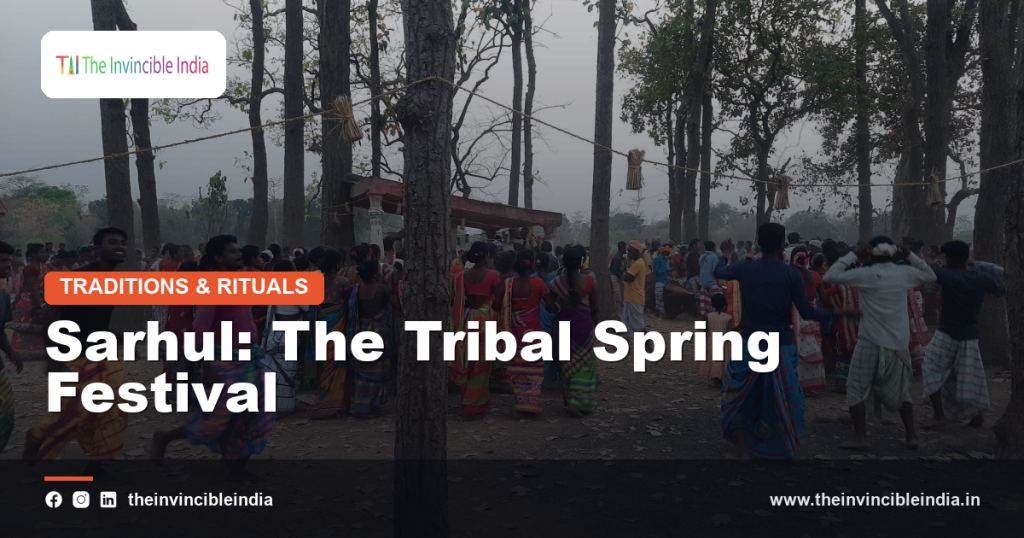
Sarhul is a spring festival observed by tribal communities of Jharkhand and neighboring states, centered on the flowering of the sacred sal tree and the arrival of the new agricultural year. Led by the village priest, known as the Pahan, the festival’s rituals take place at a sacred grove and are followed by community dance, music and shared feasting. Like the Bihu festival of Assam, Sarhul closely ties religious observance to the agricultural calendar, reflecting a deep relationship between community life and the natural world. Rooted in indigenous belief systems that treat nature as sacred, Sarhul offers a distinctive window into tribal cultural traditions that continue to be practiced and celebrated across generations.
Quick Facts
| Detail | Information |
|---|---|
| Also Known As | Ba Parab, or Flower Festival, in some communities |
| Observed By | Tribal communities of Jharkhand and neighboring states |
| Season | Spring, coinciding with the flowering of the sal tree |
| Central Tree | Sal tree, considered sacred to the observance |
| Led By | Village priest, known in various communities as Pahan |
| Key Elements | Nature worship, traditional dance, and community feasting |
Meaning and Origins of Sarhul
Sarhul is a spring festival observed by several tribal communities in and around present-day Jharkhand, marking the flowering of the sal tree and the arrival of the new agricultural year. The name is generally understood to combine words referring to the sal tree and worship, reflecting the festival’s central focus on honoring this significant tree as it comes into bloom. In some communities, the festival is also referred to by other names that emphasize its connection to flowers and the renewal of nature during the spring season. Sarhul is deeply rooted in indigenous beliefs that regard nature, and particular trees and groves in particular, as sacred and deserving of ritual respect. The festival has been observed for generations as an expression of gratitude toward nature for its role in sustaining community life, particularly through agriculture. Its continued observance today reflects the enduring importance of nature-centered belief systems within tribal cultural life in the region.
Sarhul as a Nature-Centered Festival
At its heart, Sarhul is a festival that expresses reverence for the natural world, treating trees, forests and the changing seasons as deserving of active ritual acknowledgment rather than passive appreciation. This nature-centered orientation reflects broader worldviews found among many tribal communities in the region, in which the well-being of people is understood as closely tied to the health and balance of the surrounding environment. Rather than being directed toward a single deity in the manner familiar from many other Indian festivals, Sarhul’s rituals are focused on honoring natural elements, particularly the sal tree and the sacred grove in which ceremonies are performed. This distinct religious orientation sets Sarhul apart within the broader landscape of Indian festivals, offering a valuable window into indigenous belief systems that predate and exist alongside more widely known religious traditions. The festival’s continued observance highlights the ongoing relevance of nature-focused worship in contemporary community life.
Significance of the Sal Tree
The sal tree occupies a central place in Sarhul celebrations, serving as both the literal and symbolic focus of the festival’s rituals. Its flowering each spring is treated as a signal that the new agricultural year is ready to begin, with the tree’s blossoms used directly in ceremonies performed at village shrines and sacred groves. The sal tree is valued not only for its ritual significance but also for its broader role in the ecology and economy of the region, providing timber, leaves and other resources long used by local communities. By centering the festival on the tree’s flowering cycle, Sarhul closely ties religious observance to observable natural change, reinforcing an understanding of time and season rooted in the immediate environment rather than a fixed calendar date. This close connection between festival and tree underscores the broader ecological consciousness embedded within Sarhul’s traditions.
The Role of the Pahan, or Village Priest
The Pahan, or village priest, plays a central role in the organization and performance of Sarhul rituals within many tribal communities. Responsible for maintaining the sacred grove and leading the ceremonies associated with the festival, the Pahan is typically a respected figure whose position may be inherited or determined through community custom. During Sarhul, the Pahan performs rituals intended to seek blessings for the community’s agricultural prospects in the coming year, often undertaking a period of ritual preparation and observance beforehand. The priest’s role extends beyond the festival itself, encompassing broader responsibilities related to community welfare and the maintenance of traditional religious practices throughout the year. The continued presence of the Pahan in contemporary Sarhul celebrations reflects the resilience of traditional community institutions, even as broader social and economic conditions have changed considerably over time.
Rituals Performed at the Sacred Grove
Rituals central to Sarhul are traditionally performed at a sacred grove, a preserved area of forest considered spiritually significant within the village. These groves are treated with particular respect throughout the year, and their preservation is closely tied to the broader practice of nature worship associated with the festival. During Sarhul, the Pahan and other community members gather at the grove to perform ceremonies involving the sal tree’s flowers, offerings, and prayers intended to secure a favorable agricultural season. The maintenance of sacred groves has also had an incidental ecological benefit, contributing to the protection of patches of forest that might otherwise be cleared for other uses. This connection between religious practice and environmental preservation illustrates how cultural tradition and ecological stewardship can be closely intertwined within indigenous belief systems, giving Sarhul a significance that extends beyond its immediate religious content.
Timing and Seasonal Connection
Sarhul is observed in spring, its timing linked to the flowering of the sal tree rather than fixed to a specific date on a standard calendar. This seasonal, nature-based approach to timing reflects the broader character of the festival as an observance tied closely to environmental cycles rather than abstract calendrical calculation. The precise timing can therefore vary somewhat between communities and years, depending on local conditions affecting when the sal trees come into bloom. This flexible approach to scheduling is consistent with many indigenous festival traditions worldwide, which often prioritize observed natural phenomena over fixed dates. For participating communities, the arrival of Sarhul serves as a practical as well as symbolic marker, indicating that preparations for the agricultural season are due to begin. This close alignment between festival timing and natural observation reinforces the deep connection between Sarhul and the rhythms of the surrounding environment.
Sarhul Dance and Music Traditions
Traditional dance and music form an important part of Sarhul celebrations, with community members gathering to perform group dances accompanied by traditional instruments such as drums and other percussion. These performances often take place in open community spaces following the completion of ritual observances at the sacred grove, marking a shift from solemn ceremony to shared festivity. Dance formations typically involve coordinated group movement, with participants dressed in traditional attire appropriate to the occasion. Music and dance during Sarhul serve important social functions, bringing together members of the community across generations in a shared celebratory activity. These traditions are also an important means by which cultural knowledge, including specific songs, rhythms and movements, is passed from older to younger generations. The prominence of dance and music within Sarhul reflects the festival’s dual character as both a solemn religious observance and a joyous communal celebration.
Traditional Attire Worn During Sarhul
Traditional attire worn during Sarhul reflects the distinct cultural identities of the tribal communities that observe the festival, with specific garments, colors and ornamentation carrying their own significance. Women often wear traditional sarees or wrapped garments in colors associated with the festival, sometimes adorned with flowers from the sal tree or other seasonal blooms. Men may wear traditional attire suited to the dance performances that form part of the celebrations, occasionally including specific accessories tied to community custom. The use of traditional dress during Sarhul serves both a practical and symbolic function, distinguishing festival participation from everyday life while reinforcing a visible connection to cultural heritage. As with many aspects of the festival, specific details of attire can vary between different communities, reflecting the broader diversity found among the tribal groups that observe Sarhul across the region.
Community Feasting and Shared Meals
Community feasting is an integral part of Sarhul celebrations, with shared meals bringing together village members following the completion of ritual observances. Food prepared for the occasion often draws on local agricultural produce and traditional recipes specific to the community, reflecting both the festival’s connection to the agricultural cycle and its role in reinforcing communal bonds. The sharing of food during Sarhul carries symbolic significance beyond simple nourishment, representing gratitude for the resources provided by the land and hopes for continued abundance in the season ahead. These communal meals often take place in open or shared spaces, allowing for broad participation across households within the village. The centrality of feasting within Sarhul reflects a pattern found in many harvest and seasonal festivals across India, in which the sharing of food serves as a tangible expression of community solidarity and gratitude toward the natural world.
Sarhul Among Different Tribal Communities
Sarhul is observed by several tribal communities of the region, each bringing its own particular customs, terminology and ritual details to the broader shared framework of the festival. While core elements, such as reverence for the sal tree and the central role of the village priest, are widely shared, specific practices can differ meaningfully between communities. Some groups place particular emphasis on prognostic customs, drawing on ritual observations made during the festival to anticipate conditions for the coming agricultural season. Others focus more heavily on the communal dance and feasting aspects of the celebration. This diversity within a broadly shared festival tradition reflects the wider pattern of India’s tribal communities, which often maintain distinct identities while participating in regionally shared cultural and religious practices. Sarhul thus serves as both a unifying and a distinguishing feature of tribal identity in the region.
Agricultural Significance of the Festival
Beyond its religious dimensions, Sarhul carries significant agricultural meaning for the communities that observe it, marking the point in the year when preparations for planting are set to begin. The festival’s rituals, many of which include prayers and symbolic acts intended to secure favorable conditions for crops, reflect the close relationship between tribal religious practice and agricultural livelihood. Some communities incorporate elements of seasonal forecasting into their Sarhul observances, using traditional methods to gauge prospects for rainfall or harvest in the months ahead. This agricultural dimension situates Sarhul within a broader category of seasonal festivals found across India that mark key transitions in the farming calendar. For communities whose livelihoods remain closely tied to agriculture, Sarhul functions as both a spiritual and practical marker, combining religious observance with meaningful engagement in the planning of the agricultural year.
Symbolism of the New Year in Sarhul
In many communities, Sarhul is understood not only as a spring festival but also as a marker of the new year according to traditional tribal calendars. This association reinforces the festival’s broader themes of renewal, new beginnings and hope for prosperity in the period ahead, paralleling similar new year associations found in other regional festivals across India. The symbolism of renewal is reflected throughout the festival’s rituals, from the flowering of the sal tree to the communal activities that mark a fresh start for the agricultural cycle. This dimension of Sarhul connects it to a wider pattern found in Indian festival culture, in which the arrival of spring is frequently associated with themes of rebirth and new opportunity. For many participants, Sarhul thus carries a dual significance, marking both a specific seasonal transition and a broader sense of communal renewal.
Role of Women in Sarhul Celebrations
Women play an active and often central role in the celebration of Sarhul, participating in both the ritual and festive components of the occasion. In many communities, women are involved in preparing traditional food for community feasting, as well as taking part in the dance performances that follow ritual observances at the sacred grove. Some Sarhul-related customs also involve specific roles for women in preparing offerings or maintaining aspects of the domestic and communal spaces used during the festival. This active participation reflects the broader social structures of many tribal communities in the region, in which women hold recognized and valued roles within community life and cultural practice. The visibility of women’s participation in Sarhul celebrations contributes to a fuller understanding of gender roles within these communities, complementing more male-centered aspects of the festival such as the priestly functions performed by the Pahan.
Sarhul Processions and Public Celebrations
Public processions form part of Sarhul celebrations in many communities, with participants moving through village streets accompanied by music, dance and displays of traditional attire following the completion of core rituals. These processions offer an opportunity for broader community participation beyond those directly involved in the priestly and ceremonial aspects of the festival, allowing residents to take part in a shared public celebration. In some areas, Sarhul processions have also become occasions for wider public visibility, drawing attention from beyond the immediate tribal community and contributing to broader awareness of tribal cultural traditions. The public and communal nature of these processions reinforces the festival’s role as a unifying event within the community, bringing together ritual specialists, performers and general participants in a shared expression of cultural identity and seasonal celebration.
Efforts to Preserve Sarhul Traditions
As with many indigenous festivals, efforts have been made in recent years to document and preserve the traditions associated with Sarhul, recognizing their cultural and historical significance. Community organizations, cultural bodies and, in some cases, government initiatives have supported activities aimed at recording ritual practices, traditional songs and associated customs before they risk being lost amid broader social change. These preservation efforts often involve collaboration between community elders, who hold detailed knowledge of traditional practices, and younger generations seeking to maintain connection with their cultural heritage. Public celebrations and increased visibility of Sarhul in wider media have also contributed to preservation by raising general awareness of the festival’s significance. Such efforts reflect a broader pattern across India, in which growing recognition of indigenous cultural heritage has encouraged more active preservation of traditions that were previously maintained mainly through informal, community-based transmission.
Sarhul Beyond Rural Communities
While Sarhul remains rooted primarily in rural and tribal communities, its observance has extended in various ways to urban areas and broader public awareness in recent decades. Community associations in cities with significant tribal populations sometimes organize Sarhul events, allowing members who have migrated for work or education to maintain connection with their cultural traditions. Increased media coverage and cultural programming have also introduced wider audiences to the festival’s history and significance, contributing to a broader appreciation of tribal heritage within the region and beyond. This extension of Sarhul beyond its traditional rural context reflects broader patterns of cultural adaptation among tribal communities navigating urbanization and migration. Even as its expression adapts to new settings, the festival’s core themes of nature worship and seasonal renewal continue to anchor its observance across different contexts.
Sarhul Today
Today, Sarhul continues to be observed as a vibrant expression of tribal identity and nature-centered belief among communities in Jharkhand and neighboring states. Its rituals, centered on the flowering sal tree and led by the village priest, remain closely tied to the agricultural calendar and the changing seasons, even as the festival has found new expressions in urban and public settings. The continued observance of Sarhul, alongside growing efforts at documentation and preservation, reflects the resilience of indigenous cultural traditions within a rapidly changing social landscape. As awareness of tribal heritage grows more broadly across India, Sarhul stands as a significant example of how nature worship, community identity and seasonal renewal can be woven together into a distinctive and enduring festival tradition.
Sources & Further Reading
- Ministry of Tribal Affairs, Government of India (tribal.nic.in).
- Ministry of Culture, Government of India (indiaculture.gov.in).
Frequently Asked Questions
What is Sarhul?
Sarhul is a spring festival observed by tribal communities of Jharkhand and neighboring states, marking the flowering of the sal tree and the start of the agricultural year.
Who leads the Sarhul rituals?
The Pahan, or village priest, leads Sarhul ceremonies, performing rituals at the sacred grove to seek blessings for the community’s agricultural prospects.
Why is the sal tree important to Sarhul?
The sal tree’s spring flowering signals the start of the new agricultural year, and its blossoms are used directly in the festival’s central rituals.
When is Sarhul celebrated?
Sarhul is observed in spring, with its exact timing linked to the flowering of the sal tree rather than a fixed calendar date.
What activities take place during Sarhul?
Celebrations include rituals at the sacred grove, traditional dance and music, community feasting, and in many places, public processions through village streets.