

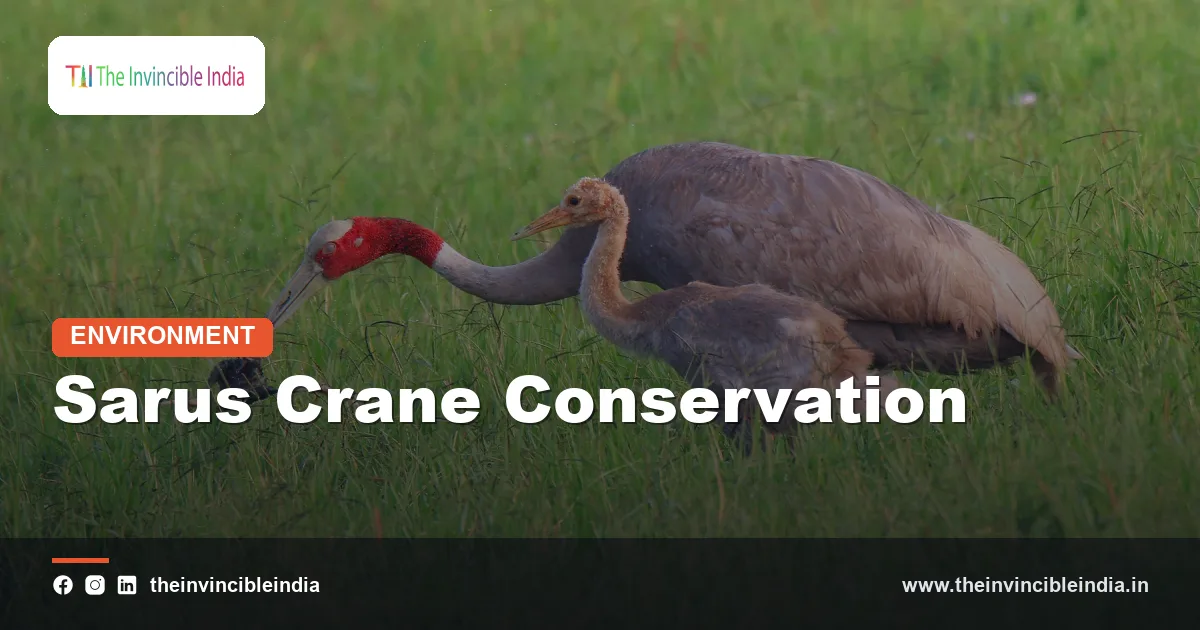
The Sarus crane (Antigone antigone) is the world’s tallest flying bird, a grey, red-headed crane that stands up to about 1.8 metres and is the state bird of Uttar Pradesh, with most of its global population living in India. It is assessed as Vulnerable on the IUCN Red List and survives mainly in a patchwork of wetlands and paddy fields in Uttar Pradesh, Gujarat, Rajasthan and Madhya Pradesh. In Indian culture it is a symbol of marital fidelity, since pairs are believed to stay together for life.
Sarus crane conservation in India is unusual because most of the birds do not live in national parks. They nest and feed on privately owned farmland, so their survival depends on the tolerance of millions of farmers and on the health of small village wetlands. This makes the Sarus a leading example of conservation that works alongside agriculture and not against it.
| Attribute | Details |
|---|---|
| Common name | Sarus crane (Indian Sarus crane, Antigone antigone antigone) |
| Family | Gruidae (the crane family) |
| Height | Up to about 1.8 metres, the tallest flying bird in the world |
| Appearance | Grey body, bare red head and upper neck, pale crown, pinkish-red legs |
| IUCN status | Vulnerable |
| Indian strongholds | Uttar Pradesh, Gujarat, Rajasthan, Madhya Pradesh |
| State bird | Uttar Pradesh |
| Breeding season | Mainly during the monsoon, from about July to October |
| Legal protection | Wildlife (Protection) Act, 1972 |
Key Takeaways
- The Sarus crane is the tallest flying bird in the world, standing up to about 1.8 metres tall, with a bare red head and neck.
- The Sarus crane is the state bird of Uttar Pradesh, and India holds the majority of the world’s Indian Sarus crane population.
- The IUCN Red List classifies the Sarus crane as Vulnerable, mainly because of wetland loss and degradation.
- Most Sarus cranes in India nest in farmland and village wetlands outside protected areas, so farmers are central to their survival.
- Major threats to the Sarus crane include drainage of wetlands, pesticide use, collisions with power lines and the loss of eggs and chicks.
- Sarus cranes are widely believed to mate for life, and the bird is a cultural symbol of marital fidelity in India.
What is the Sarus crane?
The Sarus crane is a large, non-migratory crane of the family Gruidae that lives in wetlands and farmland across South Asia, South-East Asia and northern Australia. Three populations are usually recognised: the Indian Sarus crane in India, Nepal and Pakistan, the Eastern Sarus crane in South-East Asia, and the Australian Sarus crane. The Indian subspecies is by far the largest and most secure of the three, and it is the one most people mean when they talk about the Sarus in India.
An adult is easy to identify. It has a long, slender neck, a grey body, white-tinged neck feathers, a bare red head and upper neck, and long pinkish-red legs. The wingspan can reach about 2.5 metres. Males and females look alike, though males are usually a little taller, and juvenile birds have a duller, brownish-tinged head.
The English name comes from the Hindi “sarus”, which in turn is generally linked to Sanskrit words for a bird of the lake. The bird feeds on a varied diet that includes tubers, roots, seeds, grain, insects, frogs, small fish and crustaceans, which is one reason it does well in agricultural landscapes with shallow water.
Why is the Sarus crane the world’s tallest flying bird?
The Sarus crane is the world’s tallest flying bird because it combines a very long neck and legs with broad wings that let it lift its large body into the air. Taller birds exist, such as the ostrich and the emu, but they cannot fly, so the Sarus holds the record among flying species.
Its height gives it practical advantages in its habitat. Long legs allow it to wade into the shallow water of marshes and flooded fields without wetting its body, and a high eye position helps it spot predators from a distance in open country. The bird’s loud, trumpeting call carries across wetlands for long distances, and pairs often call together in a coordinated duet.
Where do Sarus cranes live in India?
Sarus cranes in India live mainly in the Gangetic plains of Uttar Pradesh, the plains of Gujarat, parts of Rajasthan and Madhya Pradesh, and smaller numbers in Haryana, Bihar, Punjab and other states. Uttar Pradesh is the national stronghold, and the central and western districts of the state, including the Etawah and Mainpuri belt and the area around Raebareli, are known for their pairs.
The Sarus is a resident bird. It does not undertake long seasonal migrations like the Demoiselle crane or the Common crane, and instead it moves locally between nesting and feeding areas, often in a small territory around a wetland.
Uttar Pradesh
Uttar Pradesh has adopted the Sarus crane as its state bird, and the state has by far the largest share of the species in India. The birds nest in village ponds, canals, marshes and paddy fields across the Gangetic plain.
Gujarat, Rajasthan and Madhya Pradesh
Gujarat has a long-recognised Sarus population in the wetlands and farmland of its central and northern plains, and the state has conducted periodic counts. Rajasthan hosts the species in wetlands such as those around Bharatpur, and Madhya Pradesh has scattered populations in its lakes and farmland.
Why does the Sarus crane depend on farmland and wetlands together?
The Sarus crane depends on a mosaic of wetlands and farmland because it needs shallow water for nesting and safe feeding grounds close by, and rural India provides both in the same landscape. The bird builds a large nest platform of reeds, grasses and mud in standing water, and it forages in nearby paddy, wheat and fallow fields.
The key elements of a good Sarus landscape are:
- Shallow, seasonal or permanent wetlands, ponds and marshes for nesting and roosting.
- Paddy fields and other flooded croplands that act as secondary nesting and feeding areas during the monsoon.
- Open ground with tall grass or crop margins, where chicks can find food and cover.
- Low disturbance during the breeding season, from July to October.
Because wetlands, canals and fields are interconnected, a change in any of them, such as lining a canal, filling a pond or converting paddy to a dry crop, can disturb a breeding pair. This is why scientists emphasise protecting the whole landscape and not just a few reserves.
How do Sarus cranes breed, and why are they linked with fidelity?
Sarus cranes breed mostly during the monsoon, when pairs build a nest in shallow water and lay usually two eggs, which both parents incubate for about a month. Both the male and female guard the nest and care for the chicks, which can walk and feed soon after hatching.
The Sarus is linked with marital fidelity because pairs form long-lasting bonds, and field observers often see two birds foraging, roosting and calling together throughout the year. Courtship includes a display of bowing, leaping, wing-flapping and trumpeting, which is often described as a dance. Indian folklore carries many stories of a Sarus that stays beside a mate that has died, and the pair is often held up as an example of devotion.
Scientists note that the tradition is partly based on observation, since pairs are indeed long-term partners, but the stories of grieving to death are cultural rather than scientific claims. The bird’s cultural standing, however, is a real asset in conservation because it encourages communities to protect nests.
What is the conservation status of the Sarus crane?
The Sarus crane is classified as Vulnerable on the IUCN Red List, which means it faces a high risk of extinction in the wild unless threats are reduced. The species has declined sharply over the twentieth century across much of its range, and it has disappeared from some countries in South-East Asia.
In India, the Sarus crane is protected under the Wildlife (Protection) Act, 1972, which prohibits hunting, capture and the collection of eggs. The Indian population is considered a stronghold, but conservationists warn that numbers are falling locally where wetlands are disappearing. The exact national population is difficult to count because the birds are spread across millions of hectares of private land, so figures are estimates and vary between surveys.
The table below places the Sarus crane among the cranes that occur in India.
| Crane species | Status in India | IUCN category |
|---|---|---|
| Sarus crane | Resident; breeds in farmland and wetlands | Vulnerable |
| Common crane | Winter visitor | Least Concern |
| Demoiselle crane | Winter visitor, notably to Rajasthan and Gujarat | Least Concern |
| Black-necked crane | Breeds in Ladakh, a high-altitude species | Near Threatened |
| Siberian crane | Once wintered at Keoladeo, Bharatpur; now rarely or no longer seen | Critically Endangered |
What are the main threats to the Sarus crane?
The main threats to the Sarus crane are the loss and degradation of wetlands, the use of pesticides and poisons in farmland, collisions with overhead power lines, and the loss of eggs and chicks to people, dogs and other predators. These pressures usually act together.
Wetland loss
Village ponds and marshes are being drained, filled for construction, or turned into cropland. When a nesting wetland disappears, a territorial pair loses its home and often cannot breed. Changes in water management, such as canal lining and the shift to water-saving crops, can also reduce shallow water in the breeding season.
Pesticides and poisoning
Cranes feed in fields where chemicals are used, and they can be harmed by pesticide residues in grain, insects and water. Poisoned bait set for pests and other wildlife can also kill cranes by accident.
Power lines
Large birds with long wingspans are at risk when they fly into overhead cables, particularly at dawn, dusk or in fog. Power-line collisions are a recognised cause of death for large birds in India, and they are an issue in Sarus territory in Gujarat and Rajasthan in particular.
Egg and chick loss
Nests in open fields are exposed to disturbance. Eggs may be collected or destroyed accidentally by farm work, and chicks may be taken by stray dogs, jackals or other predators.
How are farmers and communities helping conserve the Sarus crane?
Farmers and village communities help conserve the Sarus crane mainly by tolerating nesting pairs on their land, protecting nests, and informing forest officials about eggs and chicks. Many farmers in Uttar Pradesh and Gujarat regard the crane as a bird that brings good fortune and treat its presence as a mark of a healthy field.
This approach is sometimes called community-led or landscape-level conservation. Rather than fencing off a reserve, programmes work with the people who already share the land. Typical steps include:
- Awareness campaigns in villages about the bird’s status and cultural value.
- Recruiting local residents as bird monitors or volunteer protectors during the breeding season.
- Recording nests and the survival of chicks, so that officials can identify wetlands that need protection.
- Encouraging farmers to leave nests undisturbed until the chicks have fledged.
- Protecting village ponds and shallow wetlands, which are often the single most valuable habitat for a pair.
State forest departments, local conservation groups and international organisations such as the International Crane Foundation have supported surveys and community work in crane landscapes. The strength of this model is its low cost and its reliance on goodwill; its weakness is that it can be undone quickly if land use changes or if compensation for farmers is not available when crops are affected.
How can the Sarus crane be protected in the future?
The Sarus crane can be protected in the future by securing village wetlands, making farming more wildlife-friendly, reducing power-line deaths and keeping a regular, standardised count of the population. Wetland protection is the central measure, since breeding pairs cannot succeed without shallow water in the monsoon.
Several actions are commonly proposed by conservation scientists:
- Recording and legally recognising small wetlands, which are often missing from official maps and are therefore easy to convert.
- Reducing the use of the most harmful pesticides in crane landscapes, and promoting less chemical-intensive farming.
- Marking or burying power lines in places where cranes concentrate, so birds can see the cables or avoid them.
- Using repeated, standardised surveys so that trends in the population can be tracked reliably.
- Rewarding landowners who host nests, whether through recognition, support or compensation for crop losses.
Bottom Line
The Sarus crane is the world’s tallest flying bird and a Vulnerable species that depends on India’s wetlands and farmland more than on its protected areas. Its survival shows that conservation in India can succeed when it works with farmers and village communities. The most important task is to keep small wetlands and nesting fields intact, since that is where the cranes breed.
Frequently Asked Questions
What is the Sarus crane?
The Sarus crane is the world’s tallest flying bird, standing up to about 1.8 metres, with a grey body and a bare red head and upper neck. It is a resident crane of wetlands and farmland in South Asia, South-East Asia and Australia. In India it is the state bird of Uttar Pradesh.
Why is the Sarus crane a symbol of marital fidelity?
The Sarus crane is a symbol of marital fidelity because pairs form long-lasting bonds and are often seen together throughout the year. Their duet calls and joint courtship dances reinforce the image of devotion. The stories of cranes dying of grief are part of folklore rather than scientifically proven fact.
Where are Sarus cranes found in India?
Sarus cranes are found mainly in Uttar Pradesh, Gujarat, Rajasthan and Madhya Pradesh, with smaller numbers in other states of the northern and central plains. Uttar Pradesh holds the largest share. Most birds live in village wetlands and farmland rather than in protected areas.
Is the Sarus crane endangered?
The Sarus crane is listed as Vulnerable on the IUCN Red List, which is one step below Endangered. This means the species faces a high risk of extinction in the wild without conservation action. Its numbers have fallen in many parts of its range, though India remains a stronghold.
What are the biggest threats to Sarus cranes?
The biggest threats are the loss of wetlands, pesticide use in farmland, collisions with power lines, and the loss of eggs and chicks to people and predators. These pressures often combine at the same site. Protecting small village wetlands is considered the most effective single response.
How do farmers help protect the Sarus crane?
Farmers help protect the Sarus crane by allowing pairs to nest in their fields and by guarding nests until the chicks fledge. In many villages the bird is regarded as auspicious, which encourages this tolerance. Conservation programmes support farmers through awareness work, volunteer monitoring and local recognition.
{“@context”:”https://schema.org”,”@graph”:[{“@type”:”FAQPage”,”mainEntity”:[{“@type”:”Question”,”name”:”What is the Sarus crane?”,”acceptedAnswer”:{“@type”:”Answer”,”text”:”The Sarus crane is the world’s tallest flying bird, standing up to about 1.8 metres, with a grey body and a bare red head and upper neck. It is a resident crane of wetlands and farmland in South Asia, South-East Asia and Australia. In India it is the state bird of Uttar Pradesh.”}},{“@type”:”Question”,”name”:”Why is the Sarus crane a symbol of marital fidelity?”,”acceptedAnswer”:{“@type”:”Answer”,”text”:”The Sarus crane is a symbol of marital fidelity because pairs form long-lasting bonds and are often seen together throughout the year. Their duet calls and joint courtship dances reinforce the image of devotion. The stories of cranes dying of grief are part of folklore rather than scientifically proven fact.”}},{“@type”:”Question”,”name”:”Where are Sarus cranes found in India?”,”acceptedAnswer”:{“@type”:”Answer”,”text”:”Sarus cranes are found mainly in Uttar Pradesh, Gujarat, Rajasthan and Madhya Pradesh, with smaller numbers in other states of the northern and central plains. Uttar Pradesh holds the largest share. Most birds live in village wetlands and farmland rather than in protected areas.”}},{“@type”:”Question”,”name”:”Is the Sarus crane endangered?”,”acceptedAnswer”:{“@type”:”Answer”,”text”:”The Sarus crane is listed as Vulnerable on the IUCN Red List, which is one step below Endangered. This means the species faces a high risk of extinction in the wild without conservation action. Its numbers have fallen in many parts of its range, though India remains a stronghold.”}},{“@type”:”Question”,”name”:”What are the biggest threats to Sarus cranes?”,”acceptedAnswer”:{“@type”:”Answer”,”text”:”The biggest threats are the loss of wetlands, pesticide use in farmland, collisions with power lines, and the loss of eggs and chicks to people and predators. These pressures often combine at the same site. Protecting small village wetlands is considered the most effective single response.”}},{“@type”:”Question”,”name”:”How do farmers help protect the Sarus crane?”,”acceptedAnswer”:{“@type”:”Answer”,”text”:”Farmers help protect the Sarus crane by allowing pairs to nest in their fields and by guarding nests until the chicks fledge. In many villages the bird is regarded as auspicious, which encourages this tolerance. Conservation programmes support farmers through awareness work, volunteer monitoring and local recognition.”}}]}]}


