

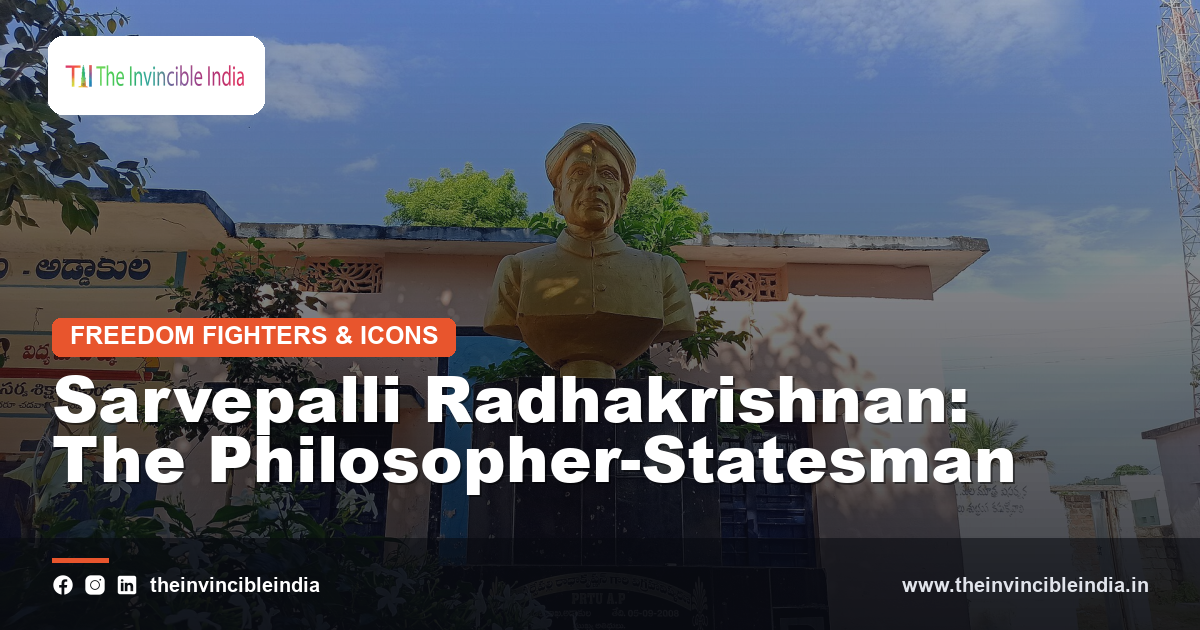
Sarvepalli Radhakrishnan was one of the most distinguished philosopher-statesmen in modern Indian history, a scholar of world renown who carried the depth of Indian philosophical thought onto the international stage before rising to the highest office in the land. Beginning his career as an academic, he taught and wrote about Indian philosophy with such clarity and insight that he became one of its most respected interpreters to audiences across the world. He went on to represent India in diplomacy, to serve as the first Vice President of independent India, and eventually as its second President, following in the line of leaders such as Jawaharlal Nehru. This guide explores his life, thought, public service and enduring legacy.
Quick Facts
| Detail | Information |
|---|---|
| Born | 5 September 1888, in Tiruttani, Madras Presidency |
| Known as | The philosopher-statesman of India |
| Field | Philosophy, particularly Indian and comparative philosophy |
| Offices held | First Vice President and second President of India |
| Notable link | His birthday is observed as Teachers Day in India |
| Honour | Recipient of the Bharat Ratna |
A Philosopher-Statesman
Sarvepalli Radhakrishnan occupies a rare place in Indian public life as a figure who combined deep scholarship with high statesmanship, moving from the quiet world of academic philosophy to the highest offices of the Indian republic. He was, above all, a teacher and a thinker, whose life’s work was to explain and defend the richness of Indian philosophical traditions to audiences in India and abroad. His scholarly reputation opened doors that led him into public service, first in diplomacy and later in government, where his dignity, learning and moderation earned him widespread respect. Few Indians of his generation moved so naturally between the classroom and the council chamber. This combination of philosophy and statesmanship is what defines Radhakrishnan’s legacy, and it is why he continues to be remembered as one of independent India’s most thoughtful and dignified public figures, admired equally for his ideas and for the manner in which he served the nation.
Early Life in Tiruttani
Sarvepalli Radhakrishnan was born into a modest Telugu-speaking Brahmin family in the town of Tiruttani, in what was then the Madras Presidency, in the late nineteenth century. His early years were spent in surroundings of simplicity and traditional religious observance, which gave him an early familiarity with the philosophical and devotional literature of India. Though the family was not wealthy, education was valued, and the young Radhakrishnan showed unusual promise from an early age, moving through mission schools and colleges with distinction. This early exposure to both traditional Indian learning and the structures of colonial-era education gave him a dual perspective that would shape his later scholarship. His humble beginnings in Tiruttani are often recalled as the quiet starting point of a life that would eventually carry Indian philosophical thought to universities and platforms across the world, and they help explain the depth of his lifelong engagement with the traditions of his homeland.
A Brilliant Student
From his school days onward, Radhakrishnan distinguished himself as an exceptionally capable student, particularly drawn to philosophy, a subject he pursued with unusual seriousness for someone of his age. He studied at Christian missionary institutions in Madras, where he encountered both Western philosophical traditions and critiques of Indian religion, an experience that spurred him to study his own heritage more closely and to defend it with scholarly rigour. His early academic writings already displayed the qualities that would mark his later career: careful argument, wide reading, and a determination to present Indian thought on equal terms with Western philosophy. This period of intellectual formation was crucial, for it set him on the path of a scholarly life devoted to interpreting and defending Indian philosophy. His success as a student was the foundation on which his entire subsequent career as a teacher, writer and public figure would be built.
A Career in Philosophy Teaching
Radhakrishnan began his professional life as a teacher of philosophy, holding academic positions at various Indian universities where he lectured with a clarity and eloquence that quickly won him a devoted following among students. He rose steadily through the academic ranks, eventually holding senior professorships at leading Indian institutions, where he combined rigorous scholarship with an engaging teaching style. His lectures ranged widely across Indian and Western philosophy, and he was known for his ability to make complex philosophical ideas accessible without diluting their depth. This long and distinguished teaching career established his reputation as one of the foremost philosophy teachers of his generation. It was this reputation, built patiently over years in the lecture hall, that eventually carried him beyond the university and into wider public life, and it remains one of the most important dimensions of his legacy as an educator and thinker.
Interpreting Indian Philosophy to the World
One of Radhakrishnan’s most significant contributions was his sustained effort to interpret Indian philosophy for audiences unfamiliar with its traditions, presenting it as a coherent and sophisticated system of thought worthy of serious study. Through his writings and lectures, he explained concepts from Hindu philosophy in language that Western readers and scholars could engage with, correcting misconceptions and emphasising the intellectual depth of India’s spiritual and philosophical heritage. His work helped to reposition Indian philosophy within the broader field of world philosophy, rather than treating it merely as an object of exotic curiosity. This role as an interpreter between civilisations was one of his most lasting achievements. By presenting Indian thought with scholarly seriousness on the world stage, Radhakrishnan did much to restore confidence in the value of India’s own intellectual traditions, both at home and abroad.
The Oxford Years
Radhakrishnan’s scholarly reputation eventually took him to Oxford, where he held a distinguished professorship dedicated to the study of Eastern religions and ethics, a position that placed him among the leading academic voices on Indian thought in Britain. His time at Oxford allowed him to engage directly with Western philosophers and theologians, presenting Indian philosophical ideas within some of the most prestigious intellectual circles of the time. He used the position to further his lifelong project of building bridges of understanding between Eastern and Western thought. His years there considerably enhanced his international standing as a scholar of world religion and philosophy. This period at Oxford is remembered as a high point in his academic career, cementing his reputation as one of the most respected interpreters of Indian philosophy to have taught at a major Western university.
A Voice for Hindu Philosophy
Throughout his academic career, Radhakrishnan was regarded as one of the most articulate and respected voices explaining Hindu philosophy to a wide readership, both in India and internationally. His writings addressed the philosophical foundations of Hindu thought, its ethical teachings, and its relevance to modern life, presented with scholarly care rather than dogmatic assertion. He sought to show that Hindu philosophy contained within it resources for addressing universal human questions about meaning, ethics and the nature of reality. His balanced and reasoned approach won him respect even among those who did not share his religious background. This role as a thoughtful and reasoned voice for Hindu philosophy remains one of his most important contributions, helping generations of readers to approach the subject with greater understanding and appreciation rather than through stereotype or misunderstanding.
Return to Public Life
As his scholarly reputation grew, Radhakrishnan gradually moved from the purely academic sphere into wider public life, taking on responsibilities that drew upon his standing as a thinker and his reputation for balanced judgement. He served in various academic administrative roles, including as a university vice chancellor, where his leadership was marked by the same thoughtfulness that characterised his scholarship. His growing public profile also brought him into contact with the leaders of the Indian independence movement and, later, of independent India’s government. This transition from professor to public figure was a natural extension of his lifelong belief that philosophy should not remain confined to the seminar room but should inform public life and national character. It set the stage for the diplomatic and political roles he would later assume in service of the new nation.
Ambassador to the Soviet Union
In the years following independence, Radhakrishnan was called upon to serve as India’s ambassador, representing the young nation abroad at a time when it was establishing its place in international affairs. His diplomatic role in Moscow allowed him to build relationships between India and other major powers during a delicate period of the Cold War, drawing on his reputation as a scholar of world standing and his gift for reasoned, dignified communication. His diplomatic service demonstrated that his philosophical training was matched by considerable practical skill in representing his country’s interests abroad. This period of diplomatic service broadened his experience beyond the academic world and prepared him further for the highest offices in Indian government. It also reflected the trust that the leadership of independent India placed in his judgement and integrity.
Vice President of India
Radhakrishnan was chosen to serve as the first Vice President of independent India, a position in which he presided over the Rajya Sabha, the upper house of Parliament, bringing to the role his characteristic dignity, fairness and command of language. His conduct of parliamentary proceedings was widely admired for its impartiality and intellectual rigour, and he used the position to further elevate the standing of reasoned public discourse in the young republic. He served in this role for a substantial period, earning respect across the political spectrum for his evenhandedness. His tenure as Vice President is remembered as a period of quiet but significant service, in which a philosopher brought his commitment to reason and fairness to the functioning of India’s parliamentary democracy, setting a tone of dignity for the office that followed him.
President of India
Radhakrishnan went on to serve as the second President of India, becoming the head of state of the nation whose philosophical traditions he had spent a lifetime studying and explaining to the world. As President, he brought to the office his characteristic thoughtfulness, restraint and dedication to constitutional propriety, serving as a unifying figure above the currents of everyday politics. His presidency was marked by his continued emphasis on education, culture and the moral responsibilities of citizenship, themes that had run through his entire career. He carried out the ceremonial and constitutional duties of the presidency with the same seriousness he had once brought to his lectures. His elevation to this highest office was seen as a fitting recognition of a life devoted to scholarship and public service in equal measure.
A Presidency of Dignity
Radhakrishnan’s presidency is remembered above all for the dignity and intellectual seriousness he brought to the highest office in the land, at a time when the young republic was still shaping the conventions of its constitutional life. He used his position to speak thoughtfully on matters of education, values and national character, addressing the country not as a politician but as a philosopher-statesman concerned with its long-term moral and intellectual development. His public addresses were noted for their eloquence and their appeal to reason rather than rhetoric. This dignified conduct of the presidency helped to establish the office as one of moral and constitutional authority, above partisan politics. It remains one of the most admired aspects of his public career, reflecting the values of restraint and reasoned judgement that had guided him throughout his life.
The Birth of Teachers Day
One of the most enduring and widely celebrated legacies associated with Radhakrishnan is the observance of Teachers Day in India, marked each year on his birthday in recognition of his lifelong devotion to teaching and learning. When friends and students proposed celebrating his birthday as a special occasion during his presidency, he requested instead that the day be observed as a tribute to teachers across the country, reflecting his own deep identification with the profession. This request transformed his personal anniversary into a national occasion honouring educators everywhere. The custom has continued ever since, with schools and colleges across India marking the day with special programmes honouring teachers. This connection between Radhakrishnan and Teachers Day remains one of the most widely known and cherished aspects of his legacy, linking his memory permanently to the profession he loved and practised for most of his life.
Author and Scholar
Throughout his life, Radhakrishnan was a prolific author, producing a substantial body of scholarly writing on Indian philosophy, comparative religion and ethics that remains studied by scholars to this day. His works addressed the great philosophical traditions of India with clarity and depth, while also engaging with Western philosophical thought in a spirit of comparison rather than confrontation. His scholarly output spanned decades and reflected his lifelong commitment to careful, reasoned argument over polemic. Many of his lectures delivered at prestigious institutions abroad were later published as books that continued to shape the study of Indian philosophy internationally. This substantial body of scholarly writing stands as one of Radhakrishnan’s most lasting contributions, ensuring that his interpretations of Indian philosophical thought continue to inform students and scholars long after his own lifetime.
Honours and Recognition
In recognition of his outstanding contributions to scholarship, education and public life, Radhakrishnan received numerous honours over the course of his career, including India’s highest civilian award, presented in acknowledgement of his distinguished service to the nation. He was also honoured by universities and academic institutions across the world, reflecting the international respect he commanded as a philosopher. These honours recognised both his scholarly achievements and his statesmanship, the two strands that ran through his entire public life. His recognition extended well beyond India, reflecting his standing as a philosopher of genuinely international reputation. This wide recognition, spanning both academic and civic honours, reflects the unusual breadth of Radhakrishnan’s achievements as a man equally at home in the lecture hall and in the highest offices of state.
The Legacy of Radhakrishnan
The legacy of Sarvepalli Radhakrishnan is that of a rare figure who bridged the worlds of scholarship and statesmanship, bringing philosophical depth and personal dignity to every role he undertook. As a teacher, he inspired generations of students; as a scholar, he reshaped how Indian philosophy was understood at home and abroad; and as Vice President and then President, he brought reasoned judgement and moral seriousness to the highest offices of the young republic. His insistence on linking his own birthday to a national celebration of teachers reflects the humility and purpose that guided his public life. This combined legacy of scholarship, diplomacy and dignified statesmanship secures Radhakrishnan’s place among the most respected of India’s national icons, remembered as much for his ideas as for his office.
Radhakrishnan Remembered Today
Today, Sarvepalli Radhakrishnan is remembered across India as a philosopher-statesman whose life exemplified the union of learning and public service, honoured each year through the celebration of Teachers Day on his birthday. His scholarly works continue to be studied by students of Indian philosophy, while his conduct in high office remains a reference point for dignity and restraint in public life. Educational institutions, cultural bodies and commentators continue to draw on his writings and his example when discussing the value of education and reasoned public discourse. His memory endures not through monuments alone but through the continuing practice of honouring teachers in his name. As a scholar, diplomat and statesman, Sarvepalli Radhakrishnan remains one of the most thoughtful and enduringly respected figures in the history of modern India.
Sources & Further Reading
- Ministry of Culture, Government of India (indiaculture.gov.in).
- Press Information Bureau, Government of India, records on former Presidents of India (pib.gov.in).
Frequently Asked Questions
Who was Sarvepalli Radhakrishnan?
Sarvepalli Radhakrishnan was a renowned Indian philosopher and statesman who taught philosophy at leading universities in India and abroad before serving as the first Vice President and later the second President of India.
Why is Radhakrishnan's birthday celebrated as Teachers Day?
When admirers proposed celebrating his birthday as a special occasion, Radhakrishnan asked that the day instead be observed as a tribute to teachers across the country, reflecting his own deep devotion to the teaching profession. The custom has continued as Teachers Day in India ever since.
What was Radhakrishnan's main academic contribution?
Radhakrishnan was widely respected for interpreting Indian and Hindu philosophy for audiences in India and the West, presenting it as a serious and coherent system of thought and helping to build understanding between Eastern and Western philosophical traditions.
What public offices did Radhakrishnan hold?
Radhakrishnan served as India’s ambassador, as the first Vice President of India presiding over the Rajya Sabha, and later as the second President of India, the nation’s head of state.
What honours did Radhakrishnan receive?
Radhakrishnan received India’s highest civilian award along with numerous honorary recognitions from universities and institutions around the world in acknowledgement of his scholarship and his statesmanship.


