

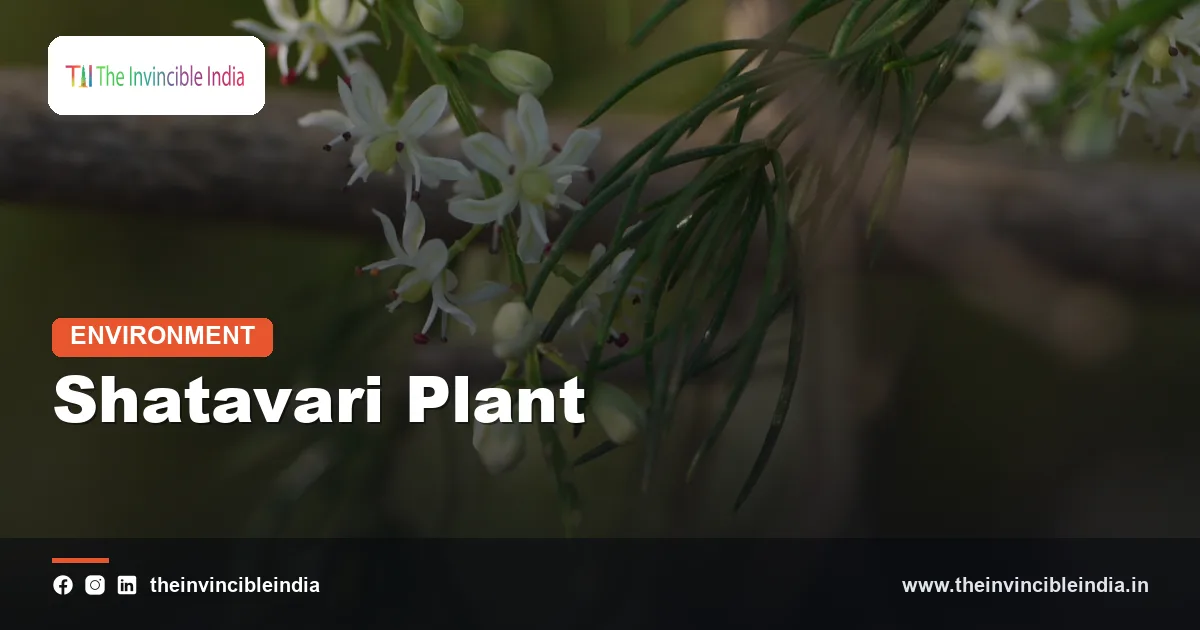
The plant called shatavari (Asparagus racemosus) is a spiny, climbing relative of the garden asparagus whose clusters of tuberous roots are among the most valued tonic herbs in Ayurveda. It grows wild across the warmer parts of India, from the plains to the lower hills, and is also cultivated on a growing scale to meet demand from the herbal industry.
Shatavari is traditionally associated with women’s health, nourishment and a cooling, soothing effect on the body. This explainer describes what the shatavari plant looks like, where it grows in India, how it is cultivated, and what its traditional uses are. Ayurvedic uses described here are traditional claims and not proven medical advice; consult a qualified doctor or registered Ayurvedic practitioner before using any herbal product. Content was last reviewed on 23 October 2026.
| Attribute | Details |
|---|---|
| Common names | Shatavari, shatavar, satavari, wild asparagus, Indian asparagus |
| Botanical name | Asparagus racemosus Willd. |
| Family | Asparagaceae (earlier placed in Liliaceae) |
| Plant type | Spiny, scrambling perennial climber with tuberous roots |
| Part used | Mainly the tuberous roots; the plant is also grown as an ornamental |
| Where grown in India | Found wild in tropical and subtropical regions up to about 1,500 m; cultivated in states such as Madhya Pradesh, Rajasthan, Gujarat, Maharashtra, Karnataka and Uttar Pradesh |
| Active compounds | Steroidal saponins (shatavarins), isoflavones, mucilage and the alkaloid asparagamine |
| Traditional uses | Rasayana tonic; traditionally associated with women’s health, lactation, digestion and a cooling effect |
| Cultivation | Propagated by seeds or root crowns; grows on well-drained soil; roots harvested after about 18 to 24 months |
Key Takeaways
- Shatavari is the common name of Asparagus racemosus, a spiny climbing plant in the Asparagaceae family that is native to India and other parts of South Asia.
- The tuberous roots of shatavari are the main part used in Ayurveda, where the herb is classed as a rasayana, or nourishing tonic.
- In Ayurvedic tradition, shatavari is mainly associated with women’s reproductive health and lactation, and it is regarded as having a cooling nature.
- Shatavari is a perennial that takes roughly 18 to 24 months of growth before its roots are harvested for commercial use.
- The main bioactive compounds in shatavari are steroidal saponins known as shatavarins, which are the subject of ongoing scientific study.
- Traditional claims about shatavari are not proven medical treatments, and pregnant women or people on medication should consult a qualified professional before use.
What is shatavari?
Shatavari is a perennial climbing shrub, Asparagus racemosus, whose bundles of fleshy roots are a standard ingredient of Ayurvedic tonics. It belongs to the same genus as the vegetable asparagus (Asparagus officinalis), but it is a wild, thorny climber and not a crop eaten as a spring vegetable.
The name shatavari is Sanskrit, and it is commonly interpreted as “one who has a hundred roots” or, in a more poetic reading, “one who has a hundred husbands”. These interpretations refer to the plant’s many tuberous roots and to its traditional reputation as a fertility and women’s health herb. Another traditional name, “narayani”, appears in some classical texts.
Shatavari has been used in the Indian tradition for many centuries and is mentioned in classical Ayurvedic works. It is classed among the herbs that nourish the body tissues and cool excess heat, according to the framework of Ayurveda.
What does the shatavari plant look like?
The shatavari plant is an extensively branched, spiny climber that can scramble over shrubs and small trees to a height of several metres. Its most distinctive features are its feathery foliage, which is actually made of modified branches, and its clusters of fleshy roots.
- Stems and spines: Slender, woody and branching, armed with short, curved spines along the stems.
- Foliage: What looks like a leaf is a cladode, a flattened, needle-like branch, arranged in tufts. The true leaves are tiny scales.
- Flowers: Small, white and sweetly fragrant, borne in slender clusters (racemes), often appearing after the first rains.
- Fruit: Small, round berries that turn from green to purplish-black when ripe.
- Roots: Clusters of tuberous, spindle-shaped roots, creamy white when peeled, which store water and nutrients.
The soft, fern-like appearance of the plant makes it a popular ornamental in gardens and floral arrangements, even though the spines make it unsuitable to handle without care.
Where does shatavari grow in India?
Shatavari grows wild in the tropical and subtropical forests, scrub and thickets of India, usually in shaded or semi-shaded spots at altitudes up to roughly 1,500 metres. It is found across peninsular India, the Western and Eastern Ghats, the central Indian forests and the foothills of the Himalaya.
Beyond India, the species occurs in Sri Lanka, Nepal, Bangladesh and parts of Southeast Asia and Australia. Wild collection has long supplied the market, but rising demand has led to concerns about overharvesting, particularly since digging up the roots kills the plant. As a result, planned cultivation has expanded in several states, including Madhya Pradesh, Rajasthan, Gujarat, Maharashtra and Karnataka. The National Medicinal Plants Board (NMPB), established in 2000, promotes cultivation of species like shatavari to reduce pressure on wild stocks.
How is shatavari cultivated?
Shatavari is cultivated as a perennial root crop on well-drained soils, usually grown from seeds or from root crowns. It prefers a warm climate with moderate rainfall and does best on light, sandy loam to red soils, since waterlogging damages the tubers.
Propagation
Seeds are collected from ripe berries, soaked and sown in nurseries, and seedlings are transplanted to the field at the start of the monsoon. Vegetative propagation using portions of the root crown (disc) is also used. Plants are spaced to allow room for the roots to spread.
Support and care
Because the plant is a climber, farmers often provide stakes, trellises or nearby support. Light irrigation, periodic weeding and organic manure help growth, and the crop is generally robust and relatively free of serious pests.
Harvest and drying
The roots are harvested after about 18 to 24 months, when the plant is mature and the tubers are thick. The tubers are dug up carefully, washed, boiled briefly, peeled, sliced and dried in the sun. A mature plant may yield a considerable quantity of fresh roots, which dry to a much smaller weight. Dried roots are stored in airtight containers to protect them from moisture and insects.
What are the traditional uses of shatavari?
In Ayurveda, shatavari is traditionally used as a rejuvenating and nourishing tonic, with a special association with women’s health. These uses come from traditional knowledge systems and should not be taken as proven medical treatments.
- Women’s health: Traditionally used to support the reproductive system during various life stages, including menstruation, pregnancy-related care and menopause, as described in classical texts.
- Lactation: Regarded as a galactagogue, a herb traditionally taken by nursing mothers to support milk production.
- Digestive soothing: Used traditionally for acidity, burning sensations and gentle digestive support because of its cooling nature.
- General tonic: Given as a rasayana for vitality, particularly after illness or in states of weakness.
- Preparations: Commonly taken as root powder (churna) with milk, as a medicated ghee (shatavari ghrita) or as a syrup or decoction.
Modern research has examined shatavari for various properties, but findings are preliminary and mixed, and this evidence should be viewed with caution. The herb is often combined with other Ayurvedic ingredients in traditional formulations.
What compounds does shatavari contain?
Shatavari contains steroidal saponins called shatavarins, along with isoflavones, flavonoids, mucilage, vitamins and trace minerals. Shatavarins I to IV are among the best-known saponins, and a cyclic alkaloid called asparagamine A has also been reported from the roots.
The mucilage content gives the roots a slightly sticky, soothing quality, which fits with the traditional description of shatavari as a cooling and moistening herb. The plant also contains fibre and compounds that behave like prebiotics in laboratory studies.
As with other herbs, composition varies with the age of the plant, soil, season and processing. Commercial extracts are therefore often standardised to a given saponin content, although standards differ between manufacturers.
How does shatavari compare with other asparagus relatives?
Shatavari is one of several useful Asparagus species, and each has a different role in food, medicine or gardening. The comparison below shows how Asparagus racemosus differs from its relatives.
| Plant | Botanical name | Main use | Notes |
|---|---|---|---|
| Shatavari | Asparagus racemosus | Medicinal tuberous roots | Spiny wild climber of India; Ayurvedic tonic |
| Garden asparagus | Asparagus officinalis | Vegetable (young shoots) | Cultivated mainly in cooler regions; not a thorny climber |
| Asparagus fern | Asparagus setaceus | Ornamental foliage | Delicate, feathery sprays used in floral decoration |
| Sprenger’s asparagus | Asparagus densiflorus | Ornamental | Popular in hanging baskets and gardens |
Only shatavari is traditionally prized in Ayurveda for its roots, so garden asparagus and ornamental ferns should not be treated as substitutes.
Is shatavari safe to use?
Shatavari is generally considered gentle when used in moderate traditional amounts, but safety depends on the individual, the dose and the quality of the product. Reported side effects are uncommon and mostly mild, such as digestive upset or allergic reactions in sensitive people.
People with an allergy to asparagus should avoid it. Those with hormone-sensitive conditions, kidney or heart disease, or who take diuretics or other regular medicines should speak to a doctor first. Pregnant and breastfeeding women should also seek professional guidance, because the herb is traditionally associated with the reproductive system and its effects are not fully established.
It is wise to buy from reputable manufacturers, follow label instructions, and consult a qualified doctor or registered Ayurvedic practitioner before beginning any herbal supplement.
Why does shatavari matter for biodiversity and farmers?
Shatavari matters because it is both a culturally important medicinal plant and a species under pressure from wild collection. Sustainable cultivation lets farmers earn a premium crop income while reducing the harvest of wild plants, which take years to establish and die when their roots are removed.
Conservation programmes encourage community nurseries, planned cultivation and responsible harvesting. Because shatavari thrives in modest conditions and also provides cover in scrubland, protecting its habitat can benefit many other plant and animal species.
How is shatavari prepared and sold today?
Shatavari is prepared and sold today as dried root pieces, fine powder, capsules, tablets, syrups, medicated ghee and standardised extracts. Traditional Ayurvedic pharmacies and modern herbal companies both stock it, and it is a regular component of compound formulations.
Quality depends on correct plant identification, proper drying and storage. Roots should be free of mould, insects and added fillers. Because several Asparagus species look similar in the field, trained collectors and suppliers who follow good collection practices help ensure that genuine Asparagus racemosus enters the supply chain.
In Indian households, the herb is usually taken only on the advice of a practitioner. Preparations differ by region and by practitioner, which is why a single universal dose does not exist in traditional medicine.
What is the place of shatavari in Ayurveda?
Shatavari holds a place in Ayurveda as one of the principal herbs for nourishing the body and balancing heat. In the Ayurvedic framework, its qualities are described as cooling, heavy and unctuous, and it is considered to balance the pitta and vata doshas.
It is grouped among the rasayana and balya (strength-giving) herbs in several classical lists, and its name appears in formulations used over many centuries. These descriptions come from traditional theory, and modern practice usually pairs them with advice from a registered practitioner. Studying shatavari therefore means understanding both its botany and the traditional knowledge that has built around it.
Bottom Line
Shatavari is a spiny Indian climber whose tuberous roots hold a long-standing place in Ayurveda as a cooling tonic associated with women’s health. Its traditional uses remain traditional claims, so professional advice and sustainable sourcing are the sensible approach.
Frequently Asked Questions
What is shatavari?
Shatavari is a spiny climbing plant, Asparagus racemosus, whose tuberous roots are used as a tonic herb in Ayurveda. It belongs to the same genus as garden asparagus but is a wild, thorny climber native to India and nearby regions.
What does the name shatavari mean?
The name shatavari is a Sanskrit word commonly interpreted as “one with a hundred roots” or “one with a hundred husbands”. The first reading refers to its many tuberous roots, and the second to its traditional reputation as a women’s health and fertility herb.
Which part of shatavari is used?
The tuberous roots are the main part of shatavari used in Ayurveda and herbal products. They are dug up, washed, boiled, peeled, sliced and dried before being made into powders, extracts, syrups or medicated ghee.
Where does shatavari grow in India?
Shatavari grows wild in tropical and subtropical forests and scrublands across India, up to roughly 1,500 metres. It is also cultivated in states such as Madhya Pradesh, Rajasthan, Gujarat, Maharashtra and Karnataka.
Is shatavari only for women?
No, shatavari is not only for women, although Ayurveda mainly associates it with women’s health. It is also described as a general rejuvenating tonic for both men and women, but individual suitability should be confirmed with a qualified professional.
Who should be careful with shatavari?
People allergic to asparagus, those with hormone-sensitive, kidney or heart conditions, and anyone on regular medicines should be careful with shatavari. Pregnant and breastfeeding women should also consult a doctor or Ayurvedic practitioner before use.
{“@context”:”https://schema.org”,”@graph”:[{“@type”:”FAQPage”,”mainEntity”:[{“@type”:”Question”,”name”:”What is shatavari?”,”acceptedAnswer”:{“@type”:”Answer”,”text”:”Shatavari is a spiny climbing plant, Asparagus racemosus, whose tuberous roots are used as a tonic herb in Ayurveda. It belongs to the same genus as garden asparagus but is a wild, thorny climber native to India and nearby regions.”}},{“@type”:”Question”,”name”:”What does the name shatavari mean?”,”acceptedAnswer”:{“@type”:”Answer”,”text”:”The name shatavari is a Sanskrit word commonly interpreted as “one with a hundred roots” or “one with a hundred husbands”. The first reading refers to its many tuberous roots, and the second to its traditional reputation as a women’s health and fertility herb.”}},{“@type”:”Question”,”name”:”Which part of shatavari is used?”,”acceptedAnswer”:{“@type”:”Answer”,”text”:”The tuberous roots are the main part of shatavari used in Ayurveda and herbal products. They are dug up, washed, boiled, peeled, sliced and dried before being made into powders, extracts, syrups or medicated ghee.”}},{“@type”:”Question”,”name”:”Where does shatavari grow in India?”,”acceptedAnswer”:{“@type”:”Answer”,”text”:”Shatavari grows wild in tropical and subtropical forests and scrublands across India, up to roughly 1,500 metres. It is also cultivated in states such as Madhya Pradesh, Rajasthan, Gujarat, Maharashtra and Karnataka.”}},{“@type”:”Question”,”name”:”Is shatavari only for women?”,”acceptedAnswer”:{“@type”:”Answer”,”text”:”No, shatavari is not only for women, although Ayurveda mainly associates it with women’s health. It is also described as a general rejuvenating tonic for both men and women, but individual suitability should be confirmed with a qualified professional.”}},{“@type”:”Question”,”name”:”Who should be careful with shatavari?”,”acceptedAnswer”:{“@type”:”Answer”,”text”:”People allergic to asparagus, those with hormone-sensitive, kidney or heart conditions, and anyone on regular medicines should be careful with shatavari. Pregnant and breastfeeding women should also consult a doctor or Ayurvedic practitioner before use.”}}]}]}


