

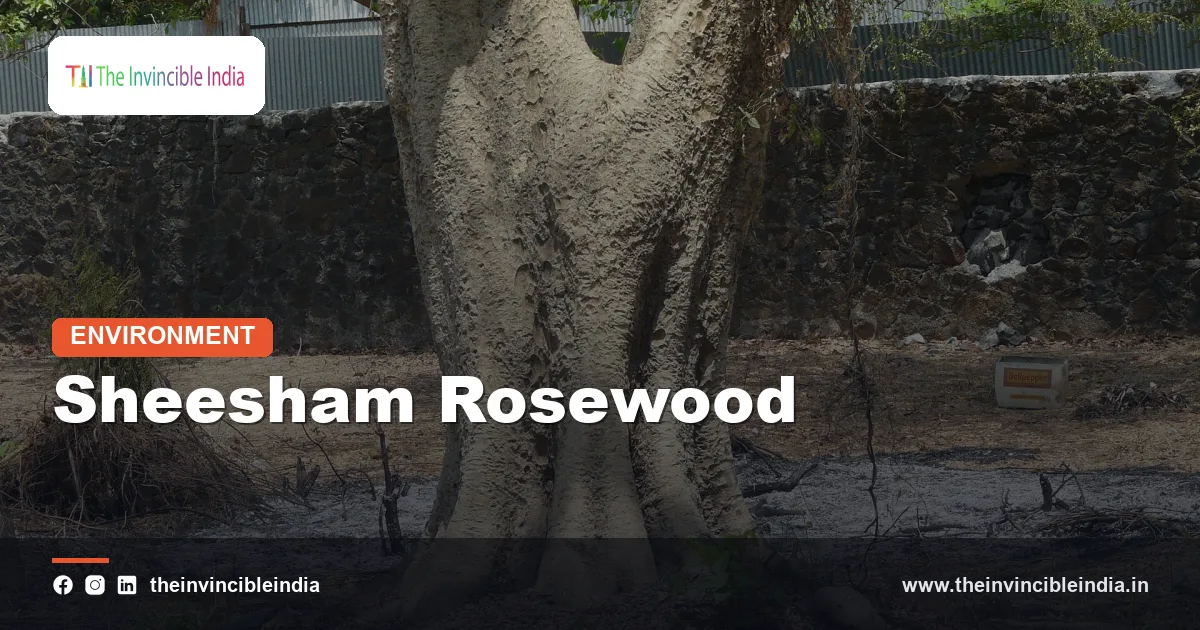
Sheesham (Dalbergia sissoo), also called shisham, tali or Indian rosewood, is a hardy, fast-growing deciduous timber tree of northern India and the wider subcontinent, valued for its strong, golden-to-dark-brown wood and for its ability to enrich the soil by fixing nitrogen. Sheesham furniture is a staple of Indian homes, and the tree is a common sight along canals, roads and riverbanks in the Gangetic plains and Punjab.
Sheesham combines three qualities that rarely come together: durable, good-looking timber, tolerance of poor and flooded soils, and usefulness in agroforestry. It is also subject to modern conservation rules, because the entire rosewood genus Dalbergia is now regulated in international trade. This explainer covers what sheesham is, where it grows, how its wood is used, and why it matters for farming, industry and conservation.
| Attribute | Detail |
|---|---|
| Scientific name | Dalbergia sissoo |
| Common names | Sheesham, shisham, tali (Punjab), sissoo, North Indian rosewood |
| Plant family | Fabaceae (the legume or pea family) |
| Native range | Indian subcontinent, including the sub-Himalayan foothills and the Indus-Ganga plains |
| Tree type | Medium to large deciduous tree, commonly 15 to 25 metres tall |
| Wood | Heavy, strong hardwood with golden-brown to dark-brown heartwood |
| Special ecological trait | Nitrogen-fixing through root-nodule bacteria |
| Typical flowering | Spring, roughly March to April |
| Trade regulation | Genus Dalbergia listed in CITES Appendix II since 2017 |
Key Takeaways
- Sheesham (Dalbergia sissoo) is a deciduous, nitrogen-fixing timber tree in the legume family, native to the Indian subcontinent.
- Sheesham heartwood is hard, durable and takes a fine polish, which makes it one of the most popular woods for Indian furniture.
- Sheesham thrives on sandy and gravelly riverbank soils and is widely planted along canals, roads and farm boundaries in north India.
- Sheesham is different from Indian rosewood proper, Dalbergia latifolia, which grows mainly in peninsular India and is also called blackwood.
- Since 2017 the whole genus Dalbergia, including sheesham, has been listed under CITES Appendix II, which regulates international trade in its wood.
- A fungal dieback disease has damaged many sheesham stands in north India since the 1990s, so planting programmes now stress disease-resistant stock and mixed species.
What Is Sheesham?
Sheesham is a deciduous tree of the legume family, scientifically named Dalbergia sissoo, that is grown across India for timber, shade, fodder and soil improvement. It is known by many local names, including shisham in Hindi, tali in Punjabi and sissoo in forestry literature.
A mature sheesham tree has a spreading, open crown and a grey-brown bark that splits into narrow, shallow fissures. Its compound leaves carry three to five leaflets, each broad and leathery with a slightly pointed tip, set alternately along the stalk. The leaves turn pale yellow before they fall in winter, and fresh pale-green foliage appears in early spring.
Small cream or pale-yellow flowers appear in clusters around March and April. They produce flat, thin pods, about four to eight centimetres long, which contain one to four seeds. These pods stay on the tree for months, and the seeds spread by wind and water, which helps the tree colonise newly deposited river sand.
Is Sheesham the Same as Indian Rosewood?
Sheesham is a type of rosewood but is not the same as the species most strictly called Indian rosewood, which is Dalbergia latifolia. Both belong to the genus Dalbergia, and the English name “rosewood” is applied to several species of this group, which causes frequent confusion in the timber trade.
| Feature | Sheesham (Dalbergia sissoo) | Indian rosewood (Dalbergia latifolia) |
|---|---|---|
| Main region | North India, the Indo-Gangetic plain and Himalayan foothills | Peninsular India, especially the Western Ghats region and Karnataka, Kerala and Tamil Nadu |
| Other names | Shisham, tali, North Indian rosewood | Bombay blackwood, black rosewood, beeti |
| Wood colour | Golden to medium-dark brown, often with darker streaks | Deep purplish-brown to nearly black |
| Common use | Furniture, doors, plywood, tool handles, carving | High-grade furniture, veneers, musical instruments |
| Growth setting | Plains, riverbanks and canal sides | Moist forest and hill slopes |
Because the names overlap, buyers who ask for “Indian rosewood” furniture may receive sheesham. Both are legitimate timbers, but they differ in colour, price and legal status in trade, so the botanical name is the reliable way to tell them apart.
Where Does Sheesham Grow in India?
Sheesham grows naturally along rivers and in the foothills of the Himalayas, and it is planted widely in Punjab, Haryana, Uttar Pradesh, Bihar, Rajasthan, Uttarakhand and neighbouring states. In its native habitat it colonises fresh alluvial deposits of sand and gravel on riverbanks, often alongside the khair tree (Senegalia catechu).
The tree prefers a warm climate with a distinct dry period and grows best at low to moderate elevations, from the plains up to the lower Himalayan slopes. It tolerates summer heat and light frost, but it does not do well in waterlogged, saline or heavy clay soils. It is intolerant of deep shade, so it needs open sunlight to do well.
Sheesham has also been planted outside its native range. Forest departments introduced it to parts of central and southern India, and it has been grown in other countries as a plantation and shade tree. In India it forms an important part of avenue plantations along old highways and canal banks laid out during the colonial period, many of which remain as shaded roads today.
Why Is Sheesham Wood So Popular for Furniture?
Sheesham wood is popular for furniture because it is strong, heavy, resistant to decay and termites, and it finishes to a rich, attractive grain. These properties make furniture made from sheesham long-lasting, which is why bed frames, dining tables, cabinets and doors in sheesham are common across India.
Qualities of the Timber
- Strength: The wood is a dense hardwood that resists bending and wear.
- Grain and colour: Heartwood ranges from golden brown to dark brown, with darker lines that give a lively pattern. Sapwood is pale and clearly different from the heartwood.
- Durability: The heartwood has natural resistance to termites and fungal rot, though sapwood is less durable.
- Workability: The wood carves and turns well and takes polish, stain and lacquer cleanly.
Traditional Uses
Beyond furniture, sheesham wood has long been used for bullock-cart wheels, agricultural implements, tool handles, boat building, railway fittings, carved panels and decorative items. Wood-carving centres in north India, including the furniture and handicraft clusters of Saharanpur in Uttar Pradesh, are well known for sheesham work. Branches and offcuts also serve as firewood and for making charcoal.
How Does Sheesham Improve the Soil?
Sheesham improves the soil because, like other legumes, it hosts nitrogen-fixing bacteria in root nodules that convert atmospheric nitrogen into forms plants can use. This process adds natural fertility to the soil around the tree.
The rhizobia bacteria living in the root nodules receive sugars from the tree, and in return provide nitrogen. When sheesham leaves fall each winter, they decompose and release this nitrogen and organic matter into the topsoil. The tree’s roots are also extensive, forming a network that binds loose sand and gravel and so limits erosion on riverbanks and slopes.
This combination of fertility, soil binding and light shade makes sheesham a valued companion tree on farms. Because its crown is open and its leaves fall in the dry season, crops growing beneath the tree often receive enough light, especially compared with dense evergreen trees.
What Role Does Sheesham Play in Agroforestry?
Sheesham plays a central role in north Indian agroforestry, where farmers plant it on field boundaries, canal banks and in block plantations alongside crops such as wheat and sugarcane. Agroforestry means growing trees together with crops or livestock on the same land to gain additional income and ecological benefits.
For small and marginal farmers, sheesham serves as a long-term savings account that grows on the farm boundary. The tree grows reasonably quickly, tolerates pruning and coppices, which means it can regrow from cut stumps. Its timber fetches a good price, and thinnings and branches provide fuel and poles in the meantime.
Common Agroforestry Uses
- Boundary and bund planting: Rows along field edges produce timber without taking up much cropland.
- Canal-side and roadside planting: State irrigation and forest departments in Punjab, Haryana and Uttar Pradesh have long planted sheesham along canal banks and highways to stabilise soil and provide shade.
- Windbreaks and shelterbelts: Rows of sheesham help protect fields against hot, dry winds.
- Fodder: The leaves are lopped as supplementary fodder for cattle and goats in some regions.
Planting is usually done with seedlings, root suckers or stump cuttings. Because the tree sends up suckers from its roots, it can spread on its own once established in suitable soil.
What Is the Sheesham Dieback Disease?
Sheesham dieback is a serious decline disease, associated mainly with the fungus Fusarium solani, in which branches die back from the top and trees may eventually die. It has affected sheesham plantations and avenue trees in north India and neighbouring countries since the 1990s.
Researchers link the problem to a mix of causes rather than a single pathogen. Stress factors such as waterlogging, poor drainage, drought, soil compaction and planting of one species over large areas are thought to make trees more vulnerable. Because sheesham is often grown in large uniform blocks from a narrow genetic base, a disease can spread quickly through the stand.
Forestry institutions have responded with several measures. They recommend using seedlings from healthy, diverse parent trees, avoiding very dense monocultures, improving drainage, and mixing sheesham with other species. Selection of resistant clones is an ongoing research aim. For farmers, healthy planting material and well-spaced, mixed plantings are the main practical safeguards.
Is Sheesham a Protected Species?
Sheesham is not strictly protected as an endangered tree, but trade in its wood is regulated because the entire genus Dalbergia was listed in Appendix II of CITES in 2017. CITES, the Convention on International Trade in Endangered Species of Wild Fauna and Flora, controls international commerce in listed species through permits.
The Dalbergia listing was adopted mainly because several rosewood species elsewhere in the world, especially in Madagascar and South-East Asia, were being illegally logged at an alarming rate, and many of these are hard to tell apart by wood alone. Placing the whole genus under control makes enforcement easier. Species such as Dalbergia sissoo are included, which means that exporting items made of sheesham may require CITES documentation, with exemptions for certain finished or small-scale items under specific annotations.
Within India, the felling and transport of sheesham on private land is governed by state tree-felling and transit rules, which differ from state to state. Some states have relaxed rules for trees grown on farms to encourage agroforestry, while forest-grown trees remain tightly regulated. Anyone buying or selling sheesham timber should check state rules and the current CITES position for export.
How Can You Identify and Care for a Sheesham Tree?
A sheesham tree can be identified by its alternate compound leaves of three to five rounded, pointed leaflets, its fissured grey bark, and its thin, flat, light-brown seed pods. These features help distinguish it from similar-looking trees such as the Indian beech (Pongamia pinnata).
For anyone planting sheesham, a few guidelines help. Choose a sunny spot with well-drained soil, since waterlogging is a leading stress. Plant disease-free seedlings and keep young trees watered in their first dry seasons. Space trees widely enough that crowns do not touch, and avoid growing only sheesham in a large block. Pruning of lower branches improves the straightness of the trunk, which raises the timber value in later years.
When buying furniture, ask for the botanical name and look for the typical golden-brown wood with contrast streaks. Genuine sheesham sounds solid when tapped and feels heavy compared to softer woods.
Bottom Line
Sheesham is one of north India’s most useful trees: a nitrogen-fixing legume that grows on poor riverbank soils, supplies strong and beautiful furniture timber, and supports farm income through agroforestry. Its future depends on healthy planting stock, mixed plantations and awareness of the trade rules that now apply to all rosewoods.
Frequently Asked Questions
What is the botanical name of sheesham?
The botanical name of sheesham is Dalbergia sissoo. It belongs to the legume family, Fabaceae, and is sometimes called North Indian rosewood. The name “sissoo” in the scientific name comes from the local word shisham.
Is sheesham wood good for furniture?
Yes, sheesham wood is very good for furniture because it is dense, strong and resistant to termites and decay. The heartwood also has an attractive golden-to-dark-brown grain that takes polish well. Properly seasoned sheesham furniture can last for generations.
What is the difference between sheesham and rosewood?
Sheesham is one kind of rosewood, whereas the name rosewood covers several Dalbergia species. True Indian rosewood, Dalbergia latifolia, grows mainly in peninsular India and has darker, purplish wood. Sheesham grows mainly in north India and has lighter golden-brown heartwood.
Does sheesham fix nitrogen in the soil?
Yes, sheesham fixes nitrogen because, as a legume, it forms root nodules with nitrogen-fixing bacteria. The nitrogen reaches the soil through fallen leaves and decaying roots. This makes sheesham a useful tree for improving poor or sandy soils.
How long does a sheesham tree take to mature?
A sheesham tree grows quickly in its early years, but it generally takes two to three decades or more to produce good-quality timber. Growth rate depends on soil, water and management. Trees on rich, well-drained land tend to mature faster than those on poor or waterlogged soil.
Is sheesham banned from export?
Sheesham is not banned outright, but international trade in it is controlled because the Dalbergia genus has been under CITES Appendix II since 2017. Exporters usually need permits and documentation for sheesham wood products, with specific exemptions for some finished items. Rules can change, so exporters should check current regulations.
{“@context”:”https://schema.org”,”@graph”:[{“@type”:”FAQPage”,”mainEntity”:[{“@type”:”Question”,”name”:”What is the botanical name of sheesham?”,”acceptedAnswer”:{“@type”:”Answer”,”text”:”The botanical name of sheesham is Dalbergia sissoo. It belongs to the legume family, Fabaceae, and is sometimes called North Indian rosewood. The name “sissoo” in the scientific name comes from the local word shisham.”}},{“@type”:”Question”,”name”:”Is sheesham wood good for furniture?”,”acceptedAnswer”:{“@type”:”Answer”,”text”:”Yes, sheesham wood is very good for furniture because it is dense, strong and resistant to termites and decay. The heartwood also has an attractive golden-to-dark-brown grain that takes polish well. Properly seasoned sheesham furniture can last for generations.”}},{“@type”:”Question”,”name”:”What is the difference between sheesham and rosewood?”,”acceptedAnswer”:{“@type”:”Answer”,”text”:”Sheesham is one kind of rosewood, whereas the name rosewood covers several Dalbergia species. True Indian rosewood, Dalbergia latifolia, grows mainly in peninsular India and has darker, purplish wood. Sheesham grows mainly in north India and has lighter golden-brown heartwood.”}},{“@type”:”Question”,”name”:”Does sheesham fix nitrogen in the soil?”,”acceptedAnswer”:{“@type”:”Answer”,”text”:”Yes, sheesham fixes nitrogen because, as a legume, it forms root nodules with nitrogen-fixing bacteria. The nitrogen reaches the soil through fallen leaves and decaying roots. This makes sheesham a useful tree for improving poor or sandy soils.”}},{“@type”:”Question”,”name”:”How long does a sheesham tree take to mature?”,”acceptedAnswer”:{“@type”:”Answer”,”text”:”A sheesham tree grows quickly in its early years, but it generally takes two to three decades or more to produce good-quality timber. Growth rate depends on soil, water and management. Trees on rich, well-drained land tend to mature faster than those on poor or waterlogged soil.”}},{“@type”:”Question”,”name”:”Is sheesham banned from export?”,”acceptedAnswer”:{“@type”:”Answer”,”text”:”Sheesham is not banned outright, but international trade in it is controlled because the Dalbergia genus has been under CITES Appendix II since 2017. Exporters usually need permits and documentation for sheesham wood products, with specific exemptions for some finished items. Rules can change, so exporters should check current regulations.”}}]}]}


