

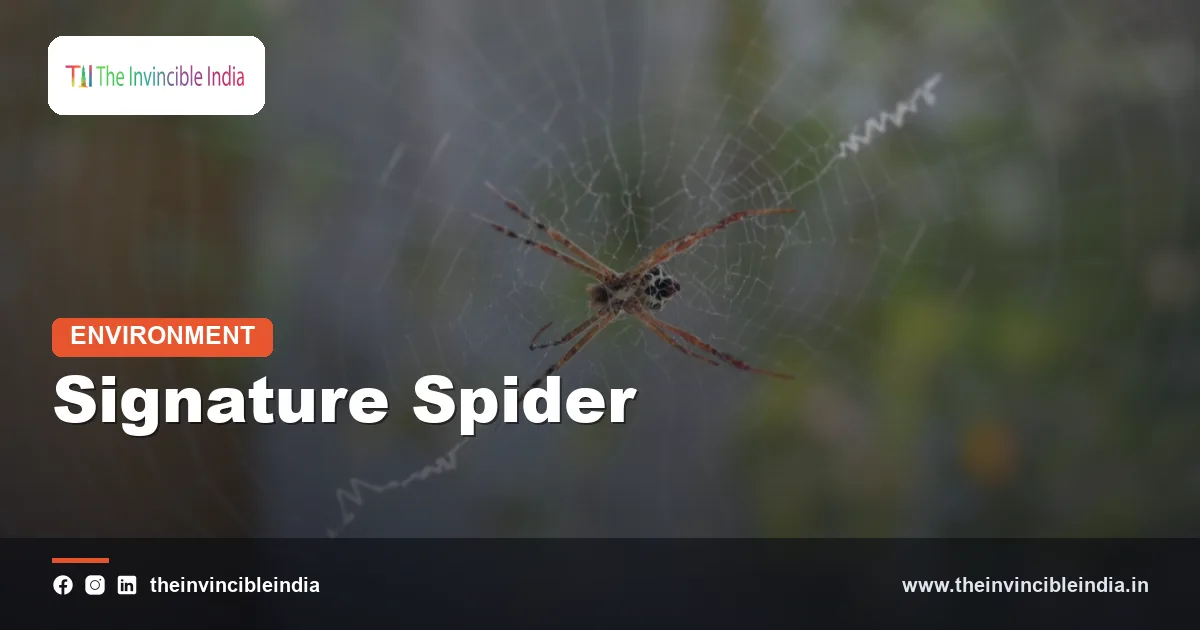
In India, the signature spider is a large, brightly banded garden orb-weaver of the genus Argiope that weaves a round web and decorates it with bold zigzag or X-shaped bands of white silk, known as stabilimenta, which look like a handwritten signature across the web. The spider belongs to the family Araneidae, the orb-weaving spiders, and is one of the most conspicuous arachnids of Indian gardens, hedgerows and field margins, especially after the monsoon.
Despite its size and striking colours, the signature spider is harmless to people and is a useful controller of flying insects. This explainer covers what the signature spider is, how it builds and decorates its web, why the sexes look so different, what scientists think the web decorations are for, and how to live alongside it safely.
| Attribute | Detail |
|---|---|
| Common name | Signature spider (also called St Andrew’s cross spider or garden orb-weaver in some regions) |
| Genus and family | Argiope, family Araneidae (orb-weaving spiders) |
| Order and class | Araneae, class Arachnida |
| Indian species commonly called by this name | Several Argiope species, including Argiope anasuja, Argiope pulchella and Argiope aemula |
| Web type | Vertical orb web with zigzag silk bands (stabilimenta) |
| Female body length | Roughly 1.5 to 2.5 cm, excluding legs (varies by species) |
| Male body length | Only a few millimetres, a fraction of the female |
| Danger to humans | Harmless; bites are very rare and mild |
| Typical lifespan | About one year; adults are most visible in the monsoon and post-monsoon months |
Key Takeaways
- The signature spider is a garden orb-weaver of the genus Argiope, family Araneidae, found widely across India.
- The signature spider gets its name from the bold zigzag or cross-shaped silk bands, called stabilimenta, that it weaves into its web.
- Female signature spiders are many times larger than males, a size difference known as sexual dimorphism.
- Scientists have proposed several explanations for web decorations, including attracting prey, warning birds and camouflaging the spider, and no single theory fully explains them across species.
- The signature spider is not dangerous to humans, and its venom is adapted to subdue small insects rather than large animals.
- Signature spiders help keep populations of flies, grasshoppers and moths in check in gardens and crop margins.
What is the signature spider?
The signature spider is a medium-to-large orb-weaving spider in the genus Argiope, recognised by its striped abdomen and by the conspicuous silk decorations it adds to its web. In India the name is applied to several closely related Argiope species rather than a single one, and the common name is used mainly by naturalists, photographers and citizen-science communities.
All spiders belong to the order Araneae. Worldwide, well over 50,000 spider species have been described, and India is home to well over a thousand of them, with new species still being recorded. Argiope is one of the more familiar genera because its webs are built in open, sunlit places at eye level, where people see them while walking through parks, farms and village edges.
The family Araneidae, to which the signature spider belongs, contains the classic “orb weavers” that spin the wheel-shaped webs people picture when they think of a spider’s web. Members of this family build webs of radial threads (spokes) crossed by a spiral of sticky capture silk.
Why is it called the signature spider?
The signature spider is called by this name because the thick white zigzag bands in its web resemble a signature scrawled in the middle of a page. These bands are the spider’s stabilimenta (singular: stabilimentum), a Latin-derived word meaning a stabiliser or support, a name given when early naturalists thought the bands strengthened the web.
The decoration can take several forms. Depending on the species, the individual spider and the age of the web, it may appear as:
- a vertical zigzag ribbon running above and below the hub;
- four bands arranged in an X, which is why some Argiope are called cross spiders;
- a spiral or disc of dense white silk around the centre;
- or no decoration at all, particularly in older, larger females.
The name “signature” is informal, but it captures what makes the spider easy to spot. A brightly marked spider sitting at the centre of a web with a conspicuous bright band is far easier to identify than most other garden spiders.
What does a signature spider look like?
An adult female signature spider has a broad, flattened abdomen marked with alternating bands of yellow, black and white or silver, and long legs that are usually banded in black and yellow or brown. The pattern varies between species, but the strong horizontal striping on the abdomen is a reliable clue to the genus.
The female
The female is the spider people notice. Her body is typically around one and a half to two and a half centimetres long, not counting the legs, and the full leg span can reach several centimetres. The abdomen may be scalloped at the edges, and the cephalothorax (the head and chest section) is covered in fine, silvery hairs. She usually rests head-down at the centre of the web, with her eight legs held in four close-set pairs so that they form an X shape.
The male
The male signature spider is tiny, often only a few millimetres long, and drab by comparison with the female. He is easily overlooked and is usually found at the edge of a female’s web rather than at its centre. The huge size gap between the sexes, with females many times heavier than males, is a well-known feature of orb-weaving spiders and is called sexual size dimorphism.
Spiderlings
Newly hatched young are minute and pale, and they disperse by releasing a silk thread that catches the breeze, a behaviour called ballooning. They grow through a series of moults before reaching adult size, usually over a few months.
Why do signature spiders decorate their webs?
Scientists do not agree on a single reason signature spiders decorate their webs, and the stabilimentum probably serves different functions in different species and situations. The question has been studied for decades, and several main hypotheses are discussed in the scientific literature.
| Hypothesis | Main idea |
|---|---|
| Prey attraction | Many silks reflect ultraviolet light, and some insects may be drawn to the bright bands, increasing the spider’s catch |
| Warning to birds | A visible band may signal that the web is there, so that birds fly around it rather than destroying it by accident |
| Predator deterrence or camouflage | Bands may break up the outline of the spider’s body, or make the spider look larger and more intimidating to wasps and birds |
| Web strengthening | The original idea behind the name, now considered weak because the bands add little mechanical strength |
| Thermoregulation or shading | The dense silk may shade the spider or reflect light, though evidence is limited |
| Resource signalling | The amount of decoration may reflect how much silk the spider can afford to spend |
The evidence is mixed. In some studies, decorated webs caught more prey in sunlit places, while in other studies they attracted more attacks from predators such as spider-hunting wasps. This trade-off suggests the spider may build more or less decoration depending on its surroundings, its hunger and the risk of predators.
The most honest summary is that the stabilimentum is a flexible behaviour with several possible benefits and costs, not a single-purpose structure.
Where is the signature spider found in India?
The signature spider is found across much of India, from plains and agricultural land to forest edges, wherever there is open, sunny vegetation on which to anchor a large web. Argiope spiders occur in tropical and subtropical regions around the world, and several species are widespread across South and Southeast Asia.
Typical Indian habitats include:
- gardens, parks and campus lawns with shrubs and tall grass;
- hedges and field bunds around farmland;
- scrub, grassland and open woodland margins;
- roadside vegetation and wasteland with tall weeds.
Which species is found where depends on region, altitude and rainfall, and field identification of Argiope species can be difficult even for experts. Some species are more common in the south and the Western Ghats, while others are found across the northern plains. Anyone interested in naming a specific individual should treat a photograph-based identification as provisional, unless it is confirmed by a specialist.
How does the signature spider build its web?
The signature spider builds its web by first laying a bridge thread, then constructing radial spokes and finally laying a sticky spiral of capture silk from the outside inwards. The result is a flat, wheel-shaped web, often placed vertically between grass stems, shrubs or fence posts.
The steps run roughly in this order:
- The spider releases a silk line that drifts on the wind until it sticks to a distant support, forming a bridge.
- She drops a second line to form a Y-shaped frame, then adds radial threads that meet at the hub.
- She lays a temporary non-sticky spiral to hold the radii in place.
- She replaces the temporary spiral with a sticky capture spiral, eating the temporary silk as she goes.
- She weaves the stabilimentum into or near the hub, often in the lower and upper halves of the web.
Orb-weaving spiders typically renew much of their web every day or every few days, eating the old silk and recycling its protein into new threads. A damaged web is quickly replaced, and an Argiope may rebuild at dawn or dusk. Spider silk is a protein fibre that is strong for its weight, and a spider can produce several types of silk, each from different glands.
What does the signature spider eat, and what eats it?
The signature spider feeds on flying and jumping insects, including flies, mosquitoes, moths, grasshoppers, bees and small beetles, which are caught in the sticky spiral. When an insect strikes the web, the spider rushes to it, bites to inject venom, and wraps the prey in silk before feeding on it.
Feeding involves external digestion. The spider injects digestive enzymes into the wrapped prey and sucks up the liquefied contents, leaving a dry husk.
The spider is also prey for other animals. Its main predators include:
- spider-hunting wasps, which paralyse spiders and stock them in nests for their larvae;
- birds, particularly small insectivorous species;
- lizards such as garden lizards;
- other spiders and praying mantises.
The spider’s bold colouring, its habit of vibrating the web when disturbed and its ability to drop from the web into the vegetation are all defensive tactics. Some Argiope shake the web vigorously so that the spider becomes a blur, making it hard for a predator to target.
How does the signature spider reproduce?
The signature spider reproduces by mating followed by egg-laying, with the tiny male approaching the large female carefully because she may attack him. In many orb-weaving spiders the male approaches the female’s web, plucks the silk in a particular pattern to announce himself, and then mates with her, often in a short window after she has moulted and her body is still soft.
Mating in Argiope is unusual in several respects:
- The male transfers sperm using modified appendages called pedipalps, not by a conventional organ.
- In some species, males do not survive mating, and females may eat them, a pattern called sexual cannibalism.
- In other cases, males may stay on the web for some time or mate with more than one female.
After mating, the female spins a tough, papery egg sac, often shaped like a flask or pear, and attaches it to vegetation near her web. A single sac can hold several hundred eggs, and a female may produce more than one sac. The spiderlings hatch inside the sac and emerge later, often after some weeks. Most adults die by the end of the season, so the species survives through eggs and young.
Is the signature spider dangerous to humans?
The signature spider is not dangerous to humans, and bites are extremely rare because the spider prefers to drop from its web or retreat when disturbed. Its venom is meant to immobilise small insects, and in the unusual event of a bite the effects are generally limited to brief local pain, redness or mild swelling, similar to a minor insect sting.
Sensible handling is still the rule. Practical advice includes:
- Do not poke or squeeze the spider; it may bite in self-defence if trapped.
- If bitten, wash the area with soap and clean water, and apply a cold compress.
- Seek medical advice if swelling spreads, if there are signs of allergy or if the bite becomes infected.
The bold colours and large size lead many people to assume the spider is venomous in the sense that matters to humans. In reality, there is no good evidence that Argiope species pose a medical risk. As with any wild animal, individual allergic reactions are theoretically possible but uncommon.
How can the signature spider be told apart from similar spiders?
The signature spider can be told apart from other Indian garden spiders mainly by its horizontally banded abdomen, its head-down posture at the hub and the presence of white zigzag silk bands in the web. Several other orb-weavers share parts of this description, so a few contrasts are useful.
| Spider | Key features | Web |
|---|---|---|
| Signature spider (Argiope) | Banded yellow, black and silver abdomen; legs held in X-shaped pairs | Vertical orb with white zigzag or X-shaped bands |
| Giant wood spider (Nephila) | Long, cylindrical abdomen; often yellow-golden silk | Very large, golden-tinted orb web, often between trees |
| Garden orb-weavers (other Araneidae) | Rounded abdomen, often mottled brown or green | Orb web without bold zigzag bands |
| Crab spiders | Flattened, crab-like legs held sideways | No capture web; ambush hunters on flowers |
If a spider is seen with a white zigzag or cross pattern in the web and a boldly striped abdomen, it is very likely an Argiope. Telling the individual species apart usually needs close inspection of the abdomen shape, the markings on the underside and the genitalia, which is work for specialists.
Why does the signature spider matter?
The signature spider matters because it is a natural predator of insects, including crop and garden pests, and because it is a visible entry point for public interest in India’s rich but under-studied spider fauna. A single garden can host many orb-weaving spiders, and together they remove large numbers of insects without any chemical input.
Their value can be summarised as follows:
- Pest regulation: they feed on flies, moths, grasshoppers and other insects that damage crops or annoy people.
- Food web role: they are food for birds, lizards and wasps, linking insects to higher animals.
- Research value: web decoration, sexual size difference and silk chemistry make Argiope a classic subject for biologists.
- Citizen science: large, easily photographed spiders are popular on biodiversity platforms, helping to record where species occur.
Avoid destroying webs unnecessarily. If a web is built across a path, it is usually easier to move the spider gently to a nearby shrub with a stick or leaf, and it will build elsewhere. Pesticide use around gardens harms spiders along with the insects they eat.
Bottom Line
The signature spider is a harmless, striking orb-weaver whose zigzag web decorations remain only partly explained by science. Its role in controlling insects and its easy visibility make it a good species to watch, photograph and protect in Indian gardens and fields. 23 October 2026
Frequently Asked Questions
What is a signature spider?
A signature spider is a garden orb-weaving spider of the genus Argiope that decorates its web with thick white zigzag or cross-shaped silk bands. In India the name is used for several closely related species. The spider is large, banded in yellow, black and silver, and harmless to people.
Is the signature spider poisonous?
The signature spider is not dangerous to humans, although like almost all spiders it has venom for subduing insects. Bites are rare and usually cause only mild local pain or redness. People should still avoid handling the spider, and anyone with spreading swelling or an allergic reaction should seek medical advice.
Why does the signature spider make a zigzag pattern in its web?
Scientists are not certain why the signature spider makes the zigzag pattern, and the answer may differ between species. The leading ideas are that the bands attract insects, warn birds away from the web, or help camouflage the spider. Evidence supports each idea in some studies and not in others.
Why is the female signature spider so much bigger than the male?
The female signature spider is much bigger than the male because she needs a large body to produce and carry many eggs. Males are tiny and short-lived, and they spend their energy on finding mates. This large difference between the sexes is called sexual size dimorphism and is common in orb-weaving spiders.
When is the signature spider most visible in India?
The signature spider is most visible in India during and after the monsoon, when adult females are large and webs are common in gardens and fields. Insects are plentiful then, which supports spider growth. Most adults die after laying eggs, so the spiders seen in autumn are often at the end of their life cycle.
Should I remove a signature spider’s web from my garden?
There is usually no need to remove a signature spider’s web from a garden, because the spider helps control insects and is not a danger. If the web blocks a path, the spider can be moved gently to a nearby shrub. Avoid spraying pesticides near the web, since they also harm spiders.
{“@context”:”https://schema.org”,”@graph”:[{“@type”:”FAQPage”,”mainEntity”:[{“@type”:”Question”,”name”:”What is a signature spider?”,”acceptedAnswer”:{“@type”:”Answer”,”text”:”A signature spider is a garden orb-weaving spider of the genus Argiope that decorates its web with thick white zigzag or cross-shaped silk bands. In India the name is used for several closely related species. The spider is large, banded in yellow, black and silver, and harmless to people.”}},{“@type”:”Question”,”name”:”Is the signature spider poisonous?”,”acceptedAnswer”:{“@type”:”Answer”,”text”:”The signature spider is not dangerous to humans, although like almost all spiders it has venom for subduing insects. Bites are rare and usually cause only mild local pain or redness. People should still avoid handling the spider, and anyone with spreading swelling or an allergic reaction should seek medical advice.”}},{“@type”:”Question”,”name”:”Why does the signature spider make a zigzag pattern in its web?”,”acceptedAnswer”:{“@type”:”Answer”,”text”:”Scientists are not certain why the signature spider makes the zigzag pattern, and the answer may differ between species. The leading ideas are that the bands attract insects, warn birds away from the web, or help camouflage the spider. Evidence supports each idea in some studies and not in others.”}},{“@type”:”Question”,”name”:”Why is the female signature spider so much bigger than the male?”,”acceptedAnswer”:{“@type”:”Answer”,”text”:”The female signature spider is much bigger than the male because she needs a large body to produce and carry many eggs. Males are tiny and short-lived, and they spend their energy on finding mates. This large difference between the sexes is called sexual size dimorphism and is common in orb-weaving spiders.”}},{“@type”:”Question”,”name”:”When is the signature spider most visible in India?”,”acceptedAnswer”:{“@type”:”Answer”,”text”:”The signature spider is most visible in India during and after the monsoon, when adult females are large and webs are common in gardens and fields. Insects are plentiful then, which supports spider growth. Most adults die after laying eggs, so the spiders seen in autumn are often at the end of their life cycle.”}},{“@type”:”Question”,”name”:”Should I remove a signature spider’s web from my garden?”,”acceptedAnswer”:{“@type”:”Answer”,”text”:”There is usually no need to remove a signature spider’s web from a garden, because the spider helps control insects and is not a danger. If the web blocks a path, the spider can be moved gently to a nearby shrub. Avoid spraying pesticides near the web, since they also harm spiders.”}}]}]}


