

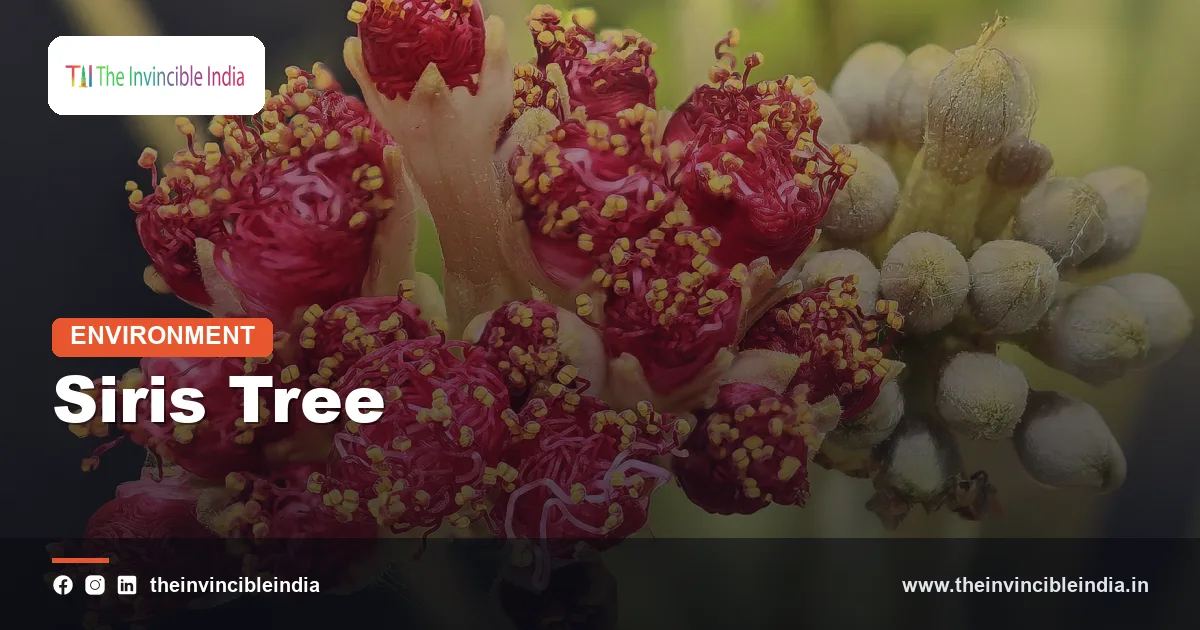
The siris tree (Albizia lebbeck) is a fast-growing, deciduous, nitrogen-fixing shade tree of the pea family, known for its feathery compound leaves, fragrant powder-puff flowers and long rattling seed pods. Native to tropical Asia and widely planted along Indian roads, canals, farms and gardens, the siris tree is valued for its dense shade, durable timber, nutritious fodder and use in traditional medicine.
This explainer describes what the siris tree is, how to recognise it, where it grows, why its pods rattle in the wind, and how it is used in forestry, farming and Ayurveda. It also compares the siris with look-alike trees and notes the cautions that come with a vigorous, spreading tree. The facts are stable botanical and agroforestry knowledge rather than changing statistics.
| Scientific name | Albizia lebbeck |
|---|---|
| Family | Fabaceae (pea family), mimosoid group |
| Common names in India | Siris, sirisha (Sanskrit), kala siris, shirish (Marathi, Bengali form sirish), vaagai (Tamil), bage (Kannada) |
| English names | Woman’s tongue tree, lebbeck tree, East Indian walnut (for the timber), frywood |
| Typical height | Roughly 15 to 25 metres, with a broad, spreading crown |
| Leaves and flowering | Deciduous in the dry season; bipinnate leaves; cream-green powder-puff flowers mainly in spring to early summer |
| Native range | Tropical Asia, including the Indian subcontinent and Myanmar, and extending towards northern Australia |
| Main uses | Shade and avenue tree, fodder, timber and furniture wood, soil improvement, folk medicine |
| Notable features | Fixes nitrogen; flat, papery pods that rattle in the wind; fast growth |
Key Takeaways
- The siris tree (Albizia lebbeck) is a tropical Asian legume that grows quickly to 15 to 25 metres and is widely used as a roadside and farm shade tree in India.
- Siris flowers are fragrant, cream-green powder-puffs with long threadlike stamens, and the tree produces them mainly in spring and early summer.
- The siris tree earns the English name “woman’s tongue tree” because its dry, papery pods rattle loudly when the wind moves them.
- As a nitrogen-fixing legume, the siris tree enriches soil with nitrogen and organic matter, which is why it is used in agroforestry and in land restoration.
- The wood of the siris tree is hard, dark brown and strong, and it is traded as a furniture and flooring timber sometimes called East Indian walnut.
- Siris leaves and pods serve as livestock fodder, and the bark, seeds and flowers have a long history of use in traditional Indian medicine.
What is the siris tree?
The siris tree is a large, spreading, deciduous tree in the genus Albizia, and it is among the commonest shade trees of the Indian plains. Its scientific name is Albizia lebbeck, and it belongs to the pea family, in the subgroup of mimosoid legumes that includes acacias, rain trees and other trees with fluffy flowers.
The genus name honours Filippo degli Albizzi, an Italian nobleman who introduced a related species to Europe in the eighteenth century. The species name lebbeck comes from an Arabic term for the tree. In Sanskrit the tree is called sirisha, and in Hindi and many other languages the names siris and sirisa are in everyday use.
The siris is native to tropical Asia, but it has been introduced to Africa, the Americas, the Caribbean and the Pacific. In some of those places it has become an invasive tree, while in India it remains a familiar, mostly welcome part of rural and urban landscapes.
How do you identify a siris tree?
A siris tree is identified by its feathery bipinnate leaves, its rounded crown, its pale puffball flowers with long stamens and its long, flat, straw-coloured pods. The combination of features is distinctive, though several related trees look similar from a distance.
Leaves
The leaves are bipinnate, meaning each leaf has several pairs of main branches, and each branch carries small oblong leaflets, usually in a few pairs. The leaflets are pale green to bluish-green and slightly unequal at the base. The tree sheds its leaves in the dry season, usually in late winter or early spring, and puts out new foliage soon after.
Flowers
The flowers are borne in round heads about 5 to 6 centimetres across. Each head is made of many tiny flowers with long, silky stamens that give a powder-puff look, and the colour is cream, greenish-white or yellowish. The flowers have a sweet fragrance, especially in the evening, and attract bees and butterflies.
Pods
The pods are flat, thin and papery, about 15 to 30 centimetres long, and they turn from green to straw-brown. Each pod holds several flat seeds. The pods stay on the tree for months and rattle in the breeze, a sound that gives the tree its English nickname.
Bark and form
The bark is grey-brown and rough, and the trunk is often short with strong, spreading limbs. The crown is wide and umbrella-shaped, which is why the tree is popular for shade.
Why is the siris called the woman’s tongue tree?
The siris is called the woman’s tongue tree because its dry, papery seed pods hang in large numbers and make a continuous rattling or whispering sound in the wind. The name is a long-standing English folk expression and is a comment on the noise rather than anything about the tree’s botany.
The sound is surprisingly loud on a breezy day, especially under a mature tree with hundreds of pods. The pods are thin walled and the seeds loose inside, so each movement produces a clatter. For this reason, the tree is sometimes described as noisy at night in the dry months.
Other common English names reflect different features. “East Indian walnut” refers to the walnut-like colour and grain of the timber, and “frywood” is a name used in some regions for the light, dry wood. These names help explain why the siris appears under different labels in forestry and timber trade literature.
Where does the siris tree grow in India?
The siris tree grows across most of India from the plains to the lower hills, in a wide range of climates and soils, and is commonly planted along roads, canals, railways and field boundaries. It does best in warm, tropical and subtropical regions with a distinct dry season.
The tree is adaptable. It tolerates drought, heat, poor soils and some salinity, and it can survive in areas with annual rainfall from fairly low to high. It does not tolerate heavy frost or persistent waterlogging, and it grows best in full sun. In the wild it is found in mixed deciduous forests and open woodland, though much of the siris seen today has been planted.
The siris is a familiar tree in towns and villages, where it shades markets, school yards and temples. It is also used on farms and along irrigation channels, both for its shade and for its leaves as fodder.
What are the uses of the siris tree?
The siris tree is used for shade, timber, fodder, soil improvement and traditional medicine, which makes it a classic multipurpose tree. The following table summarises the main uses and the part of the tree involved.
| Use | Part of tree | Details |
|---|---|---|
| Shade and avenue planting | Whole tree | Broad crown gives dense shade on roads, canals and in compounds |
| Timber and furniture | Heartwood | Hard, dark brown wood used for furniture, flooring, panelling and agricultural tools |
| Fodder | Leaves, pods | Leaves are lopped for cattle, goats and sheep, and pods are also eaten by livestock |
| Soil improvement | Leaves, roots | Nitrogen fixation and leaf litter enrich soil fertility |
| Fuelwood | Wood | Branches provide firewood and charcoal |
| Traditional medicine | Bark, seeds, flowers, leaves | Used in Ayurveda and folk remedies for allergies, respiratory complaints and skin conditions |
| Bee forage | Flowers | Nectar and pollen for honeybees and other insects |
The versatility of the siris explains why it has been planted for centuries. A single tree can shade a courtyard, feed a few goats in a lean season and, after several decades, supply valuable timber.
How is siris wood used?
Siris wood is used as a general-purpose hardwood for furniture, flooring, carts, tool handles and decorative panelling, and it is valued for its strength, attractive grain and moderate weight. The heartwood is dark brown, sometimes with a golden or chocolate tint, and it takes a good polish.
In the timber trade the wood is sometimes marketed as East Indian walnut because of its resemblance to walnut. It seasons reasonably well, though it can warp if dried carelessly. The wood is considered durable and fairly resistant to termites when well seasoned, though outdoor use still needs treatment.
The tree’s fast growth makes it a practical choice for farm forestry, where farmers need a return in a reasonable time. Because it can be coppiced and lopped, it also supplies a steady stream of fuelwood and fodder while the main stems grow into timber.
How does the siris tree help soil and agriculture?
The siris tree helps soil and agriculture by fixing atmospheric nitrogen in root nodules, dropping nutrient-rich leaves and providing shade and fodder on farms. Like other legumes, it partners with soil bacteria that convert nitrogen from the air into usable forms for plants.
- Nitrogen fixation: The roots host nodules that add nitrogen to the soil, which benefits neighbouring crops over time.
- Green manure and mulch: Leaves and prunings decompose quickly and return organic matter to the ground.
- Fodder in lean seasons: The tree carries leaves into the early dry season, and lopped branches give protein-rich feed when grass is scarce.
- Windbreak and boundary tree: Rows of siris protect fields and mark property lines.
- Shade for plantations: Albizia species are used as shade trees in tea and coffee estates, because they cast light, moving shade and enrich the soil.
Farmers using siris in agroforestry usually prune the crown regularly. Pruning keeps shade at a level crops can tolerate and gives a regular supply of green material.
What is the siris tree used for in traditional medicine?
The siris tree is used in Ayurveda and folk medicine mainly for allergic, respiratory and skin conditions, with the bark, seeds, flowers and leaves each having specific traditional applications. The Sanskrit name sirisha appears in classical Indian medical texts, where the tree is recommended in preparations for respiratory and allergic disorders and as an antidote in traditional toxicology.
- Bark: Used in decoctions and pastes for inflammation, wounds and skin disorders.
- Flowers and seeds: Used in traditional formulations for allergic complaints and asthma-like symptoms.
- Leaves: Used in poultices and, in some traditions, for eye complaints.
Modern laboratory studies have investigated anti-allergic and anti-inflammatory activity in extracts from the tree, but traditional use is not equivalent to proven medical treatment. Saponins in the bark and seeds can be harmful in large doses, so home use is not recommended without professional guidance.
The flower has also found a place in Indian poetry. Classical Sanskrit writers used the sirisha blossom as an image of delicacy and tenderness, a literary tradition that shows how long the tree has been part of Indian life.
How is the siris tree different from the rain tree and similar trees?
The siris tree differs from similar trees such as the rain tree (Albizia saman), the white siris (Albizia procera) and the silk tree (Albizia julibrissin) in leaf size, flower colour, pod shape and crown form. All belong to the same group of mimosoid legumes, so they share fluffy flowers and feathery leaves.
| Tree | Flower colour and form | Pod | Notes |
|---|---|---|---|
| Siris (Albizia lebbeck) | Cream to greenish-white powder-puffs | Flat, papery, rattles in wind | Deciduous; widespread in India |
| White siris (Albizia procera) | Whitish flower heads, smaller clusters | Flat, thinner, reddish-brown | Common in forests of north and central India |
| Rain tree (Albizia saman) | Pink and cream puffs | Thick, dark, sweet pulp | Native to tropical America; very wide, umbrella crown |
| Silk tree (Albizia julibrissin) | Pink silky puffs | Flat, pale | Grown in cooler hill areas as an ornamental |
The easiest field marks for the siris are the greenish-cream flower heads and the rattling, straw-coloured pods. The rain tree has a more dramatic, umbrella-shaped crown and pink-tinged flowers, and it is a native of tropical America rather than Asia.
What are the drawbacks and cautions with the siris tree?
The main cautions with the siris tree are its large size, its spreading roots, its brittle branches in storms and its tendency to become invasive outside Asia. These are practical issues for anyone choosing where to plant it.
- Size and roots: A mature siris is a large tree. Planting too near buildings, drains or pavements can cause damage over time.
- Branch breakage: Wide limbs can snap in cyclones and heavy storms, so periodic pruning is advisable.
- Litter: The tree sheds leaves in the dry season and drops pods, which creates seasonal mess.
- Invasiveness: In parts of the Americas, Africa and Pacific islands, the siris spreads readily and is regarded as a weed.
- Toxicity: Some plant parts contain saponins that can be harmful in large amounts, so home remedies should be treated with care.
In India, where the siris is native, such concerns are mainly about urban siting and maintenance rather than ecological damage. Municipal planners often choose it for wide roads and open spaces where its size is an advantage.
Bottom Line
The siris tree is one of India’s most useful and adaptable shade trees, giving quick cover, fragrant blossom, livestock fodder, sturdy timber and nitrogen-rich soil. It suits wide roads, farm boundaries and open land, but it needs space and sensible pruning.
Frequently Asked Questions
What is the scientific name of the siris tree?
The scientific name of the siris tree is Albizia lebbeck. It belongs to the pea family, Fabaceae, within the mimosoid group of legumes. It is also known in English as the woman’s tongue tree and the lebbeck tree.
Why is the siris tree called the woman’s tongue tree?
The siris tree is called the woman’s tongue tree because its dry, papery pods rattle loudly in the wind. The tree carries large numbers of long, flat pods that stay attached for months. The constant clatter inspired the folk name.
Is the siris tree good for shade?
Yes, the siris tree is excellent for shade because it grows quickly and develops a broad, spreading, umbrella-like crown. It is commonly planted along roads, canals, school grounds and village squares across India. It needs open space, however, because of its large size and spreading roots.
Does the siris tree fix nitrogen?
Yes, the siris tree fixes nitrogen because it is a legume that hosts nitrogen-fixing bacteria in its root nodules. This improves soil fertility and benefits nearby plants. The nutrient-rich leaves also decompose into green manure.
What is siris wood used for?
Siris wood is used for furniture, flooring, panelling, carts, tool handles and fuelwood. The hard, dark brown heartwood takes a good polish and is sometimes sold as East Indian walnut. The tree’s quick growth makes it a useful farm-forestry timber species.
Is the siris tree the same as the rain tree?
No, the siris tree and the rain tree are different species, although both belong to the genus Albizia. The siris (Albizia lebbeck) is native to tropical Asia and has cream-green flowers and rattling, papery pods. The rain tree (Albizia saman) comes from tropical America and has pink-and-cream flowers and thick, dark pods.
{“@context”:”https://schema.org”,”@graph”:[{“@type”:”FAQPage”,”mainEntity”:[{“@type”:”Question”,”name”:”What is the scientific name of the siris tree?”,”acceptedAnswer”:{“@type”:”Answer”,”text”:”The scientific name of the siris tree is Albizia lebbeck. It belongs to the pea family, Fabaceae, within the mimosoid group of legumes. It is also known in English as the woman’s tongue tree and the lebbeck tree.”}},{“@type”:”Question”,”name”:”Why is the siris tree called the woman’s tongue tree?”,”acceptedAnswer”:{“@type”:”Answer”,”text”:”The siris tree is called the woman’s tongue tree because its dry, papery pods rattle loudly in the wind. The tree carries large numbers of long, flat pods that stay attached for months. The constant clatter inspired the folk name.”}},{“@type”:”Question”,”name”:”Is the siris tree good for shade?”,”acceptedAnswer”:{“@type”:”Answer”,”text”:”Yes, the siris tree is excellent for shade because it grows quickly and develops a broad, spreading, umbrella-like crown. It is commonly planted along roads, canals, school grounds and village squares across India. It needs open space, however, because of its large size and spreading roots.”}},{“@type”:”Question”,”name”:”Does the siris tree fix nitrogen?”,”acceptedAnswer”:{“@type”:”Answer”,”text”:”Yes, the siris tree fixes nitrogen because it is a legume that hosts nitrogen-fixing bacteria in its root nodules. This improves soil fertility and benefits nearby plants. The nutrient-rich leaves also decompose into green manure.”}},{“@type”:”Question”,”name”:”What is siris wood used for?”,”acceptedAnswer”:{“@type”:”Answer”,”text”:”Siris wood is used for furniture, flooring, panelling, carts, tool handles and fuelwood. The hard, dark brown heartwood takes a good polish and is sometimes sold as East Indian walnut. The tree’s quick growth makes it a useful farm-forestry timber species.”}},{“@type”:”Question”,”name”:”Is the siris tree the same as the rain tree?”,”acceptedAnswer”:{“@type”:”Answer”,”text”:”No, the siris tree and the rain tree are different species, although both belong to the genus Albizia. The siris (Albizia lebbeck) is native to tropical Asia and has cream-green flowers and rattling, papery pods. The rain tree (Albizia saman) comes from tropical America and has pink-and-cream flowers and thick, dark pods.”}}]}]}


