

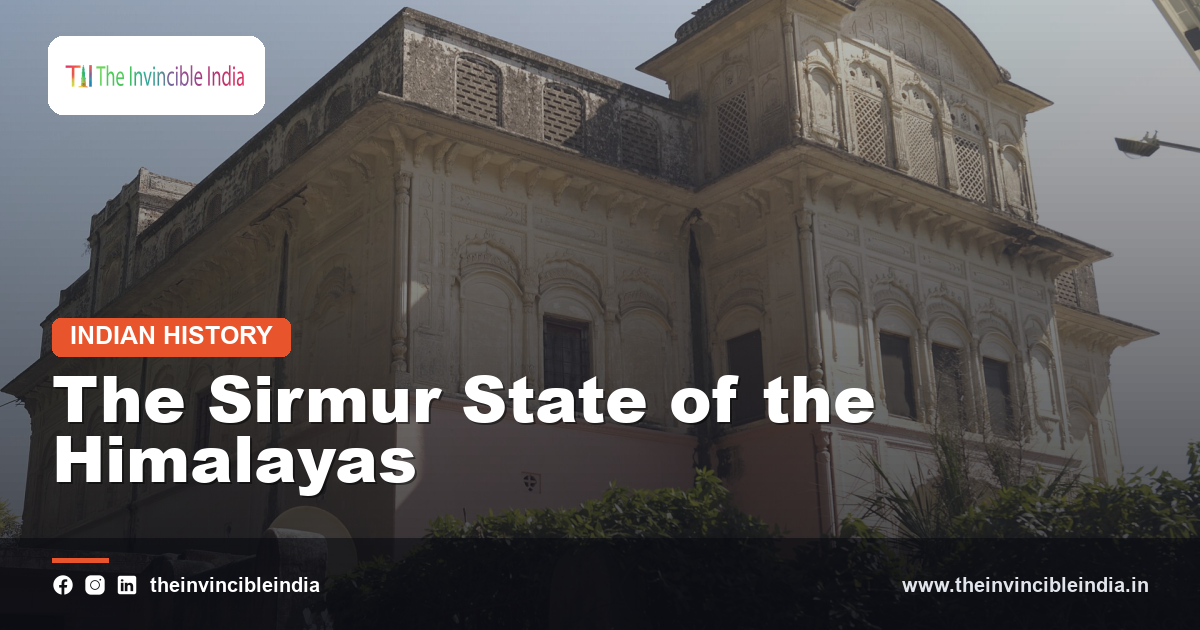
The Sirmur state, also known as Nahan after its capital, was a Rajput princely state in the Himalayan foothills of present-day Himachal Pradesh, with a long history as one of the hill states of the region. Ruled by a Rajput dynasty with its seat at the town of Nahan, Sirmur governed a tract of the lower Himalayas known for its hills, forests and sacred sites. The state is associated with the revered Renuka Lake, a holy pilgrimage site, and with the Jaitak fort, which featured in the Anglo-Gorkha war of the early nineteenth century. After the defeat of the Gorkhas, Sirmur continued as a princely state under British overlordship, and in time it acceded to independent India in 1948. As a Himalayan Rajput state, it belongs to the wider world of the houses described in our guide to the Rajputs. Because several dates and details rest on tradition and the records of the period, this account keeps to general terms where the record is uncertain.
Quick answer: The Sirmur state, also known as Nahan after its capital, was a Rajput princely state in the Himalayan foothills of present-day Himachal Pradesh, with a long history as one of the hill states of the region. Ruled by a Rajput dynasty with its seat at Nahan, it is associated with the revered Renuka Lake and the Jaitak fort of the Anglo-Gorkha war. After the defeat of the Gorkhas, Sirmur continued as a princely state under British overlordship and acceded to independent India in 1948.
Key Takeaways
- The Sirmur state, also known as Nahan after its capital, was a Rajput princely state in the Himalayan foothills.
- It lay in the region of present-day Himachal Pradesh and was one of the hill states of the region.
- Its capital was the town of Nahan.
- The state is associated with the revered Renuka Lake, a holy pilgrimage site.
- The Jaitak fort of Sirmur featured in the Anglo-Gorkha war of the early nineteenth century.
- Sirmur continued as a princely state under British overlordship and acceded to independent India in 1948.
Read on for the history, culture, and legacy in detail.
Quick Facts
| Detail | Information |
|---|---|
| State | Sirmur state (also called Nahan) |
| Type | Rajput princely state |
| Period | Medieval period to the modern era; dates debated |
| Region | Himalayan foothills, present-day Himachal Pradesh |
| Capital | Nahan |
| Sacred Site | Renuka Lake |
| Key Fort | Jaitak fort |
| Major Event | Anglo-Gorkha war, early nineteenth century |
| Acceded to India | 1948 |
What Was the Sirmur State?
The Sirmur state, also known as Nahan after its capital town, was a Rajput princely state in the Himalayan foothills of present-day Himachal Pradesh, with a long history as one of the hill states of the western Himalayas. Ruled by a Rajput dynasty, it governed a tract of the lower mountains known for its hills, forests, river valleys and sacred sites. The state existed among the numerous small kingdoms and principalities that divided the hill country of the region through the medieval and early modern periods. It is remembered for its capital at Nahan, its association with the holy Renuka Lake, and its part in the events of the Anglo-Gorkha war. As a Himalayan Rajput state, Sirmur holds an important place in the history of the hill states of the region. Its rulers maintained their authority through the challenges of mountain geography and powerful neighbours over a long span of history.
Where Is Sirmur Located?
Sirmur is a region in the Himalayan foothills of present-day Himachal Pradesh, in the lower ranges of the western Himalayas where the mountains meet the plains. A land of hills, forests, river valleys and sacred sites, the region lies in the southern part of the hill country of Himachal Pradesh. The town of Nahan served as the capital and seat of the Sirmur state, set in this foothill country. The region’s position in the lower Himalayas gave it a distinctive character between the high mountains and the plains, and brought it into contact with both the hill states and the powers of the lowlands. Its hills, forests and the revered Renuka Lake form part of its natural and sacred heritage. The terrain shaped the history and fortunes of the state and its rulers. Sirmur was thus both the homeland and the seat of the state in the Himalayan foothills of the region.
Who Ruled Sirmur?
Sirmur was ruled by a Rajput dynasty that governed the state from its capital at Nahan across a long history reaching back into the medieval period. As a Rajput ruling house, the dynasty claimed the martial and princely traditions associated with the Rajputs and held its hill state among the many principalities of the western Himalayas. The rulers maintained their authority through the medieval and early modern periods, holding their mountain territory and its forts. Their rule connected Sirmur to the wider world of the Rajput houses, though the early history rests largely on tradition. The dynasty is remembered for its long continuity and its association with the sacred and cultural heritage of the region. The details of the individual rulers are drawn from tradition and the records of the region and are treated with care. The Rajput dynasty of Sirmur thus gave the state its ruling line across its long history in the Himalayan foothills.
Why Was Nahan the Capital?
Nahan was the capital of the Sirmur state, a hill town in the Himalayan foothills that served as the seat of the Rajput dynasty and the centre of its rule. Set in the lower mountains, Nahan became the political, administrative and cultural focus of the state, where the rulers maintained their court and conducted the affairs of the territory. The town is remembered for its hill setting, its temples and its character as a princely capital of the region. Its position in the foothills made it a natural centre for a state that lay between the high mountains and the plains. The development of Nahan as a capital reflected the practice of the hill states, each with its own seat of power. The town preserves heritage associated with the long history of the state. Nahan thus anchors the Sirmur state in the historical geography of the Himalayan foothills, giving the state its alternative name.
What Is Renuka Lake?
Renuka Lake, in the Sirmur region, is a revered lake and a holy pilgrimage site, counted among the sacred waters of the Himalayan foothills. The lake is associated in tradition with the goddess Renuka and is the focus of devotion and pilgrimage, drawing devotees to its shores. Set amid the hills and forests of the region, Renuka is admired both for its natural beauty and for its religious importance. As one of the notable sacred sites of the Sirmur country, the lake forms an important part of the heritage of the region. Its association with tradition and devotion gives it a profound religious significance. The lake remains a cherished pilgrimage and heritage site today, celebrated in the region. As with other sacred sites, its traditions are described in general terms, reflecting the broadly known heritage. Renuka Lake thus stands among the most important sacred and natural landmarks of the Sirmur state and its region.
What Was the Jaitak Fort?
The Jaitak fort was a stronghold in the Sirmur region that featured in the Anglo-Gorkha war of the early nineteenth century, a notable episode in the history of the state and the western Himalayas. Set in the hill country, the fort became a point of contention during the conflict, when the Gorkhas of Nepal had extended their power into the region and the British forces campaigned against them. The fort is remembered in connection with the military events of this war, which reshaped the political order of the hill states. As a mountain stronghold, Jaitak reflects the fortified character of the hill country and its role in the warfare of the age. Its remains stand among the heritage associated with the Anglo-Gorkha war in the region. The details of the fort and the campaign are drawn from the records of the period and are described in general terms. The Jaitak fort thus embodies a dramatic chapter in the history of the Sirmur region.
What Was the Anglo-Gorkha War?
The Anglo-Gorkha war of the early nineteenth century was a major conflict that reshaped the political order of the western Himalayas, including the Sirmur region. In the years before the war, the expanding power of the Gorkhas of Nepal had pushed westward across the hill country, bringing many of the small states, including parts of the region around Sirmur, under their control or pressure. The conflict between the Gorkhas and the rising British power in the plains led to campaigns across the hill country, with forts such as Jaitak featuring in the fighting. The defeat of the Gorkhas in the war brought an end to their expansion in the western Himalayas and led to a new settlement of the hill states. For Sirmur, the outcome meant continuation as a princely state under British overlordship. The details of the war are drawn from the records of the period and are described in general terms. The war thus marks a turning point in the history of the region.
How Did Sirmur Become a British Princely State?
Sirmur became a recognised princely state under British overlordship following the settlement that came after the defeat of the Gorkhas in the Anglo-Gorkha war, generally dated to after 1815. With the Gorkhas driven out of the western Himalayas, the political order of the hill states was reshaped, and Sirmur continued under its Rajput dynasty within the framework of British paramountcy. As a princely state, Sirmur managed its internal affairs under its ruling house while acknowledging the overarching authority. This arrangement preserved the continuity of the dynasty through the changed circumstances of the nineteenth century. The state continued to be ruled from its capital at Nahan. The details of the settlement and the state’s status are drawn from the records of the period and are described in general terms. Sirmur thus continued as a Himalayan Rajput princely state under the British framework until the integration of the states into independent India.
How Did Sirmur Relate to Neighbouring Hill States?
Sirmur related to its neighbours through the patterns of rivalry, alliance and conflict that characterised the many hill states of the western Himalayas. The region of present-day Himachal Pradesh was divided among numerous small principalities, and Sirmur engaged with these neighbouring states through the shifting relations common among the hill kingdoms. It also had dealings with the powers of the plains and, in the early nineteenth century, faced the dramatic pressure of the Gorkhas of Nepal. The mountain geography shaped these relations, favouring a patchwork of small states each holding its own hill country. These interactions influenced the fortunes of Sirmur over the centuries. As a Rajput state, Sirmur shared in the wider traditions and relations of the hill houses of the region. The details of these relations are drawn from tradition and the records of the period and are described in general terms. Sirmur thus navigated the complex landscape of the Himalayan hill states.
How Was the Sirmur State Governed?
The Sirmur state was governed by its Rajput ruler, whose authority rested on control of the hill country, its forts, its revenues and its people, from the capital at Nahan. The administration managed the resources of a foothill land of hills, forests and river valleys, drawing revenue from agriculture and the lands of the region. The forts and strongholds of the hill country were important to the control and defence of the state. As in other hill states, local chiefs and officials held responsibilities within the structure of government, and the ruler depended on their support. Under British paramountcy, as a princely state, Sirmur conducted its internal affairs under its ruling house while acknowledging the overarching authority. The details of the administration are drawn from tradition and the records of the region. This system of governance enabled the Rajput dynasty to hold its hill state through the long history of Sirmur in the Himalayan foothills.
What Was the Culture of Sirmur?
The culture of Sirmur was shaped by its Himalayan foothill setting, its Rajput ruling traditions, and the devotional and folk life of its people, forming a distinctive hill culture within the wider heritage of the region. The sacred sites of the state, above all the revered Renuka Lake, gave devotion an important place in its culture, and the region shared in the religious traditions of the western Himalayas. The hill society developed its own customs, festivals, folk traditions and ways of life suited to the mountain environment. The Rajput rulers, as patrons and masters of the state, were tied to its religious and cultural life, and Nahan developed as a centre of heritage. The culture of Sirmur blended the broader traditions of Hindu devotion and Rajput heritage with the distinctive character of the hill country. The details of this culture are described in general terms, reflecting the broadly known heritage. Through this culture Sirmur contributed to the rich heritage of the Himalayan hill states.
What Heritage Did Sirmur Leave?
Sirmur left a rich heritage reflecting its long history as a Himalayan Rajput state, seen in its capital town of Nahan, its sacred sites and its forts. The town of Nahan preserves temples, buildings and the character of a princely hill capital, bearing witness to the rule of the dynasty. The revered Renuka Lake stands as the foremost sacred site of the state, a cherished place of pilgrimage and natural beauty. The forts of the region, including the Jaitak fort of the Anglo-Gorkha war, reflect the fortified and martial character of the hill country. Together these sites illustrate the political, religious and cultural life of Sirmur over its long history. As with other heritage, these monuments and sites are studied through tradition, records and local knowledge. The heritage of Sirmur thus bears witness to the long history of the state in the Himalayan foothills and its place among the hill states of the region.
How Did Sirmur Join India?
Sirmur, the Rajput princely state, acceded to independent India in 1948, as the princely states were integrated into the new nation following independence in 1947. With the end of British paramountcy, the rulers of the princely states acceded to India, and Sirmur was merged into the republic, becoming part of the area that today forms the state of Himachal Pradesh. This transition brought to a close the long rule of the Rajput dynasty as a ruling house, though the family retained its historical standing and heritage. The integration of the states was part of the great reshaping of the political map of the subcontinent after independence. The accession of 1948 marked the end of Sirmur as a separate ruling state. The details of the integration belong to the broadly recorded history of the period. The joining of Sirmur to India thus closed the final chapter of the state as a Himalayan princely house.
Why Is the Sirmur State Significant?
The Sirmur state is significant as one of the enduring Rajput hill states of the western Himalayas and as a principality with a long history centred on its capital at Nahan. Its association with the revered Renuka Lake gives it a notable place among the sacred sites of the region, while the Jaitak fort ties it to the dramatic events of the Anglo-Gorkha war. The state’s history illustrates the distinctive world of the Himalayan hill states, their patchwork of small principalities, and their relations with the Gorkhas and the British power. As a Rajput state, Sirmur connects to the wider traditions of the Rajput houses in a Himalayan setting. For students of Indian history, Sirmur offers a vivid example of a hill state of the western Himalayas with a rich religious and martial heritage. Its significance rests on this blend of long continuity, sacred sites, fortified hill country and a dramatic history of war and continuation.
The Sirmur State Today
The Sirmur state is remembered today through the heritage of the region of present-day Himachal Pradesh, including the capital town of Nahan, the revered Renuka Lake, and the forts of the hill country such as Jaitak. These sites draw visitors, pilgrims and admirers of history and nature, standing as enduring symbols of the long history of the state and the rule of its Rajput dynasty. The memory of Sirmur as a Himalayan hill state and its part in the Anglo-Gorkha war remains part of the historical identity of the region. The family retains its historical standing and its association with the heritage of the area. Scholars continue to study the traditions, records and monuments of the state to refine the understanding of its history. For readers of Indian history, Sirmur offers a striking example of a Himalayan Rajput state. Its legacy endures in the hills, lake, forts and traditions of the Sirmur region.
Sources & Further Reading
- Archaeological Survey of India (asi.nic.in).
- Ministry of Culture, Government of India (indiaculture.gov.in).
- Department of Tourism, Government of Himachal Pradesh (himachaltourism.gov.in).
Frequently Asked Questions
What was the Sirmur state?
The Sirmur state, also known as Nahan after its capital, was a Rajput princely state in the Himalayan foothills of present-day Himachal Pradesh. It was one of the hill states of the western Himalayas, with a long history reaching back into the medieval period.
Where was the Sirmur state located?
The Sirmur state lay in the Himalayan foothills of present-day Himachal Pradesh, in the lower ranges of the western Himalayas where the mountains meet the plains. Its capital was the hill town of Nahan.
What is Renuka Lake?
Renuka Lake, in the Sirmur region, is a revered lake and a holy pilgrimage site associated in tradition with the goddess Renuka. Set amid hills and forests, it is admired for both its religious importance and its natural beauty.
What was the Jaitak fort?
The Jaitak fort was a stronghold in the Sirmur region that featured in the Anglo-Gorkha war of the early nineteenth century. It became a point of contention during the campaigns against the Gorkhas of Nepal in the western Himalayas.
How did Sirmur become a princely state?
Sirmur became a recognised princely state under British overlordship following the settlement after the defeat of the Gorkhas in the Anglo-Gorkha war, generally dated to after 1815. It continued under its Rajput dynasty from its capital at Nahan.
When did Sirmur join India?
Sirmur acceded to independent India in 1948, as the princely states were integrated into the new nation after independence. It was merged into the republic and became part of the area that today forms the state of Himachal Pradesh.


