

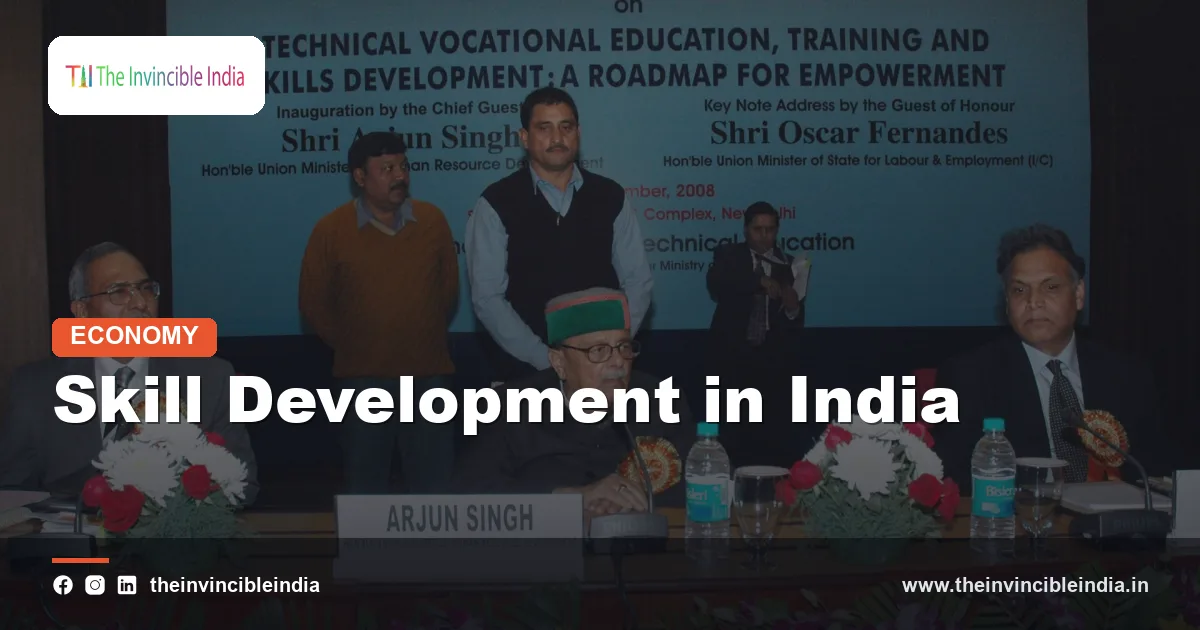
In policy terms, skill development in India is the national effort to train people in job-ready, industry-relevant skills so that the country’s large and young workforce becomes more employable and productive. It is coordinated mainly by the Ministry of Skill Development and Entrepreneurship (MSDE), which was created in 2014, and it is carried out through institutions such as Industrial Training Institutes (ITIs), the National Skill Development Corporation (NSDC) and a network of Sector Skill Councils.
The flagship programme is the Skill India Mission, launched on 15 July 2015, which brought together schemes such as the Pradhan Mantri Kaushal Vikas Yojana (PMKVY), apprenticeship promotion and a common qualification framework. This explainer covers the institutions, schemes, standards and challenges of skill development in India, and why it matters for the economy. Last updated: 12 October 2026.
| Attribute | Detail |
|---|---|
| Nodal ministry | Ministry of Skill Development and Entrepreneurship (MSDE), created in 2014 |
| Flagship mission | Skill India Mission, launched 15 July 2015 |
| Policy document | National Policy for Skill Development and Entrepreneurship, 2015 |
| Public-private body | National Skill Development Corporation (NSDC), set up in 2009 |
| Long-term training network | Industrial Training Institutes (ITIs) under the Craftsmen Training Scheme, begun in 1950 |
| Short-term training scheme | Pradhan Mantri Kaushal Vikas Yojana (PMKVY), launched 2015 |
| Apprenticeship law | Apprentices Act, 1961 (amended several times) |
| Qualification framework | National Skills Qualification Framework (NSQF), with ten levels |
Key Takeaways
- Skill development in India is led by the Ministry of Skill Development and Entrepreneurship, which was set up in 2014 to bring skilling schemes under one ministry.
- The Skill India Mission was launched on 15 July 2015, the same day the first National Policy for Skill Development and Entrepreneurship in the new framework was released.
- The National Skill Development Corporation is a public-private company set up in 2009 to fund and promote private skill-training providers.
- Industrial Training Institutes have offered trade training under the Craftsmen Training Scheme since 1950 and remain the largest long-term vocational training network in India.
- The National Skills Qualification Framework organises qualifications into ten levels based on knowledge, skills and responsibility, so that vocational and academic learning can be compared.
- Only a small share of India’s workforce has received formal skill training, which is a central challenge for realising the country’s demographic dividend.
What is skill development in India?
Skill development in India means building the practical abilities that workers need to find or improve employment, whether in factories, services, construction, agriculture or self-employment. It covers vocational courses, apprenticeships, short-term training, upskilling of existing workers and certification of skills that people have learned on the job.
In India, much work is done in the informal economy, where people learn skills from family members or by working with others rather than in formal classrooms. A major goal of skill policy is therefore to recognise this informal learning, give it a certificate, and connect it with formal pathways for further education and better jobs.
Why does skill development matter for India?
Skill development matters for India because the country has one of the youngest workforces in the world, and the benefit of that demographic profile, called the demographic dividend, depends on how many young people are employable. A large working-age population helps growth only if workers have the skills that employers need.
Three main reasons explain the policy emphasis:
- Demographic dividend: A large share of the population is of working age, and millions of young people enter the labour market each year.
- Employability gap: Employers often report that graduates and job seekers lack workplace skills, even when they have formal degrees.
- Productivity and growth: Better skills raise productivity, wages and the competitiveness of industry, and they help move workers from low-productivity farm work to manufacturing and services.
Skill development also supports inclusion, because training can open paths to earning for women, rural youth, persons with disabilities and workers from disadvantaged communities.
Which ministry and bodies run skill development in India?
The Ministry of Skill Development and Entrepreneurship (MSDE) is the main ministry for skill development in India, and it works with agencies such as the National Skill Development Corporation, the Directorate General of Training and the National Council for Vocational Education and Training. Other ministries, including Education, Rural Development, Labour and Housing and Urban Affairs, also run skilling schemes.
| Body | Role |
|---|---|
| Ministry of Skill Development and Entrepreneurship (MSDE) | Policy, coordination and oversight of skilling schemes |
| National Skill Development Corporation (NSDC) | Funds and supports private training providers; works with industry |
| Directorate General of Training (DGT) | Runs ITIs, the Craftsmen Training Scheme and apprenticeship training |
| Sector Skill Councils (SSCs) | Industry-led bodies that define standards and conduct assessment |
| National Council for Vocational Education and Training (NCVET) | Regulates awarding bodies and qualifications, set up in 2018 |
| State Skill Development Missions | Plan and deliver skilling at the state level |
Because India is a federal country, states also run their own skill missions, polytechnics and training programmes that complement central schemes.
What is the Skill India Mission?
The Skill India Mission is a national campaign launched by the Government of India on 15 July 2015 to train a large number of people in industry-relevant skills and to bring various skilling efforts under a common framework. The date was chosen to coincide with World Youth Skills Day.
The mission has several components: the National Policy for Skill Development and Entrepreneurship, 2015; the Pradhan Mantri Kaushal Vikas Yojana; the National Skill Development Mission; and initiatives on entrepreneurship, apprenticeship and recognition of prior learning. It replaced the earlier National Policy on Skill Development of 2009, which had set out the first major targets for skilling.
Earlier institutions, such as the National Skill Development Agency and the National Skill Development Mission set up in the late 2000s, laid the groundwork. The 2014 creation of a dedicated ministry gave skilling a distinct place in government.
What is the National Skill Development Corporation and what do Sector Skill Councils do?
The National Skill Development Corporation (NSDC) is a not-for-profit public-private company established in 2009 to promote skill development by funding training providers, creating industry partnerships and developing standards. Its structure includes a minority government shareholding alongside a majority private shareholding.
NSDC works closely with Sector Skill Councils (SSCs), which are industry-led bodies for individual sectors such as electronics, automotive, construction, healthcare, retail and information technology. SSCs perform several functions:
- They identify the skills employers need in their sector.
- They define National Occupational Standards and qualification packs, which describe what a worker must be able to do in a particular job role.
- They develop training content and train trainers.
- They assess and certify candidates.
The involvement of industry is intended to make training match actual workplace demand rather than only the supply of courses.
What are ITIs and the Craftsmen Training Scheme?
Industrial Training Institutes (ITIs) are government and private institutions that offer vocational training in trades such as electrician, fitter, welder, mechanic, plumber and computer operator, and the Craftsmen Training Scheme (CTS) is the programme under which they provide this training. The scheme was launched in 1950, and it is among the oldest skilling programmes in India.
ITI courses typically last between six months and two years, and are held after school education. Trainees are tested and awarded the National Trade Certificate, recognised by the National Council for Vocational Training. The Directorate General of Training sets the syllabus and conducts examinations, while states manage most government ITIs.
ITIs face challenges that include ageing equipment, uneven quality, and limited industry connections in some regions. Modernisation schemes have aimed at upgrading the courses and infrastructure of ITIs, improving instructors and linking them with industry partners.
What is the Pradhan Mantri Kaushal Vikas Yojana?
The Pradhan Mantri Kaushal Vikas Yojana (PMKVY) is the central government’s flagship short-term skill training scheme, launched in 2015 to provide free, industry-linked training and certification to young people. It is implemented by the National Skill Development Corporation and training partners.
PMKVY has run in several versions since 2015, each adjusting the design in response to feedback on quality and placement. Its main components are:
- Short-term training: Courses of a few weeks to a few months aligned with National Occupational Standards.
- Recognition of Prior Learning (RPL): Assessment and certification of people who already have skills from work experience but no formal certificate.
- Assessment and certification: Trainees are tested by independent assessors and awarded a recognised certificate.
- Special projects: Training for particular groups or sectors, such as people in hard-to-reach areas.
Evaluations have raised issues with placement rates and with the number of trainees who drop out or remain uncertified, and policy has since stressed quality, tracking and employer engagement.
How do apprenticeships work in India?
Apprenticeships in India combine on-the-job training in a workplace with related classroom instruction, and they are governed by the Apprentices Act, 1961, which was amended in 1973, 1986 and 2014. Employers in covered establishments engage apprentices for a fixed period and pay them a stipend.
The government has promoted apprenticeships through the National Apprenticeship Promotion Scheme (NAPS), launched in 2016, under which the central government shares part of the stipend cost with employers. A separate National Apprenticeship Training Scheme (NATS), run by the education ministry, covers graduate, technician and technician-vocational apprentices.
Compared with countries such as Germany, where apprenticeship is a main pathway into skilled work, apprenticeships in India still account for a limited share of the workforce. Efforts to expand them include simplifying registration, extending the scheme to new trades and encouraging firms of all sizes to participate.
What is the National Skills Qualification Framework?
The National Skills Qualification Framework (NSQF) is a framework that organises all qualifications, academic and vocational, into levels numbered from 1 to 10 according to the knowledge, skills and responsibility they represent. It was notified in 2013 to bring a common national standard to skill training.
The NSQF makes it easier for learners to move between vocational and general education, and for employers to understand what a certificate means. Each level is described by outcomes, such as the complexity of tasks a person can perform and the degree of independence they have.
| NSQF level range | Broad meaning |
|---|---|
| Levels 1 to 4 | Basic and routine tasks, working under supervision, entry-level vocational skills |
| Levels 5 to 6 | Skilled work with some independence, supervisory ability, diploma-level equivalence |
| Levels 7 to 8 | Advanced skills and responsibility, bachelor’s and master’s level equivalence |
| Levels 9 to 10 | Highly specialised expertise, doctoral-level equivalence |
The National Education Policy 2020 further aims to integrate vocational education into mainstream schooling from the middle school stage, so that students are exposed to skills early.
What are the main challenges of skill development in India?
The main challenges of skill development in India are the low share of the workforce with formal training, uneven quality of training, weak links between training and jobs, and the large size of the informal economy. Surveys over the years have shown that only a small percentage of India’s workforce has received formal vocational training, far lower than in many advanced and East Asian economies.
- Quality and relevance: Course content, equipment and trainers do not always match what employers expect.
- Placement and retention: Many trained candidates do not find jobs in their trade, and some dropouts leave before finishing.
- Social perception: Vocational education is often seen as a second choice compared with a degree.
- Informal sector: Most workers are in informal jobs, where formal certificates are not always valued.
- Fragmentation: Many ministries run overlapping schemes, which complicates coordination and measurement.
- Access and inclusion: Women’s participation in the workforce and in training is lower than men’s, and rural and remote areas have fewer training centres.
Responses include digital platforms for training and certification, greater industry involvement, stronger monitoring of outcomes and better integration of vocational courses in schools and colleges.
Bottom Line
Skill development in India is a multi-agency effort anchored by the Ministry of Skill Development and Entrepreneurship, the Skill India Mission and institutions from ITIs to NSDC. Its success will decide whether India turns its young population into a productive workforce, and the key tests are quality, relevance and jobs after training.
Frequently Asked Questions
What is skill development in India?
Skill development in India is the national effort to train people in practical, job-ready skills so they can find work or become self-employed. It includes ITIs, short-term courses, apprenticeships and certification of existing skills. The Ministry of Skill Development and Entrepreneurship leads the effort.
When was the Skill India Mission launched?
The Skill India Mission was launched on 15 July 2015, which is also celebrated as World Youth Skills Day. It brought together skilling schemes, including the Pradhan Mantri Kaushal Vikas Yojana, under a common framework. The Ministry of Skill Development and Entrepreneurship had been created the year before, in 2014.
What does NSDC do?
The National Skill Development Corporation is a public-private company, set up in 2009, that promotes skill development by funding and supporting training providers. It works with Sector Skill Councils to set standards and certify trainees. It also implements parts of PMKVY.
What is PMKVY?
PMKVY, or the Pradhan Mantri Kaushal Vikas Yojana, is the central government’s flagship short-term skill training scheme, launched in 2015. It offers industry-aligned training, assessment and certification, including recognition of prior learning for people who already have skills. It has run in several versions with changes to improve quality and placement.
What is the difference between ITIs and apprenticeships?
ITIs provide classroom and workshop training in trades under the Craftsmen Training Scheme, while apprenticeships combine on-the-job training in a workplace with related instruction and a stipend. ITIs are mainly institutional, whereas apprenticeships are employer-based. Many ITI graduates later enter apprenticeships under the Apprentices Act, 1961.
What is the National Skills Qualification Framework?
The National Skills Qualification Framework is a system that places all qualifications on a ten-level scale according to knowledge, skills and responsibility. It was notified in 2013 so that vocational and academic qualifications could be compared and learners could move between them. It helps employers understand the meaning of a certificate.
{“@context”:”https://schema.org”,”@graph”:[{“@type”:”FAQPage”,”mainEntity”:[{“@type”:”Question”,”name”:”What is skill development in India?”,”acceptedAnswer”:{“@type”:”Answer”,”text”:”Skill development in India is the national effort to train people in practical, job-ready skills so they can find work or become self-employed. It includes ITIs, short-term courses, apprenticeships and certification of existing skills. The Ministry of Skill Development and Entrepreneurship leads the effort.”}},{“@type”:”Question”,”name”:”When was the Skill India Mission launched?”,”acceptedAnswer”:{“@type”:”Answer”,”text”:”The Skill India Mission was launched on 15 July 2015, which is also celebrated as World Youth Skills Day. It brought together skilling schemes, including the Pradhan Mantri Kaushal Vikas Yojana, under a common framework. The Ministry of Skill Development and Entrepreneurship had been created the year before, in 2014.”}},{“@type”:”Question”,”name”:”What does NSDC do?”,”acceptedAnswer”:{“@type”:”Answer”,”text”:”The National Skill Development Corporation is a public-private company, set up in 2009, that promotes skill development by funding and supporting training providers. It works with Sector Skill Councils to set standards and certify trainees. It also implements parts of PMKVY.”}},{“@type”:”Question”,”name”:”What is PMKVY?”,”acceptedAnswer”:{“@type”:”Answer”,”text”:”PMKVY, or the Pradhan Mantri Kaushal Vikas Yojana, is the central government’s flagship short-term skill training scheme, launched in 2015. It offers industry-aligned training, assessment and certification, including recognition of prior learning for people who already have skills. It has run in several versions with changes to improve quality and placement.”}},{“@type”:”Question”,”name”:”What is the difference between ITIs and apprenticeships?”,”acceptedAnswer”:{“@type”:”Answer”,”text”:”ITIs provide classroom and workshop training in trades under the Craftsmen Training Scheme, while apprenticeships combine on-the-job training in a workplace with related instruction and a stipend. ITIs are mainly institutional, whereas apprenticeships are employer-based. Many ITI graduates later enter apprenticeships under the Apprentices Act, 1961.”}},{“@type”:”Question”,”name”:”What is the National Skills Qualification Framework?”,”acceptedAnswer”:{“@type”:”Answer”,”text”:”The National Skills Qualification Framework is a system that places all qualifications on a ten-level scale according to knowledge, skills and responsibility. It was notified in 2013 so that vocational and academic qualifications could be compared and learners could move between them. It helps employers understand the meaning of a certificate.”}}]}]}


