

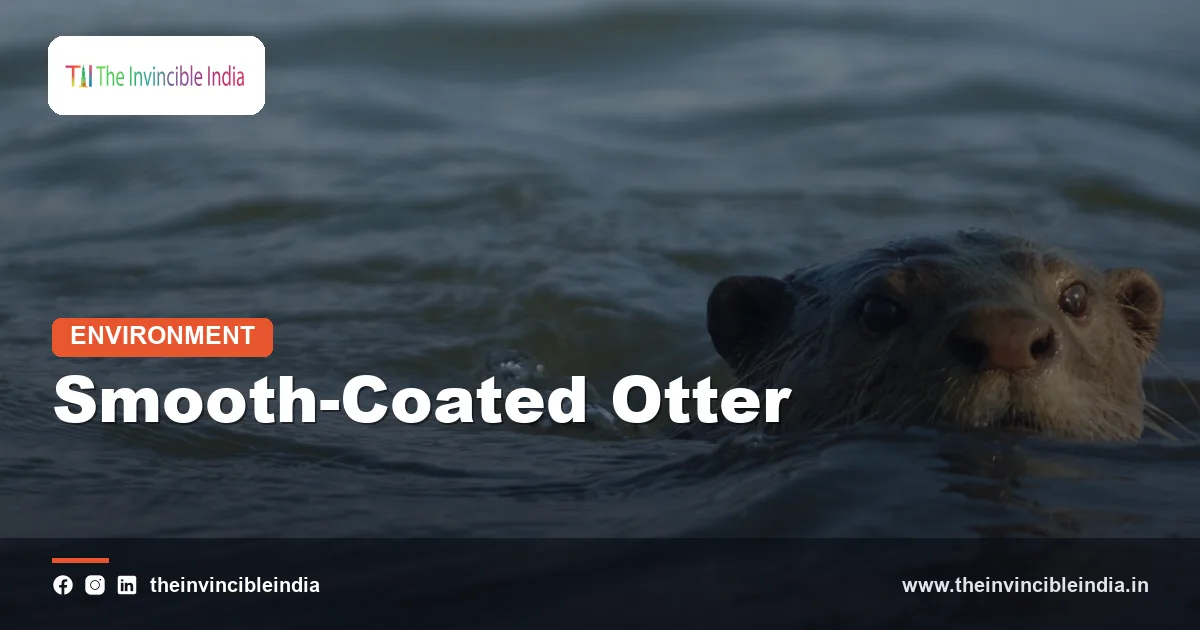
The smooth-coated otter (Lutrogale perspicillata) is the largest otter found in India, a sociable, fish-eating freshwater and coastal mammal that lives in rivers, wetlands, lagoons and mangroves and is classified as Vulnerable by the International Union for Conservation of Nature (IUCN). Because the smooth-coated otter sits at the top of aquatic food chains and depends on clean water, abundant fish and undisturbed banks, its presence is widely treated as a sign of a healthy river or wetland.
Smooth-coated otter conservation in India is therefore as much about protecting water systems as it is about protecting one species. This explainer covers what the animal is, where it lives, how its family groups work, what threatens it, how Indian law protects it, and which landscapes, including Chilika lagoon, matter most.
Quick Facts
| Attribute | Detail |
|---|---|
| Common name | Smooth-coated otter (also called Indian smooth-coated otter) |
| Scientific name | Lutrogale perspicillata |
| Family | Mustelidae (the weasel family) |
| Body size | Roughly 1.1 to 1.3 metres from nose to tail tip; adults commonly weigh around 7 to 11 kilograms |
| Habitat | Large rivers, freshwater wetlands, lagoons, estuaries, paddy fields and mangrove creeks |
| Social structure | Family groups, often of several animals and sometimes more than ten |
| IUCN status | Vulnerable |
| International trade control | Listed on Appendix I of CITES since 2019 |
| Legal protection in India | Wildlife (Protection) Act, 1972, with hunting, capture and trade prohibited |
Key Takeaways
- The smooth-coated otter is the largest of the three otter species found in India and is named for its short, sleek, velvety fur.
- Smooth-coated otters live in cooperative family groups whose members hunt, groom, play and raise pups together.
- The smooth-coated otter is an indicator species, meaning its health reflects the condition of the river, wetland or mangrove it lives in.
- Wetland loss, water pollution, sand mining, fishing conflict and the illegal fur trade are the main threats to the smooth-coated otter in India.
- The smooth-coated otter is classified as Vulnerable by the IUCN, and international commercial trade in the species is restricted under CITES Appendix I.
- Chilika lagoon in Odisha, the Sundarbans and Bhitarkanika mangroves, the Chambal and Ganga river systems, and rivers of the Western Ghats are important strongholds for the smooth-coated otter.
What is the smooth-coated otter?
The smooth-coated otter is a semi-aquatic carnivore in the weasel family that is built for fast swimming and fish hunting. Its body is long and muscular, its head is rounded and flattened, and its tail is thick at the base and flattened from top to bottom, working like a rudder and a paddle. The short, dense fur is usually dark brown on the back and paler on the throat and belly, and it traps a layer of air that keeps the animal warm and buoyant.
The common name refers to that fur, which lies flatter and looks sleeker than the shaggier coat of the Eurasian otter. The species also has a hairless, flattened nose pad shaped like a wide, flat triangle, fully webbed feet with strong claws, and sensitive whiskers called vibrissae that detect movement in muddy or dark water.
How does the smooth-coated otter differ from other Indian otters?
The smooth-coated otter differs from other Indian otters mainly in size, fur and preferred habitat. India is home to three otter species, and each occupies a somewhat different niche.
| Species | Scientific name | Typical habitat in India | Notable feature |
|---|---|---|---|
| Smooth-coated otter | Lutrogale perspicillata | Large rivers, plains wetlands, lagoons, mangroves | Largest Indian otter; flat rudder-like tail; sleek short fur |
| Eurasian otter | Lutra lutra | Hill streams and rivers in the Himalaya, Western Ghats and parts of the south | Shaggier coat; prefers cold, clear, fast-flowing water |
| Asian small-clawed otter | Aonyx cinereus | Forest streams, marshes and paddy fields in the Himalayan foothills, Northeast, and parts of the Ghats | Smallest otter in the world; reduced claws and dexterous fingers for handling shellfish |
The Asian small-clawed otter is also listed as Vulnerable by the IUCN, while the Eurasian otter is assessed as Near Threatened globally. All three depend on healthy freshwater habitat, so measures that help one species, such as clean rivers and intact banks, usually help the others.
Where does the smooth-coated otter live in India?
The smooth-coated otter lives across much of peninsular and northern India wherever permanent water, fish and bankside cover occur together. Its range stretches from the Indus and Ganga plains through the Western Ghats and the east-coast rivers to the Brahmaputra valley and the Northeast, and the species also occurs elsewhere in South and Southeast Asia.
The animal is flexible about the type of water body. Smooth-coated otters use large, slow lowland rivers, reservoirs, village ponds, irrigation canals, flooded paddy fields, brackish lagoons and tidal mangrove creeks. What they need is a reliable supply of fish, a place to rest, and quiet banks or islands for dens.
What is a holt, and why do otters need one?
A holt is an otter den, usually dug into an earthen riverbank, hidden among tree roots, or tucked into dense reeds and rock crevices. Smooth-coated otters use holts for resting and for giving birth. A holt typically has an entrance close to the waterline, so the animals can slip in and out unseen.
Holts are a key reason riverbank condition matters. When banks are cleared, cemented, grazed bare or dug away, otters lose safe places to rear pups even when fish remain plentiful.
How do smooth-coated otters live and hunt?
Smooth-coated otters live and hunt in tightly bonded family groups that cooperate in the water. A typical group is built around a breeding pair and their offspring from several litters, and group sizes of around four to eight are common, with larger gatherings recorded in some wetlands.
Group life brings real benefits. Members herd fish into shallows, take turns watching for danger, and help guard young pups. Older siblings sometimes act as helpers, which makes the smooth-coated otter one of the more strongly cooperative members of its family.
What do smooth-coated otters eat?
The smooth-coated otter eats mainly fish, supplemented by crabs, prawns, frogs, insects and, occasionally, small birds or rodents. It tends to take the fish that are most abundant and easiest to catch, which means it often feeds on common species rather than rare ones.
An adult needs a substantial amount of food every day, so a group can only persist where fish stocks are healthy. This direct dependence on fish is why overfishing, poisoning and drainage show up quickly in otter numbers.
How do smooth-coated otters communicate?
Smooth-coated otters communicate with a mix of calls and scent. They use chirps, whistles, chatters and loud alarm calls to keep the group together, and they mark territory with droppings called spraint and with scent from glands. Researchers use spraint surveys, along with tracks and camera traps, to detect otters without disturbing them.
Why is the smooth-coated otter an indicator of water health?
The smooth-coated otter is an indicator of water health because it needs clean water, plentiful fish and intact riverbank habitat all at the same time. As a top predator, it also accumulates pollutants through the food chain, so contaminated waters affect it more strongly than they affect animals lower down.
When otters thrive in a stretch of river, that is a strong sign that fish stocks are intact, that banks have cover, and that the water is not heavily polluted. When otters vanish from a place where they were once common, the cause is often a combination of disturbance, toxic runoff or fish decline that also harms people who rely on the same water.
Otters also function as an umbrella of sorts. Protecting enough river, bank and floodplain for a family group to live in preserves habitat for many fish, birds, turtles and plants that share the same system.
What threatens the smooth-coated otter in India?
The smooth-coated otter in India is threatened mainly by the loss and degradation of wetlands, water pollution, sand and stone mining, conflict with fishers, and poaching for its skin. These pressures often act together.
- Wetland and riverbank loss: Marshes are drained for farming and construction, banks are hardened or cleared, and mangroves are cut. Each change removes feeding grounds and holts.
- Pollution: Industrial effluent, pesticide and fertiliser runoff, and untreated sewage reduce fish stocks and expose otters to toxins that build up in their bodies.
- Sand mining and dams: Digging sand from riverbeds and banks destroys dens and disturbs the animals, while dams and barrages break river continuity and change fish movement.
- Fishing conflict: Otters sometimes damage nets or take fish from ponds and traps. Angry fishers may retaliate by killing otters, trapping them or poisoning water, and otters can also drown in fishing gear.
- Illegal fur and body-part trade: Otter skins have long been traded illegally, and live young are sometimes captured for the pet trade.
- Road deaths and disturbance: Otters crossing roads between water bodies can be killed by vehicles, and heavy boat traffic or tourism near dens can drive groups away.
Why was the smooth-coated otter traded, and is the fur trade still a threat?
The smooth-coated otter was traded because its dense, water-resistant pelt has commercial value, and illegal trade in skins remains a recognised threat across Asia. Seizures of otter skins in the region over past decades pointed to organised trade routes through which pelts moved across borders.
That trade is a major reason the species was moved up to CITES Appendix I in 2019, which generally prohibits international commercial trade. In India, domestic hunting and trade are banned under the wildlife law, so enforcement, border cooperation and awareness among rural communities are the main tools against it.
How does Indian law protect the smooth-coated otter?
Indian law protects the smooth-coated otter mainly through the Wildlife (Protection) Act, 1972, which bans hunting, capture, and trade in scheduled species and allows habitat to be secured as sanctuaries, national parks and conservation reserves. Otters sit among the strictly protected animals in the Act’s schedules, and penalties for hunting and trafficking can include imprisonment and fines.
India is also a party to CITES, so international commercial trade in the species is restricted. Additional protection comes from laws that safeguard habitat, such as rules governing wetlands, coastal regulation zones and the Environment (Protection) Act, 1986, along with state fisheries and mining regulations that affect the rivers where otters live.
Law alone is not enough. Many otters live outside protected areas, in village ponds and river stretches that no sanctuary covers, so practical protection depends on how well local authorities regulate sand mining, pollution and fishing methods.
Which places are strongholds for the smooth-coated otter?
Strongholds for the smooth-coated otter in India are large, well-connected wetland and river systems with plentiful fish and limited disturbance. Several landscapes stand out.
| Landscape | State or region | Why it matters for otters |
|---|---|---|
| Chilika lagoon | Odisha | One of Asia’s largest brackish-water lagoons, with rich fish stocks, reed beds and islands that support otters |
| Bhitarkanika mangroves | Odisha | Tidal creeks and dense mangroves provide food and den cover |
| Sundarbans | West Bengal | A vast mangrove delta shared with Bangladesh where otters traditionally share waters with fishers |
| Chambal and Ganga river stretches | Madhya Pradesh, Uttar Pradesh, Rajasthan, Bihar | Long, relatively clean river sections protected as sanctuaries in parts |
| Rivers and backwaters of the Western Ghats | Kerala, Karnataka, Tamil Nadu, Goa, Maharashtra | Forest-fed streams and reservoirs support smooth-coated, Eurasian and small-clawed otters |
| Brahmaputra floodplain and Northeast wetlands | Assam and neighbouring states | Large rivers, beels and swamps give shelter to otters among other wetland wildlife |
What makes Chilika lagoon important for otter conservation?
Chilika lagoon in Odisha is important for otter conservation because it is a large, productive brackish-water ecosystem where smooth-coated otters find abundant fish, reed cover and quiet islands. The lagoon is a Ramsar Site, recognised internationally as a wetland of importance, and it is best known for its migratory birds and for its Irrawaddy dolphins.
Chilika also shows the tension between wildlife and livelihoods. Hundreds of thousands of people depend on the lagoon for fishing, so conservation there works best when it supports sustainable fishing rather than opposing it. Otters in such a setting are valuable partly because they signal that the lagoon’s fish nursery function is still intact.
How are smooth-coated otters being conserved in India?
Smooth-coated otters in India are being conserved through habitat protection, scientific monitoring, community engagement and law enforcement. Because the species is widespread but patchy, effective work tends to be local and river-specific rather than a single national programme.
- Protected wetlands and river sanctuaries: Sanctuaries, Ramsar Sites and national parks secure core habitat and limit disturbance.
- Population surveys and monitoring: Field teams use spraint counts, track surveys and camera traps, and universities and wildlife institutes have been improving baseline data for rivers and wetlands.
- Community-based stewardship: In several regions, forest departments and conservation groups work with fishing communities on guidelines that reduce net damage and avoid retaliation.
- Rescue and rehabilitation: Orphaned pups and injured animals are rescued and, where possible, returned to the wild.
- Better river management: Reducing pollution, regulating sand mining, protecting riparian vegetation and restoring wetlands all help otters indirectly.
Because smooth-coated otters are charismatic and photogenic, they have become a useful flagship for wetland conservation. Public interest in a playful family of otters can help build support for protecting an entire river stretch.
How can ordinary people help smooth-coated otters?
Ordinary people can help smooth-coated otters by keeping rivers and ponds clean, avoiding disturbance at den sites, and reporting suspected poaching or trapping to the forest department. Small choices add up along a river that many families share.
- Avoid dumping waste, chemicals or plastic in rivers, ponds and canals.
- Do not feed, handle or keep wild otter pups as pets, because it is illegal and often fatal for the animal.
- Keep dogs, boats and noisy groups away from riverbank dens, especially in the breeding season.
- Support sustainable, locally managed fishing that does not rely on poisons, explosives or fine-mesh nets.
- Share sightings through reputable citizen-science platforms so researchers can map where otters still live.
Bottom Line
Smooth-coated otter conservation in India depends on keeping rivers, wetlands, lagoons and mangroves clean, connected and well managed. The species is widespread but Vulnerable, and its fate is tied to fish, water quality and riverbank habitat that people also depend on. Protecting otters is a practical way to protect healthy water.
Frequently Asked Questions
Is the smooth-coated otter endangered in India?
The smooth-coated otter is not classified as Endangered, but it is listed as Vulnerable by the IUCN, which means it faces a high risk of decline in the wild. In India it is widespread but patchy, and local populations have disappeared where wetlands were drained or polluted.
How big is a smooth-coated otter?
A smooth-coated otter is about 1.1 to 1.3 metres long including its tail and commonly weighs around 7 to 11 kilograms. It is the largest otter species in India and is noticeably heavier than the Asian small-clawed otter.
What do smooth-coated otters eat?
Smooth-coated otters eat mainly fish, along with crabs, prawns, frogs and other small animals. They often hunt cooperatively, with group members herding fish into shallow water.
Why is the smooth-coated otter called an indicator species?
The smooth-coated otter is called an indicator species because it only thrives where water is relatively clean and fish are plentiful. As a top predator it also accumulates pollutants, so its decline can warn of wider problems in a river or wetland.
Where can smooth-coated otters be seen in India?
Smooth-coated otters can be seen in places such as Chilika lagoon, the Sundarbans and Bhitarkanika mangroves, stretches of the Chambal and Ganga, and rivers and reservoirs of the Western Ghats. Sightings are never guaranteed, and the best chances come from quiet boat trips at dawn or dusk with an experienced local guide.
Is it legal to keep an otter as a pet in India?
No, keeping an otter as a pet is not legal in India, because otters are protected wild animals under the Wildlife (Protection) Act, 1972. Capturing, buying or selling an otter can lead to prosecution, and any pup found alone should be reported to the forest department rather than taken home.
{“@context”:”https://schema.org”,”@graph”:[{“@type”:”FAQPage”,”mainEntity”:[{“@type”:”Question”,”name”:”Is the smooth-coated otter endangered in India?”,”acceptedAnswer”:{“@type”:”Answer”,”text”:”The smooth-coated otter is not classified as Endangered, but it is listed as Vulnerable by the IUCN, which means it faces a high risk of decline in the wild. In India it is widespread but patchy, and local populations have disappeared where wetlands were drained or polluted.”}},{“@type”:”Question”,”name”:”How big is a smooth-coated otter?”,”acceptedAnswer”:{“@type”:”Answer”,”text”:”A smooth-coated otter is about 1.1 to 1.3 metres long including its tail and commonly weighs around 7 to 11 kilograms. It is the largest otter species in India and is noticeably heavier than the Asian small-clawed otter.”}},{“@type”:”Question”,”name”:”What do smooth-coated otters eat?”,”acceptedAnswer”:{“@type”:”Answer”,”text”:”Smooth-coated otters eat mainly fish, along with crabs, prawns, frogs and other small animals. They often hunt cooperatively, with group members herding fish into shallow water.”}},{“@type”:”Question”,”name”:”Why is the smooth-coated otter called an indicator species?”,”acceptedAnswer”:{“@type”:”Answer”,”text”:”The smooth-coated otter is called an indicator species because it only thrives where water is relatively clean and fish are plentiful. As a top predator it also accumulates pollutants, so its decline can warn of wider problems in a river or wetland.”}},{“@type”:”Question”,”name”:”Where can smooth-coated otters be seen in India?”,”acceptedAnswer”:{“@type”:”Answer”,”text”:”Smooth-coated otters can be seen in places such as Chilika lagoon, the Sundarbans and Bhitarkanika mangroves, stretches of the Chambal and Ganga, and rivers and reservoirs of the Western Ghats. Sightings are never guaranteed, and the best chances come from quiet boat trips at dawn or dusk with an experienced local guide.”}},{“@type”:”Question”,”name”:”Is it legal to keep an otter as a pet in India?”,”acceptedAnswer”:{“@type”:”Answer”,”text”:”No, keeping an otter as a pet is not legal in India, because otters are protected wild animals under the Wildlife (Protection) Act, 1972. Capturing, buying or selling an otter can lead to prosecution, and any pup found alone should be reported to the forest department rather than taken home.”}}]}]}


