

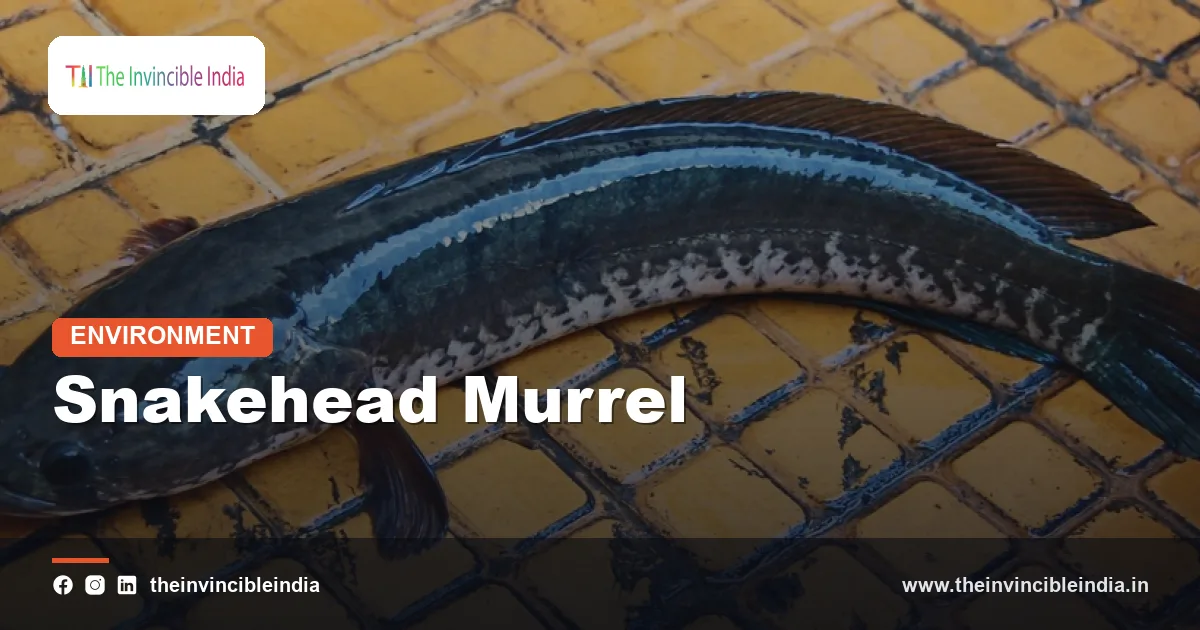
The snakehead murrel is a hardy, air-breathing, predatory freshwater fish of the family Channidae, known in India as murrel and belonging to the genus Channa, prized as food and notable for surviving in poorly oxygenated water and even wriggling across damp ground. Several native Indian species, including the striped snakehead (Channa striata), the giant snakehead (Channa marulius) and the spotted snakehead (Channa punctata), are grouped under the common name murrel.
The snakehead murrel is found in ponds, paddy fields, swamps, canals, rivers and reservoirs across the country, and it is valued in regional cuisines and in traditional beliefs about recovery and health. This explainer covers how to recognise the fish, how its air-breathing works, what it eats, how it raises its young, how it is cultured and what threatens it.
| Attribute | Detail |
|---|---|
| Family and genus | Channidae, genus Channa (the snakeheads) |
| Common Indian species | Striped snakehead (Channa striata), giant snakehead (Channa marulius), spotted snakehead (Channa punctata), dwarf snakehead (Channa gachua) |
| Common names | Murrel; shol or shol mach (Bengali); saur or soal (Hindi); varaal (Malayalam); korramenu (Telugu) |
| Breathing | Gills plus an air-breathing chamber above the gills |
| Diet | Carnivorous: fish, frogs, crustaceans and insects |
| Habitat | Ponds, wetlands, paddy fields, canals, slow rivers, reservoirs |
| Parental care | Both parents typically guard eggs and young in many species |
| Culinary status | Premium freshwater fish in many parts of India |
| Notable survival trait | Can tolerate low oxygen, and can survive out of water for some time if kept moist |
Key Takeaways
- The snakehead murrel is a group of predatory freshwater fish of the genus Channa that breathe both with gills and with an air-breathing organ above the gills.
- The snakehead murrel can survive in stagnant, oxygen-poor water and can endure out-of-water spells if its skin and breathing chamber remain moist.
- The snakehead murrel has a long, torpedo-shaped body, a flattened head with large scales and a long dorsal fin, which together give it a snake-like look.
- The snakehead murrel is carnivorous and feeds mainly on smaller fish, frogs, crustaceans and insects, making it an apex predator in many small water bodies.
- The snakehead murrel is prized as a premium food fish in much of India and is the focus of growing aquaculture research.
- The snakehead murrel found in India is native, and it should not be confused with the northern snakehead (Channa argus), which has become an invasive pest in parts of the United States.
What is the snakehead murrel?
The snakehead murrel is a freshwater predatory fish of the genus Channa, family Channidae, called murrel in India and snakehead in English because its flattened head and scaly crown resemble those of a snake. The family includes species in Africa and Asia, and India has a rich selection of them.
Species widely seen in India include the striped snakehead or common murrel (Channa striata), the giant snakehead (Channa marulius), the spotted snakehead (Channa punctata) and the small, hill-stream dwarf snakehead (Channa gachua). In addition to these, there are a number of lesser-known species, some of them restricted to particular regions such as the Western Ghats or the north-east, so the group as a whole contains roughly a dozen or more Indian species.
In Indian languages the fish has many names. In Bengal it is shol (striata) or gajar (marulius), in Hindi-speaking areas it is called saur or soal, and in Kerala varaal is a familiar term. Regional names can be applied to more than one species, so they should be treated as approximate.
What does a snakehead murrel look like?
A snakehead murrel has a long, almost cylindrical body, a broad head flattened on top and covered in large scale-like plates, a large mouth with sharp teeth and a long continuous dorsal fin running most of the length of the back. The shape and head give the fish its snake-like appearance.
- Body: elongated and muscular; colouring ranges from olive and brown to dark grey, often with darker blotches or bands along the sides.
- Fins: a long dorsal fin and anal fin, with no spines, and rounded tail fin.
- Mouth: large, extending back past the eyes, lined with strong teeth for gripping prey.
- Size: the dwarf snakehead is only a few centimetres to about 20 cm; the striped snakehead often grows to 50 cm or so; the giant snakehead can exceed a metre in length in large rivers and reservoirs.
Juveniles of several species look quite different from adults, often showing bright orange or reddish colour with dark stripes, which makes identification of small specimens tricky.
How does the snakehead murrel breathe air?
The snakehead murrel breathes air through a specialised air-breathing chamber, called the suprabranchial chamber, located above the gills, which is lined with a thin, richly supplied respiratory membrane. The fish rises to the surface, gulps air into this chamber and absorbs oxygen directly into the blood, supplementing the oxygen it takes from the water with its gills.
This adaptation allows the snakehead murrel to live in stagnant ponds, swamps and paddy fields where dissolved oxygen is very low, conditions in which many carps would die. Adult fish of many species are in fact obligate air-breathers, meaning they must reach the surface periodically or they will drown, even in well-oxygenated water.
The fish can also survive short periods out of water, provided its skin and breathing chamber stay damp. During droughts, some species burrow into soft mud and remain dormant until the rains return. Their ability to wriggle across wet ground, especially at night and after rain, lets them move between water bodies, an ability that has contributed to folk stories of “fish that walk”.
What does the snakehead murrel eat?
The snakehead murrel is a carnivore that eats mainly smaller fish, frogs, tadpoles, crustaceans such as prawns and crabs, and aquatic insects. It lies in wait among vegetation and strikes suddenly, gripping prey with its sharp teeth and swallowing it whole.
Young murrels feed on zooplankton, insect larvae and tiny crustaceans, shifting to fish and larger prey as they grow. Because it eats so many other fish, the snakehead murrel can seriously reduce the stock of carp fingerlings in a pond, which is why fish farmers usually keep it out of carp ponds. It is an effective predator, and in natural wetlands it occupies a position near the top of the food web.
Feeding is greatest in warm weather and lessens in the cooler months. In captivity, murrels can be trained to accept pellet feed, though many farms still depend on low-value trash fish as feed, which raises questions of cost and sustainability.
How does the snakehead murrel breed and care for its young?
The snakehead murrel typically breeds in the monsoon and warmer months, with the parents building or preparing a nest in vegetation, laying floating or adhesive eggs and guarding the eggs and the young fry. Parental care is a notable feature of the family, and in many species both the male and the female protect the brood.
- Nesting: some species clear a circular space among aquatic plants or build a floating nest of vegetation.
- Eggs: a clutch can run to several thousand eggs, depending on the size of the female.
- Guarding: parents patrol the nest and stay with the fry for weeks, driving off intruders.
- Fry: young murrels swim in tight schools beneath a guarding parent.
This strong parental behaviour helps survival of the young but makes the fish vulnerable to capture during the breeding season, because guarding fish do not flee readily. Some fisheries regulations and community practices therefore recommend avoiding fishing for murrel during the monsoon breeding period.
Where is the snakehead murrel found in India?
The snakehead murrel is found across most of India in ponds, tanks, lakes, swamps, irrigation canals, paddy fields and slow-flowing rivers, with different species favouring different habitats. It is widely distributed in the plains of the Gangetic region, the Deccan and the peninsular south, and the north-east harbours several special species.
| Species | Typical habitat | Notes |
|---|---|---|
| Striped snakehead (Channa striata) | Ponds, paddy fields, swamps, slow rivers | Most widespread and commercially important murrel; tolerates poor water quality |
| Giant snakehead (Channa marulius) | Large rivers, reservoirs, lakes | Grows to over a metre and is a prized angling fish |
| Spotted snakehead (Channa punctata) | Small ponds, ditches, paddy fields | Smaller; often sold in local markets |
| Dwarf snakehead (Channa gachua) | Hill streams and small clear waters | Small, attractive species found in the north-east and the south |
Their tolerance of low oxygen and their ability to survive in shallow, weedy water make murrels some of the last fish to remain when a seasonal pond shrinks. They are also frequent finds in newly flooded paddy fields during the monsoon.
Why is the snakehead murrel valued as food?
The snakehead murrel is valued as food because its flesh is firm, has relatively few fine bones compared with carps and is regarded in many Indian regions as tasty and nutritious. It commands a higher price per kilogram than most common carps in many markets.
In several communities the fish is also believed to speed up recovery after illness, surgery or childbirth, and it is traditionally eaten for strength. Some research on snakeheads in Southeast Asia has examined high levels of albumin and certain amino acids in their flesh, but the strength of the clinical evidence is still limited, so such claims are best described as traditional beliefs.
- It is sold live in many Indian markets, where buyers prefer fish that are freshly caught.
- It is cooked in curries, fried or steamed in regional recipes, with spices and tamarind or mustard depending on the state.
- Larger giant snakeheads are valued for thick steaks, and small murrels are eaten whole.
Can the snakehead murrel be farmed?
Yes, the snakehead murrel can be farmed, and its culture is a growing area of interest in India because of its high market price, its air-breathing ability and its tolerance of crowded, low-oxygen conditions. However, farming it successfully requires careful management of seed supply, feed and its predatory behaviour.
Researchers at Indian institutions have worked on breeding murrels in captivity and on developing formulated feeds. Murrel culture is reported from states including Andhra Pradesh, Tamil Nadu, West Bengal and Kerala, but production volumes remain far smaller than those of carps, and the scale of the sector is hard to state exactly.
Challenges in murrel culture
- Seed availability: reliable hatchery production of fingerlings is still developing, and many farmers depend on wild-collected seed.
- Cannibalism: young murrels eat smaller siblings, so fish must be graded by size.
- Feed: the carnivorous diet raises feed costs, and trash fish feeding can pollute ponds.
- Escape: fish can leave ponds across wet ground, so banks and nets must be secured.
Is the snakehead murrel an invasive species?
The snakehead murrel found in India is a native species and is not considered invasive there, but other snakeheads such as the northern snakehead (Channa argus) have become invasive pests in parts of the United States and elsewhere. The difference between native and introduced settings explains why the same group of fish is a cherished food fish in one region and a regulated ecological threat in another.
In the United States, several snakehead species are listed under injurious wildlife regulations, which restrict their import and transport, because they can outcompete native fish. In India the concern is in the opposite direction. Wild murrel stocks are reduced by habitat loss, drainage of wetlands, pollution, pesticide use in paddy fields and over-fishing. Some lesser-known Indian snakeheads with small ranges, such as species in the Western Ghats and the north-east, are of conservation concern, and a few have been rediscovered after being thought lost for a long time.
The giant snakehead is generally assessed as Least Concern globally, but local declines are reported, and protecting wetlands and breeding seasons is important for the long-term supply of all murrels.
How can you tell a snakehead murrel from a snake or an eel?
A snakehead murrel can be told apart from a snake or an eel by its fins, gills and scales: murrels have a true dorsal fin and an anal fin, gill covers, scales and paired pectoral fins, none of which a snake has. Eels have a similar elongated shape but lack the scale-covered, flattened head and the large toothy mouth of a murrel.
- Murrel versus snake: a snake has no fins and no gill covers, and it has a forked tongue and a scaly, limbless body that ends in a tail.
- Murrel versus eel: most eels have a continuous fin around the tail and slimy, almost scaleless skin, and they lack the rounded tail fin of the murrel.
- Murrel versus catfish: catfish have whisker-like barbels around the mouth, which murrels never have.
Anglers, fishers and curious visitors to ponds often confuse the species at first glance, especially when a murrel is seen basking near the surface or moving across damp ground. A quick look for fins and a rounded tail settles the question.
Bottom Line
The snakehead murrel is a native Indian predator that breathes air, tolerates harsh pond conditions and is prized as a premium food fish. Its hardiness, parental care and market value make it both ecologically fascinating and economically promising, but wild stocks need wetland protection and responsible fishing.
Frequently Asked Questions
What is a snakehead murrel?
A snakehead murrel is a predatory freshwater fish of the genus Channa, known in India as murrel, with a long body and a flattened, snake-like head. It breathes both through gills and through an air-breathing chamber. Common Indian species include the striped, giant and spotted snakeheads.
Can a snakehead murrel live out of water?
Yes, a snakehead murrel can survive out of water for some time because it can breathe air, provided its skin and breathing chamber stay moist. It can also wriggle over damp ground to reach other water bodies. Prolonged dry exposure is still fatal.
Is murrel fish good to eat?
Yes, murrel is a popular and premium food fish in many parts of India, valued for its firm flesh and fewer fine bones than carps. It is often eaten in curries and is traditionally believed to aid recovery after illness. Scientific proof of such health claims is limited.
What does a snakehead murrel eat?
A snakehead murrel eats mainly smaller fish, frogs, crustaceans and insects, which it ambushes and swallows whole. Young fish feed on zooplankton and insect larvae. Because it preys on other fish, it is not suitable for stocking with carp fingerlings.
Is the Indian snakehead murrel the same as the invasive snakehead in the United States?
No, the Indian murrel species such as Channa striata and Channa marulius are native fish in India, whereas the invasive fish in the United States is mainly the northern snakehead (Channa argus). They belong to the same genus but are different species. Indian murrels are not considered invasive in India.
Can snakehead murrel be farmed in India?
Yes, snakehead murrel can be farmed in India and has attracted interest for its high market price and tolerance of low oxygen. Challenges include limited hatchery seed, cannibalism among young fish and the cost of carnivorous feed. Production is still much smaller than that of carps.
{“@context”:”https://schema.org”,”@graph”:[{“@type”:”FAQPage”,”mainEntity”:[{“@type”:”Question”,”name”:”What is a snakehead murrel?”,”acceptedAnswer”:{“@type”:”Answer”,”text”:”A snakehead murrel is a predatory freshwater fish of the genus Channa, known in India as murrel, with a long body and a flattened, snake-like head. It breathes both through gills and through an air-breathing chamber. Common Indian species include the striped, giant and spotted snakeheads.”}},{“@type”:”Question”,”name”:”Can a snakehead murrel live out of water?”,”acceptedAnswer”:{“@type”:”Answer”,”text”:”Yes, a snakehead murrel can survive out of water for some time because it can breathe air, provided its skin and breathing chamber stay moist. It can also wriggle over damp ground to reach other water bodies. Prolonged dry exposure is still fatal.”}},{“@type”:”Question”,”name”:”Is murrel fish good to eat?”,”acceptedAnswer”:{“@type”:”Answer”,”text”:”Yes, murrel is a popular and premium food fish in many parts of India, valued for its firm flesh and fewer fine bones than carps. It is often eaten in curries and is traditionally believed to aid recovery after illness. Scientific proof of such health claims is limited.”}},{“@type”:”Question”,”name”:”What does a snakehead murrel eat?”,”acceptedAnswer”:{“@type”:”Answer”,”text”:”A snakehead murrel eats mainly smaller fish, frogs, crustaceans and insects, which it ambushes and swallows whole. Young fish feed on zooplankton and insect larvae. Because it preys on other fish, it is not suitable for stocking with carp fingerlings.”}},{“@type”:”Question”,”name”:”Is the Indian snakehead murrel the same as the invasive snakehead in the United States?”,”acceptedAnswer”:{“@type”:”Answer”,”text”:”No, the Indian murrel species such as Channa striata and Channa marulius are native fish in India, whereas the invasive fish in the United States is mainly the northern snakehead (Channa argus). They belong to the same genus but are different species. Indian murrels are not considered invasive in India.”}},{“@type”:”Question”,”name”:”Can snakehead murrel be farmed in India?”,”acceptedAnswer”:{“@type”:”Answer”,”text”:”Yes, snakehead murrel can be farmed in India and has attracted interest for its high market price and tolerance of low oxygen. Challenges include limited hatchery seed, cannibalism among young fish and the cost of carnivorous feed. Production is still much smaller than that of carps.”}}]}]}


