

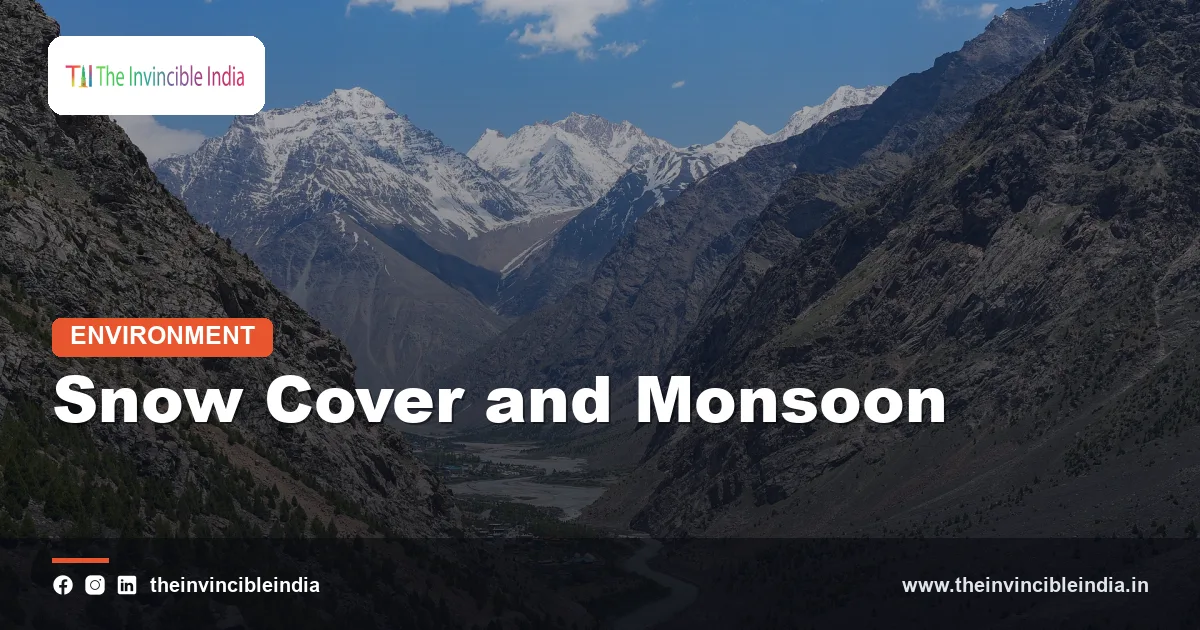
Eurasian snow cover is the blanket of winter and spring snow lying over the Himalaya, the Tibetan Plateau and the wider Eurasian landmass, and for well over a century forecasters have watched it as a clue to the strength of India’s coming summer monsoon, with unusually heavy snow traditionally linked to a weaker rainy season. The idea is simple to state and surprisingly hard to prove: a colder, whiter continent in March should, in principle, delay and dampen the great seasonal heating that pulls moist ocean winds towards India in June. Last reviewed: 3 November 2026.
This explainer walks through where the snow-monsoon idea came from, the physics behind it, why it works in some years and fails in others, and how much weight Indian scientists give it today. The short version is that the link is genuine but imperfect. Snow is one input among several, never a standalone forecast, and its influence has been shifting as the climate warms.
Quick Facts
| Topic | Relationship between winter-spring Eurasian and Himalayan snow cover and the following Indian summer monsoon |
|---|---|
| Origin of the idea | Proposed in the 1880s by Henry Blanford of the India Meteorological Department |
| Classic hypothesis | More snow in winter and spring tends to mean a weaker, later or drier monsoon |
| Main physical pathways | Snow reflects sunlight, melting uses up heat, and wet ground stays cool for longer |
| Regions watched | Western Eurasia, the Tibetan Plateau and the Himalaya, with Eurasia as a whole most studied |
| Strength of the link | Real in many decades, but modest and unstable over time |
| Competing influences | El Nino and La Nina, the Indian Ocean Dipole, ocean heat and atmospheric patterns |
| Role in forecasting | One supporting predictor in a larger set, never used alone |
Key Takeaways
- Eurasian snow cover is the extent and depth of snow over Eurasia and the Himalaya in winter and spring, and it has been studied for more than a century as a possible predictor of Indian monsoon rainfall.
- The classic idea, first put forward by Henry Blanford in the 1880s, is that heavy snow weakens the following monsoon by keeping the land cooler and wetter, which reduces the land-sea contrast that drives the rains.
- The physical reasoning rests on snow reflecting sunlight, snowmelt absorbing heat, and damp soil staying cool, all of which delay summer warming over the continent.
- The relationship is real but imperfect: it has been stronger in some decades than others and is easily overridden by El Nino, La Nina and Indian Ocean conditions.
- Snow cover is used by forecasters as one of several predictors, never as a single deciding factor, and its usefulness is limited by patchy high-mountain data.
- Warming is shrinking and reshaping snow cover, which means that older statistical links cannot simply be assumed to hold in future.
What is Eurasian snow cover and why does it matter to India?
Eurasian snow cover is the area of land across Europe and Asia, including the high mountains to India’s north, that is buried under snow during the cold half of the year. It matters to India because the monsoon is a thermal engine: the rains arrive when the vast Asian landmass heats up faster than the surrounding oceans, drawing moist air inland. Anything that slows that heating can, in theory, alter the strength or timing of the rains.
India depends heavily on that rainfall. The June to September season delivers most of the country’s annual precipitation, feeds the kharif crop, refills reservoirs and shapes the farm economy for the year. Even modest swings in seasonal totals can mean the difference between a comfortable year and a drought, which is why forecasters hunt for any signal that appears months in advance. Snow, which can be seen and measured from space during the winter, looked like an obvious candidate for such a long-lead signal.
The snow in question covers three overlapping zones. There is the seasonal blanket over western and central Eurasia, the high-altitude snowfields of the Tibetan Plateau, and the Himalayan and Hindu Kush ranges that directly overlook the Indian plains. Scientists do not always agree about which zone matters most, and that disagreement is part of the reason the link remains debated.
Who first linked Himalayan snow to the monsoon?
Henry Blanford, the first Meteorological Reporter to the Government of India and a leading figure in the early India Meteorological Department, first proposed the link in the 1880s after noticing that years of heavy Himalayan snow were often followed by a poor monsoon in the northwestern plains. He argued that extensive snow over the mountains in winter and spring could influence the atmosphere over the following months and so affect the rains.
Blanford’s observation was based on the limited records then available, mostly reports of snowfall in the western Himalaya and rainfall totals for northern India. It was an early example of a scientist hunting for a lagged relationship, an event in one season that foreshadows weather in another. The hypothesis was attractive because it matched everyday intuition: a colder, snowier winter seemed likely to give a cooler, slower start to summer.
Later researchers, including Gilbert Walker, who headed the Indian weather service in the early twentieth century, took up the idea and tested it alongside other possible predictors. Walker’s wider work on pressure patterns eventually produced the foundations of what we now call the Southern Oscillation, which turned out to be a stronger and more reliable clue than snow. Blanford’s idea nevertheless survived as one of the oldest hypotheses in tropical meteorology and has been revisited every time better data became available.
How could winter snow weaken the monsoon?
Heavy winter and spring snow could weaken the monsoon mainly by delaying the seasonal warming of the land, which shrinks the temperature gap between the continent and the Indian Ocean that powers the monsoon winds. Three physical effects are usually cited, and they reinforce one another.
The first is reflection. Fresh snow is highly reflective, so it sends a large share of incoming sunlight back to space instead of letting the ground absorb it. A snow-covered surface therefore warms more slowly in spring than bare ground. The second is the energy cost of melting. Once the sun does reach the snow, a large amount of heat goes into changing ice to water rather than raising the temperature of the surface and the air above it. The third is soil moisture. Meltwater soaks into the ground, and wet soil heats up slowly because evaporation carries energy away. This damp ground can stay cool well into early summer, long after the snow itself has vanished.
Taken together, these effects could leave the high plateau and surrounding land colder than usual when the monsoon is trying to establish itself. A weaker heat source over Asia means a weaker pressure gradient towards India, and so potentially a later onset, a feebler circulation or less rain in some regions. The reasoning is physically sound, but its real-world strength depends on how long the snow lasts and how many other influences are acting at the same time.
What does the evidence say about the snow-monsoon link?
The evidence suggests an inverse relationship that appears in many studies but is modest in size and not stable over time. When satellite monitoring of snow began in the late 1960s, researchers were able to test Blanford’s idea against several decades of data, and a number of early analyses found that years with extensive Eurasian winter snow tended to be followed by weaker Indian rainfall.
These results helped establish snow cover as a recognised candidate predictor. Later work, however, found that the correlation was stronger in some periods and weaker in others. Studies of longer records reported that the relationship was clearer in the decades before the 1980s and then faded, while other analyses argued that it re-emerged when snow in specific regions or seasons was examined separately. This sensitivity is typical of weak climate teleconnections, which can look convincing in one window of years and vanish in the next.
Computer modelling experiments have supported the physical idea, showing that artificially adding snow to the Tibetan Plateau or western Eurasia can delay spring warming and reduce rainfall in the model monsoon. Yet the models also show large variation from one simulation to another, and they often exaggerate the role of snow compared with observations. The honest summary is that the mechanism is plausible, the statistical signal is real but fragile, and no single study has settled the question.
Why is the link real but imperfect?
The link is imperfect because many other influences act on the monsoon at the same time, and some of them are far stronger than snow. The Indian summer monsoon responds to the tropical Pacific, the Indian Ocean, the position of jet streams, soil moisture over India and internal variability that no one can predict months ahead.
El Nino is the best-known overriding factor. In El Nino years the Pacific warms, the global circulation shifts, and the Indian monsoon tends to weaken regardless of what the snow has done. La Nina does the opposite. If snow cover and El Nino both point towards a weak monsoon, the signal is reinforced; if they conflict, snow usually loses. The Indian Ocean Dipole, which describes the contrast between the western and eastern Indian Ocean, adds a further layer of influence.
There are also problems of definition. Snow cover can be measured as area, as depth or as water content, and the answer changes with each. Snow in the eastern Himalaya may behave differently from snow in the west, and a snowy March may matter more than a snowy January. Researchers also point out that the relationship may work through intermediate steps, such as spring soil moisture or atmospheric circulation, that are themselves variable. All of this makes the snow signal a faint one that has to be extracted carefully from noisy data.
How do scientists measure snow cover?
Scientists measure snow cover mainly with satellites that detect the extent of white surface and, increasingly, with sensors and models that estimate depth and the water stored in the snow. Optical and microwave instruments have produced continuous maps of Northern Hemisphere snow extent for several decades, which is what makes long-term comparisons with the monsoon possible.
Extent is the easiest quantity to observe: a pixel is simply snowy or not. Depth and snow water equivalent, which tell how much water would be released on melting, are harder, especially in steep terrain where clouds, shadows and uneven surfaces confuse the sensors. Ground observations in the high Himalaya are sparse, because stations are few and conditions are extreme, so much of what is known about mountain snow comes from satellite products and reanalysis datasets that blend models with observations.
India’s research and weather agencies combine these data sources with records of western disturbances, the winter weather systems that bring snow to the western Himalaya. The patchiness of high-altitude data is one practical reason that snow-based forecasting remains uncertain. An accurate predictor needs reliable measurement, and in the mountains that is still difficult.
Is snow cover used to forecast the monsoon today?
Yes, snow cover has been used as one input among many in the statistical forecasting of the monsoon, but it plays a supporting role and is not relied upon alone. India’s weather office has at various times included snow-related predictors in its long-range forecast models alongside ocean, atmospheric and temperature indicators, and these predictors have been reviewed and replaced as their performance changed.
The reason for the cautious treatment is the instability of the relationship. A predictor that worked well in the past may fail in future, and statistical models need inputs that remain useful year after year. Forecasters therefore tend to prefer a basket of signals, each of which captures a different slice of the monsoon system, rather than trusting any single one. Snow cover earns its place as a supporting clue because it is available early, months before the rains, and carries information that the ocean signals do not.
The comparison below shows how snow sits among the better-known monsoon predictors.
| Predictor | What is watched | Typical lead time | Reliability in broad terms |
|---|---|---|---|
| El Nino and La Nina (ENSO) | Pacific Ocean surface temperature and pressure | Several months | Strongest single signal, but varies with El Nino type |
| Indian Ocean Dipole | East-west temperature contrast in the Indian Ocean | A few months | Moderate, can offset or reinforce ENSO |
| Eurasian snow cover | Winter and spring snow over Eurasia and the Himalaya | Three to five months | Modest and unstable over the decades |
| Land and sea temperatures | Northern Hemisphere and Indian region warmth | Weeks to months | Useful as a supporting signal |
| Atmospheric pressure patterns | Pressure and winds over the Indian Ocean and Asia | Weeks to months | Moderate, often used in statistical models |
How is climate change altering the snow-monsoon picture?
Climate change is altering the picture by shrinking snow cover, shortening the snow season and shifting where and when snow falls, so the old statistical relationships cannot be assumed to remain valid. Observations suggest that Northern Hemisphere spring snow extent has generally been declining as temperatures rise, and the Himalaya have seen glacier loss and changing snowfall patterns, though the trends differ between regions and ranges.
A warmer climate also changes the pathways through which snow might influence the monsoon. With less snow and earlier melt, the cooling effect of snow on spring land temperatures should weaken, which may help explain why some researchers report a fading of the classic relationship in recent decades. At the same time, a warmer atmosphere holds more moisture, so monsoon rainfall is becoming more intense in short bursts even when seasonal totals change little.
Some studies have suggested that the weakening of the snow-monsoon link is itself a symptom of a changing climate system, with other drivers such as ocean warming taking a larger role. Others caution that the apparent fading may be partly statistical noise. Either way, researchers agree that predictors rooted in past behaviour need continual re-testing, because a warming world is not guaranteed to behave like the twentieth century.
Does Himalayan snow matter for India beyond the monsoon?
Himalayan snow matters enormously for India beyond the monsoon because it is a seasonal water store that feeds the great northern rivers during the dry months. Snow and glacier melt contribute to the flow of the Indus, Ganga and Brahmaputra systems, sustaining irrigation and drinking water in the pre-monsoon period when rainfall is scarce.
The balance between snowmelt and rain varies from river to river. Rivers in the western Himalaya depend more on snow and ice than those fed mainly by monsoon rain further east, which makes the north-western basins more sensitive to changing snowfall. Winter snow built up by western disturbances provides much of the water that flows in spring and early summer, helping farmers sow and irrigate before the monsoon arrives.
This is a different question from whether snow predicts the monsoon, but the two are linked in public discussion. A poor snow winter can mean low early-season river flow regardless of what the monsoon later does, and a heavy snow year can mean flood risk from rapid melt. Treating snow as both a possible rainfall clue and a water resource shows why it deserves careful monitoring even if its forecasting value is modest.
What should readers take away from the snow-monsoon story?
Readers should take away that the snow-monsoon story is a good example of how climate science works: a sensible physical idea, tested against data, found to be partly right, and kept in use with humility. Blanford’s observation was not wrong, but it was never the whole story.
For anyone following the monsoon outlook each year, the practical lesson is to treat any single predictor with caution. When the official forecast is issued in April and updated later, the numbers reflect a combination of ocean, atmospheric and land signals, with snow only one thread. A forecast of a normal or above-normal monsoon does not depend on snow being low, and a heavy snow winter does not by itself mean drought.
It is also worth remembering that the monsoon is not a single number. Rainfall varies enormously by region, by month and by day, so a seasonal total that looks normal can still hide floods in one area and dry spells in another. Snow cover helps researchers understand the large-scale background but says little about those local extremes.
Bottom Line
Snow cover over the Himalaya and Eurasia is one of the oldest monsoon predictors, and the idea that heavy winter snow weakens the following rains rests on sound physics: snow reflects sunlight, melting absorbs heat and wet soil stays cool. The real-world link is genuine but modest, varies from decade to decade and is easily overridden by El Nino, La Nina and Indian Ocean conditions. Forecasters therefore use snow as one supporting clue among many, and a warming climate means that even that role needs constant re-checking.
Frequently Asked Questions
Does heavy Himalayan snow always cause a weak monsoon?
No. Heavy snow tends to be associated with a weaker monsoon in many studies, but the link is modest and unstable, and stronger influences such as El Nino and the Indian Ocean Dipole can override it.
Who proposed that snow affects the Indian monsoon?
Henry Blanford, an early meteorologist of the India Meteorological Department, proposed the idea in the 1880s after noticing that heavy Himalayan snow often preceded poor monsoon rains in northern India.
How does snow weaken the monsoon physically?
Snow reflects sunlight, melting consumes heat and the wet ground left behind stays cool, which delays summer warming of the continent and reduces the land-sea temperature contrast that drives the monsoon winds.
Does the India Meteorological Department use snow cover in its forecasts?
Snow-related predictors have been used as one input among many in statistical forecasting, but they play a supporting role and are reviewed over time because the relationship is not constant.
Is climate change affecting the snow-monsoon relationship?
Probably. Snow cover and the snow season are changing as temperatures rise, and some studies suggest that the classic link has weakened in recent decades, though the cause is still debated.
Why does Himalayan snow matter if it is not a perfect forecast tool?
Himalayan snow stores winter water that feeds the Indus, Ganga and Brahmaputra systems through the dry months, so it matters for rivers, irrigation and flood risk regardless of its value for predicting rainfall.
{“@context”:”https://schema.org”,”@graph”:[{“@type”:”FAQPage”,”mainEntity”:[{“@type”:”Question”,”name”:”Does heavy Himalayan snow always cause a weak monsoon?”,”acceptedAnswer”:{“@type”:”Answer”,”text”:”No. Heavy snow tends to be associated with a weaker monsoon in many studies, but the link is modest and unstable, and stronger influences such as El Nino and the Indian Ocean Dipole can override it.”}},{“@type”:”Question”,”name”:”Who proposed that snow affects the Indian monsoon?”,”acceptedAnswer”:{“@type”:”Answer”,”text”:”Henry Blanford, an early meteorologist of the India Meteorological Department, proposed the idea in the 1880s after noticing that heavy Himalayan snow often preceded poor monsoon rains in northern India.”}},{“@type”:”Question”,”name”:”How does snow weaken the monsoon physically?”,”acceptedAnswer”:{“@type”:”Answer”,”text”:”Snow reflects sunlight, melting consumes heat and the wet ground left behind stays cool, which delays summer warming of the continent and reduces the land-sea temperature contrast that drives the monsoon winds.”}},{“@type”:”Question”,”name”:”Does the India Meteorological Department use snow cover in its forecasts?”,”acceptedAnswer”:{“@type”:”Answer”,”text”:”Snow-related predictors have been used as one input among many in statistical forecasting, but they play a supporting role and are reviewed over time because the relationship is not constant.”}},{“@type”:”Question”,”name”:”Is climate change affecting the snow-monsoon relationship?”,”acceptedAnswer”:{“@type”:”Answer”,”text”:”Probably. Snow cover and the snow season are changing as temperatures rise, and some studies suggest that the classic link has weakened in recent decades, though the cause is still debated.”}},{“@type”:”Question”,”name”:”Why does Himalayan snow matter if it is not a perfect forecast tool?”,”acceptedAnswer”:{“@type”:”Answer”,”text”:”Himalayan snow stores winter water that feeds the Indus, Ganga and Brahmaputra systems through the dry months, so it matters for rivers, irrigation and flood risk regardless of its value for predicting rainfall.”}}]}]}


