

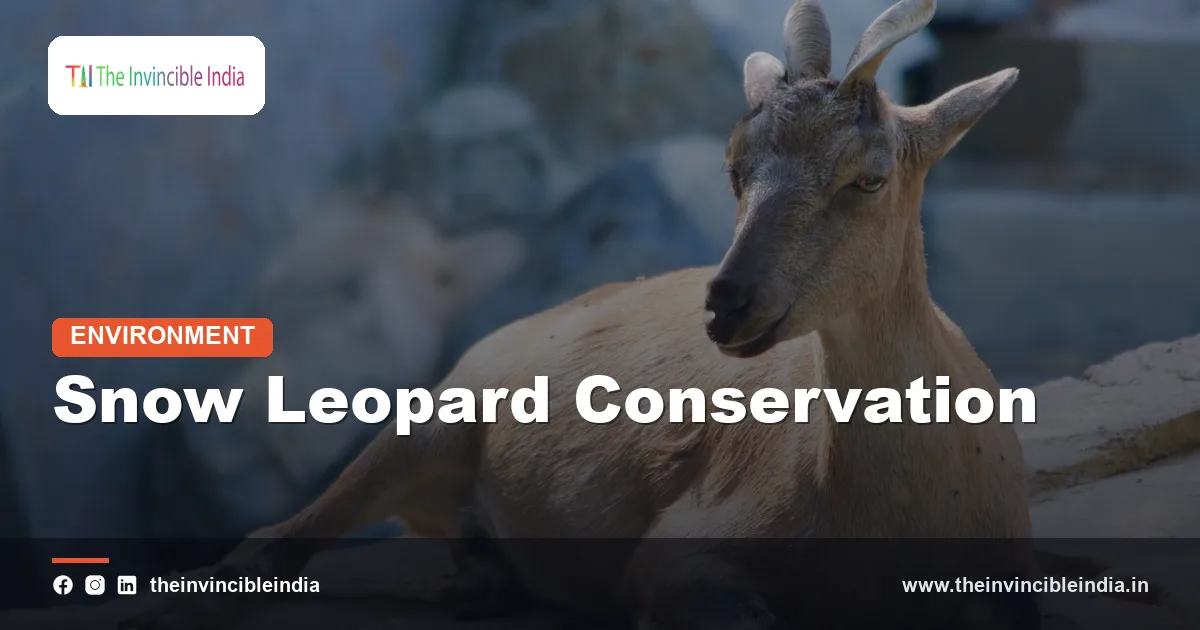
Few animals capture the imagination like the snow leopard, and snow leopard conservation has become one of the most important wildlife efforts in the Indian Himalaya. Known as the “ghost of the mountains” because of its remarkable camouflage and secretive habits, this big cat lives high above the tree line, among rocky cliffs, glaciers and alpine meadows. It is so elusive that many people who spend a lifetime in its habitat never see one.
India forms part of the global range of the species, with populations across the cold, arid mountains of Ladakh, Himachal Pradesh, Uttarakhand, Sikkim and Arunachal Pradesh. This explainer describes the animal and its habitat, India’s range states, the national Project Snow Leopard launched in 2009, the SECURE Himalaya programme, the first national population assessment, the threats the species faces, and the community-led approaches that are central to its future.
| Fact | Detail |
|---|---|
| Scientific name | Panthera uncia |
| Nickname | Ghost of the mountains |
| IUCN status | Vulnerable |
| Indian legal status | Schedule I of the Wildlife (Protection) Act, 1972 |
| State/UT animal | State animal of Himachal Pradesh and the Union Territory of Ladakh |
| Indian range | Ladakh, Jammu and Kashmir, Himachal Pradesh, Uttarakhand, Sikkim and Arunachal Pradesh |
| Habitat altitude | Generally from about 3,000 to over 4,500 metres |
| National programme | Project Snow Leopard, launched in 2009 |
| Landscape project | SECURE Himalaya, supported by the Global Environment Facility and UNDP |
The Ghost of the Mountains
The snow leopard is a medium-sized big cat built for the cold. Its body is covered in thick, pale grey to smoky fur marked with dark rosettes and spots, which blend perfectly with rock and snow. Adults are typically much lighter in build than a common leopard, and their bodies are well-insulated against sub-zero temperatures.
Adaptations to the cold and the cliffs
- Long, thick tail: used for balance on steep, broken terrain and wrapped around the body like a scarf for warmth when resting.
- Broad, furry paws: act like natural snowshoes and keep the feet warm.
- Powerful hind legs: allow the cat to leap across wide gaps and chase prey up and down slopes.
- Short nasal passages and large nostrils: help warm and process the thin, cold air.
- Dense, layered fur: provides insulation, with especially long hair on the belly.
An unusual big cat
Unlike lions, tigers and leopards, the snow leopard cannot roar, because of differences in the structure of its throat. Instead it communicates through chuffing, mewing, hissing and wailing sounds, as well as through scent marks, scrapes and claw marks left on rocks. These signs, rather than sightings, are what researchers use to track the species.
Habitat and Himalayan Range
Snow leopards live in the high mountains of Central and South Asia, spanning twelve countries, including India, Nepal, Bhutan, China, Mongolia, Russia, Kazakhstan, Kyrgyzstan, Tajikistan, Uzbekistan, Afghanistan and Pakistan. India holds a meaningful share of the global range, though much of the global population lies in the Tibetan plateau and central Asian mountains.
Indian range states
- Ladakh: the most important stronghold in India, with the cold desert landscapes of the Hemis National Park, the Changthang and the Zanskar region.
- Jammu and Kashmir: high-altitude areas in the Kashmir and Kishtwar regions.
- Himachal Pradesh: the Spiti valley, Pin Valley National Park, the Kinnaur region and the Great Himalayan National Park area.
- Uttarakhand: upper Himalayan reaches, including areas near Gangotri and Nanda Devi.
- Sikkim: the high ridges of the north, around the Kanchenjunga landscape.
- Arunachal Pradesh: remote, high-altitude areas in Tawang, West Kameng and other northern districts.
Terrain
Snow leopards prefer steep, rugged terrain broken by cliffs, ridges and ravines, usually above the tree line and below the permanent snow. In summer they may range higher, to alpine pastures, and in winter they descend to valleys following their prey. Their home ranges are large and vary with how abundant prey is.
Diet and Role in the Ecosystem
The snow leopard is an apex predator, sitting at the top of the high-altitude food chain. It feeds mainly on wild mountain ungulates, with the most important prey species being the blue sheep, or bharal, and the Himalayan ibex. In other parts of its range, it also preys on argali, urial and other wild sheep and goats, as well as marmots, pikas, hares and game birds.
When wild prey is scarce
Where natural prey has declined, snow leopards may turn to domestic livestock such as sheep, goats, yaks and horses. This makes the relationship between the species and mountain communities complex, since a single predation incident can cause serious economic loss to a family that depends on its herd.
Why the predator matters
By regulating herbivore numbers, the snow leopard helps maintain the balance of pasture and vegetation in fragile mountain ecosystems. These landscapes are also the source of major rivers, so conserving them supports the water security of millions of people downstream. For this reason, the snow leopard is described as an indicator of the health of the high Himalaya, and a flagship species for mountain conservation.
Why It Is Hard to Count a Ghost
For decades, the status of the snow leopard in India was uncertain. The cats live in remote, steep and often inaccessible terrain, they are active mostly at dawn and dusk, and their fur is almost impossible to see against the rocks. Early estimates were based on indirect signs and guesswork, and conservation planning suffered from a lack of reliable data.
Modern survey methods
- Camera traps: motion-triggered cameras placed along ridgelines and trails photograph passing animals. Each snow leopard has a unique rosette pattern, which allows individuals to be identified.
- Sign surveys: researchers walk transects to record scrapes, scat, pugmarks and scent marks.
- Genetic analysis: DNA extracted from scat can identify individuals and track relationships.
- Prey surveys: counts of bharal, ibex and other wild herbivores indicate how many predators the area can support.
- Satellite collars: in a few studies, collars have shown how far animals travel across mountain ranges.
Why reliable numbers matter
Without credible population data, it is impossible to know whether conservation actions are working. This need led to a national exercise to estimate snow leopard numbers on a scientific basis, described later in this explainer.
Project Snow Leopard (2009)
The Government of India launched Project Snow Leopard in 2009, through the Ministry of Environment, Forest and Climate Change, as a national strategy to safeguard the species and its habitat. The project recognises that the snow leopard cannot be protected by fencing off a small reserve; it requires a landscape-level approach that involves communities and addresses the economic needs of people who share the habitat.
Key objectives
- Promote a participatory and inclusive approach to conservation across the Himalayan states.
- Strengthen scientific monitoring and research on snow leopards and their prey.
- Protect and improve habitat, including wild prey populations.
- Reduce human-wildlife conflict and provide support to affected herders.
- Build the capacity of forest staff, local communities and conservation partners.
Landscape planning
The strategy identified priority landscapes in the Himalayan states and called for management plans prepared with the participation of local people. It treated pastoral livelihoods, tourism and conservation as part of a single system, and encouraged states to share information and coordinate across boundaries.
The SECURE Himalaya Project
SECURE Himalaya is a major conservation and livelihoods initiative of the Ministry of Environment, Forest and Climate Change, supported by the Global Environment Facility and implemented with the United Nations Development Programme. The name is an acronym for securing livelihoods, conservation, sustainable use and restoration of high-range Himalayan ecosystems. It was launched in 2017 to cover important landscapes where the snow leopard and its prey live.
States and landscapes
The project operates in the high-altitude regions of Himachal Pradesh, Jammu and Kashmir, Ladakh, Uttarakhand and Sikkim. These landscapes combine wildlife habitat, pastures, forests and settlements, and are important both for biodiversity and for the livelihoods of mountain people.
Main components
- Landscape management: improving the management of protected areas, pastures and forests with community involvement.
- Sustainable livelihoods: promoting alternatives to resource-intensive activities, such as improved grazing practices, handicrafts and nature-based enterprises.
- Combating wildlife crime: strengthening enforcement and monitoring against poaching and illegal trade.
- Knowledge and learning: sharing data, best practices and scientific research among states and partners.
The project also supports regional cooperation, since snow leopards cross national borders, and fits within a wider international effort to protect the species across its entire range.
The First National Population Assessment
India conducted its first scientific national assessment of snow leopards in a programme known as the Snow Leopard Population Assessment in India, or SPAI. It was led by the Wildlife Institute of India and the Nature Conservation Foundation, in partnership with the state forest departments and other organisations, and was carried out over several years in the early 2020s.
How it worked
Survey teams divided the potential habitat into grids, mapped signs and interviewed local communities, then deployed camera traps across a large part of the range. Using photographs of individual animals and statistical methods, the scientists estimated how many snow leopards inhabited the surveyed areas. The exercise covered the full Indian Himalayan range for the first time.
What it showed
The assessment estimated the Indian snow leopard population at roughly seven hundred animals, with Ladakh holding the largest share, followed by Uttarakhand, Himachal Pradesh, Arunachal Pradesh, Sikkim and Jammu and Kashmir. The figure is an estimate with a margin of uncertainty, but it gave a reliable baseline against which future changes can be measured.
Importantly, the exercise revealed that snow leopards occur in some areas where their presence had not previously been confirmed, and it provided new knowledge about habitat use and connectivity between landscapes.
Threat One: Poaching and Illegal Trade
Snow leopards have been hunted for their beautiful pelts and bones, which are used in illegal trade in some parts of Asia. Although the species is fully protected in India, and international trade is prohibited, poaching and trade remain a risk, especially in remote areas where monitoring is difficult.
Legal protection
- It is listed in Schedule I of the Wildlife (Protection) Act, 1972, which carries the strictest penalties.
- It is listed in Appendix I of CITES, banning commercial international trade.
- It is covered by the Convention on Migratory Species as a species needing cross-border cooperation.
Preventing wildlife crime
Enforcement agencies, forest guards and local informants play a role in detecting poaching networks. Training, intelligence sharing between states and countries and engagement with communities that live near the habitat are considered among the most effective tools against wildlife crime.
Threat Two: Prey Decline and Habitat Pressure
Because the snow leopard depends on wild prey, anything that reduces the numbers of bharal, ibex and other herbivores threatens the cat itself. Overgrazing by domestic livestock reduces the pasture available to wild herbivores and may cause competition between them. Diseases passed from livestock to wildlife can also be a danger.
Growing human footprint
- Roads, tunnels, hydropower projects and mining that fragment habitat.
- Unregulated tourism that can disturb wildlife in sensitive areas.
- Defence and border infrastructure in high-altitude zones.
- Free-ranging dogs, which can harass wildlife and spread diseases.
Climate change
The Himalaya is warming and glaciers are retreating. Changes in snow cover, vegetation and the tree line could shift the ranges of snow leopards and their prey, with the possibility that suitable habitat shrinks or becomes more fragmented. Because these species have little room to move higher up the mountains, they are considered particularly vulnerable to long-term climate change.
Threat Three: Human-Wildlife Conflict
Livestock is the main source of wealth for many Himalayan families, so attacks by snow leopards, especially when they enter poorly protected corrals at night, can cause grievous losses. In some incidents a single predator has killed many animals in one night. Retaliatory killing, by shooting, poisoning or trapping, has historically been a significant cause of death for the cats.
Common solutions
- Predator-proof corrals: strengthening livestock enclosures with sturdy walls and covered roofs prevents surplus killing.
- Livestock insurance: community-managed schemes that compensate families for losses.
- Compensation programmes: government relief for verified predation incidents.
- Herding practices: improved herding and guarding methods to reduce risk.
- Vaccination and health care: keeping livestock healthy to reduce competition and disease spread.
Changing attitudes
In many Himalayan cultures, local traditions encourage respect for wildlife. Building on these values, conservation programmes aim to ensure that the people who live with the snow leopard also benefit from its presence, so that protecting it becomes a source of pride and income rather than a burden.
Community-Based Conservation
Since most snow leopard habitat lies outside strictly protected areas, in village pastures and community lands, the species cannot survive without local support. Conservation organisations, forest departments and community groups have therefore developed approaches that put communities at the centre.
Homestays and nature tourism
One of the best-known models is the Himalayan Homestay programme, in which village households host visitors, offering meals, accommodation and guided walks. Tourists, often from other countries, come to Ladakh in winter to track snow leopards, with local guides and trackers earning income directly from the presence of the cats. Areas such as Hemis National Park and the Spiti valley have become destinations for wildlife viewing, and the income gives families an incentive to protect rather than persecute the predator.
Local guardians and monitoring
Villagers are trained as citizen scientists to run camera traps, record signs and report threats. Youth groups, women’s self-help groups and monastic institutions have been engaged in awareness and protection activities. Nature education in schools and communication campaigns also help build pride in the species.
Partners
Organisations such as the Nature Conservation Foundation, the Snow Leopard Conservancy India Trust and the Wildlife Institute of India, together with state forest departments, work alongside communities. International cooperation is also significant: the Global Snow Leopard and Ecosystem Protection Programme, endorsed by the twelve range countries in 2013, aims to secure important snow leopard landscapes by cooperative action, and 23 October is marked as International Snow Leopard Day.
Conclusion
The snow leopard is a living symbol of the Himalaya’s wild beauty and ecological fragility. India’s response, combining a national strategy, the SECURE Himalaya project, scientific population assessment and community-based conservation, shows that it is possible to protect a wide-ranging predator while supporting mountain livelihoods. The challenge ahead is to keep prey populations healthy, reduce conflict and manage development and climate pressures, so that the “ghost of the mountains” remains a presence on the high ridges for generations to come.
Frequently Asked Questions
Why is the snow leopard called the ghost of the mountains?
It earns this name because its pale, spotted coat blends perfectly with rocks and snow and because it is extremely shy and lives in remote, high-altitude terrain. Even experienced trackers may spend long periods in its habitat without seeing one.
In which Indian states and Union Territories are snow leopards found?
Snow leopards occur in the Himalayan regions of Ladakh, Jammu and Kashmir, Himachal Pradesh, Uttarakhand, Sikkim and Arunachal Pradesh. Ladakh holds the largest share of the Indian population.
What is Project Snow Leopard?
Project Snow Leopard is a national initiative launched by the Government of India in 2009 to conserve the species and its habitat through a participatory, landscape-level approach. It focuses on scientific monitoring, habitat protection, conflict reduction and capacity building across the Himalayan states.
What is the SECURE Himalaya project?
SECURE Himalaya is a programme of the Ministry of Environment, Forest and Climate Change, supported by the Global Environment Facility and UNDP and launched in 2017. It aims to conserve high-altitude ecosystems and improve community livelihoods in Himachal Pradesh, Jammu and Kashmir, Ladakh, Uttarakhand and Sikkim.
How many snow leopards are there in India?
India’s first scientific population assessment, led by the Wildlife Institute of India and the Nature Conservation Foundation, estimated the population at roughly seven hundred animals, with Ladakh holding the largest number. As with all wildlife estimates, the figure carries some uncertainty and can change as surveys are repeated.
What are the biggest threats to snow leopards?
The main threats are poaching and illegal trade, the decline of wild prey, retaliatory killing after livestock losses, habitat disturbance from infrastructure and unregulated tourism, and climate change. Community-based conservation, predator-proof corrals and insurance schemes are key responses.


