

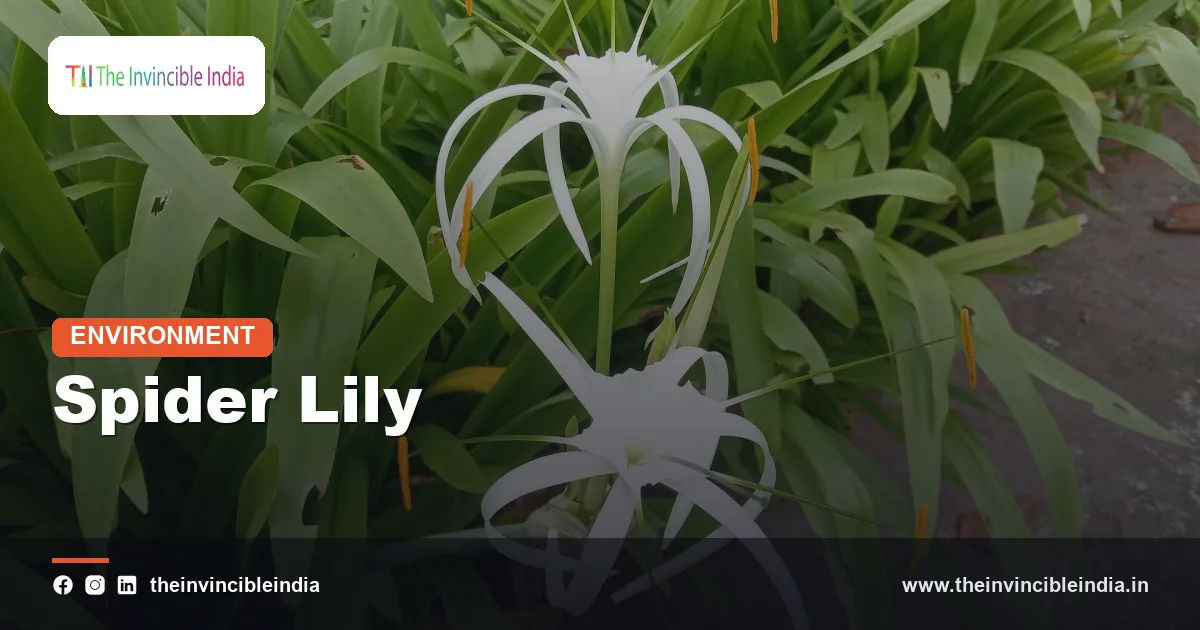
The spider lily is a white, sweetly fragrant bulb plant of the amaryllis family, grown widely in Indian gardens for its large flowers with long, thin, spidery petals that open in clusters during and after the monsoon. In India the name spider lily is used mainly for Hymenocallis littoralis, a tropical American species, and also loosely for the native or long-naturalised Crinum lilies, which have a similar spidery look.
The spider lily is popular because it is hardy, evergreen in warm climates and almost trouble-free once established. It thrives in sun or light shade, tolerates wet ground and returns every year from the same bulb. This explainer describes what the spider lily is, which plants are called by that name in India, how to grow and propagate it, and what precautions to take around its toxic bulbs.
Quick Facts: Spider Lily
| Common names | Spider lily, beach spider lily, white spider lily; Crinum species are also called poison bulb or grand crinum |
|---|---|
| Scientific names | Hymenocallis littoralis (garden spider lily); Crinum asiaticum and related Crinum species |
| Family | Amaryllidaceae (the amaryllis family) |
| Origin | Hymenocallis: tropical America; Crinum asiaticum: tropical Asia and the Indian Ocean coasts |
| Where found in India | Gardens, parks, temple grounds and roadsides across the plains and warm hill regions, often near water and in coastal areas |
| Flowering | Mainly from the start of the monsoon into autumn; may flower again in warm, moist conditions |
| Growth form | Evergreen or semi-evergreen bulb with glossy strap-shaped leaves, usually 60 to 90 centimetres tall |
| Uses | Ornamental planting, pond and drain edges, cut flowers; certain Crinum species in traditional medicine |
| Safety | Bulbs contain toxic alkaloids such as lycorine and should not be eaten |
Key Takeaways
- The spider lily is a bulbous plant of the amaryllis family (Amaryllidaceae) that bears white, fragrant flowers with long, narrow, spreading petals.
- The garden spider lily seen in India is usually Hymenocallis littoralis, a species native to tropical America.
- The name spider lily is also applied in India to Crinum lilies, such as Crinum asiaticum, which are native to tropical Asia.
- The spider lily flowers mainly with the monsoon rains and is pollinated at night by moths that are drawn to its scent.
- The spider lily grows easily in full sun or partial shade, in moist, well-drained soil, and spreads by producing offset bulbs.
- The bulbs of the spider lily contain toxic alkaloids, so they should be kept away from children and pets and never eaten.
What is a spider lily?
A spider lily is a perennial flowering bulb whose blooms have a central cup or trumpet surrounded by six long, narrow, curved petals that look like the legs of a spider. In India, the plant most often called a spider lily is Hymenocallis littoralis, a member of the family Amaryllidaceae that is grown for its pure white, scented flowers.
A typical Hymenocallis littoralis plant grows from a large, rounded bulb below the soil. From the bulb rises a fan of glossy, deep green, strap-like leaves that can reach nearly a metre in length. A thick, leafless flower stalk emerges from the centre of the leaf clump and carries an umbrella-shaped cluster, called an umbel, of several large flowers.
Each flower has a distinctive feature. The six narrow, spreading outer segments, called tepals, surround a delicate, funnel-shaped white cup formed from the joined bases of the stamens. This cup, called the staminal corona, gives the genus its name, which comes from Greek words meaning “beautiful membrane”. The flower opens in the evening and gives off a strong, sweet fragrance.
Which plants are called spider lilies in India?
Several different bulb plants are called spider lilies in India, and the name is not a precise scientific term. The three main plants that people mean are the beach spider lily (Hymenocallis littoralis), the Asiatic poison bulb (Crinum asiaticum) and, less often in India, the red spider lily (Lycoris radiata) of East Asia.
| Plant | Origin | Flower | Notes |
|---|---|---|---|
| Hymenocallis littoralis (beach spider lily) | Tropical America | White, fragrant, with a central cup and long, thin outer segments | The common garden spider lily in India; also known as the white spider lily |
| Crinum asiaticum (poison bulb, grand crinum) | Tropical Asia and Indian Ocean coasts | White, scented, with narrow, curved petals in a large cluster | Larger plant; grows on coasts and in gardens; bulbs used in traditional medicine |
| Other Crinum lilies (for example Crinum latifolium and Crinum defixum) | Tropical Asia | White, sometimes pink-striped, funnel-shaped | Often grown near ponds and temples |
| Lycoris radiata (red spider lily) | East Asia | Red, with very long curved stamens | Not common in Indian gardens; needs a cooler climate |
Because the same common name covers more than one plant, gardeners and botanists prefer to use the scientific name when buying or identifying bulbs. In this article, spider lily refers mainly to Hymenocallis littoralis, and the Crinum lilies are described where their care or uses differ.
Where does the spider lily grow in India?
The spider lily grows across most of tropical and subtropical India, in gardens, parks, institutional campuses, temple compounds and along roadsides and canals. It is especially common in the humid coastal belt, in the Gangetic plains and in southern India, where the warm climate allows the plants to stay green all year.
The species Hymenocallis littoralis is native to the warm regions of Central and South America and the Caribbean, where it grows near rivers and coasts. The word littoralis means “of the shore”. It was brought to Asia as an ornamental plant and is now one of the commonly grown garden bulbs in India, though it is generally treated as a cultivated plant and not as a wild species.
The native Crinum asiaticum grows naturally along sandy shores, riverbanks and mangrove edges in parts of coastal India and across tropical Asia, and it is also widely planted. Both plants prefer warmth and regular moisture, and neither tolerates hard frost. In the cooler northern hills, they are usually grown in pots and sheltered during winter.
When does the spider lily bloom?
The spider lily blooms mainly from the onset of the monsoon through autumn, with the main flush often triggered by the first heavy rains after the hot season. In places with warm, moist weather and regular watering, the plant may produce flowers more than once in a year.
Each flowering stalk carries a cluster of several buds that open over a few days, in the late afternoon or evening. A single flower lasts only a day or two, but the plant keeps producing new buds, so a healthy clump looks full of flowers for several weeks. Larger, older clumps with many bulbs tend to flower more heavily than newly planted single bulbs.
Why does the flower open in the evening?
The spider lily opens in the evening because its main pollinators are night-flying moths, especially hawkmoths, which are attracted to white flowers and strong scent. The long floral tube and the pale colour make the flower easy to find in dim light. Visitors to a spider lily clump at dusk often see these moths hovering to sip nectar.
How do you grow a spider lily?
A spider lily is grown by planting the bulb in rich, moist, well-drained soil in full sun or partial shade, watering it regularly during the growing season and feeding it two or three times a year. It is one of the easier bulbs to grow in India, and a neglected clump will still survive for years.
Light and position
The spider lily flowers best with four to six hours of direct sun a day, although it tolerates partial shade and may keep greener leaves there. In very hot, dry regions, light afternoon shade protects the foliage from scorching. It can be planted in borders, along walls, beside ponds and in large containers.
Soil and planting
The spider lily prefers loamy soil enriched with compost or well-rotted manure. Bulbs are planted with the neck at or just above the soil surface, about 45 to 60 centimetres apart, because each plant spreads into a clump over time. Planting at the start of the rains gives the roots the best start, and the plant tolerates occasional waterlogging better than most garden bulbs.
Water and feeding
Regular watering during the warm season keeps the leaves glossy and encourages flowers. In dry spells, the plant slows down, and the leaves may droop or yellow slightly, but it recovers with the next rain. A balanced fertiliser or compost applied before the monsoon and again after flowering supports growth.
Container growing
For pots, a wide, deep container with drainage holes and a mix of garden soil, compost and sand suits the plant. The pot should be roomy because the roots are thick and fleshy. Potted plants need more frequent watering and feeding than those planted in the ground.
How do you propagate a spider lily?
A spider lily is propagated mainly by dividing the clump and replanting the offset bulbs that form beside the parent bulb. This method gives plants identical to the parent and flowers within a year or two, which makes it the standard way to multiply the plant in nurseries and gardens.
- Choose the time: Divide the clump after flowering or at the start of the rains, when the soil is moist and warm.
- Lift the clump: Dig carefully around the clump to avoid cutting the thick roots, and lift it with the soil.
- Separate the offsets: Gently pull or cut apart bulbs, keeping some roots attached to each offset.
- Replant at once: Plant each bulb at the same depth as before, water well and keep the soil moist while new roots form.
Seed is possible for some Crinum species, but it is slow, and many cultivated forms are propagated vegetatively. Gardeners should wear gloves when handling bulbs, since the sap can irritate the skin.
What pests and problems affect spider lilies?
Spider lilies are hardy, but they can be affected by caterpillars, snails, slugs and fungal leaf spots, especially in the wet season. Most problems are cosmetic and can be handled by simple, early action.
- Lily caterpillars and leaf-eating larvae: They chew leaves and sometimes bore into the bulb neck. Hand-picking and removing damaged leaves usually controls them.
- Snails and slugs: They feed at night on young leaves and buds during the monsoon. Clearing debris and using barriers reduces damage.
- Leaf spots and red blotch: Fungal diseases cause reddish or brown marks on leaves and flower stalks in humid conditions. Removing affected leaves and avoiding overhead watering helps.
- Bulb rot: Bulbs left in constantly waterlogged soil with poor aeration may rot. Planting with the neck above the soil and ensuring some drainage prevents this.
- Overcrowding: Old, crowded clumps flower less, and dividing them every few years restores flowering.
Is the spider lily poisonous?
Yes, the spider lily is poisonous if eaten, because the bulbs, and to a lesser degree the leaves, contain alkaloids such as lycorine that cause vomiting, abdominal pain and diarrhoea. This toxicity is common to many members of the amaryllis family, including daffodils, crinums and hippeastrums.
The bulb is the most dangerous part, and the risk is greatest for children, dogs and cats that dig up or chew bulbs. Handling the plant is safe for most people, but the sap may irritate sensitive skin, so gloves are sensible when dividing clumps. If a person or pet has eaten any part of the plant, medical or veterinary advice should be sought promptly.
Some Crinum species are used in traditional systems of medicine in India and other Asian countries, where bulb preparations are applied or taken for various complaints. Because the bulbs are toxic and doses are unreliable, these practices should not be tried at home without qualified guidance.
What are the uses of the spider lily?
The spider lily is used mainly as an ornamental plant for its beauty and fragrance, and it also serves as a landscaping plant for wet or low-lying spots and as a source of nectar for night-flying insects. Its large, scented flowers are also used as cut flowers for short-term display.
- Garden and landscape: Clumps work well as borders, as screens and as accents along paths, walls and pond edges.
- Wet and low-lying sites: The plant tolerates damp and seasonally flooded ground, so it suits drain edges and rain gardens.
- Fragrance: The evening scent adds to courtyards, terraces and balcony gardens.
- Pollinator support: The nectar feeds hawkmoths and other night visitors.
- Traditional medicine: Certain Crinum species have a long history of use in folk medicine.
How can you tell a spider lily from similar flowers?
A spider lily can be told apart from similar white flowers by its central cup, its long, narrow, curved outer petals and its umbel of several flowers on a stout, leafless stalk. Other white-flowered bulbs look similar at first glance but differ in shape and growth habit.
- Crinum lily: Has a long, funnel-shaped flower without a distinct central cup, larger leaves and a bulb with a prominent neck.
- Rain lily (Zephyranthes): Much smaller, with grass-like leaves and a single, upright, crocus-like flower that appears after rain.
- Hippeastrum: Has big trumpet-shaped flowers, often red or pink, on a hollow stalk with broad petals.
- Tuberose: Has a spike of waxy white flowers with a heavy scent, rather than an umbel of spidery blooms.
Bottom Line
The spider lily is a tough, fragrant bulb that gives Indian gardens a long season of white, spidery flowers from the monsoon onwards. It needs sun or light shade, moist but draining soil and occasional division, and its bulbs must be kept out of reach of children and pets because they are toxic.
Frequently Asked Questions
What is a spider lily?
A spider lily is a bulb plant of the amaryllis family that has large, fragrant white flowers with long, thin, spreading petals and a central cup. In India, it usually means Hymenocallis littoralis, and sometimes Crinum lilies. It is grown as an ornamental in gardens and near water.
When does the spider lily flower in India?
The spider lily flowers mainly from the beginning of the monsoon until autumn. The first heavy rains often trigger a flush of buds, and the flowers open in the evening. In warm, moist conditions, a healthy clump may flower more than once.
How do you grow a spider lily at home?
You grow a spider lily by planting the bulb in rich, well-drained soil in full sun or partial shade, with the neck at the soil surface. Water it regularly in the growing season and feed it with compost or a balanced fertiliser before and after the rains. In pots, use a large container with drainage holes.
Is the spider lily poisonous to pets and children?
Yes, the spider lily is poisonous if eaten. Its bulbs and, to a lesser extent, its leaves contain alkaloids such as lycorine that can cause vomiting, stomach pain and diarrhoea. Keep the bulbs away from children, dogs and cats, and seek medical or veterinary help if any part is eaten.
How is the spider lily propagated?
The spider lily is propagated by dividing the clump and replanting the small offset bulbs that grow beside the parent bulb. The best time is after flowering or at the start of the rains. Each offset should keep some roots and be replanted at the same depth as before.
What is the difference between a spider lily and a crinum lily?
A spider lily of the genus Hymenocallis has a distinct central cup joining the stamens and long, thin outer petals, while a crinum lily has a funnel-shaped flower without that cup and a larger, taller plant. Both are in the amaryllis family and both are called spider lilies in some places. Crinum asiaticum is native to tropical Asia, while Hymenocallis littoralis is native to tropical America.
{“@context”:”https://schema.org”,”@graph”:[{“@type”:”FAQPage”,”mainEntity”:[{“@type”:”Question”,”name”:”What is a spider lily?”,”acceptedAnswer”:{“@type”:”Answer”,”text”:”A spider lily is a bulb plant of the amaryllis family that has large, fragrant white flowers with long, thin, spreading petals and a central cup. In India, it usually means Hymenocallis littoralis, and sometimes Crinum lilies. It is grown as an ornamental in gardens and near water.”}},{“@type”:”Question”,”name”:”When does the spider lily flower in India?”,”acceptedAnswer”:{“@type”:”Answer”,”text”:”The spider lily flowers mainly from the beginning of the monsoon until autumn. The first heavy rains often trigger a flush of buds, and the flowers open in the evening. In warm, moist conditions, a healthy clump may flower more than once.”}},{“@type”:”Question”,”name”:”How do you grow a spider lily at home?”,”acceptedAnswer”:{“@type”:”Answer”,”text”:”You grow a spider lily by planting the bulb in rich, well-drained soil in full sun or partial shade, with the neck at the soil surface. Water it regularly in the growing season and feed it with compost or a balanced fertiliser before and after the rains. In pots, use a large container with drainage holes.”}},{“@type”:”Question”,”name”:”Is the spider lily poisonous to pets and children?”,”acceptedAnswer”:{“@type”:”Answer”,”text”:”Yes, the spider lily is poisonous if eaten. Its bulbs and, to a lesser extent, its leaves contain alkaloids such as lycorine that can cause vomiting, stomach pain and diarrhoea. Keep the bulbs away from children, dogs and cats, and seek medical or veterinary help if any part is eaten.”}},{“@type”:”Question”,”name”:”How is the spider lily propagated?”,”acceptedAnswer”:{“@type”:”Answer”,”text”:”The spider lily is propagated by dividing the clump and replanting the small offset bulbs that grow beside the parent bulb. The best time is after flowering or at the start of the rains. Each offset should keep some roots and be replanted at the same depth as before.”}},{“@type”:”Question”,”name”:”What is the difference between a spider lily and a crinum lily?”,”acceptedAnswer”:{“@type”:”Answer”,”text”:”A spider lily of the genus Hymenocallis has a distinct central cup joining the stamens and long, thin outer petals, while a crinum lily has a funnel-shaped flower without that cup and a larger, taller plant. Both are in the amaryllis family and both are called spider lilies in some places. Crinum asiaticum is native to tropical Asia, while Hymenocallis littoralis is native to tropical America.”}}]}]}


