

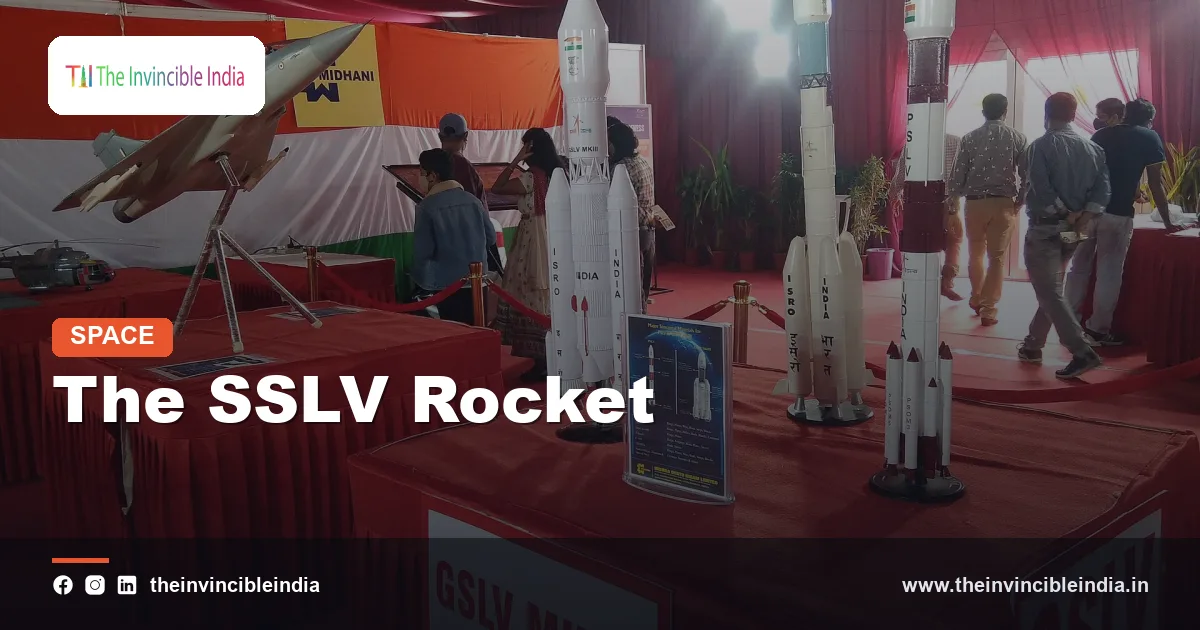
The Small Satellite Launch Vehicle, or SSLV, is ISRO’s newest operational rocket, designed to carry small satellites into low Earth orbit quickly and at low cost. Standing about 34 metres tall, it has three solid-propellant stages and a small liquid-fuelled upper module, and it is built to be assembled in a few days rather than weeks. Its purpose is to serve a fast-growing market of small commercial, academic and defence satellites that previously had to wait for a ride on larger rockets.
The SSLV filled a gap in India’s launcher family. The Polar Satellite Launch Vehicle (PSLV) and the heavier GSLV and LVM3 are excellent for large payloads, but they are not economical for a single small satellite. The SSLV was conceived as a launch-on-demand vehicle that needs minimal infrastructure and manpower. After a difficult first flight in 2022 and successful flights in 2023 and 2024, it is now being prepared for transfer to industry.
| Fact | Detail |
|---|---|
| Full name | Small Satellite Launch Vehicle (SSLV) |
| Developer | Indian Space Research Organisation (ISRO), Vikram Sarabhai Space Centre |
| Configuration | Three solid stages and a liquid Velocity Trimming Module |
| Height | About 34 metres |
| Payload class | Up to about 500 kg to low Earth orbit |
| Maiden flight | SSLV-D1, 7 August 2022 (partial failure) |
| First successful flight | SSLV-D2, 10 February 2023 |
| Launch site | Satish Dhawan Space Centre, Sriharikota |
Why India Needed a Small Launcher
For years, small satellites in India travelled as secondary passengers on PSLV missions. The arrangement worked well, but it depended on the schedule and orbit of a larger primary payload. A university or start-up with a satellite weighing a few tens of kilograms had to wait until a suitable mission was available, and could not choose its own orbit.
At the same time, the global satellite industry was changing. Cheaper electronics and miniaturisation made small satellites powerful enough for Earth observation, communication and scientific work. Constellations of dozens or hundreds of small satellites became commercially attractive. This created demand for dedicated, frequent and affordable launches.
The Gap in the Market
- Large launchers are too expensive and too infrequent for single small satellites.
- Rideshare missions force customers to accept an orbit chosen by someone else.
- A dedicated small rocket allows precise orbits and flexible launch dates.
- Defence and emergency users need rapid-response launch capability.
Many countries and companies were developing small launchers at the time, and India chose to build its own to retain a share of this growing market.
Design Philosophy: Launch on Demand
The key idea behind the SSLV is simplicity. The designers set out to create a rocket that is cheap to build, quick to assemble and easy to launch, even if it is slightly less efficient than a larger vehicle. This led to a number of design decisions that distinguish it from its bigger siblings.
Principal Design Goals
- Low cost per launch: Using solid motors, which are simpler and cheaper to build and handle than liquid engines.
- Quick turnaround: The rocket is integrated in a horizontal position and then moved to the pad, so launch preparation takes days instead of weeks.
- Small launch team: Modern automation and checkout systems reduce the number of people required.
- Multiple satellite capability: A flexible payload bay can carry several small satellites at once.
- Launch on demand: The same vehicle can be configured to a wide range of orbits with minimal change.
These principles reflect a broader shift in launch services, where speed and affordability have become as important as raw performance.
Vehicle Architecture and the Three Solid Stages
The SSLV is a four-section rocket. The first three sections are solid-propellant stages, which burn in sequence, and the top section is a liquid-propellant module that fine-tunes the orbit.
First Stage
The first stage, known as SS1, is the largest and most powerful. Its solid motor provides the thrust needed to lift the rocket off the pad and push it through the dense lower atmosphere. It burns for around a minute or so before it separates.
Second Stage
The second stage, SS2, takes over after the first stage drops away. It continues to accelerate the vehicle as it climbs through the thinner upper atmosphere and the payload fairing is jettisoned shortly afterwards.
Third Stage
The third solid stage, SS3, gives the final main push. By the time it burns out, the vehicle has reached nearly the required altitude and speed.
The solid stages use a composite propellant mix of a type long mastered by ISRO from its work on the PSLV and GSLV boosters. They are cast at the Sriharikota facilities and are filled with fuel in a single piece, which keeps the design compact.
The Velocity Trimming Module
At the top of the SSLV sits the Velocity Trimming Module (VTM), a small liquid-propellant stage. Solid motors burn until their fuel is exhausted, and the exact final velocity can vary slightly from one flight to another. The VTM corrects for this, adjusting the speed and trajectory so that the satellites are placed in the correct orbit with high accuracy.
What the VTM Does
- Fine-tunes the final velocity after the third stage has burned out.
- Provides attitude control, so that the payload is correctly oriented for separation.
- Allows satellites to be released into slightly different orbits during a single mission.
- Can perform a short coasting phase before the satellites are deployed.
The module uses a cluster of small thrusters, and a compact set of avionics and sensors guide the final stages of the flight. The VTM is what makes the SSLV capable of precise orbital insertion despite being primarily a solid-fuelled rocket, and it also played a central role in the issues observed on the first flight.
Payload Capacity and Orbits
The SSLV is designed for payloads of up to about 500 kg to a low Earth orbit at roughly 500 km altitude, and for around 300 kg to a sun-synchronous polar orbit at similar altitude. These figures place it firmly in the small-lift category, which suits microsatellites and the heavier class of nanosatellites.
| Parameter | Approximate capability |
|---|---|
| Low Earth orbit (about 500 km) | Up to roughly 500 kg |
| Sun-synchronous orbit (about 500 km) | Up to roughly 300 kg |
| Typical payloads | Earth-observation microsatellites, technology demonstrators, student satellites |
| Launch mode | Single or multiple satellites on one flight |
| Preparation time | Days rather than weeks |
Comparison with the PSLV
The PSLV can carry well over a tonne to low Earth orbit, but it requires a longer assembly campaign and larger resources. The SSLV complements it rather than replacing it. The larger rocket remains the choice for heavier payloads and for deep-space missions, while the smaller one handles the light, frequent and flexible launches.
The Maiden Flight: SSLV-D1
The first development flight, SSLV-D1, lifted off from Sriharikota on 7 August 2022. It carried two satellites: the Earth Observation Satellite EOS-02 and AzaadiSAT, a small student satellite built by girls from schools across the country to mark the 75th year of independence.
The initial stages performed normally, and the vehicle separated its stages as planned. However, during the second stage separation, a vibration affected a sensor, which caused the onboard computer to incorrectly judge the vehicle’s state. A fault-detection logic then tried to respond, and the Velocity Trimming Module fired at the wrong time. The satellites were placed in an elliptical orbit that was too low to be stable, and they could not be used.
The Aftermath
- ISRO appointed a failure analysis committee, which identified the sensor fault and flaws in the response logic.
- Corrective measures included improving the sensor configuration and revising the software logic.
- The agency stated that the vehicle’s basic performance, including the three solid stages, had been validated.
As with the early flights of many rockets, the lessons from the first attempt shaped the next.
SSLV-D2 and the Third Development Flight
The second development flight, SSLV-D2, was launched on 10 February 2023. It carried three satellites, EOS-07, Janus-1 and AzaadiSAT-2, and placed all of them in the intended circular orbit at about 450 km altitude. The success demonstrated that the corrective measures worked and that the vehicle design was fundamentally sound.
A third development flight, SSLV-D3, followed on 16 August 2024, carrying the Earth observation satellite EOS-08 and a small demonstration satellite. It, too, achieved its intended orbit. With this, ISRO declared the development phase of the vehicle complete, clearing it for operational and commercial use.
Timeline of the Programme
- 7 August 2022: SSLV-D1, partial failure with satellites placed in an unusable orbit.
- 10 February 2023: SSLV-D2, successful.
- 16 August 2024: SSLV-D3, successful, completing the development flights.
Technology Transfer to Industry
An important feature of the SSLV is that it was always envisaged as a vehicle that industry would eventually build and operate. Since the space-sector reforms of 2020, the Indian government has created two bodies to help make this happen. NewSpace India Limited (NSIL), the commercial arm of the Department of Space, markets ISRO’s products and services and manages the transfer of technology. The Indian National Space Promotion and Authorisation Centre (IN-SPACe) acts as a single window that authorises and supports private space activities, and it provides access to ISRO’s facilities.
Under this plan, a selected industrial partner would manufacture the SSLV in volume and market launches to customers, with ISRO providing technical know-how and training. A competitive bidding process was held for the technology transfer, and Hindustan Aeronautics Limited was reportedly chosen as the partner in 2025.
Why Hand It Over?
- It frees ISRO to focus on research, deep-space missions and human spaceflight.
- It allows commercial customers to deal with a company rather than a government agency.
- It encourages volume production, which should lower costs.
- It builds a manufacturing base in the Indian space industry.
Launch Sites for Small Rockets
The SSLV has so far flown from the Satish Dhawan Space Centre at Sriharikota, but India has also planned a new spaceport dedicated to small launchers. The site at Kulasekarapattinam, on the coast of Tamil Nadu, has been selected because its geography is well suited to southward launches into polar orbits without the dog-leg manoeuvre required from Sriharikota. A dedicated pad would also help increase launch frequency, an important consideration for a rocket meant to fly often.
Alongside government efforts, private start-ups such as Skyroot Aerospace and Agnikul Cosmos are developing their own small launchers. Skyroot’s Vikram-S flew a sub-orbital test in November 2022, the first privately built Indian rocket to reach space. These companies, together with the SSLV, are expected to build a diverse small-launch sector.
Competition and Outlook
The global small-launch market is competitive. Several companies in the United States, New Zealand, Europe and China operate or are developing vehicles in the same class, and larger rockets also offer low-cost rideshare opportunities for small satellites. The SSLV will have to compete on price, reliability and flexibility.
India has several advantages. The country has a strong record of reliable launches, a growing domestic customer base in Earth observation and defence, and a low-cost engineering ecosystem. If the SSLV can be produced at scale and launched often, it could become a standard route to orbit for many small satellite operators, both Indian and foreign.
Challenges
- Building up a high launch rate while retaining reliability.
- Competing with rideshare services on larger rockets.
- Establishing a smooth transfer to industry and a clear commercial model.
- Setting up additional launch infrastructure on time.
Conclusion
The Small Satellite Launch Vehicle represents a new phase for ISRO, in which the agency designs a rocket and then hands it to industry to produce and sell. Its design emphasises simplicity and speed, its performance has been proven in flight after an early setback, and its future lies in a market that is only beginning to mature. For India’s space ambitions, the SSLV is as much about building a commercial launch industry as about the rocket itself, last reviewed in 2 October 2026.
Frequently Asked Questions
What is the SSLV?
The SSLV, or Small Satellite Launch Vehicle, is a small-lift ISRO rocket meant to launch small satellites into low Earth orbit. It has three solid stages and a liquid Velocity Trimming Module, and it is designed to be built and launched quickly and at low cost.
How much payload can the SSLV carry?
It is designed to carry up to roughly 500 kg to a low Earth orbit at about 500 km altitude, and around 300 kg to a sun-synchronous orbit. These figures are approximate and depend on the mission configuration.
What happened on the first SSLV flight?
SSLV-D1, launched on 7 August 2022, placed its satellites in an unstable elliptical orbit after a sensor issue during stage separation affected the onboard logic and the final module. The satellites could not be used, and ISRO corrected the problem before the next flight.
When did the SSLV achieve its first success?
SSLV-D2 on 10 February 2023 placed EOS-07, Janus-1 and AzaadiSAT-2 into the intended orbit. A third development flight, SSLV-D3, followed in August 2024, and ISRO then declared the development phase complete.
What is the role of NSIL and IN-SPACe?
NewSpace India Limited, ISRO’s commercial arm, manages the transfer of SSLV technology to industry and markets launch services. IN-SPACe is the regulator and promoter that authorises private space activity and provides access to ISRO facilities.
How is the SSLV different from the PSLV?
The PSLV is a larger rocket with alternating solid and liquid stages, suited to heavier payloads and deep-space missions. The SSLV is smaller, uses mostly solid stages and focuses on fast, low-cost launches of small satellites.


