

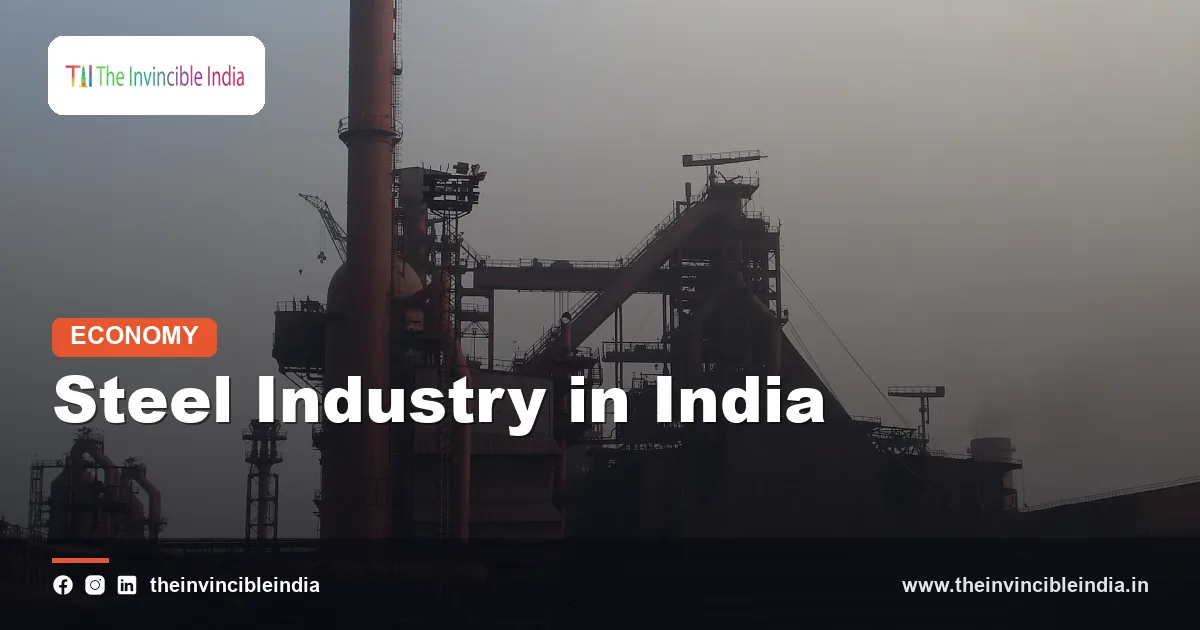
The steel industry in India is one of the largest in the world and a cornerstone of the country’s industrial economy. India ranks as the world’s second-largest producer of crude steel, behind only China, having overtaken Japan in the late 2010s. Steel goes into bridges, railways, buildings, cars, appliances and defence equipment, so its growth closely tracks the broader story of national development.
This explainer tells the story of the steel industry in India from the founding of the Tata Iron and Steel Company in 1907 and the public sector build-up led by SAIL to the dominance of large private groups today. It covers the main players, the National Steel Policy of 2017, the raw materials that feed furnaces, the challenges the sector faces and the shift towards cleaner production.
| Topic | Iron and steel production and use in India |
|---|---|
| Global rank | Second-largest crude steel producer after China |
| First modern integrated steel company | Tata Iron and Steel Company (TISCO), established 1907 at Sakchi, now Jamshedpur |
| First steel produced at Jamshedpur | 1912 |
| Public sector flagship | Steel Authority of India Limited (SAIL), formed in 1973 |
| Major private groups | Tata Steel, JSW Steel, Jindal Steel and Power, ArcelorMittal Nippon Steel India |
| Key policy document | National Steel Policy 2017 |
| Administrative ministry | Ministry of Steel |
Origins: From Ancient Iron to TISCO
India has a very old metallurgical tradition. Wootz steel, produced in southern India and exported across the ancient world, was prized for sword blades, and the Iron Pillar at Delhi, over fifteen centuries old, is a well-known testament to early ironworking skill. These were artisanal industries, however, and modern mass production arrived much later.
The turning point was the vision of Jamsetji Nusserwanji Tata, who dreamed of an Indian steel industry but did not live to see it. After geological surveys found rich iron ore in the region now in Odisha and Jharkhand, his son Sir Dorabji Tata and colleagues established the Tata Iron and Steel Company in 1907 at Sakchi, a village in present-day Jharkhand. The settlement grew into the planned industrial town of Jamshedpur, and the first steel was produced in 1912. Other early units included the Indian Iron and Steel Company at Burnpur in West Bengal and the Mysore Iron Works at Bhadravati in Karnataka, which started in the 1920s.
Why TISCO Mattered
- It supplied steel for railways and, in wartime, for the armed forces.
- It pioneered township planning, welfare facilities and labour practices.
- It showed that large-scale heavy industry could be built with Indian capital.
The Public Sector Era and SAIL
After Independence, steel was treated as a “commanding height” of the economy. The Industrial Policy Resolution of 1956 reserved new steel capacity for the public sector. During the Second Five-Year Plan, the government set up three integrated plants with foreign collaboration: Rourkela in Odisha with German firms, Bhilai in Chhattisgarh with Soviet help and Durgapur in West Bengal with British support. Hindustan Steel Limited, formed in 1954, managed these projects, and Bokaro in Jharkhand followed with Soviet assistance.
The Steel Authority of India Limited (SAIL) was incorporated in 1973 as a holding company that took over Hindustan Steel and other public sector units. Later, it absorbed the older IISCO plant at Burnpur. SAIL also runs special steel plants at Durgapur, Salem and Bhadravati. A separate public sector firm, Rashtriya Ispat Nigam Limited, runs the Visakhapatnam Steel Plant on the Andhra coast, built as a shore-based unit using imported coking coal.
SAIL’s Integrated Plants
- Bhilai Steel Plant (Chhattisgarh)
- Rourkela Steel Plant (Odisha)
- Durgapur Steel Plant (West Bengal)
- Bokaro Steel Plant (Jharkhand)
- IISCO Steel Plant, Burnpur (West Bengal)
Liberalisation and the Rise of Private Players
Until 1991, steel was tightly controlled through licensing, pricing and distribution rules. The reforms of 1991 delicensed the industry and, in the early 1990s, price and distribution controls were removed. Private companies expanded rapidly, often through new greenfield projects with large blast furnaces, electric arc furnaces or direct reduced iron units.
Tata Steel modernised and expanded, built a large new plant at Kalinganagar in Odisha and, in 2007, acquired the Anglo-Dutch group Corus, which gave it a significant presence in Europe. JSW Steel, part of the JSW Group, built the large Vijayanagar works in Karnataka and grew through new capacity and acquisitions. Jindal Steel and Power developed operations at Raigarh in Chhattisgarh and Angul in Odisha, known for long products, rails and structural sections.
The Insolvency and Bankruptcy Code of 2016 brought another wave of change, as stressed steel assets were resolved through competitive bidding. Examples include the takeover of Bhushan Steel by Tata Steel and of Essar Steel by the ArcelorMittal and Nippon Steel combination, now known as ArcelorMittal Nippon Steel India.
Major Players at a Glance
| Company | Ownership | Known for |
|---|---|---|
| SAIL | Public sector | Five integrated plants, rails, plates and structurals |
| Rashtriya Ispat Nigam Limited | Public sector | Coastal integrated plant at Visakhapatnam |
| Tata Steel | Private (Tata group) | Jamshedpur, Kalinganagar, Meramandali; automotive and flat steel |
| JSW Steel | Private (JSW group) | Vijayanagar and other plants; coated and flat steel |
| Jindal Steel and Power | Private (Jindal group) | Raigarh and Angul; rails and structural sections |
| ArcelorMittal Nippon Steel India | Joint venture | Hazira in Gujarat; flat products |
Besides these large groups, a vast number of medium and small producers operate induction furnaces and sponge iron kilns. This “secondary sector” accounts for a considerable share of total output, particularly in long products used in construction.
How Steel Is Made: Routes and Products
Steel can be made in several ways, and India uses a mix of all the main methods.
- Blast furnace and basic oxygen furnace (BF-BOF): iron ore, coking coal and limestone produce molten iron, which is refined into steel. This is used in integrated plants and depends on coking coal.
- Direct reduced iron (DRI) with electric furnaces: iron ore is reduced to sponge iron using gas or non-coking coal, then melted in electric arc or induction furnaces. India is the world’s largest producer of DRI, largely through coal-based kilns.
- Scrap-based electric arc furnaces: recycled steel is melted again, which uses less energy and emits much less carbon dioxide.
Types of Products
- Flat products: hot and cold rolled coils, sheets and coated steel, used in automobiles, appliances and pipes.
- Long products: reinforcement bars (TMT), wire rods and sections, used mainly in building and infrastructure.
- Special steels: alloy, stainless and electrical steel, used in engineering, defence and power equipment.
Raw Materials: Iron Ore and Coking Coal
India is richly endowed with iron ore, mostly haematite and magnetite, found in Odisha, Jharkhand, Chhattisgarh, Karnataka and Goa. Important mining areas include Keonjhar and Sundargarh in Odisha, Singhbhum in Jharkhand, Bailadila in Chhattisgarh and the Bellary-Hospet belt in Karnataka. The National Mineral Development Corporation, a public sector firm founded in 1958, is a leading producer, along with private miners and SAIL’s captive mines.
The weak link is coking coal. Domestic coking coal has high ash and limited availability, so integrated plants import premium grades from overseas, mainly Australia, and other suppliers in recent years. This exposes steelmakers to global price swings and shipping costs. Other inputs include limestone, dolomite, manganese ore, ferro-alloys and scrap.
Mining Law and Auctions
After concerns about illegal mining in some states, the Mines and Minerals (Development and Regulation) Act was amended in 2015 to bring in auctions for mineral concessions. Steel companies have since bid for iron ore blocks, in some cases facing higher costs for ore than under earlier arrangements. Export controls on iron ore have also been used from time to time to keep ore available for domestic mills.
The National Steel Policy 2017
The Government of India released the National Steel Policy in 2017, replacing earlier versions of 2005. It set out a long-term vision for a globally competitive and self-reliant industry. The policy’s headline targets for the year 2030-31 included:
- Total steel-making capacity of 300 million tonnes.
- Crude steel production of around 255 million tonnes.
- Per-capita finished steel consumption of about 158 kilograms.
- Greater self-sufficiency in high-grade automotive steel, electrical steel and special alloys.
The document also called for ensuring raw material security, encouraging domestic manufacturing of steel for strategic sectors, promoting research and development, and lowering the sector’s environmental impact. A related measure in the same year asked that domestically manufactured iron and steel products be given preference in government procurement.
Other Support Measures
- Safeguard and anti-dumping duties to protect against surges of cheap imports.
- A production-linked incentive scheme for specialty steel, approved in 2021.
- A steel scrap recycling policy in 2019 and a vehicle scrapping framework to increase scrap supply.
- Promotion of steel in public infrastructure, including railways and highways.
Demand, Trade and the Economy
Steel consumption in India is driven mainly by construction and infrastructure, followed by capital goods, automobiles, packaging and consumer durables. As the country builds roads, railways, metro lines, ports, housing and industrial corridors, demand for both long and flat products rises. Per-capita consumption is still well below that of many developed and some emerging economies, which suggests room for growth.
India has been both an exporter and importer of steel at different times, depending on global prices and domestic demand. It typically exports semi-finished and finished products to markets in Europe, West Asia, Southeast Asia and Africa, while importing certain specialised steels and, at times, cheaper products from large producers like China, which has led to trade remedy cases. The industry is also a large employer, directly and through allied sectors such as mining, transport, machinery and fabrication.
Challenges Facing the Industry
For all its scale, the steel industry in India faces a range of structural challenges.
- Coking coal dependence: reliance on imports raises costs and creates supply risk.
- Global overcapacity: excess production abroad can lead to dumping and price volatility.
- Logistics: ore, coal and finished steel move largely by rail and road, and bottlenecks raise delivered costs.
- Energy and water use: steel making is energy-intensive, so power prices and availability influence competitiveness.
- Fragmentation: many small units with older technology coexist with world-scale plants, which creates uneven efficiency.
- Debt and cyclicality: heavy capital investment and fluctuating prices have caused financial stress in the past.
- Trade barriers abroad: carbon-related border measures, such as the European Union’s Carbon Border Adjustment Mechanism, could affect exports.
Land acquisition, environmental clearances and the need for skilled workers add to project timelines, and the industry also seeks more research into advanced high-strength steels.
Decarbonisation and the Green Steel Transition
Steel is one of the hardest industrial sectors to decarbonise because conventional blast furnaces use coal as both fuel and chemical reducing agent. India, as a fast-growing producer, will see emissions rise unless technologies change. The sector is also important to the country’s climate commitments, including its goal of net-zero emissions by 2070.
Pathways Being Explored
- Energy efficiency: improvements under the Perform, Achieve and Trade scheme, which sets targets for energy-intensive industries.
- More scrap and electric arc furnaces: using renewable electricity to melt recycled steel.
- Hydrogen-based direct reduction: replacing coal or gas with green hydrogen, supported by the National Green Hydrogen Mission launched in 2023.
- Carbon capture and use: pilot projects to trap emissions from furnaces.
- Waste heat recovery and use of by-products: slag in cement and roads, and gas in power generation.
- Green steel standards: definitions and labelling to help domestic and export markets recognise lower-emission steel.
Several large producers have announced pilot plants and long-term emission-reduction goals. Cost, technology readiness and availability of renewable power will decide how fast the transition proceeds.
Conclusion
From a single plant at Sakchi to the world’s second-largest steel producer, the steel industry in India has travelled a long road. Public sector plants built the foundation, private groups expanded capacity after liberalisation, and policy documents like the National Steel Policy 2017 now guide the next stage. Raw material security, competitiveness and cleaner production remain the central themes for the coming decades.
Frequently Asked Questions
Which country is the largest steel producer, and where does India rank?
China is the largest producer of crude steel by a wide margin, and India ranks second. India moved past Japan to take the second position in the late 2010s and continues to add capacity to meet infrastructure and manufacturing demand.
When was the first modern steel plant established in India?
The Tata Iron and Steel Company was established in 1907 at Sakchi, now Jamshedpur in Jharkhand, and began producing steel in 1912. Other early plants included the Indian Iron and Steel Company at Burnpur and the Mysore Iron Works at Bhadravati.
What is SAIL?
The Steel Authority of India Limited is a public sector steelmaker formed in 1973. It operates integrated steel plants at Bhilai, Rourkela, Durgapur, Bokaro and Burnpur, as well as special steel plants, and is managed under the Ministry of Steel.
What does the National Steel Policy 2017 aim to achieve?
It aims to build a globally competitive and self-reliant steel industry by 2030-31, with targets of 300 million tonnes of capacity, around 255 million tonnes of production and per-capita consumption of roughly 158 kilograms. It also stresses raw material security, quality steel and lower environmental impact.
Why does India import coking coal?
Coking coal is needed in blast furnaces, but India’s domestic reserves are limited and have a high ash content. Steelmakers therefore import better-quality coal, mainly from Australia and other sources, to improve furnace efficiency and meet product specifications.
How is the Indian steel industry becoming greener?
Producers are improving energy efficiency, using more scrap in electric arc furnaces, testing hydrogen-based iron making and exploring carbon capture. The government supports these efforts through schemes such as the National Green Hydrogen Mission and policies on scrap recycling and green steel.


