

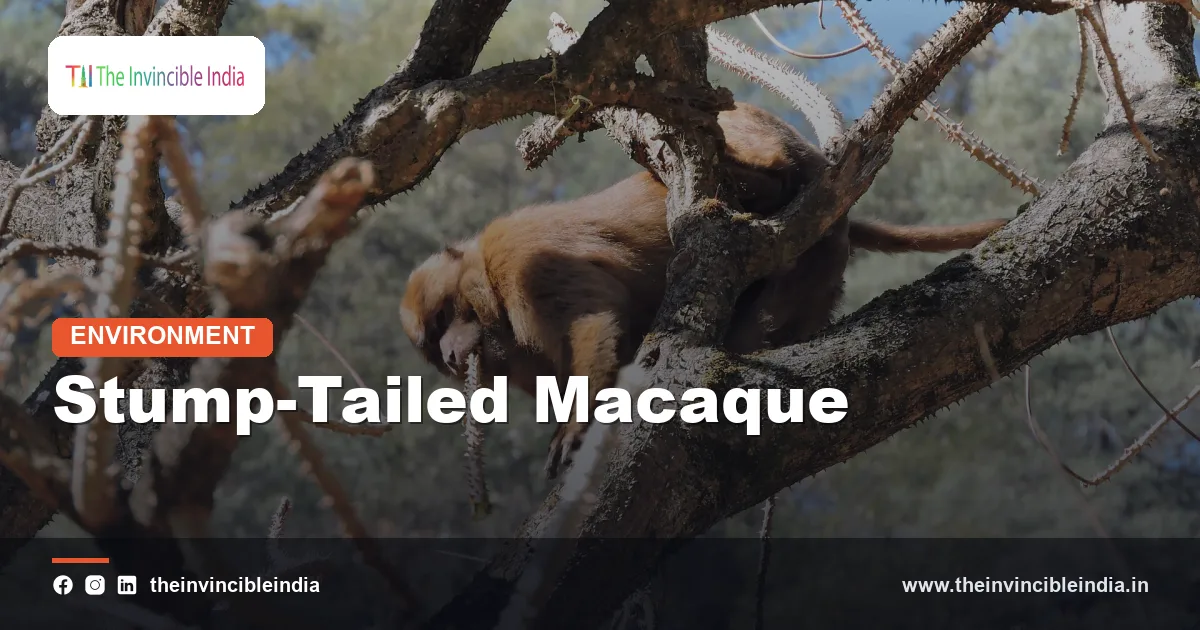
The stump-tailed macaque (Macaca arctoides), also known as the bear macaque, is a heavily built, short-tailed monkey of the evergreen forests of Northeast India and Southeast Asia, and stump-tailed macaque conservation centres on protecting its forest habitat and stopping hunting and capture. The species is listed as Vulnerable by the International Union for Conservation of Nature (IUCN) because its populations are believed to be declining across its range.
The stump-tailed macaque is easy to recognise from its shaggy dark coat, its bare red or brown face and the tiny tail that gives it its name. In India it is found mainly in the Northeast hills, where it shares forests with langurs, gibbons and other primates. This explainer covers its appearance, range, behaviour, threats and protection. It was last reviewed on 17 October 2026.
Quick Facts
| Common names | Stump-tailed macaque, bear macaque |
|---|---|
| Scientific name | Macaca arctoides |
| Family | Cercopithecidae, genus Macaca (macaques) |
| Indian range | Northeast India, including Assam, Arunachal Pradesh, Meghalaya, Nagaland, Manipur, Mizoram and Tripura, in suitable forest |
| Range beyond India | Bangladesh, Myanmar, Thailand, Laos, Cambodia, Vietnam, southern China and the northern Malay Peninsula |
| Habitat | Tropical and subtropical evergreen and semi-evergreen forest, from lowlands to hill forests |
| Distinguishing features | Shaggy dark brown coat, hairless red to dark brown face, very short tail |
| IUCN status | Vulnerable, according to IUCN assessments |
| Legal protection | Protected under the Wildlife (Protection) Act, 1972; listed in CITES Appendix II; readers should check the current Schedule |
Key Takeaways
- The stump-tailed macaque (Macaca arctoides) is a large, short-tailed monkey, also called the bear macaque, found in the evergreen forests of Northeast India and Southeast Asia.
- The stump-tailed macaque is classified as Vulnerable by the IUCN because of habitat loss and hunting that are believed to be reducing populations across its range.
- The stump-tailed macaque is recognised by its shaggy coat, hairless red-to-brown face and a stub of a tail only a few centimetres long.
- Stump-tailed macaques live in large mixed troops, feed mainly on fruit, and also eat leaves, seeds, insects and small animals.
- In India the stump-tailed macaque is a forest species of the Northeast, and it is protected under the Wildlife (Protection) Act, 1972.
- Protecting large tracts of connected evergreen forest and curbing hunting and capture are the most important steps in stump-tailed macaque conservation.
What Is the Stump-Tailed Macaque?
The stump-tailed macaque is a stocky, ground-and-tree living monkey of the genus Macaca, named for its very short tail and also called the bear macaque because of its thick coat and heavy build. It is one of the larger macaques of Asia.
The species is native to the forests of Northeast India and a wide arc of mainland Southeast Asia. Compared with the rhesus macaque, the monkey that most people in India see in towns and temples, the stump-tailed macaque is a shy forest animal that is rarely found near human settlements. Its scientific name, Macaca arctoides, means “bear-like macaque”.
The species has been studied by scientists for its social behaviour, and it is notable for relatively tolerant interactions within troops. It is, however, much less well documented in the wild than some other macaques because it lives in dense, hilly forests that are hard to survey.
What Does a Stump-Tailed Macaque Look Like?
A stump-tailed macaque has a long, shaggy coat of dark brown to blackish fur, a bare face that is red or reddish-brown and darkens with age, and a short stub of a tail only a few centimetres long. The build is stocky, with short limbs and a robust body.
Adult males are noticeably larger than females, and in the wild adult males commonly weigh around ten kilograms or more, with considerable variation. As animals age, the hair on the crown often thins, giving older individuals a partly bald forehead. The face may become deep brown or nearly black and is often patchy with age and sun exposure. Infants are born with a paler coat and pinker face, and they darken as they grow.
Why is the tail so short?
The stub-like tail is a feature of the species and is thought to reflect a lifestyle spent partly on the ground and in lower forest layers, where a long balancing tail is less critical than in the treetops. Several other macaques also have reduced tails, and the trait varies between species.
Where Does the Stump-Tailed Macaque Live in India?
The stump-tailed macaque lives in the hill and foothill forests of Northeast India, mainly in Assam, Arunachal Pradesh, Meghalaya, Nagaland, Manipur, Mizoram and Tripura, usually in evergreen and semi-evergreen forest. Populations in India are patchy and concentrated in larger forest blocks.
It has been recorded in protected areas such as Namdapha National Park, Pakke Tiger Reserve, Manas National Park, Dampa Tiger Reserve and the Gibbon Wildlife Sanctuary, though the precise list of sites depends on survey effort. Outside India, the monkey ranges through Bangladesh, Myanmar, Thailand, Laos, Cambodia, Vietnam, southern China and the northern part of the Malay Peninsula.
The species occurs from low-lying forest to hills of well over a thousand metres, and it prefers areas with continuous tree cover. In the Northeast it often shares habitat with other primates, including the capped langur, the Assamese macaque and the western hoolock gibbon.
How Does the Stump-Tailed Macaque Live and Feed?
The stump-tailed macaque lives in large multi-male, multi-female troops and feeds mainly on fruit, supplemented by leaves, seeds, flowers, insects and small animals. Troop sizes vary but can reach a few dozen individuals in good habitat.
The monkeys forage both on the ground and in trees, and they may travel long distances across the forest floor between feeding sites. They are known to eat small animals such as crabs, frogs, birds’ eggs and insects, which provide protein alongside fruit. Where forests border farmland, they may also raid crops, a habit that brings them into conflict with villagers.
Social life
Within the troop there is a clear dominance hierarchy, but researchers have described the stump-tailed macaque as relatively tolerant, with frequent reconciliation after conflicts and notable cooperation, including adult males taking an interest in infants. Such behaviour has made the species a subject of research in primate sociality.
Reproduction
Females give birth to a single infant, after a gestation of around six months, and infants cling to their mothers for the early months of life. Sexual maturity is reached after several years, which means populations recover slowly after a decline.
Ecological role
By eating fruit and passing seeds in their droppings, stump-tailed macaques help to disperse the seeds of forest trees. This role makes them valuable to forest regeneration, and their decline may reduce seed movement in the forests they inhabit.
Why Is the Stump-Tailed Macaque Vulnerable?
The stump-tailed macaque is considered Vulnerable because its forests are being lost and degraded and because the animals are hunted and captured across much of their range. In IUCN terms, Vulnerable means that the species faces a high risk of extinction in the wild in the medium term.
Reliable counts of the species are hard to obtain, because it lives in remote, rugged forests. Assessments therefore rely on survey sites, reported declines and estimates of habitat loss. As a result, population figures for India should be treated as approximate, and any number quoted should be read with caution.
What Are the Main Threats to the Stump-Tailed Macaque?
The main threats to the stump-tailed macaque are loss and fragmentation of forest, hunting for meat and traditional medicine, capture for the pet trade, and retaliation in crop-raiding conflicts. These pressures often act together in the same landscape.
Habitat loss
Evergreen forests in the Northeast and Southeast Asia have been cleared for agriculture, plantations, logging, roads and hydropower. Even where forest remains, fragmentation isolates troops and limits access to fruiting trees.
Hunting
In many parts of the species’ range, monkeys are hunted as food or for body parts used in local medicine. Hunting is illegal in India, but remote forests are hard to patrol, and demand for wild meat persists in some areas.
Capture and trade
Infant macaques are sometimes captured for the pet trade, which often involves killing the mother. The species has also been used in biomedical research in some countries. India restricted the export of monkeys for research decades ago, and international trade is regulated under CITES.
Human-wildlife conflict
When forests shrink, troops may move into fields and orchards, damaging crops. Villagers may respond by chasing, trapping or killing the animals, which worsens the pressure on already declining populations.
How Is the Stump-Tailed Macaque Protected in India?
The stump-tailed macaque is protected in India under the Wildlife (Protection) Act, 1972, which prohibits hunting and trade in listed species, and it is listed in Appendix II of CITES, which regulates international trade. Schedule placements under the Act were reorganised by the 2022 amendment, so the current Schedule should be checked in the latest notified text.
Habitat protection is provided mainly through national parks, wildlife sanctuaries and tiger reserves in the Northeast, along with reserved and community-managed forests. Forest departments and wildlife wardens are responsible for enforcement.
Protection tools at a glance
| Tool | What it does |
|---|---|
| Wildlife (Protection) Act, 1972 | Prohibits hunting, capture and trade; enables protected areas |
| National parks, sanctuaries and tiger reserves | Secure large forest blocks such as Namdapha, Pakke, Manas and Dampa |
| CITES Appendix II | Regulates international trade through permits |
| Community forests | Extend habitat protection outside formal reserves |
| Awareness and anti-poaching work | Reduce hunting and pet-trade demand |
| Field surveys | Provide data for assessing population trends |
How Does the Stump-Tailed Macaque Differ From Other Macaques in India?
The stump-tailed macaque differs from other Indian macaques mainly in its short tail, shaggy coat and forest habitat, whereas other macaques such as the rhesus are more adaptable and live near people. India has several macaque species, and each has its own range and ecological niche.
| Species | Tail | Typical habitat | Notes |
|---|---|---|---|
| Stump-tailed macaque | Very short stub | Evergreen forests of the Northeast | Shy; Vulnerable per IUCN |
| Rhesus macaque | Medium length | Forests, towns, temples and farmland across much of India | Highly adaptable; common |
| Assamese macaque | Medium length | Hill forests of the Northeast and Himalayan foothills | Shares habitat with the stump-tailed macaque in some areas |
| Bonnet macaque | Long | Peninsular India | Found in the south |
| Lion-tailed macaque | Long, tufted | Rainforests of the Western Ghats | Endemic and endangered |
What Conservation Measures Help the Stump-Tailed Macaque?
Conservation measures that help the stump-tailed macaque include protecting large, connected evergreen forests, enforcing anti-hunting laws, controlling the pet trade, reducing conflict with farmers and carrying out regular surveys. The species needs forest that is continuous enough for troops to range widely.
- Safeguard core habitat: maintain strong protection of national parks, sanctuaries and tiger reserves in the Northeast.
- Link forest blocks: restore corridors and plant native fruiting trees between fragments.
- Enforce the law: patrol against hunting and trade and prosecute wildlife crime.
- Reduce conflict: help farmers with crop protection near forest edges to avoid retaliation.
- Engage communities: involve villages in forest protection and offer alternative livelihoods to hunting.
- Monitor populations: use camera traps and transect surveys to track numbers and distribution.
Why Does Stump-Tailed Macaque Conservation Matter?
Stump-tailed macaque conservation matters because the species is a Vulnerable forest primate and a seed disperser, and because protecting its habitat also protects many other species of the Northeast. The region is among the richest in primate diversity in India, and the stump-tailed macaque is one part of that wealth.
The monkey also has scientific value, as research into its social behaviour helps scientists understand tolerance, conflict resolution and cooperation in primates. Its decline would be a loss for both ecology and science.
Bottom Line
The stump-tailed macaque is a Vulnerable, shaggy-coated monkey of the evergreen forests of Northeast India, recognisable by its red face and stub tail. Its future relies on keeping large forest blocks connected, stopping hunting and capture, and working with local communities to reduce conflict.
Frequently Asked Questions
What is a stump-tailed macaque?
A stump-tailed macaque is a large, stocky monkey, scientifically Macaca arctoides, also called the bear macaque. It has a shaggy dark coat, a hairless red to brown face and a very short tail. It lives in the evergreen forests of Northeast India and parts of Southeast Asia.
Why is it called a stump-tailed macaque?
It is called a stump-tailed macaque because its tail is only a short stub, a few centimetres long. The name distinguishes it from other macaques that have longer tails. It is also called the bear macaque because of its thick coat and heavy build.
Where is the stump-tailed macaque found in India?
The stump-tailed macaque is found in the forests of Northeast India, including Assam, Arunachal Pradesh, Meghalaya, Nagaland, Manipur, Mizoram and Tripura. It has been recorded in areas such as Namdapha, Pakke and Manas. Outside India it lives in Bangladesh, Myanmar and several Southeast Asian countries.
Is the stump-tailed macaque endangered?
The stump-tailed macaque is classified as Vulnerable by the IUCN, which means it faces a high risk of extinction in the wild in the medium term. It is not classed as Endangered. Habitat loss and hunting are the main causes of its decline.
What does the stump-tailed macaque eat?
The stump-tailed macaque eats mainly fruit, along with leaves, seeds, flowers, insects and small animals such as crabs and frogs. It also raids crops near forest edges. By eating fruit, it helps to spread forest tree seeds.
How is the stump-tailed macaque protected in India?
The stump-tailed macaque is protected under the Wildlife (Protection) Act, 1972, which bans hunting and trade, and by protected areas such as national parks and tiger reserves in the Northeast. It is also listed in CITES Appendix II. The exact Schedule listing should be checked in the latest text of the Act.
{“@context”:”https://schema.org”,”@graph”:[{“@type”:”FAQPage”,”mainEntity”:[{“@type”:”Question”,”name”:”What is a stump-tailed macaque?”,”acceptedAnswer”:{“@type”:”Answer”,”text”:”A stump-tailed macaque is a large, stocky monkey, scientifically Macaca arctoides, also called the bear macaque. It has a shaggy dark coat, a hairless red to brown face and a very short tail. It lives in the evergreen forests of Northeast India and parts of Southeast Asia.”}},{“@type”:”Question”,”name”:”Why is it called a stump-tailed macaque?”,”acceptedAnswer”:{“@type”:”Answer”,”text”:”It is called a stump-tailed macaque because its tail is only a short stub, a few centimetres long. The name distinguishes it from other macaques that have longer tails. It is also called the bear macaque because of its thick coat and heavy build.”}},{“@type”:”Question”,”name”:”Where is the stump-tailed macaque found in India?”,”acceptedAnswer”:{“@type”:”Answer”,”text”:”The stump-tailed macaque is found in the forests of Northeast India, including Assam, Arunachal Pradesh, Meghalaya, Nagaland, Manipur, Mizoram and Tripura. It has been recorded in areas such as Namdapha, Pakke and Manas. Outside India it lives in Bangladesh, Myanmar and several Southeast Asian countries.”}},{“@type”:”Question”,”name”:”Is the stump-tailed macaque endangered?”,”acceptedAnswer”:{“@type”:”Answer”,”text”:”The stump-tailed macaque is classified as Vulnerable by the IUCN, which means it faces a high risk of extinction in the wild in the medium term. It is not classed as Endangered. Habitat loss and hunting are the main causes of its decline.”}},{“@type”:”Question”,”name”:”What does the stump-tailed macaque eat?”,”acceptedAnswer”:{“@type”:”Answer”,”text”:”The stump-tailed macaque eats mainly fruit, along with leaves, seeds, flowers, insects and small animals such as crabs and frogs. It also raids crops near forest edges. By eating fruit, it helps to spread forest tree seeds.”}},{“@type”:”Question”,”name”:”How is the stump-tailed macaque protected in India?”,”acceptedAnswer”:{“@type”:”Answer”,”text”:”The stump-tailed macaque is protected under the Wildlife (Protection) Act, 1972, which bans hunting and trade, and by protected areas such as national parks and tiger reserves in the Northeast. It is also listed in CITES Appendix II. The exact Schedule listing should be checked in the latest text of the Act.”}}]}]}


