

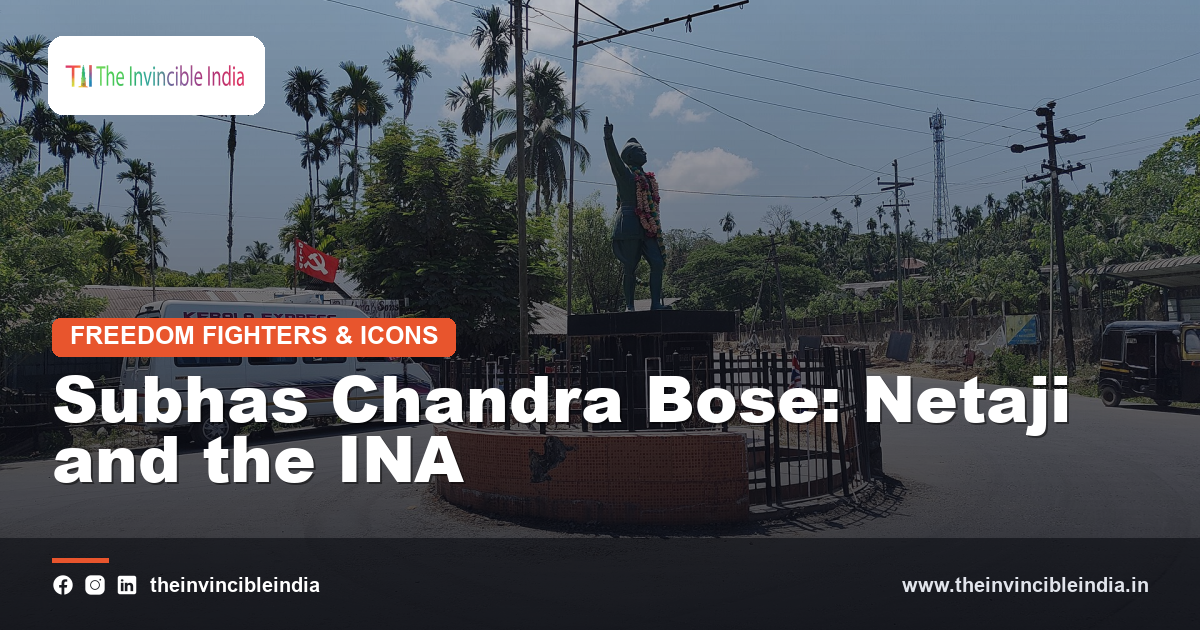
Subhas Chandra Bose, revered as Netaji, meaning respected leader, was one of the most dynamic and beloved figures of India’s freedom struggle, a fiery patriot who believed that freedom must be won through determined struggle. A brilliant and charismatic leader, he broke from the mainstream of the movement to pursue a more militant path, and during the Second World War he led the Indian National Army in an armed campaign for India’s liberation. His stirring call, promising freedom in exchange for sacrifice, and his greeting of Jai Hind, meaning victory to India, became rallying cries of the nation. Though his life ended in mystery, his memory is cherished as that of a fearless hero. This guide explores the life, struggle and enduring legacy of Netaji Subhas Chandra Bose, one of India’s greatest freedom fighters.
Quick Facts
| Detail | Information |
|---|---|
| Born | 23 January 1897, in Cuttack, Odisha |
| Known as | Netaji, meaning respected leader |
| Belief | That freedom must be won through determined struggle |
| Led | The Indian National Army (Azad Hind Fauj) |
| Famous words | Give me blood, and I shall give you freedom; Jai Hind |
| Government | Formed the Azad Hind provisional government |
The Fearless Leader
Subhas Chandra Bose, revered as Netaji, was one of the most dynamic, charismatic and beloved leaders of India’s freedom struggle, a fearless patriot whose passionate commitment to freedom inspired millions. Unlike some other leaders, Bose believed that India’s freedom would have to be won through determined and, if necessary, armed struggle, and he pursued this path with courage and conviction. His fiery patriotism, his organisational genius, and his willingness to sacrifice everything for the cause made him a hero to the nation, and his memory is cherished with deep affection and pride. As Netaji, the respected leader, Subhas Chandra Bose holds a place of the highest honour among the heroes of India’s freedom struggle and its most beloved national icons.
Early Life and Education
Subhas Chandra Bose was born on 23 January 1897 in Cuttack, in Odisha, into a well-to-do and educated family. A brilliant student, he received an excellent education and went to England, where he prepared for and passed the prestigious civil service examination, an achievement that promised a comfortable and distinguished career. But Bose’s heart was in the cause of his country’s freedom, and in a striking act of patriotic sacrifice, he gave up the security of the civil service to devote himself to the struggle for independence. This early decision to renounce a promising career for the cause of freedom revealed the depth of his patriotism and his commitment, and it set the course for his life as one of the great leaders of the freedom struggle.
Entry into the Freedom Struggle
Having given up the civil service, Bose threw himself into the freedom struggle, rising rapidly through the ranks of the national movement through his energy, ability and dedication. He became a prominent and popular leader, admired especially by the youth for his fiery patriotism and his uncompromising commitment to complete independence. Bose brought great organisational skill and a passionate, radical spirit to the movement, and he became one of its most dynamic figures. His entry into the freedom struggle and his rapid rise to prominence marked the beginning of his career as one of its foremost leaders, and his energy and radicalism brought a new force and urgency to the demand for freedom.
A More Militant Path
Bose came to believe that India’s freedom could not be won by moderate means alone and that a more determined and militant path was needed, a conviction that set him apart from some other leaders of the movement. While he respected the great figures of the struggle, he differed from the strategy of purely non-violent methods and believed that the situation called for a more forceful approach to winning freedom. This difference in strategy led eventually to his breaking away to pursue his own path. Bose’s belief in a more militant road to freedom, and his willingness to act on that conviction, distinguished him among the leaders of the movement and led him towards the dramatic course of armed struggle for which he is above all remembered.
The Break and the Journey
Convinced of the need for a different path, Bose eventually broke away to pursue the armed struggle for freedom, embarking on one of the most dramatic episodes of the freedom movement. During the Second World War, he made a daring escape from India and undertook an extraordinary journey abroad in search of support for the liberation of his country, seeking help from powers then at war with the British. This bold and perilous journey, undertaken in secret and against great odds, took him far from India in pursuit of his goal. This dramatic escape and journey abroad in search of support for India’s freedom is one of the most remarkable episodes in the story of Bose and of the freedom struggle, revealing his courage and determination.
The Indian National Army
The great achievement of Bose’s armed struggle was his leadership of the Indian National Army, the Azad Hind Fauj, a force raised to fight for the liberation of India. Bose took command of and reorganised this army, made up largely of Indians who had been prisoners of war and of Indians living abroad, and he inspired it with his vision of a free India, leading it in a campaign to liberate the country from the east during the war. Under his leadership, the Indian National Army became a powerful symbol of the armed struggle for freedom. Bose’s leadership of the Indian National Army, and its campaign for the liberation of India, is the central and most celebrated chapter of his life and his greatest contribution to the freedom struggle.
Give Me Blood
Bose was a stirring orator whose passionate speeches inspired his followers and the nation, and his most famous exhortation, promising freedom in return for the sacrifice of blood, became one of the most memorable rallying cries of the freedom struggle. In this famous call, he asked his soldiers and countrymen for their sacrifice and dedication, promising that such sacrifice would win the freedom of India. This stirring appeal captured the spirit of his leadership and his belief in the necessity of struggle and sacrifice for the cause of freedom. This famous exhortation, promising freedom in exchange for sacrifice, remains one of the most stirring and celebrated calls of the freedom struggle and is forever associated with the fiery patriotism of Netaji.
Jai Hind
Among the enduring legacies of Bose is the greeting Jai Hind, meaning victory to India, which he popularised as a slogan and salute of the freedom movement and which became a rallying cry of the nation. This stirring greeting, expressing the aspiration for India’s victory and freedom, was adopted by Bose and his Indian National Army and spread across the country, and it remains in use to this day as a patriotic salute. The phrase Jai Hind, associated with Bose and the freedom struggle, is one of his lasting contributions to the national spirit. This famous greeting, popularised by Netaji, endures as a beloved patriotic salute and a lasting symbol of the freedom struggle and of Bose’s role in it.
The Azad Hind Government
As part of his struggle for freedom, Bose established a provisional government of free India, known as the Azad Hind government, to lead the fight for liberation and to represent the aspiration for an independent India. This provisional government, formed abroad during the war, was a bold assertion of India’s claim to independence and of Bose’s vision of a free nation, and it gave a political framework to the armed struggle of the Indian National Army. The formation of the Azad Hind government was a significant and symbolic act in the freedom struggle. This provisional government of free India, established by Bose, expressed the determination to win and to govern an independent India and is an important part of the story of his struggle for freedom.
A Charismatic Leader
Bose was a leader of extraordinary charisma, whose personal magnetism, courage and passionate commitment inspired intense devotion among his followers and admiration across the nation. He had a remarkable ability to inspire and to lead, and he won the loyalty and love of his soldiers and of the people through his fearless dedication to the cause of freedom. His charisma, combined with his organisational genius and his willingness to sacrifice everything, made him one of the most beloved and inspiring figures of the freedom struggle. This charismatic leadership, which won him the devotion of his followers and the love of the nation, was central to Bose’s role and is a large part of why he is remembered with such affection and pride as Netaji, the beloved leader.
A Vision for India
Beyond the immediate struggle for freedom, Bose held a vision for the future of India as a strong, united, modern and independent nation, free from oppression and injustice. He believed in the unity of all Indians, regardless of religion or region, and his Indian National Army embodied this ideal of national unity, bringing together Indians of different faiths and backgrounds in the common cause of freedom. His vision was of a free India that would take its rightful place in the world. This vision of a strong, united and independent India, and his commitment to national unity across the divisions of religion and region, was an important part of Bose’s ideals and adds to the significance of his legacy as a national leader.
Women in the Struggle
A notable and progressive aspect of Bose’s leadership was his inclusion of women in the armed struggle for freedom, an unusual step for the time. His Indian National Army included a regiment of women soldiers, reflecting his belief in the equal role of women in the fight for freedom and his progressive vision of national unity and participation. This inclusion of women as soldiers in the struggle for independence was a striking and forward-looking feature of Bose’s movement. The role of women in Bose’s Indian National Army reflects his progressive ideals and his vision of the participation of all Indians, women as well as men, in the cause of freedom, and it is a notable and inspiring aspect of his leadership.
The Mystery of His End
The life of Subhas Chandra Bose ended in mystery, for the circumstances of his death have long been the subject of question and debate. He is widely reported to have died in an accident in 1945, near the end of the war, but the circumstances of his passing have been questioned by some, and his end remains one of the enduring mysteries of modern Indian history, the subject of much speculation and investigation over the years. Whatever the truth of his end, the uncertainty surrounding it has only added to the legend of Netaji. The mystery of Bose’s end is a striking and much-discussed aspect of his story, and it has contributed to the enduring fascination with his life and to his legendary status in the memory of the nation.
The Legacy of Netaji
The legacy of Subhas Chandra Bose is that of a fearless patriot and hero who gave everything for the freedom of his country, and his memory is cherished with deep affection and pride across India. Though his path differed from that of some other leaders, his courage, his sacrifice and his passionate love of country have made him one of the most beloved figures of the freedom struggle, honoured and admired across the nation. His stirring words, his greeting of Jai Hind, and his example of fearless dedication continue to inspire. This legacy, as Netaji, the fearless and beloved leader who fought for India’s freedom through determined struggle, secures Bose’s place among the greatest heroes of the freedom movement and the most cherished of India’s national icons.
Bose Remembered Today
Today Subhas Chandra Bose is remembered and honoured across India as one of the greatest heroes of the freedom struggle, his memory cherished with pride and affection. His birthday is commemorated, his statues and memorials honour his contribution, and his stirring words and his example continue to inspire the nation, especially the young. He is celebrated as a symbol of fearless patriotism, sacrifice and determination in the cause of freedom. His greeting of Jai Hind remains in daily use as a patriotic salute. As Netaji, the beloved and fearless leader who led the armed struggle for India’s freedom and who gave everything for his country, Subhas Chandra Bose endures as one of the most revered and inspiring of India’s freedom fighters and national icons.
Sources & Further Reading
- Ministry of Culture, Government of India, on Subhas Chandra Bose and the freedom struggle (indiaculture.gov.in).
- National archives and memorials devoted to Netaji and the Indian National Army.
Frequently Asked Questions
Who was Subhas Chandra Bose?
Subhas Chandra Bose, revered as Netaji, was one of the most dynamic and beloved leaders of India’s freedom struggle, a fiery patriot who believed freedom must be won through determined struggle and who led the Indian National Army in an armed campaign for India’s liberation.
What was the Indian National Army?
The Indian National Army, or Azad Hind Fauj, was a force led by Subhas Chandra Bose to fight for the liberation of India, made up largely of Indians who had been prisoners of war and Indians living abroad, which campaigned for the country’s freedom during the Second World War.
What are Bose's most famous words?
Bose’s most famous words include his stirring exhortation promising freedom in return for the sacrifice of blood, and his greeting Jai Hind, meaning victory to India, which he popularised and which remains in use as a patriotic salute to this day.
Why is Bose called Netaji?
Bose is called Netaji, meaning respected leader, a title of honour and affection given to him by his followers and the nation in recognition of his charismatic leadership, his fearless patriotism and his devotion to the cause of India’s freedom.
How did Subhas Chandra Bose die?
Subhas Chandra Bose is widely reported to have died in an accident in 1945, near the end of the Second World War, but the circumstances of his death have long been questioned and debated, and his end remains one of the enduring mysteries of modern Indian history.


