

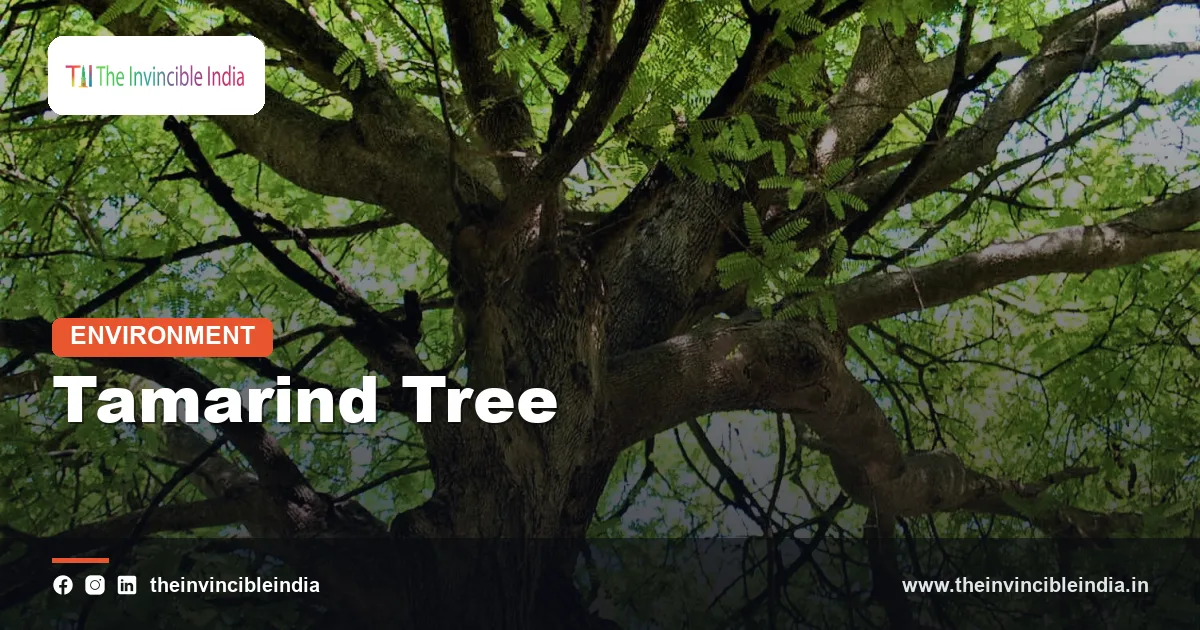
The tamarind tree (Tamarindus indica), known in Hindi as imli, is a long-lived, broad-crowned tropical tree whose sour-sweet pod pulp is one of the defining flavours of Indian cooking. Although it is now thoroughly Indian in cultural terms, the tree is believed to have originated in tropical Africa and was carried to the subcontinent many centuries ago.
Beyond the kitchen, the tamarind tree is valued for its dense shade, its hard, durable wood and its hardiness in dry weather, and it is surrounded by a rich body of folklore. This explainer covers what the tamarind tree is, where it came from, how it is used in sambar, chutneys and other dishes, how long it lives, and how to treat the popular belief that sleeping beneath it is harmful. Information was last reviewed on 22 October 2026.
| Attribute | Detail |
|---|---|
| Scientific name | Tamarindus indica |
| Family | Fabaceae (the legume family) |
| Common names | Tamarind, imli (Hindi), puli (Tamil), chinta (Telugu), hunase (Kannada), chinch (Marathi) |
| Origin | Tropical Africa, introduced to the Indian subcontinent in ancient times |
| Typical height | Often 12 to 25 metres, with a dense, spreading crown |
| Edible part | The sticky, sour-sweet pulp inside brown pods |
| Main acid in the pulp | Tartaric acid |
| Typical lifespan | Commonly 150 to 200 years, and sometimes longer |
| Key culinary uses | Sambar, rasam, chutneys, chaat, pulihora and many regional curries |
Key Takeaways
- The tamarind tree, Tamarindus indica, is a legume-family tree whose brown pods contain a sour-sweet pulp used throughout Indian cooking.
- The tamarind tree is believed to be native to tropical Africa, and its English name comes from the Arabic tamar hindi, meaning “date of India”.
- Tamarind pulp gets its sourness mainly from tartaric acid and is used to flavour sambar, rasam, chutneys, chaat and rice dishes across the country.
- A tamarind tree grows slowly into a large, dense-crowned tree and can live for well over a century.
- The heartwood of the tamarind tree is dark, hard and dense, and it has traditionally been used for mortars, pestles, oil presses and chopping blocks.
- The folk belief that sleeping under a tamarind tree is harmful is a tradition without scientific support, though the thick shade can be damp and dark at night.
What is the tamarind tree?
The tamarind tree is a large tropical tree in the legume family, Fabaceae, grown for its edible pod pulp, its shade and its strong wood. Its botanical name is Tamarindus indica, and it is the only species in its genus.
The tree produces long, curved, brown pods that hold a sticky brown pulp surrounding several hard, glossy seeds. This pulp is the tamarind used in kitchens, and it has been traded across the Indian Ocean world for many centuries. In Hindi and Urdu it is called imli, in Tamil puli, in Telugu chinta, in Kannada hunase and in Marathi chinch.
Where did the tamarind tree originate and how did it reach India?
The tamarind tree is believed to have originated in the dry savannas of tropical Africa and to have reached the Indian subcontinent in ancient times, probably through early trade across the Indian Ocean. Botanists generally regard it as native to Africa, though it has been cultivated in India for so long that it feels entirely local.
The English word tamarind comes from the Arabic tamar hindi, meaning “date of India”. The name suggests that Arab traders first met the fruit in India and likened its dark, sticky pulp to dates. From India and the wider Indian Ocean world, the tree later travelled to Southeast Asia and, after the sixteenth century, to the Americas, where it is now common in Mexico, the Caribbean and parts of South America.
How can you identify a tamarind tree?
A tamarind tree can be identified by its dense, rounded crown, its feathery compound leaves and its brown, bean-like pods hanging from the branches. The trunk is thick and rough, with grey-brown bark that cracks into patches with age, and the tree often looks dome-shaped from a distance.
Leaves and flowers
The leaves are pinnate, made of many pairs of tiny oblong leaflets, which gives the canopy a fine, feathery look. The leaflets fold together at night and in cloudy weather, a behaviour called nyctinasty. The flowers are small, in loose clusters, with yellowish petals streaked with red.
Pods
The pods are typically 5 to 15 centimetres long, curved and cylindrical or slightly flattened, with a brittle, tan-brown shell. Inside lies the fibrous, sticky pulp that gives tamarind its flavour. Raw young pods are green and very sour, and ripe pods are brown and sweeter with a pleasant tang.
Why is tamarind central to Indian cooking?
Tamarind is central to Indian cooking because it provides a reliable, natural source of sourness that balances heat, sweetness and salt, especially across South India and in many chutneys and street foods. Before the wide availability of other souring agents, tamarind was among the most versatile ways to give curries and lentil dishes a tangy edge.
Tamarind pulp is soaked in warm water and strained to make the liquid used in dishes. The characteristic sourness comes mainly from tartaric acid, which is unusually abundant in tamarind among common foods, along with smaller amounts of other organic acids and natural sugars.
| Dish or preparation | Role of tamarind |
|---|---|
| Sambar | Gives the lentil and vegetable stew its tangy base |
| Rasam | Provides the sour backbone of the thin, peppery broth |
| Imli chutney (meethi chutney) | Blended with jaggery and spices as a sweet-sour sauce for samosas and chaat |
| Pani puri water (imli pani) | Adds tang to the spiced water that fills the puris |
| Pulihora or puliyogare | Flavours tamarind rice in Andhra Pradesh, Telangana, Karnataka and Tamil Nadu |
| Imli candy and pulp sweets | Sweetened and spiced tamarind snacks popular across the country |
How long does a tamarind tree live and how does it grow?
A tamarind tree usually lives for 150 to 200 years and sometimes much longer, growing slowly into a large, sturdy tree with a very long productive life. Seed-grown trees can take around a decade or more to bear fruit, whereas grafted or selected trees often fruit sooner.
The tamarind tree is well adapted to hot, seasonally dry climates and, once established, tolerates drought, heat and coastal winds better than many fruit trees. It prefers full sun and well-drained soils and is damaged by frost. Its deep taproot helps it endure dry spells, and its wood is strong enough to withstand storms that break weaker trees.
Because of this durability, tamarind trees are often the oldest trees in a village or along an old road. They have been planted as avenue trees for shade, and large old specimens are common in the countryside of the Deccan and southern India.
What is tamarind wood used for?
Tamarind wood is used for heavy-duty items such as mortars, pestles, oil presses, chopping blocks, tool handles and furniture, because the heartwood is dark, very hard and dense. It resists wear well and takes a good polish, although it is difficult to work with and slow to season.
In rural India, tamarind wood has also been valued as fuel and for making high-quality charcoal. Because the tree grows slowly, the timber is considered valuable, and the tree is often kept for its fruit rather than felled for wood.
Is it true that sleeping under a tamarind tree is harmful?
No, there is no scientific evidence that sleeping under a tamarind tree is harmful, and the belief is best understood as folklore. In many parts of India, stories describe tamarind trees as the homes of spirits, and people are warned against resting beneath them at night.
Several practical explanations are offered for the tradition. The tamarind’s thick, low canopy creates deep, dark shade and can hold humid, still air, which can feel oppressive, and a large old tree at the edge of a village was an easy place for ghost stories to attach. It has also been suggested that such tales may have helped keep people, and especially children, away from places where falling branches or snakes were possible. These are plausible explanations rather than proven origins.
It is therefore safest to treat the belief as cultural heritage. Resting in the daytime shade of a tamarind tree is common in India, and the tree’s shade is widely appreciated in hot weather.
What other uses does the tamarind tree have?
The tamarind tree has uses beyond cooking, including seed-based industrial products, traditional remedies and shade. Each part of the tree has been put to some use in rural economies.
- Seeds: the seed kernel is ground into tamarind kernel powder, a starchy material traditionally used as a sizing agent in textile and jute processing and as a source of a plant gum used as a thickener.
- Leaves and flowers: the young leaves and flowers are eaten in some regions, and they are used in chutneys and soups.
- Traditional medicine: tamarind pulp is used in Ayurveda and folk practice as a mild digestive and cooling drink, though such uses are traditional and not a substitute for medical advice.
- Cleaning: the acidic pulp has long been used to clean brass and copper utensils and temple vessels.
- Shade and wind protection: the dense canopy provides shelter in village squares and farmland.
Where is tamarind grown in India?
Tamarind is grown mainly in the peninsular and central parts of India, and states including Chhattisgarh, Andhra Pradesh, Karnataka, Tamil Nadu and Maharashtra are important sources of tamarind. India is generally counted among the world’s largest producers and consumers of tamarind.
Much tamarind in India comes from scattered trees on farm boundaries, village commons and forest fringes rather than from large plantations. In forest regions such as Bastar in Chhattisgarh, tamarind is among the produce collected by tribal communities and sold in local markets. Specific production figures vary from year to year.
Does tamarind have nutritional or health value?
Tamarind pulp provides carbohydrates in the form of natural sugars, along with organic acids, dietary fibre and small amounts of minerals such as potassium, magnesium and iron, but it is eaten in small quantities and is not a major source of any single nutrient. Its main role in the diet is flavour rather than nutrition.
In traditional Indian practice, a cooling drink made from tamarind pulp is taken in summer, and the pulp is used as a mild digestive aid. Scientific studies have examined tamarind extracts for antioxidant and other properties, but most of this research is early-stage, and tamarind should not be seen as a treatment for any disease. Because tamarind is acidic and sticky, frequent snacking on sweetened tamarind candy can contribute to tooth wear and cavities, and people who take regular medication or have a medical condition should check with a doctor before consuming large amounts as a supplement.
How is the tamarind tree grown and cared for?
The tamarind tree is grown from seed or by grafting, and it needs a warm climate, full sun, well-drained soil and patience, since it matures slowly. Seeds have hard coats and germinate better after soaking in water, while grafted saplings of selected varieties usually begin to bear fruit earlier than seedlings.
Young trees need regular watering for the first few years and protection from grazing animals, after which they rarely need much care. Mature trees are normally harvested once a year, when the pods ripen and dry on the branches, typically in the dry months of winter and early summer. The pods are knocked or picked, the shells removed, and the pulp is pressed into blocks or sold with its seeds still inside. Because the tree grows large and spreads widely, it should be planted well away from buildings, wires and boundary walls.
Bottom Line
The tamarind tree is a long-lived, shade-giving tree of African origin that became thoroughly woven into Indian food, trade and folklore. It matters for its tangy pulp, its strong wood and its endurance, while the belief that sleeping under it is harmful is a tradition rather than established fact.
Frequently Asked Questions
What is the scientific name of the tamarind tree?
The scientific name of the tamarind tree is Tamarindus indica. It belongs to the legume family Fabaceae and is known as imli in Hindi.
Is the tamarind tree native to India?
No, the tamarind tree is believed to be native to tropical Africa rather than India. It reached the Indian subcontinent in ancient times and has been cultivated there for so long that it is now part of everyday Indian life. The English name comes from the Arabic tamar hindi, meaning “date of India”.
Why is tamarind used in sambar and rasam?
Tamarind is used in sambar and rasam because its sourness, which comes mainly from tartaric acid, balances the spices, lentils and vegetables. The strained liquid of soaked tamarind pulp gives these South Indian dishes their characteristic tangy base.
How long does a tamarind tree live?
A tamarind tree commonly lives for 150 to 200 years and sometimes longer. It grows slowly, tolerates drought and heat, and is often among the oldest trees in a village or beside an old road.
Is it dangerous to sleep under a tamarind tree?
No, there is no scientific evidence that sleeping under a tamarind tree is dangerous. The belief is folklore, and the tree’s dense, dark shade and its association with ghost stories probably explain why the tradition arose. Resting in its daytime shade is common and generally considered pleasant.
What is tamarind wood used for?
Tamarind wood is used for mortars, pestles, oil presses, chopping blocks, tool handles and some furniture because it is dark, hard and dense. It is also valued as fuel and for making charcoal, but it is slow to grow and hard to work.
{“@context”:”https://schema.org”,”@graph”:[{“@type”:”FAQPage”,”mainEntity”:[{“@type”:”Question”,”name”:”What is the scientific name of the tamarind tree?”,”acceptedAnswer”:{“@type”:”Answer”,”text”:”The scientific name of the tamarind tree is Tamarindus indica. It belongs to the legume family Fabaceae and is known as imli in Hindi.”}},{“@type”:”Question”,”name”:”Is the tamarind tree native to India?”,”acceptedAnswer”:{“@type”:”Answer”,”text”:”No, the tamarind tree is believed to be native to tropical Africa rather than India. It reached the Indian subcontinent in ancient times and has been cultivated there for so long that it is now part of everyday Indian life. The English name comes from the Arabic tamar hindi, meaning “date of India”.”}},{“@type”:”Question”,”name”:”Why is tamarind used in sambar and rasam?”,”acceptedAnswer”:{“@type”:”Answer”,”text”:”Tamarind is used in sambar and rasam because its sourness, which comes mainly from tartaric acid, balances the spices, lentils and vegetables. The strained liquid of soaked tamarind pulp gives these South Indian dishes their characteristic tangy base.”}},{“@type”:”Question”,”name”:”How long does a tamarind tree live?”,”acceptedAnswer”:{“@type”:”Answer”,”text”:”A tamarind tree commonly lives for 150 to 200 years and sometimes longer. It grows slowly, tolerates drought and heat, and is often among the oldest trees in a village or beside an old road.”}},{“@type”:”Question”,”name”:”Is it dangerous to sleep under a tamarind tree?”,”acceptedAnswer”:{“@type”:”Answer”,”text”:”No, there is no scientific evidence that sleeping under a tamarind tree is dangerous. The belief is folklore, and the tree’s dense, dark shade and its association with ghost stories probably explain why the tradition arose. Resting in its daytime shade is common and generally considered pleasant.”}},{“@type”:”Question”,”name”:”What is tamarind wood used for?”,”acceptedAnswer”:{“@type”:”Answer”,”text”:”Tamarind wood is used for mortars, pestles, oil presses, chopping blocks, tool handles and some furniture because it is dark, hard and dense. It is also valued as fuel and for making charcoal, but it is slow to grow and hard to work.”}}]}]}


