

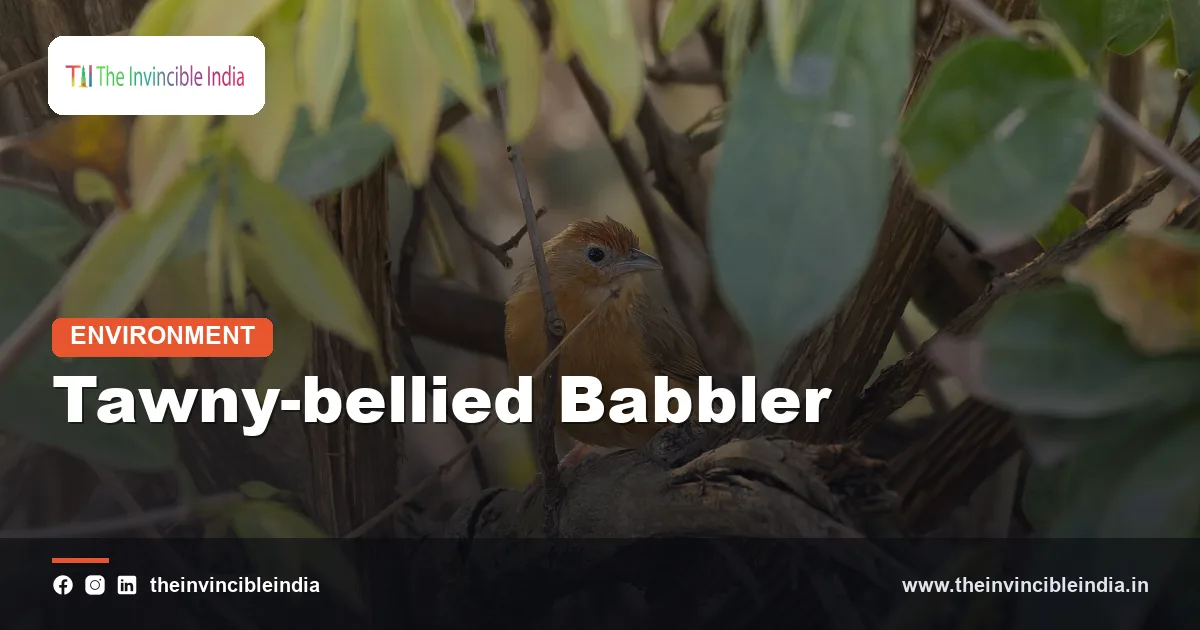
The tawny-bellied babbler (Dumetia hyperythra) is a small, shy, olive-brown babbler of Indian tall grass, scrub and bushy undergrowth, easily recognised by its warm tawny underside and rufous crown. It creeps and flits close to the ground in small flocks, and its soft chattering calls often reveal its presence long before the bird itself is seen.
Much smaller and quieter than the large “seven sisters” babblers of gardens and fields, the tawny-bellied babbler is a bird of dense cover that many people overlook. This explainer covers how to identify the tawny-bellied babbler, where it is found in India, what it eats, how it behaves, how it breeds and how it differs from similar birds. Information was last reviewed on 23 October 2026.
| Attribute | Details |
|---|---|
| Common name | Tawny-bellied babbler |
| Scientific name | Dumetia hyperythra |
| Family | Timaliidae (Old World babblers, or tree babblers) |
| Size | About 13 cm long; a small, compact babbler |
| Range and habitat in India | Scattered across parts of peninsular and northern India; tall grass, scrub, bamboo and bushy forest edges |
| Diet | Mainly small insects and spiders, with some seeds and berries |
| Breeding | Small domed nest of grass in dense low cover, usually with a small clutch of pale eggs |
| Conservation status | Least Concern on the IUCN Red List |
Key Takeaways
- The tawny-bellied babbler (Dumetia hyperythra) is a small, olive-brown babbler about 13 cm long with a tawny-orange underside and a rufous forehead and crown.
- The tawny-bellied babbler lives in tall grass, thorn scrub, bamboo and thick undergrowth, where it moves in small, skulking flocks close to the ground.
- The tawny-bellied babbler eats mostly small insects and spiders, which it picks from leaves, stems and the base of grass clumps.
- The tawny-bellied babbler builds a domed nest of grass in dense low vegetation, a design that hides the eggs and young from predators.
- The tawny-bellied babbler is a resident bird that does not migrate, and its soft, chattering calls are often the best clue to its presence.
- The tawny-bellied babbler is listed as Least Concern, although loss of grassland and scrub can reduce local populations.
What Is the Tawny-bellied Babbler?
The tawny-bellied babbler is a small, sociable songbird in the family Timaliidae, the Old World babblers, and it is one of the smaller babblers of the Indian subcontinent. It spends its life in low, dense vegetation, rarely flying far and almost never perching in the open for long.
The scientific name Dumetia hyperythra combines a Latin word for thicket (dumetum) with a Greek word meaning “reddish underneath” (hyperythra), neatly summing up the bird’s habitat and colour. The genus Dumetia contains only a few closely related species. A related bird of southern India, the white-bellied babbler, was once treated as a form of the same species, so some older books describe the two together.
The tawny-bellied babbler is a resident species. Flocks keep to a limited area through the year, using the same patches of grass and scrub for feeding and for shelter.
What Does the Tawny-bellied Babbler Look Like?
The tawny-bellied babbler is a small, compact bird with olive-brown upperparts, a rufous forehead and crown, and a tawny or orange-buff belly. It measures only about 13 cm, which makes it much smaller than the familiar jungle babbler of gardens.
Identification features include:
- Rufous crown and forehead: the top of the head has a reddish-brown tone that contrasts with the olive-brown back.
- Tawny underparts: the belly and flanks are a warm orange-buff, the feature from which the bird takes its name.
- Pale throat: the throat and upper breast are often paler, sometimes whitish, giving a soft contrast with the belly.
- Olive-brown upperparts: the back and wings are plain and rather dull, helping the bird blend into dry grass and leaves.
- Short, rounded wings and a fairly long tail: adapted for short, weak flights through dense cover.
Males and females of the tawny-bellied babbler look similar. The small size, warm underside and habit of creeping through grass are enough to separate it from most other birds of the same habitat.
Where Is the Tawny-bellied Babbler Found in India?
The tawny-bellied babbler is found in scattered parts of peninsular and northern India wherever tall grass, thorn scrub and thick undergrowth occur. It is generally a bird of low elevations and foothills and tends to avoid both very dry desert and the deepest wet forest.
Typical habitats of the tawny-bellied babbler include:
- Tall, dense grassland and grass-covered slopes.
- Thorn scrub and dry deciduous undergrowth.
- Bamboo clumps and bushy clearings in forest.
- Edges of forests, rocky hillsides and abandoned fields with thick cover.
- Overgrown hedges, scrubby ravines and canal banks.
The key requirement is dense low cover. The tawny-bellied babbler feeds and nests within the lower layer of vegetation, and it avoids open ground where it would be exposed. Because suitable habitat is patchy, the bird is local in many areas and may be absent from places that look similar but lack thick grass. The exact boundaries of its range vary with the species classification used, so it is best to check a current field guide for a local region.
What Does the Tawny-bellied Babbler Eat?
The tawny-bellied babbler eats mainly small insects and spiders, which it picks from leaves, grass stems and twigs as it moves through dense vegetation. Caterpillars, small beetles, ants, bugs and flies are typical food items.
Seeds and tiny berries are also eaten, and the bird may take nectar from flowers on occasion. This varied diet supports the species through the year as insect numbers change with the seasons.
The foraging style of the tawny-bellied babbler includes:
- Gleaning: picking insects from leaves and stems while hopping and clambering through bushes.
- Probing grass bases: searching clumps and litter at ground level for hidden prey.
- Climbing: clinging to thin stems and moving up and down in the lower layer of vegetation.
- Group foraging: several birds feed close together, calling softly to stay in touch.
By feeding on insects, the tawny-bellied babbler helps to control small pests in grassland and scrub. It is a modest but real part of the food web of these habitats.
How Does the Tawny-bellied Babbler Behave?
The tawny-bellied babbler is a shy, skulking bird that lives in small flocks and keeps almost entirely to dense cover, only rarely showing itself in the open. Flocks are commonly of about six to ten birds, which flit through bushes and grass one after another.
Behaviour that distinguishes the species includes:
- Skulking movement: birds creep and hop low in the vegetation rather than flying high or far.
- Short, weak flights: a bird crossing a gap flies low and fast and drops quickly into cover.
- Constant soft calling: flock members chatter quietly to stay in touch when they cannot see one another.
- Alarm response: when a predator or human approaches, the flock goes quiet or gives sharp notes and slips deeper into cover.
- Group roosting: at night the birds often shelter together in a thicket.
The tawny-bellied babbler is far less bold than the large babblers of farmland. A person standing still near a dense bush may find that the birds gradually emerge to feed, but any sudden movement sends them back into hiding.
What Does the Tawny-bellied Babbler Sound Like?
The call of the tawny-bellied babbler is a soft, rapid series of chattering, scolding or tinkling notes, usually given by several birds at once from inside dense cover. It is much quieter and finer than the loud squealing of larger babblers, and it is typically the first sign that a flock is nearby.
Types of call include:
- Contact notes: low, repeated chirps that keep the flock together as it moves through the grass.
- Scolding calls: harsher, chattering notes given when the birds are disturbed or alarmed.
- Excited chorus: a burst of overlapping calls when flock members meet or when a threat appears.
Birdwatchers often find the tawny-bellied babbler by sound. Standing quietly at the edge of a patch of tall grass and listening carefully can reveal the gentle chatter of a flock that would otherwise stay hidden.
How Does the Tawny-bellied Babbler Breed?
The tawny-bellied babbler builds a small domed nest of grass, with a side entrance, in dense low vegetation such as a grass clump, a thorny bush or a bamboo thicket. The covered shape hides the eggs and nestlings and protects them from sun, rain and predators.
Key facts about breeding are:
- Season: breeding usually happens in the months around the rains, though the exact period varies from region to region.
- Nest: a neat dome of dry grass and fine plant material, placed low and well hidden.
- Eggs: a small clutch, typically of pale eggs, laid inside the domed chamber.
- Care of young: both parents, and sometimes other flock members, bring small insects to the nestlings.
- After leaving the nest: young birds join the flock and continue to be fed for a short period.
Because the nest is so well concealed, it is difficult to find unless the observer sees an adult carrying food or nesting material. People should avoid searching for nests, as disturbance can cause the adults to abandon them.
How Do You Tell the Tawny-bellied Babbler from Similar Birds?
The tawny-bellied babbler is told from similar small babblers by its tiny size, tawny belly, rufous crown and habit of moving in groups through tall grass. The table below compares it with other small skulking birds of scrub.
| Species | Size | Main identification clues | Typical habitat |
|---|---|---|---|
| Tawny-bellied babbler | About 13 cm | Tawny belly, rufous crown, olive-brown back, small flocks | Tall grass and scrub |
| Yellow-eyed babbler | About 17 cm | Bright yellow eye, white throat and breast, rusty crown | Reed beds and wet tall grass |
| Dark-fronted babbler | About 13 cm | Dark forehead and face, olive-brown back | Forest undergrowth in south India |
| Jungle babbler | About 25 cm | Much larger, plain greyish-brown, noisy | Gardens and woodland edges |
The large babblers can be separated at once by size, since the tawny-bellied babbler is about half the length. Among the small babblers, the warm underside and rufous cap are the best clues.
Is the Tawny-bellied Babbler Threatened?
The tawny-bellied babbler is not considered globally threatened and is classified as Least Concern by the International Union for Conservation of Nature (IUCN). It has a wide range, and local populations are generally stable.
Several pressures can still affect the species locally:
- Clearance or conversion of tall grassland and scrub for farming and construction.
- Grass fires and heavy grazing that remove the dense cover the bird needs.
- Pesticide use that reduces insect food.
- Invasion of grassland by dense alien shrubs, which can change the habitat structure.
Protecting areas of natural grassland, scrub and forest edge benefits the tawny-bellied babbler and many other small birds. Grasslands in India are often undervalued, yet they host a number of specialised species.
How Can You Watch the Tawny-bellied Babbler?
The best way to see the tawny-bellied babbler is to stand quietly at the edge of tall grass or scrub in the early morning and listen for its soft chattering. Patience is essential, as the birds are shy and move fast through dense cover.
Practical suggestions are:
- Visit early, when the birds are most active and the light is soft.
- Stay still and keep the sun behind you to see the tawny belly clearly.
- Look at grass stems and low bushes rather than high branches.
- Use binoculars to see the rufous crown and small size.
- Avoid trampling grass or flushing the flock deliberately.
Even a brief view is rewarding. The tawny-bellied babbler is a good example of how much life a seemingly empty patch of scrub can hold.
Why Does the Tawny-bellied Babbler Matter?
The tawny-bellied babbler matters because it eats insects, indicates healthy tall-grass and scrub habitat and shows how small birds depend on dense low vegetation. Although tiny and secretive, it is part of the web of life in India’s grasslands and forest edges.
Its presence suggests that cover, food and nesting sites are available. Because its habitat is patchy and often overlooked, the bird also helps draw attention to the value of grassland and scrub, which are sometimes dismissed as wasteland.
Bottom Line
The tawny-bellied babbler is a small, tawny-bellied, skulking flock bird of India’s tall grass and scrub that eats insects and nests in a hidden dome. It is not threatened, but it depends on dense low cover that disappears when grasslands are cleared.
Frequently Asked Questions
What is the scientific name of the tawny-bellied babbler?
The scientific name of the tawny-bellied babbler is Dumetia hyperythra. It belongs to the family Timaliidae, the Old World babblers. The genus name refers to thickets, and the species name refers to its reddish underside.
How big is the tawny-bellied babbler?
The tawny-bellied babbler is about 13 cm long, making it a small babbler. It is roughly half the length of the jungle babbler. It has a compact body, a rufous crown and a fairly long tail.
Where does the tawny-bellied babbler live?
The tawny-bellied babbler lives in tall grass, thorn scrub, bamboo and thick undergrowth in parts of peninsular and northern India. It keeps close to the ground and avoids open spaces. It is a resident bird that does not migrate.
What does the tawny-bellied babbler eat?
The tawny-bellied babbler eats mainly small insects and spiders, picked from leaves, stems and grass bases. It also takes some seeds and small berries. Its insect diet helps control pests in scrub and grassland.
How does the tawny-bellied babbler build its nest?
The tawny-bellied babbler builds a small domed nest of grass with a side entrance, placed low in dense vegetation such as a grass clump or bush. The dome hides the eggs and chicks from predators. Both parents feed the young.
Is the tawny-bellied babbler endangered?
No, the tawny-bellied babbler is not endangered and is classified as Least Concern by the IUCN. Local numbers can fall when tall grassland and scrub are cleared, burned or overgrazed.
{“@context”:”https://schema.org”,”@graph”:[{“@type”:”FAQPage”,”mainEntity”:[{“@type”:”Question”,”name”:”What is the scientific name of the tawny-bellied babbler?”,”acceptedAnswer”:{“@type”:”Answer”,”text”:”The scientific name of the tawny-bellied babbler is Dumetia hyperythra. It belongs to the family Timaliidae, the Old World babblers. The genus name refers to thickets, and the species name refers to its reddish underside.”}},{“@type”:”Question”,”name”:”How big is the tawny-bellied babbler?”,”acceptedAnswer”:{“@type”:”Answer”,”text”:”The tawny-bellied babbler is about 13 cm long, making it a small babbler. It is roughly half the length of the jungle babbler. It has a compact body, a rufous crown and a fairly long tail.”}},{“@type”:”Question”,”name”:”Where does the tawny-bellied babbler live?”,”acceptedAnswer”:{“@type”:”Answer”,”text”:”The tawny-bellied babbler lives in tall grass, thorn scrub, bamboo and thick undergrowth in parts of peninsular and northern India. It keeps close to the ground and avoids open spaces. It is a resident bird that does not migrate.”}},{“@type”:”Question”,”name”:”What does the tawny-bellied babbler eat?”,”acceptedAnswer”:{“@type”:”Answer”,”text”:”The tawny-bellied babbler eats mainly small insects and spiders, picked from leaves, stems and grass bases. It also takes some seeds and small berries. Its insect diet helps control pests in scrub and grassland.”}},{“@type”:”Question”,”name”:”How does the tawny-bellied babbler build its nest?”,”acceptedAnswer”:{“@type”:”Answer”,”text”:”The tawny-bellied babbler builds a small domed nest of grass with a side entrance, placed low in dense vegetation such as a grass clump or bush. The dome hides the eggs and chicks from predators. Both parents feed the young.”}},{“@type”:”Question”,”name”:”Is the tawny-bellied babbler endangered?”,”acceptedAnswer”:{“@type”:”Answer”,”text”:”No, the tawny-bellied babbler is not endangered and is classified as Least Concern by the IUCN. Local numbers can fall when tall grassland and scrub are cleared, burned or overgrazed.”}}]}]}


