

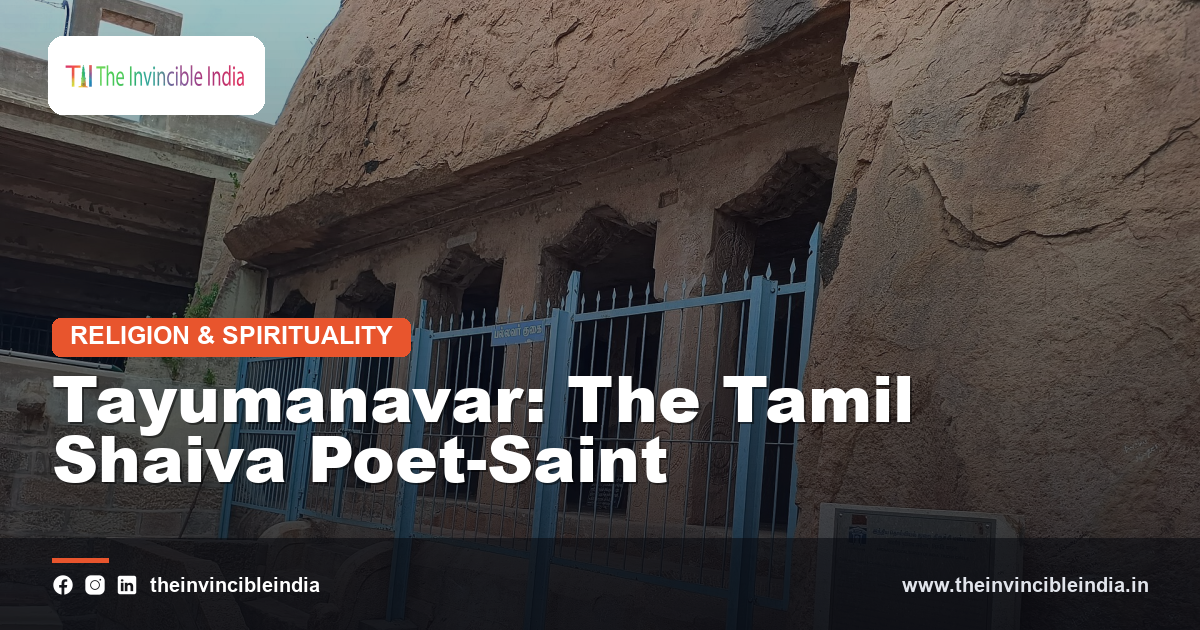
Tayumanavar was a Tamil Shaiva poet-saint, generally placed in the seventeenth and eighteenth centuries, who stands within the philosophical tradition of Shaiva Siddhanta and is loved for his Tamil poems of deep, non-dual devotion to Shiva. He is closely associated with the Rockfort temple at Tiruchirappalli in Tamil Nadu, the shrine of Thayumanaswami, a form of Shiva, from whom the saint takes his name. His poetry is admired for its serene longing for union with the divine and for its reflective, philosophical spirit. His life and work belong to the wider world of Shaivism, the worship of Shiva, and though the details of his life come largely through tradition, his standing as a beloved Tamil poet-saint is firmly held.
Quick answer: Tayumanavar was a Tamil Shaiva poet-saint, generally placed in the seventeenth and eighteenth centuries, within the Shaiva Siddhanta philosophical tradition. Known for Tamil poems of non-dual devotion to Shiva, he is associated with the Rockfort temple at Tiruchirappalli, the shrine of Thayumanaswami from whom he takes his name. His verses express a serene longing for union with the divine and a reflective, philosophical spirit, and they remain a cherished part of Tamil devotion.
Key Takeaways
- Tayumanavar was a Tamil Shaiva poet-saint of the Shaiva Siddhanta tradition.
- He is generally placed in the seventeenth and eighteenth centuries.
- He is known for Tamil poems of deep, non-dual devotion to Shiva.
- He is associated with the Rockfort (Thayumanaswami) temple at Tiruchirappalli.
- His name is linked with Thayumanaswami, a form of Shiva worshipped at the Rockfort.
- His poetry is admired for its serene longing and reflective, philosophical spirit.
The sections below explain his life as told by tradition, the Shaiva Siddhanta tradition, his poetry of non-dual devotion, his link with the Rockfort temple and his continuing place in Tamil devotion.
Quick Facts
| Detail | Information |
|---|---|
| Also known as | Tayumanavar, Thayumanavar |
| Tradition | Tamil Shaivism, Shaiva Siddhanta |
| Era | Seventeenth to eighteenth century, generally placed |
| Region | Tiruchirappalli, Tamil Nadu |
| Language of works | Tamil |
| Principal works | Tamil devotional poems of non-dual devotion |
| Deity | Shiva, worshipped as Thayumanaswami |
| Principal shrine | Rockfort (Thayumanaswami) temple, Tiruchirappalli |
Who Was Tayumanavar?
Tayumanavar was a Tamil Shaiva poet-saint, generally placed in the seventeenth and eighteenth centuries, who is loved for his Tamil poems of deep devotion to Shiva and for the reflective, philosophical spirit of his verse. He stands within the tradition of Shaiva Siddhanta, the classical philosophy of Tamil Shaivism.
His name, also written Thayumanavar, is linked with Thayumanaswami, a form of Shiva worshipped at the Rockfort temple in Tiruchirappalli, with which the saint is closely associated. Tradition pictures him as a soul absorbed in the longing for union with the divine, whose poems express both devotion and contemplation. Although the details of his life come largely through devotional tradition, his verses survive and reveal a saint of serene and profound devotion, securing his place among the beloved poet-saints of the Tamil Shaiva tradition.
What Does the Name Tayumanavar Mean?
The name Tayumanavar is linked with Thayumanaswami, a form of Shiva worshipped at the Rockfort temple in Tiruchirappalli, and tradition connects the saint’s name with this deity. The name helps readers recognise the poet-saint and marks his close bond with the shrine and its Lord.
The form of Shiva known as Thayumanaswami is understood in tradition through a cherished story of the Lord’s compassion, and the saint who bears a name linked with this deity is remembered as devoted to Shiva in this gracious form. Also written Thayumanavar, he appears under this name in the Tamil tradition of devotional poetry. Keeping the name in mind helps a reader follow his story and understand the deep connection between the poet-saint, the Rockfort shrine and the form of Shiva whose grace his poems celebrate.
When and Where Did Tayumanavar Live?
Tayumanavar is generally placed in the seventeenth and eighteenth centuries, and because the sources are largely devotional it is wise to describe his era in general terms rather than fix exact dates. He is associated with Tiruchirappalli in Tamil Nadu and above all with its famous Rockfort temple.
Tiruchirappalli, a historic city of the Tamil country on the Kaveri, is known for the Rockfort rising above it, crowned with ancient shrines. The Rockfort temple of Thayumanaswami is the place with which the saint’s memory is most closely bound. This region was long a centre of Tamil Shaiva devotion and learning. Because the details of his life come largely through tradition, careful writers describe his region and general period with confidence while leaving finer chronology open, in keeping with the respectful caution the sources invite.
What Is the Shaiva Siddhanta Tradition?
Shaiva Siddhanta is the classical philosophical and devotional tradition of Tamil Shaivism, which holds Shiva as the supreme reality and teaches a path of devotion, grace and the soul’s journey towards union with the divine. Tayumanavar is counted among its honoured poet-saints.
The tradition rests on the devotional hymns of the earlier Tamil Shaiva saints and on a body of philosophical teaching that reflects on the nature of God, the soul and the bonds that hold the soul, and on the grace that frees it. Shaiva Siddhanta teaches that the soul, by devotion and divine grace, may come to union with Shiva. Tayumanavar’s poems express the spirit of this tradition, uniting heartfelt devotion with philosophical reflection, and they are cherished as among its most beautiful and accessible expressions.
What Is the Poetry of Tayumanavar Known For?
The poetry of Tayumanavar is known for its serene longing for union with the divine, its reflective and philosophical spirit, and its blending of heartfelt devotion to Shiva with the contemplation of non-dual truth. His verses are admired for their depth, calm and beauty.
His poems often express the soul’s yearning for peace and for union with the supreme reality, dwelling on the stilling of the restless mind and the grace that leads the soul to the divine. They unite the devotional warmth of the Tamil Shaiva tradition with a contemplative, philosophical outlook that reaches towards the non-dual. For readers and devotees these poems offer both comfort and insight, a path of devotion that is also a path of reflection. The poetry of Tayumanavar holds a cherished place in the Tamil Shaiva heritage for this union of feeling and thought.
What Is Non-Dual Devotion in His Poetry?
Non-dual devotion in the poetry of Tayumanavar is the expression of a love for Shiva that reaches towards the realisation of the oneness of the soul with the supreme reality, uniting the warmth of devotion with the contemplation of non-dual truth. This is one of the marks of his verse.
His poems often speak of the longing to still the mind and to rest in the peace of the divine, in which the sense of separation between the soul and the Lord gives way to a deep union. This spirit draws on the contemplative currents within the Tamil tradition and gives his devotion a reflective, philosophical character. For devotees and readers the non-dual spirit of his poetry offers a vision of devotion that leads towards inner peace and union. It is one of the features that give his verse its distinctive serenity and depth.
What Themes Appear in Tayumanavar's Poems?
Tayumanavar’s poems are marked by the longing for union with Shiva, the quest for inner peace, the stilling of the restless mind, and praise of the grace of the Lord. The tone is one of serene devotion and contemplation rather than exuberant praise.
His verses dwell on the soul’s yearning for the divine, on the bonds that trouble the mind and the grace that frees it, and on the peace that comes from resting in the supreme reality. They often reflect on the passing nature of worldly things in contrast to the lasting worth of devotion and realisation. For devotees these poems are both prayer and guide, a way of turning the heart and mind towards Shiva. They are valued for their devotion, their wisdom and their power to bring calm, and they hold a cherished place in the Tamil Shaiva heritage.
How Is Tayumanavar Linked to the Rockfort Temple?
Tayumanavar is linked above all to the Rockfort temple at Tiruchirappalli, the shrine of Thayumanaswami, a form of Shiva, from whom the saint takes his name. The temple, set on the great rock rising above the city, is the place with which his memory is most closely bound.
The Rockfort and its ancient shrines are among the famous landmarks of the Tamil country, and the temple of Thayumanaswami is a revered centre of Shaiva worship. Tradition connects the saint deeply with this shrine and its gracious form of Shiva. The association of Tayumanavar with the Rockfort temple gives his memory a firm and sacred setting, and for pilgrims and devotees the link keeps alive the story of the poet-saint and the devotion to Shiva that his poems so beautifully express.
Who Is Thayumanaswami, the Form of Shiva?
Thayumanaswami is the form of Shiva worshipped at the Rockfort temple in Tiruchirappalli, whose name is understood in tradition through a cherished story of the Lord’s compassion in coming to the aid of a devotee as a mother would. The poet-saint Tayumanavar bears a name linked with this gracious form.
The tradition surrounding Thayumanaswami tells of the Lord’s motherly care for his devotees, and this story is treasured as an image of divine compassion. The worship of Shiva in this form at the Rockfort temple is a living part of the devotion of the Tamil country. The link between the saint and this form of the Lord deepens the meaning of his name and his devotion. For devotees the story of Thayumanaswami, understood as devotional tradition, expresses the tender grace of the Lord towards those who turn to him.
How Does Tayumanavar Fit the Tamil Shaiva Tradition?
Tayumanavar fits within the long and rich tradition of Tamil Shaiva devotion, which stretches back to the earlier Shaiva saints whose hymns form the sacred canon of the tradition. He is honoured as a later poet-saint who carried forward this heritage of devotion to Shiva.
The Tamil Shaiva tradition had produced great hymnists and teachers whose songs and teachings shaped the worship of Shiva across the land. Tayumanavar stands within this tradition, uniting its devotional warmth with the philosophical spirit of Shaiva Siddhanta. His poetry adds a reflective, contemplative voice to the heritage of Tamil Shaivism. Seeing him within this tradition helps a reader appreciate how the devotion to Shiva was renewed and deepened by later saints, and how Tayumanavar’s serene and philosophical verse took its place among the treasures of Tamil devotion.
How Do Tayumanavar's Poems Express Devotion?
Tayumanavar’s poems express devotion through a serene and reflective love for Shiva, through the longing for inner peace and union with the divine, and through trust in the grace of the Lord. His devotion is calm, deep and contemplative.
He often speaks in the voice of a soul that yearns to still its restlessness and to rest in the peace of the supreme reality, calling on the grace of Shiva to lead it there. His poems unite this devotion with the contemplation of non-dual truth, so that praise and reflection flow together. For devotees these verses are a way of turning both heart and mind towards the Lord and of seeking the peace that devotion brings. The devotion of Tayumanavar, expressed in his poetry, remains a living source of comfort and inspiration in the Tamil Shaiva tradition.
How Are Tayumanavar's Poems Preserved and Sung?
Tayumanavar’s poems are preserved as part of the living tradition of Tamil Shaiva devotion, carried down through recitation, song and collection, and they continue to be read and sung by devotees and lovers of Tamil poetry. His verses remain a cherished part of the heritage.
These poems have been handed down both through performance and through written collection, and they are set to music and sung in the devotional traditions of the Tamil country. Their survival in living use gives a clear witness to the saint’s devotion and art, even where details of his life rest on tradition. The preservation of his poems keeps his serene devotion present for new generations. Through this continuing life in word and song, the devotion of Tayumanavar reaches listeners long after his own age, as a part of the devotional culture of Tamil Shaivism.
How Is Tayumanavar Honoured in Tradition and Art?
Tayumanavar is honoured in Tamil Shaiva tradition and art as a beloved poet-saint, remembered at the Rockfort temple and wherever his poems are read and sung. His memory is cherished among the saints and devotees of the tradition.
His image is honoured in the tradition, and the art expresses his character as a contemplative singer of the praise of Shiva rather than any worldly rank. His poems are recited and sung in worship and in the study of Tamil devotional literature, keeping his devotion alive. The honour given to Tayumanavar reflects the love in which the poet-saint and his verse are held, and keeps his memory present in the devotional and literary life of the Tamil Shaiva tradition, especially at the Rockfort shrine with which his name is bound.
Why Does Tayumanavar Still Matter Today?
Tayumanavar still matters today because his poems remain a living and beloved part of Tamil Shaiva devotion, read and sung for their serene devotion and their reflective wisdom. His verse continues to bring comfort and insight to new generations.
For devotees he is a beloved poet-saint whose poems unite heartfelt devotion to Shiva with the contemplation of non-dual truth and the quest for inner peace. Scholars value his poetry as a treasure of Tamil literature and of the Shaiva Siddhanta tradition, while readers and worshippers treasure it as a path of devotion and reflection. Careful readers honour the context of his tradition and treat the devotional accounts of his life, and the story of Thayumanaswami, as belief, while recognising the enduring beauty and depth of his poetry.
Tayumanavar Today
Tayumanavar today is remembered as a beloved Tamil Shaiva poet-saint of the Shaiva Siddhanta tradition, known for his poems of serene, non-dual devotion to Shiva and associated with the Rockfort temple of Thayumanaswami at Tiruchirappalli. His verses remain a living presence in Tamil devotion and literature.
Through his poetry he gave the Tamil Shaiva tradition a voice of calm devotion and philosophical reflection, uniting the longing for the divine with the quest for inner peace. The details of his life come largely through tradition, yet the survival and continued reading of his poems give a clear witness to his devotion and art. His legacy endures as a reminder that devotion and contemplation can flow together, leading the soul towards the peace and union that his verses so beautifully seek.
Sources & Further Reading
- Ministry of Culture, Government of India (indiaculture.gov.in).
- Sahitya Akademi general references on Tamil devotional literature.
Frequently Asked Questions
Who was Tayumanavar?
Tayumanavar was a Tamil Shaiva poet-saint, generally placed in the seventeenth and eighteenth centuries, within the Shaiva Siddhanta tradition. He is known for Tamil poems of non-dual devotion to Shiva and is associated with the Rockfort temple at Tiruchirappalli.
What is Tayumanavar's poetry known for?
Tayumanavar’s poetry is known for its serene longing for union with the divine, its reflective and philosophical spirit, and its blending of devotion to Shiva with the contemplation of non-dual truth. His verses are admired for their depth, calm and beauty.
What is Shaiva Siddhanta?
Shaiva Siddhanta is the classical philosophical and devotional tradition of Tamil Shaivism, which holds Shiva as the supreme reality and teaches a path of devotion, grace and the soul’s journey towards union with the divine. Tayumanavar is counted among its honoured poet-saints.
Where is Tayumanavar associated?
Tayumanavar is associated with Tiruchirappalli in Tamil Nadu and above all with its famous Rockfort temple, the shrine of Thayumanaswami, a form of Shiva from whom the saint takes his name. The region was long a centre of Tamil Shaiva devotion.
Who is Thayumanaswami?
Thayumanaswami is the form of Shiva worshipped at the Rockfort temple in Tiruchirappalli, whose name is understood through a cherished tradition of the Lord’s motherly compassion towards a devotee. The poet-saint Tayumanavar bears a name linked with this gracious form.
What themes appear in Tayumanavar's poems?
Tayumanavar’s poems dwell on the longing for union with Shiva, the quest for inner peace, the stilling of the restless mind, and the grace of the Lord. They unite serene devotion with philosophical reflection in the spirit of Shaiva Siddhanta.


