

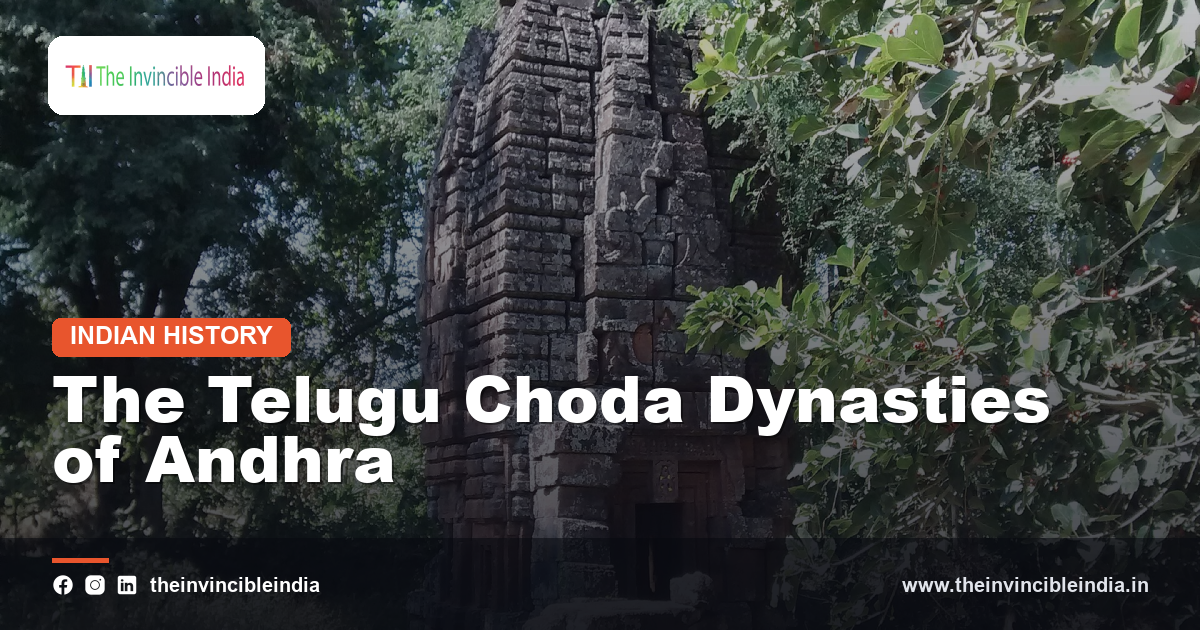
The Telugu Chodas, also known as the Telugu Cholas or Telugu Choda chiefs, were a group of minor dynasties and chiefly families of the Telugu country in present-day Andhra who claimed descent from the great Chola line of the far south. Spread across several branches, such as those associated with the Renati region, Pottapi, Nellore and Konidena, these families ruled various tracts of Andhra over a long and loosely defined span roughly placed between about the sixth and thirteenth centuries, most often as feudatories of greater powers. Because they are obscure and their records scattered, much about them is uncertain, and this guide, like our account of the Chola dynasty from which they claimed descent, treats their history with particular caution.
Quick answer: The Telugu Chodas, also called the Telugu Cholas, were a group of minor dynasties and chiefly families of the Telugu country in present-day Andhra who claimed descent from the great Chola line of the far south. They are known in several branches, such as the Renati Cholas, Pottapi, Nellore and Konidena lines, and ruled various tracts of Andhra over a long and loosely defined span, most often as feudatories of greater powers. Because they are obscure and their records scattered, their history is treated with particular caution.
Key Takeaways
- The Telugu Chodas, also called the Telugu Cholas, were minor dynasties and chiefly families of the Telugu country in present-day Andhra.
- They claimed descent from the great Chola line of the far south, though these claims are traditional.
- They are known in several branches, such as the Renati Cholas, and the Pottapi, Nellore and Konidena lines.
- Their history is loosely placed over a long span, roughly between about the sixth and thirteenth centuries.
- They most often ruled as feudatories of greater powers rather than as independent kingdoms.
- Because they are obscure and their records scattered, much about them remains uncertain and debated.
Read on for the history, culture, and legacy in detail.
Quick Facts
| Detail | Information |
|---|---|
| Dynasty | Telugu Chodas (Telugu Cholas / Telugu Choda chiefs) |
| Region | Telugu country, present-day Andhra |
| Claimed Descent | From the Chola line of the far south (traditional) |
| Branches | Renati Cholas; Pottapi, Nellore and Konidena lines |
| Era | Loosely placed, roughly sixth to thirteenth centuries |
| Status | Most often feudatories of greater powers |
| Evidence | Chiefly scattered inscriptions |
| Note | Obscure dynasties; chronology debated |
Who Were the Telugu Chodas?
The Telugu Chodas, also called the Telugu Cholas, were a group of minor dynasties and chiefly families of the Telugu country in present-day Andhra who claimed descent from the great Chola line of the far south. Rather than a single unified dynasty, they comprised several branches and families who ruled different tracts of Andhra at various times over a long and loosely defined period. Most often they held their territories as feudatories or subordinate chiefs of the greater powers that dominated southern India. Their claimed Chola ancestry, like the genealogical claims of many ruling families, was part of their self-presentation and is treated by historians as traditional. Because these families are obscure and their records scattered, much about them remains uncertain and debated. The Telugu Chodas therefore represent the many minor lineages that made up the lower tiers of the political order in the medieval Telugu country.
Where Did the Telugu Chodas Rule?
The Telugu Chodas ruled various tracts of the Telugu country in present-day Andhra, a region of fertile plains, river valleys, plateaus and coastal lands in the eastern part of the Deccan and the eastern seaboard. Different branches of the Telugu Chodas were associated with different parts of this region, including areas linked with the Renati country and with places such as Pottapi, Nellore and Konidena. Their territories were generally modest in scale, reflecting their status as minor chiefs and feudatories. The varied geography of Andhra, with its agricultural lands and strategic positions, shaped the fortunes of these local families. Because they were scattered across the region and ruled at different times, the Telugu Chodas did not control a single contiguous realm. Their presence across many parts of Andhra illustrates how minor dynasties filled the political landscape of the Telugu country beneath the greater powers of the age.
Why Did They Claim Chola Descent?
The Telugu Chodas claimed descent from the great Chola line of the far south because association with so illustrious a dynasty conferred prestige and legitimacy on their rule. Claiming descent from a celebrated royal house was a common practice among ruling families across India, who used such genealogies to enhance their status and justify their authority. For the Telugu Chodas, a link to the renowned Cholas, one of the most powerful and famous dynasties of southern India, was especially valuable. Historians treat these claims as traditional rather than as firmly documented historical descent, since genealogical assertions of this kind often reflect aspiration as much as fact. The adoption of the Choda or Chola name, however, shows the enduring prestige of the Chola dynasty across the Telugu country. The claimed descent is therefore significant for what it reveals about the cultural influence and reputation of the Cholas in the region.
What Were the Main Branches of the Telugu Chodas?
The Telugu Chodas are known in several branches and lines, each associated with a different part of the Telugu country and ruling at various times over the long and loosely defined span of their history. Among the branches traditionally identified are the Renati Cholas, associated with the Renati region, and lines connected with places such as Pottapi, Nellore and Konidena. These branches were distinct chiefly families who shared the Telugu Choda identity and the claimed descent from the Cholas. Because the records are scattered and the families obscure, the relationships among these branches and their precise chronology are uncertain and debated by historians. The existence of multiple branches reflects the way the Telugu Choda identity was spread among several local lineages rather than concentrated in a single dynasty. The study of these branches helps historians map the minor powers that ruled across the medieval Telugu country.
Who Were the Renati Cholas?
The Renati Cholas were one of the branches of the Telugu Chodas, associated with the Renati region of the Telugu country and known chiefly from inscriptions. As with the other Telugu Choda lines, they were a minor dynasty of chiefs who ruled their tract of Andhra, most often as feudatories or subordinate rulers under greater powers. The Renati Cholas are of particular interest to scholars because of the inscriptions associated with them, which shed light on the early history and language of the region. Like the other branches, they claimed the Choda or Chola identity, reflecting the prestige of the Chola name. Because the records are limited and the dynasty obscure, their history is reconstructed cautiously from scattered evidence. The Renati Cholas illustrate the character of the Telugu Choda families as minor local powers whose history survives mainly through epigraphy rather than through a continuous chronicle.
Who Were the Nellore Cholas?
The Nellore Cholas were a branch of the Telugu Chodas associated with the Nellore region of coastal Andhra, known as one of the local lines that claimed Chola descent. Like the other branches, they were a family of chiefs who ruled their territory, generally within the political order dominated by greater southern powers. The Nellore region, in the coastal country of Andhra, lay within the sphere of influence of the major dynasties of the far south and the Deccan, and the Nellore Cholas operated in relation to these powers. Their history, like that of the other Telugu Choda lines, is reconstructed from scattered inscriptions and is treated with caution by historians. The Nellore Cholas represent another of the minor local dynasties that made up the lower tiers of the political landscape of medieval Andhra. Their presence reflects the spread of the Telugu Choda identity across the coastal Telugu country.
Were the Telugu Chodas Independent or Feudatories?
The Telugu Chodas were most often feudatories or subordinate chiefs rather than independent sovereigns, holding their territories under the overlordship of the greater powers that dominated southern India at different times. As minor dynasties with modest resources, they generally found it practical to acknowledge the supremacy of larger kingdoms while retaining local authority over their own tracts. At certain times and in certain places they may have exercised greater autonomy, but their characteristic role was that of feudatory. This status was common among the many minor families of the medieval Telugu country, who operated within a hierarchy of overlords and subordinates. The Telugu Chodas shifted their allegiance as the balance of power changed around them. Their feudatory position is central to understanding their history and their place in the political order. It also helps explain why they remained minor and obscure rather than rising to great prominence.
Which Great Powers Did They Serve?
The Telugu Chodas served, at various times and in various places, the great powers that dominated southern India and the Deccan over the long span of their history. Depending on the period and the branch, these overlords included the major dynasties of the Telugu country and the surrounding regions, such as the great powers of the far south and the Deccan plateau. As feudatories, the Telugu Choda families acknowledged the supremacy of whichever paramount power held sway over their territory, adjusting their allegiance as circumstances changed. This placed them within the shifting network of alliances and subordinations that characterised the medieval political order. The specific overlords varied among the branches and across the centuries, and the details are reconstructed cautiously from scattered inscriptions. The role of the Telugu Chodas as servants of greater powers connects their history to the broader story of the major dynasties of southern India under whom they held their lands.
What Do Inscriptions Tell Us About Them?
Inscriptions are the principal source for the history of the Telugu Chodas, since these obscure families left no continuous chronicles of their own. The Telugu Choda name and the names of their branches appear in epigraphs that record grants, titles, genealogies and relationships, providing the scattered evidence from which historians reconstruct their outline. Some of these inscriptions are of particular interest for the light they shed on the early history and language of the Telugu country. Because the records are spread across many centuries, regions and branches, assembling them into a coherent narrative is difficult and leaves many gaps, so the names, dates and relationships of individual chiefs are often uncertain. Scholars interpret these inscriptions with care, aware of their limits and of the traditional nature of the genealogical claims. The inscriptional record is thus both the foundation and the boundary of what can be known about the Telugu Chodas.
Why Are the Telugu Chodas Considered Obscure?
The Telugu Chodas are considered obscure because, despite their presence across the Telugu country over a long span, they left behind only scattered and fragmentary evidence rather than a clear and continuous historical record. As minor families and feudatories, they rarely featured prominently in the records of the age, which focused on the greater powers under whom they served. There is no surviving dynastic chronicle, and the sources are spread across many branches, centuries and regions, which makes a coherent reconstruction difficult. As a result, the names, dates and relationships of individual Telugu Choda chiefs are frequently uncertain and debated among historians. This obscurity is a defining feature of these families and shapes how they are studied. Responsible accounts of the Telugu Chodas therefore emphasise caution, general patterns and the acknowledgement of uncertainty over precise or confident claims.
How Did the Telugu Chodas Patronise Temples?
The Telugu Chodas, like other ruling families of the Telugu country, are associated with the patronage of temples and the religious life of their territories, in keeping with the practices of the age. As local chiefs holding land in a region rich in temple traditions, they are connected in inscriptions with grants to religious institutions and support for worship. Such patronage reinforced the legitimacy of ruling families and tied them to the sacred landscape of their tracts. The Telugu country was home to a vibrant temple culture, and the minor dynasties shared in and supported this devotional life within their means. While specific attributions are limited by the scattered evidence, the general pattern of temple patronage is well established for families of this kind. Through such support the Telugu Chodas participated in the religious culture of medieval Andhra. Their patronage, though modest, formed part of the wider devotional life of the Telugu country.
How Did They Fit into Telugu Country Politics?
The Telugu Chodas fit into the politics of the Telugu country as part of the lower and middle tiers of a layered political order dominated by greater powers. Beneath the major dynasties that rose and fell across southern India, a multitude of minor families, including the Telugu Chodas, held local authority over their own tracts as feudatories, allies or subordinates. These families provided the connective tissue of the political landscape, governing at the local level while acknowledging the supremacy of paramount rulers. Their shifting allegiances reflected the changing balance of power among the great dynasties. The Telugu Chodas, spread across several branches, were among the many such families that filled the medieval Telugu country. Their role illustrates how the politics of the region operated through a hierarchy of powers great and small. Understanding these minor families is essential to a full picture of the political order of medieval Andhra.
How Did the Telugu Chodas Fade?
The Telugu Chodas faded as the political order of the Telugu country changed and the region was absorbed into the structures of the greater powers that came to dominate southern India in the later medieval period. As major empires reorganised the governance of Andhra, the independent identity and local authority of the many minor families, including the Telugu Chodas, gradually diminished. The branches of the Telugu Chodas, already minor and obscure, lost their distinct standing as the larger powers consolidated control. The precise circumstances and timing of this fading are reconstructed from scattered evidence and are described cautiously by historians. Rather than a dramatic conquest, the end of the Telugu Chodas appears as a gradual absorption into the wider political order. Their disappearance from the record reflects the fate of many minor dynasties as the great empires of the later medieval south extended their authority over the region.
Why Do the Telugu Chodas Matter in History?
The Telugu Chodas matter in history as an example of the many minor dynasties and chiefly families that formed the lower tiers of the political order of the medieval Telugu country. While none of them was a great power, their collective presence illustrates how authority in medieval southern India was distributed through a hierarchy of greater and lesser rulers. Their claimed descent from the Cholas reveals the enduring prestige of that famous dynasty across the Telugu country. The inscriptions associated with them, especially those of branches such as the Renati Cholas, are valuable for the study of the early history and language of the region. The study of the Telugu Chodas also shows how historians recover the past of obscure families from fragmentary evidence. For a full understanding of medieval Andhra, such minor lineages are essential. The Telugu Chodas therefore hold a quiet but genuine place in regional history.
The Telugu Chodas Today
The Telugu Chodas are remembered today chiefly in the pages of history and epigraphy rather than through prominent monuments, studied as examples of the minor dynasties of the medieval Telugu country. Scholars of South Indian history continue to examine the scattered inscriptions that preserve the names of the Telugu Choda branches, refining the understanding of these obscure families and their place in the region’s past. The inscriptions associated with branches such as the Renati Cholas remain of particular interest for the study of the early history and language of Andhra. The temple and cultural heritage of the Telugu country preserves the broader world in which these families shared. For readers of Indian history, the Telugu Chodas offer an instructive example of how minor dynasties contributed to the fabric of medieval southern India. Their legacy endures mainly as a subject of patient historical and epigraphic study.
Sources & Further Reading
- Archaeological Survey of India (asi.nic.in).
- Ministry of Culture, Government of India (indiaculture.gov.in).
- Department of Tourism, Government of Andhra Pradesh (tourism.ap.gov.in).
Frequently Asked Questions
Who were the Telugu Chodas?
The Telugu Chodas, also called the Telugu Cholas, were a group of minor dynasties and chiefly families of the Telugu country in present-day Andhra who claimed descent from the great Chola line of the far south. They are known in several branches and most often ruled as feudatories of greater powers.
Did the Telugu Chodas really descend from the Cholas?
The Telugu Chodas claimed descent from the great Chola dynasty, but historians treat this as a traditional genealogical claim rather than firmly documented descent. Claiming descent from a celebrated royal house was a common practice used to enhance prestige and legitimacy.
What were the main branches of the Telugu Chodas?
The Telugu Chodas are known in several branches, including the Renati Cholas associated with the Renati region, and lines connected with places such as Pottapi, Nellore and Konidena. The relationships among these branches are uncertain and debated by historians.
Were the Telugu Chodas independent rulers?
The Telugu Chodas were most often feudatories or subordinate chiefs rather than independent sovereigns, holding their territories under the overlordship of greater southern powers. This feudatory status was common among the minor families of the medieval Telugu country.
Why are the Telugu Chodas considered obscure?
The Telugu Chodas are considered obscure because they left only scattered inscriptions rather than a continuous chronicle, spread across many branches, centuries and regions. As a result, the names, dates and relationships of individual chiefs are often uncertain and debated.
Why are the Telugu Choda inscriptions important?
The inscriptions associated with the Telugu Chodas, especially those of branches such as the Renati Cholas, are valuable for the study of the early history and language of the Telugu country. They provide much of the scattered evidence from which the history of these obscure families is reconstructed.


