

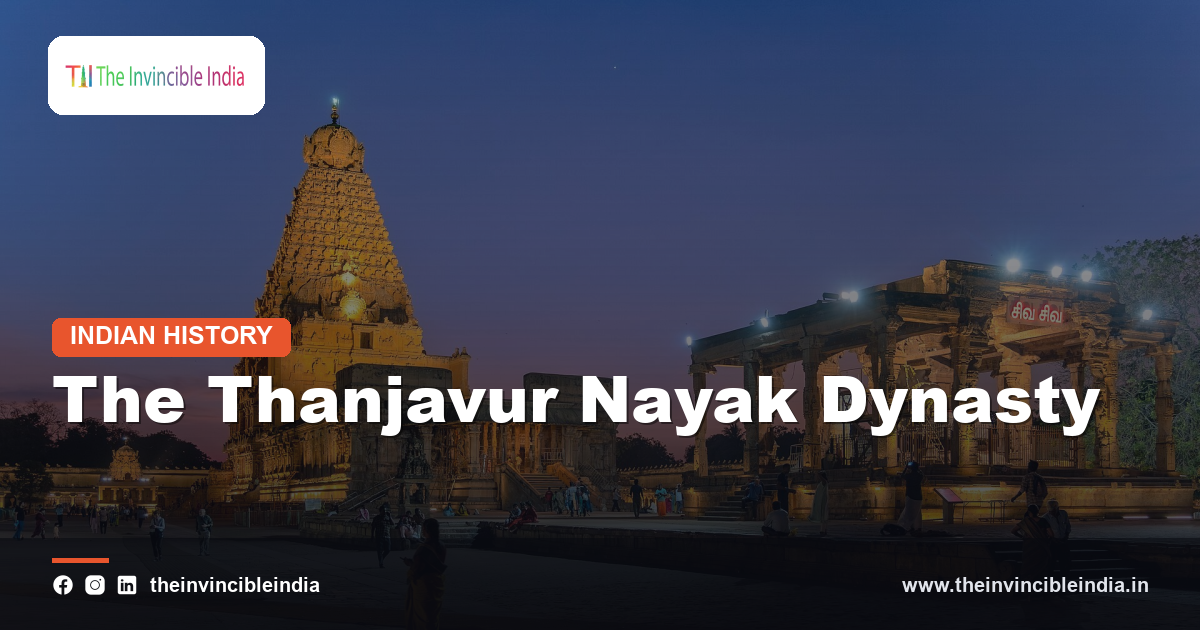
The Thanjavur Nayak dynasty, also known as the Nayaks of Thanjavur or the Tanjore Nayaks, was a Telugu-speaking ruling line that governed the fertile Kaveri delta of present-day Tamil Nadu from the sixteenth to the seventeenth century. They began as governors appointed by the emperors of Vijayanagara and later ruled as an independent kingdom centred on Thanjavur, also spelled Tanjore. Their court is remembered for music, dance, painting and scholarship, themes that connect it to the wider story told in our guide to the Vijayanagara Empire. Exact reign dates are debated among historians, so this guide uses general terms.
Quick answer: The Thanjavur Nayak dynasty was a line of rulers of the Kaveri delta in southern India who first served as governors of the Vijayanagara Empire and later governed Thanjavur as a largely independent kingdom. They are remembered as patrons of Carnatic music, dance drama, Telugu and Sanskrit literature, painting and temple building. Their rule ended in the seventeenth century when the Marathas took Thanjavur, but their cultural institutions continued.
Key Takeaways
- The Thanjavur Nayaks were governors appointed by Vijayanagara who later ruled the Kaveri delta as an independent kingdom.
- Sevappa Nayak is traditionally named as the founder of the line, and Raghunatha Nayak is remembered as its greatest patron.
- Their court produced notable Telugu and Sanskrit literature, including works by women poets.
- They supported music, Bharatanatyam-related dance drama and the Thanjavur school of painting.
- The Nayak palace and the library later known as the Saraswathi Mahal Library grew from their court.
- Maratha rule over Thanjavur followed the Nayak period in the seventeenth century.
Read on for the history, culture, and legacy in detail.
Quick Facts
| Detail | Information |
|---|---|
| Dynasty | Thanjavur Nayaks (Nayaks of Thanjavur, Tanjore Nayaks) |
| Region | Kaveri delta, present-day Tamil Nadu |
| Origin | Governors appointed by the Vijayanagara Empire |
| Capital | Thanjavur (Tanjore) |
| Cultural Legacy | Music, dance drama, Telugu literature, Thanjavur painting |
| Succeeded By | The Maratha rulers of Thanjavur |
Who Were the Thanjavur Nayaks?
The Thanjavur Nayaks were a Telugu-speaking dynasty of governors and kings who ruled the Kaveri delta in the era after the great Chola period. The word Nayaka, meaning leader or commander, described military chiefs who held territory on behalf of the Vijayanagara emperors, and the Thanjavur line began in exactly this way. Over time, as the central power of Vijayanagara weakened, the Nayaks of Thanjavur, like their counterparts at Madurai and Gingee, acted as sovereign rulers while still honouring the old imperial tradition. Their kingdom lay in one of the most productive rice-growing regions of the south, which gave them wealth to support the arts. The Thanjavur Nayaks therefore stand as a bridge between Vijayanagara rule and later regional powers.
How Did the Nayak System Begin Under Vijayanagara?
The Nayak system began as a way for the Vijayanagara emperors to govern distant southern territories through trusted military leaders. A Nayaka received the right to administer and collect revenue from a region and, in return, maintained troops and paid tribute to the imperial court. This arrangement allowed the empire to hold the Tamil country after its conquest, and it created regional powers with their own forts and courts. When imperial authority declined after the empire suffered a major defeat in the later sixteenth century, the Nayaks of Madurai, Thanjavur and Gingee gradually became independent. The Thanjavur Nayaks thus inherited both a military system and a courtly culture from Vijayanagara, and they carried both forward in their own kingdom.
Who Founded the Thanjavur Nayak Line?
Sevappa Nayak is traditionally named as the founder of the Thanjavur Nayak line, appointed to govern Thanjavur by a Vijayanagara emperor in the sixteenth century. Tradition links his appointment to the court of Achyuta Deva Raya and to family ties with the royal house, although details of the early years rest partly on later chronicles and poetry. Sevappa is remembered for strengthening the fortifications of Thanjavur and for supporting temple works and public tanks. Historians agree on the broad outline of the founding but treat precise dates with caution, since inscriptions and literary sources do not always agree. Sevappa Nayak is therefore best understood as the founder who gave the dynasty its first stable footing in the delta.
Why Is Raghunatha Nayak Considered the Greatest Ruler?
Raghunatha Nayak is considered the greatest ruler of the line because his reign is remembered as the high point of the dynasty’s power and culture. He was a capable soldier, but he is celebrated above all as a scholar, poet and musician who gathered learned people at his court. Works attributed to him and to his court show deep engagement with Sanskrit and Telugu learning, and he is credited with encouraging musical experiment and dance drama. His court also saw early dealings with European trading companies on the Coromandel coast, including the grant of a coastal settlement to the Danes at Tranquebar. Raghunatha Nayak thus represents the dynasty at its most confident, combining political skill with generous patronage of the arts.
What Was the Role of Vijayaraghava Nayak?
Vijayaraghava Nayak was the last important ruler of the Thanjavur Nayak line, and his reign is remembered for both literary brilliance and political crisis. A gifted scholar and composer, he wrote and supported works in Telugu, including dance dramas that were performed at the court. At the same time, the kingdom faced pressure from the neighbouring Nayaks of Madurai and from changing alliances across the south. Traditional accounts describe a final conflict in which the kingdom lost its independence and a new ruling house took control of Thanjavur. Vijayaraghava Nayak is therefore remembered as the final defender of Nayak sovereignty and as a poet-king whose creative output outlasted the dynasty itself.
What Is the Thanjavur Palace and Fort Complex?
The Thanjavur palace is a large royal complex of halls, courtyards, towers and galleries that grew over several centuries and began substantially under the Nayaks. The Nayak rulers built or extended the fortification and the main palace buildings, including audience halls with arcaded courtyards, a feature of Nayak architecture across the Tamil country. Later Maratha rulers added their own structures, so the present complex reflects layered building rather than a single period. A tall tower within the complex and the elegant durbar hall are among its best-known features. The palace complex remains the clearest physical reminder of how the Nayaks and their successors expressed royal power through architecture.
How Did the Nayaks Support Temples and Architecture?
The Thanjavur Nayaks supported temples by repairing older shrines, adding new halls and gateways, and endowing festivals and rituals. Nayak builders favoured tall gateway towers called gopurams, long pillared corridors and elaborately sculpted mandapas, features that appear in many temples of the Tamil country. In the Thanjavur region, they are associated with additions to existing Chola-period temples and with the care of major Vaishnava and Shaiva centres. The great Brihadisvara temple, built centuries earlier, received Nayak-period attention such as additional shrines and enclosures, showing respect for the older heritage. Nayak architecture thus continued the southern temple tradition while adding the pillared corridors and ornate detail that mark the later centuries.
Why Is Thanjavur Associated With Music and Dance?
Thanjavur is associated with music and dance because the Nayak court treated both as essential parts of royal life and religious worship. Court musicians and dancers performed in the palace and at temples, and rulers themselves composed songs and dance dramas. The Telugu-language dance-drama traditions that flourished in the delta influenced the development of forms later grouped under Bharatanatyam and related styles, while the veena and mridangam were refined by court instrument makers. This environment prepared the ground for the golden age of Carnatic music in the Kaveri delta in later centuries. Thanjavur therefore became a cradle of southern classical arts, a role it still holds in the cultural memory of Tamil Nadu.
What Literature Flourished at the Nayak Court?
Telugu, Sanskrit and Tamil literature all flourished at the Nayak court, making Thanjavur a rare multilingual centre of learning. Nayak rulers were themselves authors, and the court attracted poets, grammarians and scholars of music and poetics. Women poets also gained recognition, and the court poetess Ramabhadramba is widely known for a Sanskrit historical poem about Raghunatha Nayak. Telugu prose, verse and dance drama were produced in large numbers, and a body of Telugu literature from Thanjavur is regarded as an important late chapter of the language’s classical writing. The Nayak court therefore kept literature alive in the Tamil country at a time of political change, and its writers left a lasting literary record.
What Is the Thanjavur School of Painting?
The Thanjavur school of painting is a style of devotional painting known for rich colours, gold leaf and raised gesso work, and it grew in the Kaveri delta during the Nayak and Maratha periods. Artists painted images of gods, goddesses and saints on wooden panels, giving figures rounded faces, elegant poses and glittering ornament. The tradition drew on the visual language of Vijayanagara and the Nayak courts, and it served temple and household worship. Thanjavur paintings are still produced today and the style has received protection as a recognised regional craft. The Thanjavur school thus preserves, in portable form, the devotional aesthetic that the Nayak court helped to establish.
Why Is the Saraswathi Mahal Library Connected to the Nayaks?
The Saraswathi Mahal Library is connected to the Nayaks because its origins lie in the royal collection of manuscripts gathered by the Thanjavur court. The Nayak rulers collected texts in Sanskrit, Telugu and other languages, and the Maratha rulers who followed expanded the collection greatly, especially under Serfoji II, a ruler known for scholarship. Today the library holds manuscripts on palm leaf and paper covering subjects such as religion, medicine, music and literature. It is counted among the notable manuscript libraries of India and remains open to researchers. The library is therefore a living link between the Nayak love of learning and modern study of south Indian heritage.
How Did the Thanjavur Nayaks Deal With European Traders?
The Thanjavur Nayaks dealt with European traders mainly through coastal grants and trade agreements, since the Coromandel coast was a busy zone of commerce. The Portuguese, Dutch and Danish companies sought ports and warehouses on the eastern shore, and the Nayak rulers allowed limited settlements in return for trade benefits and revenue. The Danish settlement at Tranquebar, on the Thanjavur coast, is among the best-known examples of such an arrangement. These dealings brought new goods and ideas to the delta but did not shift political control to Europeans during the Nayak period. The Nayaks thus acted as careful coastal rulers who used foreign trade to enrich the kingdom without surrendering authority.
How Did Nayak Rule Come to an End?
Nayak rule at Thanjavur came to an end in the seventeenth century after a period of war and shifting alliances in the south. Conflict with the Nayaks of Madurai weakened the kingdom, and the courts of the Deccan and the Maratha chiefs watched the region closely. The Marathas, led by a commander who was a half-brother of Shivaji, took control of Thanjavur and founded a new ruling line that lasted into the colonial age. Many details of the final years are preserved in later chronicles, so historians treat exact dates and events with care. The end of Nayak rule thus marked a change of dynasty rather than a break in culture, because the arts and institutions continued under the new rulers.
What Was the Society of the Nayak Kingdom Like?
Nayak society in the Kaveri delta was agrarian, temple-centred and culturally diverse. Farmers, weavers, temple servants, merchants and court artists lived in towns and villages organised around irrigation channels and sacred centres. Telugu-speaking Nayak families lived alongside Tamil communities, and the resulting blend shaped food, language and festivals. Temples served as social and economic centres, employing priests, musicians, dancers and craftspeople. Royal gifts of land and revenue supported these institutions and tied the kingdom’s prosperity to religion and art. Nayak society was therefore a layered world of farming, worship and patronage, and its patterns are still visible in the traditions of the delta.
How Do Historians Study the Thanjavur Nayaks?
Historians study the Thanjavur Nayaks through inscriptions, temple records, court literature, European travel accounts and the surviving palace and library collections. Telugu and Sanskrit court poems preserve the dynasty’s own story, while inscriptions give details of grants and building works. European company records add an outside view of trade and diplomacy on the coast. Because these sources differ in tone and reliability, scholars compare them carefully, and the chronology of the early rulers remains debated. The study of the Nayaks also depends on cooperation between archives, museums and temple institutions. The result is a picture that is richer in culture than in exact dates, which is why general descriptions are the safest summary.
Thanjavur Nayak Heritage Today
The heritage of the Thanjavur Nayaks survives in the palace complex, the temples of the delta, the Saraswathi Mahal Library, and the living arts of music, dance and painting. Visitors to Thanjavur can see layers of Chola, Nayak and Maratha history side by side, which makes the city a rewarding place for the study of southern heritage. Festivals and performances in the delta continue traditions that the Nayak court nurtured, and Thanjavur painting and instrument making remain active crafts. Museums and heritage bodies work to conserve the buildings and manuscripts. The Thanjavur Nayak dynasty therefore endures less as a political memory than as a cultural inheritance, one that still shapes how southern India understands its classical arts.
Sources & Further Reading
- Archaeological Survey of India (asi.nic.in).
- Ministry of Culture, Government of India (indiaculture.gov.in).
Frequently Asked Questions
Who were the Thanjavur Nayaks?
The Thanjavur Nayaks were a Telugu-speaking dynasty that governed the Kaveri delta of present-day Tamil Nadu, first as governors of the Vijayanagara Empire and then as independent rulers. They are remembered mainly as patrons of music, dance, literature and painting.
Who was the greatest Thanjavur Nayak ruler?
Raghunatha Nayak is generally regarded as the greatest ruler of the line. He was a soldier, scholar and musician whose court became a major centre of Sanskrit and Telugu learning.
Who founded the Thanjavur Nayak dynasty?
Sevappa Nayak is traditionally named as the founder, appointed by a Vijayanagara emperor in the sixteenth century. Exact dates are debated, so historians describe the founding in general terms.
How did the Thanjavur Nayak dynasty end?
The dynasty ended in the seventeenth century when the Marathas took control of Thanjavur after conflict in the south. A Maratha line then ruled the kingdom, and the arts and institutions of the court continued.
What is the Saraswathi Mahal Library?
The Saraswathi Mahal Library is a manuscript library in Thanjavur that grew out of the royal collection of the Nayak and Maratha rulers. It holds manuscripts on palm leaf and paper in many languages and subjects.
Why is Thanjavur important in Indian art?
Thanjavur is important because it was a major centre of temple architecture, Carnatic music, classical dance, and devotional painting. The Nayak and Maratha courts supported these arts over several centuries.


