

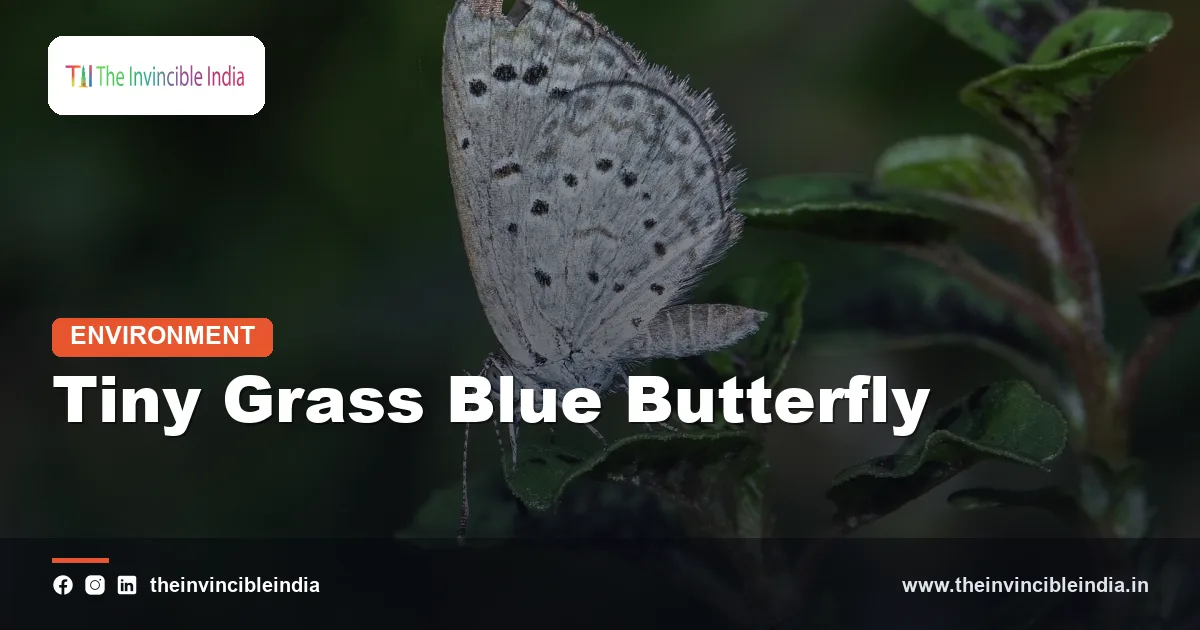
The tiny grass blue (Zizula hylax) is a minute lycaenid butterfly, among the smallest butterflies in India, with a wingspan of often less than 2 cm and a habit of flitting low over grass, lawns and damp ground. It is easily overlooked, and many people mistake it for a moth or a flying speck.
Yet the tiny grass blue is common across the Indian plains and one of the most widespread small butterflies in the Old World. Learning to notice it sharpens an observer’s eye for detail and reveals the hidden world of the grassy edges and weedy patches around us.
Quick Facts
| Common name | Tiny grass blue (also called the gaika blue in parts of Africa) |
|---|---|
| Scientific name | Zizula hylax (Fabricius, 1775) |
| Family | Lycaenidae (blues, coppers and hairstreaks), subfamily Polyommatinae |
| Wingspan | Roughly 14 to 22 mm, among the smallest of all Indian butterflies |
| Host plants | Mainly members of the acanthus family (Acanthaceae), such as Asystasia and Barleria, and some related herbs |
| Range and habitat | Throughout India and much of Africa, Asia and Australasia; grassy, damp and disturbed ground, lawns and field edges |
| Broods | Many overlapping broods, with butterflies on the wing through most of the year in warm regions |
| Notable features | Very small size, no tail, spotted pale underside and a low, weak, fluttering flight |
Key Takeaways
- The tiny grass blue (Zizula hylax) is one of the smallest butterflies in India, with a wingspan of roughly 1.4 to 2.2 cm.
- The tiny grass blue has no tail on its hindwing, and a pale underside marked with rows of small black spots.
- Tiny grass blue caterpillars feed mainly on members of the acanthus family, including Asystasia and Barleria.
- The tiny grass blue flies low over grass and bare ground and is often found on lawns, paths, field bunds and damp patches.
- The tiny grass blue occurs across India and throughout much of Africa, Asia and Australasia.
- The male tiny grass blue is dusky blue above, while the female is mostly brown.
What is the tiny grass blue butterfly?
The tiny grass blue is a very small butterfly, Zizula hylax, in the family Lycaenidae, named for its minute size and its fondness for grassy habitats. It is among the smallest butterflies of the Indian subcontinent and is often seen only as a pale flicker just above the ground.
It was described by Johan Christian Fabricius in the eighteenth century and belongs to the genus Zizula, which contains very few species. Its range is remarkable for such a tiny insect: it occurs widely across Africa and Asia and reaches Australia, with different regional common names, including gaika blue in Africa.
The word “tiny” is not marketing. When it settles on a leaf, the whole butterfly can sit on a fingernail, and the wings are narrow and delicate. Even a seasoned naturalist may need a close photograph to be sure of an identification.
How can you identify a tiny grass blue?
A tiny grass blue is identified by its very small size, its lack of a hindwing tail and an underside of pale grey-brown with rows of small black spots. Size and the low, fluttering flight are the first clues, while the spotted underside is the confirming one.
Male and female
The male is dusky violet-blue above, with a dark border around the wings. The female is brown above, sometimes with a faint blue tinge near the wing bases. When the butterfly is feeding or resting with closed wings, only the underside shows.
Common points to check
- Size: under about 2.2 cm across, noticeably smaller than other grass blues.
- Tail: absent, which separates it from the pea blue, gram blue and zebra blue.
- Underside: pale ground colour with small black spots in neat rows, and a fine pale fringe on the wings.
- Flight: low, weak and flickering, close to the ground and short in distance.
Where does the tiny grass blue live?
The tiny grass blue lives in grassy, damp or disturbed open places, such as lawns, paddy bunds, roadsides, riverbanks, parks and waste ground, across most of India. It is usually found in low vegetation where its host plants grow among grasses and herbs.
It is common from the plains up into the lower hills and is often abundant after the rains, when weeds and grass spring up. Dry, hard and bare ground has fewer butterflies, but they may appear along irrigation channels and in gardens that are watered.
Beyond India the species has an extensive range across Africa, the Middle East, South and South-East Asia and Australia. This wide distribution shows that a tiny butterfly can be a very successful one, as long as its food plants and warm weather are available.
What does the tiny grass blue eat?
Tiny grass blue caterpillars eat the leaves, buds and flowers of low herbs, particularly members of the acanthus family, while adults sip nectar from small flowers. This host choice sets the species apart from many other blues, which prefer legumes.
Larval host plants
Recorded hosts are mostly in the family Acanthaceae, including Asystasia, Barleria and similar herbs of wasteland and garden edges. Caterpillars are small and green or brownish and remain well hidden among buds and young leaves.
Adult feeding
Adults feed on nectar from tiny flowers close to the ground, such as those of small weeds. They are also often seen on damp soil, sipping moisture and minerals. Because the flowers they use are small and low, the butterfly is rarely seen among garden showpieces.
What is the life cycle of the tiny grass blue?
The life cycle of the tiny grass blue has four stages, egg, caterpillar, pupa and adult, and in warm weather the whole cycle can take only a few weeks. Many generations can follow each other during a year.
- Egg: the female lays minute, pale, flattened eggs singly on buds, flowers or tender leaves of the host plant.
- Caterpillar: the larva is slug-like and tiny, feeding slowly on buds and leaves and hiding among the plant parts.
- Pupa: the caterpillar forms a small, compact pupa attached to a stem or leaf, or sheltered in plant litter.
- Adult: the butterfly emerges, dries its wings and begins feeding and breeding.
The speed of growth depends on temperature and food supply. After the monsoon, when host plants flourish, the numbers of tiny grass blues often rise dramatically, and large numbers can be seen across the same patch of lawn or roadside.
Why is the tiny grass blue so small?
The tiny grass blue is small because its body plan and way of life favour minute size, with short-lived, fast-breeding adults that exploit low, scattered resources. Small size allows quick development, low food needs and an ability to live in very small patches of habitat.
Among butterflies, size varies enormously, from the huge birdwing butterflies to the minute blues. The tiny grass blue sits at the lower end, and its wings are enough to lift a very light body for short flights. Small butterflies often rely on abundance rather than size, producing many offspring and having several generations a year.
Small size also has disadvantages. Tiny butterflies lose water quickly and are easily blown about by wind, which is why the tiny grass blue sticks to the shelter of low vegetation. It is also an easy meal for spiders and dragonflies, though its quick, low flight and cryptic colours help it survive.
Why does the tiny grass blue gather on damp ground?
The tiny grass blue gathers on damp ground to drink water and take in dissolved salts and minerals, a behaviour known as mud-puddling. Nectar supplies sugar but only a few minerals, so damp soil helps make up the shortfall, especially for males.
The salts are thought to support reproduction and general body function. The butterflies press their mouthparts, the proboscis, to the wet surface and sip, sometimes for several minutes. Small groups may form at a single spot, such as a puddle edge, a leaking pipe, a seepage on a path or the margin of a stream.
For observers this is helpful. A patch of damp earth in the right habitat is a reliable place to find tiny grass blues sitting still, which makes photography easier than when the butterflies are in flight. The habit also shows why small damp places are valuable in gardens and parks, because they offer resources that dry lawns and paved areas do not.
The behaviour is not unique to this species. Many blues, sulphurs and swallowtails puddle in the same way, and mixed gatherings of different butterflies on one damp patch are common in India during the warm months. The tiny grass blue is usually the smallest participant, easily missed among larger neighbours until it moves.
How does the tiny grass blue differ from other grass blues?
The tiny grass blue differs from other grass blues mainly in its smaller size, absence of a tail and the pattern of spots beneath. Several small blues share grassy habitats and may be confused, so a short comparison is helpful.
| Butterfly | Scientific name | Relative size | Helpful clue |
|---|---|---|---|
| Tiny grass blue | Zizula hylax | Smallest of the group | Under about 2.2 cm, tailless, rows of tiny underside spots |
| Dark grass blue | Zizeeria karsandra | Small, a little larger | Darker upperside; common on lawns and damp ground |
| Lesser grass blue | Zizina otis | Small, a little larger | Open grassy places; also tailless |
| Pea blue | Lampides boeticus | Larger | Thin tail and wavy brown and white underside |
Size is relative, and wing wear can make identification harder. The most reliable approach is to combine size, the lack of a tail, habitat and a clear photograph of the underside.
What role does the tiny grass blue play in the ecosystem?
The tiny grass blue serves as a small pollinator and a food source in grassland and garden ecosystems. Although each butterfly carries only a little pollen, the species is abundant, and its visits to low flowers add up across a season.
Its eggs, caterpillars and adults are eaten by spiders, ants, wasps, small lizards, frogs and insect-eating birds. In this way the butterfly passes plant energy up the food chain, turning leaves and buds into prey for larger animals.
The species also tells observers something about the land. A thriving population usually means that there are low weeds, patches of damp soil and few pesticides. Where lawns are cut very short and sprayed, tiny grass blues soon vanish.
How can you spot and photograph a tiny grass blue?
You can spot a tiny grass blue by walking slowly through grassy or damp areas and watching the ground for small, pale flickers that settle after a short flight. Early morning and late afternoon are good times, because the butterflies are active but less skittish.
- Look on lawns, paddy bunds, paths, water edges and patches of low weeds with flowers.
- Stand still and let the butterfly return; it often settles again within a few metres.
- Use a macro setting or a close-focus lens and photograph from the side to capture the underside spots.
- Include a coin or leaf in a record shot, if possible, to show the size.
- Upload photographs with the date and place to a community biodiversity platform.
Avoid trampling the host plants or the damp patches where butterflies gather. A gentle, low approach gives better pictures and protects the habitat.
How can gardens help the tiny grass blue?
Gardens can help the tiny grass blue by leaving patches of low weeds and grass unmown, keeping damp soil available and avoiding pesticides. Even a small, untidy corner can sustain breeding populations of this undemanding butterfly.
Allowing plants such as Asystasia and Barleria to grow in a semi-wild corner provides food for caterpillars. Small flowering weeds supply nectar, and a shallow dish of damp sand or a leaking tap provides moisture. Leaving some bare, sunlit ground helps the butterflies settle and bask.
These steps cost little and support many other small creatures, including bees, hoverflies and other blues. Few acts of gardening are as simple, or as rewarding, as letting a corner of the lawn grow wild.
Bottom Line
The tiny grass blue is a minute, tailless lycaenid that thrives on grass, damp ground and acanthus-family weeds across India. Its small size hides a large range and a quiet importance in everyday ecosystems.
Frequently Asked Questions
What is a tiny grass blue butterfly?
A tiny grass blue is a very small lycaenid butterfly, Zizula hylax, with a wingspan of roughly 1.4 to 2.2 cm. It is among the smallest butterflies in India. It lives in grassy, damp and disturbed places across the country.
Is the tiny grass blue the smallest butterfly in India?
The tiny grass blue is among the smallest butterflies in India, but it is not the only very small one. Other tiny lycaenids and skippers overlap with it in size. It is best described as one of the smallest rather than the single smallest.
How do I identify a tiny grass blue?
Look for a very small butterfly with no tail and a pale underside with rows of tiny black spots. It flies low and weakly over grass and bare ground. The male is dusky blue above and the female is brown.
What do tiny grass blue caterpillars eat?
Tiny grass blue caterpillars mainly eat plants of the acanthus family, such as Asystasia and Barleria. They feed on buds, flowers and tender leaves. The larvae are small and well hidden among the plant parts.
Where can I see a tiny grass blue?
You can see a tiny grass blue on lawns, paddy bunds, roadsides, riverbanks and waste ground across most of India. It prefers low vegetation and damp soil. Numbers are often highest after the monsoon.
Does the tiny grass blue have a tail?
No, the tiny grass blue has no tail on its hindwing. This helps separate it from tailed blues such as the pea blue, gram blue and zebra blue. Its very small size and spotted underside provide further clues.
{“@context”:”https://schema.org”,”@graph”:[{“@type”:”FAQPage”,”mainEntity”:[{“@type”:”Question”,”name”:”What is a tiny grass blue butterfly?”,”acceptedAnswer”:{“@type”:”Answer”,”text”:”A tiny grass blue is a very small lycaenid butterfly, Zizula hylax, with a wingspan of roughly 1.4 to 2.2 cm. It is among the smallest butterflies in India. It lives in grassy, damp and disturbed places across the country.”}},{“@type”:”Question”,”name”:”Is the tiny grass blue the smallest butterfly in India?”,”acceptedAnswer”:{“@type”:”Answer”,”text”:”The tiny grass blue is among the smallest butterflies in India, but it is not the only very small one. Other tiny lycaenids and skippers overlap with it in size. It is best described as one of the smallest rather than the single smallest.”}},{“@type”:”Question”,”name”:”How do I identify a tiny grass blue?”,”acceptedAnswer”:{“@type”:”Answer”,”text”:”Look for a very small butterfly with no tail and a pale underside with rows of tiny black spots. It flies low and weakly over grass and bare ground. The male is dusky blue above and the female is brown.”}},{“@type”:”Question”,”name”:”What do tiny grass blue caterpillars eat?”,”acceptedAnswer”:{“@type”:”Answer”,”text”:”Tiny grass blue caterpillars mainly eat plants of the acanthus family, such as Asystasia and Barleria. They feed on buds, flowers and tender leaves. The larvae are small and well hidden among the plant parts.”}},{“@type”:”Question”,”name”:”Where can I see a tiny grass blue?”,”acceptedAnswer”:{“@type”:”Answer”,”text”:”You can see a tiny grass blue on lawns, paddy bunds, roadsides, riverbanks and waste ground across most of India. It prefers low vegetation and damp soil. Numbers are often highest after the monsoon.”}},{“@type”:”Question”,”name”:”Does the tiny grass blue have a tail?”,”acceptedAnswer”:{“@type”:”Answer”,”text”:”No, the tiny grass blue has no tail on its hindwing. This helps separate it from tailed blues such as the pea blue, gram blue and zebra blue. Its very small size and spotted underside provide further clues.”}}]}]}


