

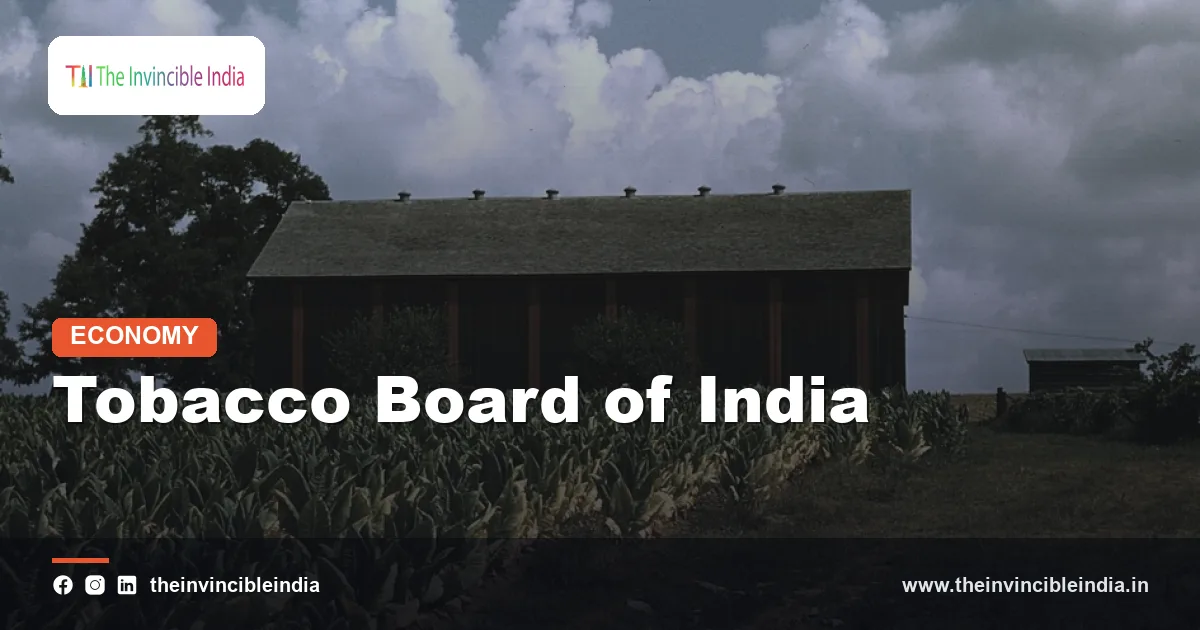
The Tobacco Board of India is a statutory body, set up under the Tobacco Board Act, 1975 and functioning under the Ministry of Commerce and Industry, that regulates the production and marketing of Virginia tobacco and promotes the export of Indian tobacco. Headquartered in Guntur, Andhra Pradesh, the Board began work on 1 January 1976 and oversees growers, auction platforms and exporters in the main tobacco-growing states.
The Tobacco Board of India deals with tobacco as an agricultural commodity and an export product, which is a different subject from public-health regulation of tobacco use. This explainer describes the Board’s origins, structure and functions, the e-auction system, the welfare of growers and India’s place in global tobacco trade, in a factual and neutral manner. It was last reviewed on 21 October 2026.
| Attribute | Detail |
|---|---|
| Full name | Tobacco Board of India (often called the Tobacco Board) |
| Established | Constituted under the Tobacco Board Act, 1975; began functioning on 1 January 1976 |
| Parent ministry | Ministry of Commerce and Industry, Government of India |
| Headquarters | Guntur, Andhra Pradesh |
| Predecessor | Central Tobacco Committee (set up in 1945) |
| Type | Statutory commodity board |
| Main regulated crop | Flue-cured Virginia (FCV) tobacco |
| Auction centres | Auction platforms in Andhra Pradesh and Karnataka |
Key Takeaways
- The Tobacco Board of India was created by the Tobacco Board Act, 1975 and has been functioning since 1 January 1976.
- The Tobacco Board of India is headquartered in Guntur, Andhra Pradesh, and works under the Ministry of Commerce and Industry.
- Flue-cured Virginia (FCV) tobacco is the crop that the Tobacco Board of India regulates most directly, through grower registration, barn registration and a system of crop authorisation.
- FCV tobacco in India is sold through e-auctions at auction platforms in Andhra Pradesh and Karnataka, which are managed by the Tobacco Board of India.
- The Tobacco Board of India also promotes the export of Indian tobacco and tobacco products, and India is among the world’s major tobacco producers and exporters.
- Tobacco use is regulated for health reasons under separate laws, such as the Cigarettes and Other Tobacco Products Act, 2003, which the Ministry of Health and Family Welfare administers.
What is the Tobacco Board of India?
The Tobacco Board of India is a commodity board under the Government of India that looks after the growing, curing, marketing and export of tobacco, especially the flue-cured Virginia variety. Like the Coffee Board, the Tea Board, the Rubber Board and the Spices Board, it is one of the sector-specific boards under the Ministry of Commerce and Industry that connect farm production with trade.
The Board’s legal basis is the Tobacco Board Act, 1975. The Act gave it duties covering the quality of the crop, orderly marketing, regulation of production to match demand, growers’ welfare, and the development of exports. The Board is a body corporate, meaning it can hold property and enter into contracts in its own name.
The Board is not a manufacturer or a trader. It does not buy tobacco for itself. Its job is to set the rules of the market, register the participants, run the auction platforms and make sure that growers receive transparent and fair price discovery.
When and why was the Tobacco Board of India set up?
The Tobacco Board of India was set up in 1976 under the Tobacco Board Act, 1975, to replace the earlier Central Tobacco Committee and to give the tobacco sector a stronger statutory body that could regulate both production and exports. The earlier committee, formed in 1945, had worked mostly through research and cess collection under the Central Tobacco Committee Act.
By the early 1970s the Indian tobacco economy had changed. Flue-cured Virginia tobacco had become an important export crop and a significant source of foreign exchange, while a large number of small farmers in Andhra Pradesh and Karnataka depended on it. Growers often faced wide price swings, uneven grading, and the bargaining power of buyers. The government decided that a dedicated board with regulatory powers was needed to stabilise the crop, ensure quality and widen export markets.
The Board’s formation also coincided with a period in which India built up commodity boards for several export-oriented crops, in line with a general policy of strengthening agricultural exports.
What are the functions of the Tobacco Board of India?
The Tobacco Board of India performs regulatory, developmental and export-promotion functions that cover the full chain from the farm to the foreign buyer. The Act lays out these duties, and the Board carries them out through its headquarters and regional offices.
- Regulating production: The Board registers growers and curing barns and, each season, sets the quantity of FCV tobacco that may be grown, called the authorised crop size, in order to avoid excess supply that depresses prices.
- Regulating marketing: The Board runs the auction platforms where growers sell their produce and makes sure that purchases follow the rules.
- Quality improvement: It promotes good agricultural practices, curing methods, grading standards and research on varieties, often in coordination with research institutions such as the Central Tobacco Research Institute (CTRI) in Rajahmundry.
- Export promotion: It helps Indian exporters reach foreign buyers, collects market information and registers exporters of tobacco.
- Grower welfare: It carries out welfare schemes for registered growers and their families.
- Advice to the government: It gives recommendations on policy issues such as trade, duties, and crop diversification.
How is the Tobacco Board of India organised?
The Tobacco Board of India is governed by a Board that is headed by a Chairman and includes representatives of growers, the tobacco trade, state governments, Members of Parliament and officers of the central government. The Chairman is appointed by the central government, and a Secretary and other officials run day-to-day administration.
The membership is deliberately mixed so that the main interests in the industry have a say. Growers from the main producing states, merchants and exporters, manufacturers and government officers all sit together on the Board. The Board’s decisions on matters such as crop size, minimum prices and auction rules are therefore the result of negotiation among those groups and the government.
The Board has its headquarters in Guntur and works through regional offices and auction platform offices in the producing areas. Regional offices cover places such as Ongole and Rajahmundry in Andhra Pradesh and Mysuru in Karnataka. A cell dealing with export promotion operates in addition, working with trade bodies and Indian missions abroad.
What is flue-cured Virginia (FCV) tobacco?
Flue-cured Virginia tobacco is a variety of tobacco leaf that is dried, or cured, in closed barns using controlled heat transmitted through flues, without exposing the leaf to smoke. The method produces a bright, light-coloured leaf that is the principal raw material for cigarettes around the world.
In India, FCV tobacco is grown mainly in two states. Andhra Pradesh produces the larger share, on three main soil types: the Southern Light Soils, Northern Light Soils and Northern Black Soils. Karnataka grows FCV in its Karnataka Light Soils region, mostly around the districts of Mysuru and Hassan. Because the crop is grown under contract-like conditions, with registration and closely monitored barns, it is among the more regulated crops in Indian agriculture.
India also produces several other types of tobacco that are outside the main FCV regulation, such as country tobacco (Natu), burley, bidi tobacco, hookah, chewing and cigar types, grown in states including Gujarat, Karnataka, Tamil Nadu, West Bengal, Uttar Pradesh and Bihar. The Board’s work on these types is mostly confined to trade and export support rather than detailed production control.
How do the tobacco e-auctions work?
Tobacco e-auctions are online-assisted auctions in which registered growers bring bales of cured FCV tobacco to an auction platform and registered buyers bid for them through an electronic system, with the Tobacco Board of India supervising the process. The sale takes place at designated auction platforms in the producing regions, rather than in private markets.
The key steps are as follows:
- Registration: A grower must be registered with the Board and holds a registration record that specifies the authorised area and quantity.
- Bale preparation: The grower grades the cured leaf and packs it into bales, which are tagged with a bale identification number.
- Arrival and weighing: The bales are brought to the auction platform, weighed, and lined up for auction in a fixed order.
- Bidding: Registered buyers, which include cigarette manufacturers, exporters and leaf dealers, place electronic bids, and the system records the bids to the Board.
- Acceptance and payment: If the highest bid is acceptable, the sale is finalised and payment is made through banking channels, with weighing and grade details recorded in the system.
The e-auction system was introduced to improve transparency, reduce disputes and give growers a visible record of bids. Before it, auctions were conducted by manual calling of bids. The Board’s platforms operate in Andhra Pradesh, in places such as Ongole, Podili, Kandukur, Kanigiri, Tangutur, Vellampalli, Jeelugumilli, Gopalapuram, Jangareddygudem, and Devarapalli, and in Karnataka around Hunsur, Periyapatna, Shivarsanthe, Ramanathapura and Kushalnagar. The exact list of platforms can change from year to year.
How are growers registered and supported?
Growers who wish to cultivate FCV tobacco must register with the Tobacco Board of India, and registration lets them obtain permission to grow, access auction platforms and receive welfare benefits. The Board’s registration system also allows it to keep production within the quantity that the market is likely to absorb.
The Board and its related institutions support growers through a number of measures. These include:
- Training and extension on good agricultural practices, crop protection and efficient curing methods that lower fuel use.
- Promotion of better curing barns and alternative fuels to reduce dependence on firewood and protect forests.
- Welfare schemes for registered growers, such as help in education, health and social security-type benefits for families.
- Information on market conditions and prices to help growers plan the next season’s crop.
- Efforts to promote crop diversification where farmers seek alternatives to tobacco.
The Board has also worked with state governments on matters such as unauthorised cultivation. When production exceeds the authorised quantity, farmers may find it difficult to sell all their tobacco at good prices, so enforcement of crop limits is considered an important element of price stability.
What is India’s position in global tobacco trade?
India is one of the world’s largest tobacco producers, usually listed among the top few, and a significant exporter of unmanufactured tobacco, with exports of the order of a billion US dollars in recent years. China and Brazil are the other very large producers. India’s competitive strengths include a long growing and curing tradition, relatively low cost of production and a range of leaf types.
Indian tobacco is exported to a wide set of countries in the European Union, the Middle East, Africa, Southeast Asia and elsewhere. Unmanufactured FCV tobacco makes up the largest share by value, followed by other types and products such as tobacco extracts and bidi and cigar tobacco in smaller amounts. The Board supports Indian exporters by tracking international demand, participating in trade events and helping buyers to evaluate Indian leaf.
Exports are subject to the changing regulations of importing countries, including limits on residues of agrochemicals in leaf and international commitments on tobacco control. Quality compliance is therefore a major concern, and the Board encourages growers to follow approved agrochemical use and good practices.
Who regulates tobacco consumption in India?
Tobacco consumption in India is regulated by the Ministry of Health and Family Welfare under the Cigarettes and Other Tobacco Products Act, 2003 (COTPA), which is separate from the Tobacco Board of India. The Act restricts smoking in public places, bans most advertising and sponsorship, prohibits sale to minors and requires health warnings on packs.
India is a party to the World Health Organization Framework Convention on Tobacco Control (FCTC), which it ratified in 2004. The government has additionally banned electronic cigarettes through the Prohibition of Electronic Cigarettes Act, 2019. The National Tobacco Control Programme works on awareness, cessation support and enforcement.
The result is that two policy areas coexist. One focuses on agriculture, livelihoods and trade, where the Tobacco Board of India works. The other focuses on public health and demand reduction, where the health ministry leads. The Board has said, in line with national policy, that it supports sustainable livelihoods of growers, including alternative crops where feasible. The Board’s role is therefore limited to the farm and trade side of the sector and does not extend to promoting domestic consumption.
What are the different types of tobacco grown in India?
India grows several types of tobacco that differ by use, curing method and region, and FCV is only one of them. The table below summarises the main types.
| Type | Main use | Typical regions |
|---|---|---|
| Flue-cured Virginia (FCV) | Cigarettes and export | Andhra Pradesh, Karnataka |
| Burley | Cigarette blends | Andhra Pradesh |
| Natu (country) tobacco | Hookah, chewing, local products | Andhra Pradesh, Karnataka |
| Bidi tobacco | Bidis | Gujarat, Karnataka, Maharashtra, West Bengal |
| Chewing, hookah and cigar types | Chewing products, hookah, cigars | Tamil Nadu, West Bengal, Bihar, Uttar Pradesh, Assam |
Because these types differ in how they are grown and traded, the degree of regulation differs too. FCV is the most tightly regulated under the Tobacco Board Act, while other types are more loosely organised.
What challenges does the Tobacco Board of India face?
The Tobacco Board of India faces a set of challenges that include falling domestic demand pressure from health policy, international tobacco-control norms, residue limits in export markets, fuel and environmental concerns, and the need to give growers alternatives. Each of these influences how the Board balances livelihoods against wider public policy.
Livelihood dependence
A large number of farmers and rural workers, including those who work in barns and processing, depend on tobacco for income in specific districts. Transitioning away from the crop requires viable alternatives with comparable returns, which are not always easy to find.
Market access and compliance
Importing countries have tightened rules on pesticide residues and traceability. The Board therefore stresses good agricultural practices and monitoring.
Environmental concerns
Curing consumes large amounts of fuel, historically firewood. Efforts to promote efficient barns and renewable fuels aim to reduce the pressure on forests.
Price and crop balance
Over-production in a season can result in unsold bales and lower prices, while a short crop can reduce export competitiveness. Setting the crop size each year is a difficult balancing task that involves growers, buyers and the government.
Bottom Line
The Tobacco Board of India is the agricultural and trade regulator for the country’s tobacco crop, especially FCV tobacco, working through registration, e-auctions and export promotion from its headquarters in Guntur. Its role is separate from health regulation, and it operates in the space between farmer livelihoods, orderly markets and an evolving global policy environment on tobacco.
Frequently Asked Questions
What is the Tobacco Board of India?
The Tobacco Board of India is a statutory body under the Ministry of Commerce and Industry that regulates the production, marketing and export of tobacco, especially flue-cured Virginia tobacco. It was created by the Tobacco Board Act, 1975, and began functioning in 1976. Its headquarters are in Guntur, Andhra Pradesh.
Where is the headquarters of the Tobacco Board of India?
The headquarters of the Tobacco Board of India is in Guntur, Andhra Pradesh. The city lies in the heart of one of the main tobacco-growing regions of the country. The Board also runs regional offices and auction platforms in Andhra Pradesh and Karnataka.
How are tobacco e-auctions conducted?
Tobacco e-auctions are held at Tobacco Board auction platforms where registered growers sell graded bales to registered buyers through an electronic bidding system. Each bale is weighed, identified and offered in sequence, and the results are recorded in the system. The process aims to make price discovery transparent for growers.
Which states grow flue-cured Virginia tobacco?
Andhra Pradesh and Karnataka are the two main states that grow flue-cured Virginia tobacco in India. Andhra Pradesh accounts for the larger share, across its light and black soil regions. Karnataka’s crop is concentrated in the districts around Mysuru and Hassan.
Does the Tobacco Board of India regulate smoking?
No, the Tobacco Board of India does not regulate smoking or tobacco use. Its role covers the farm and trade side, such as crop registration, auctions and exports. Public-health rules, including the Cigarettes and Other Tobacco Products Act, 2003, are administered by the Ministry of Health and Family Welfare.
Is India a major tobacco exporter?
Yes, India is among the world’s leading tobacco producers and a significant exporter of unmanufactured tobacco. Exports are worth roughly a billion US dollars in recent years, although the figure varies year to year. The Tobacco Board of India supports exporters by promoting Indian leaf in international markets.
{“@context”:”https://schema.org”,”@graph”:[{“@type”:”FAQPage”,”mainEntity”:[{“@type”:”Question”,”name”:”What is the Tobacco Board of India?”,”acceptedAnswer”:{“@type”:”Answer”,”text”:”The Tobacco Board of India is a statutory body under the Ministry of Commerce and Industry that regulates the production, marketing and export of tobacco, especially flue-cured Virginia tobacco. It was created by the Tobacco Board Act, 1975, and began functioning in 1976. Its headquarters are in Guntur, Andhra Pradesh.”}},{“@type”:”Question”,”name”:”Where is the headquarters of the Tobacco Board of India?”,”acceptedAnswer”:{“@type”:”Answer”,”text”:”The headquarters of the Tobacco Board of India is in Guntur, Andhra Pradesh. The city lies in the heart of one of the main tobacco-growing regions of the country. The Board also runs regional offices and auction platforms in Andhra Pradesh and Karnataka.”}},{“@type”:”Question”,”name”:”How are tobacco e-auctions conducted?”,”acceptedAnswer”:{“@type”:”Answer”,”text”:”Tobacco e-auctions are held at Tobacco Board auction platforms where registered growers sell graded bales to registered buyers through an electronic bidding system. Each bale is weighed, identified and offered in sequence, and the results are recorded in the system. The process aims to make price discovery transparent for growers.”}},{“@type”:”Question”,”name”:”Which states grow flue-cured Virginia tobacco?”,”acceptedAnswer”:{“@type”:”Answer”,”text”:”Andhra Pradesh and Karnataka are the two main states that grow flue-cured Virginia tobacco in India. Andhra Pradesh accounts for the larger share, across its light and black soil regions. Karnataka’s crop is concentrated in the districts around Mysuru and Hassan.”}},{“@type”:”Question”,”name”:”Does the Tobacco Board of India regulate smoking?”,”acceptedAnswer”:{“@type”:”Answer”,”text”:”No, the Tobacco Board of India does not regulate smoking or tobacco use. Its role covers the farm and trade side, such as crop registration, auctions and exports. Public-health rules, including the Cigarettes and Other Tobacco Products Act, 2003, are administered by the Ministry of Health and Family Welfare.”}},{“@type”:”Question”,”name”:”Is India a major tobacco exporter?”,”acceptedAnswer”:{“@type”:”Answer”,”text”:”Yes, India is among the world’s leading tobacco producers and a significant exporter of unmanufactured tobacco. Exports are worth roughly a billion US dollars in recent years, although the figure varies year to year. The Tobacco Board of India supports exporters by promoting Indian leaf in international markets.”}}]}]}


