

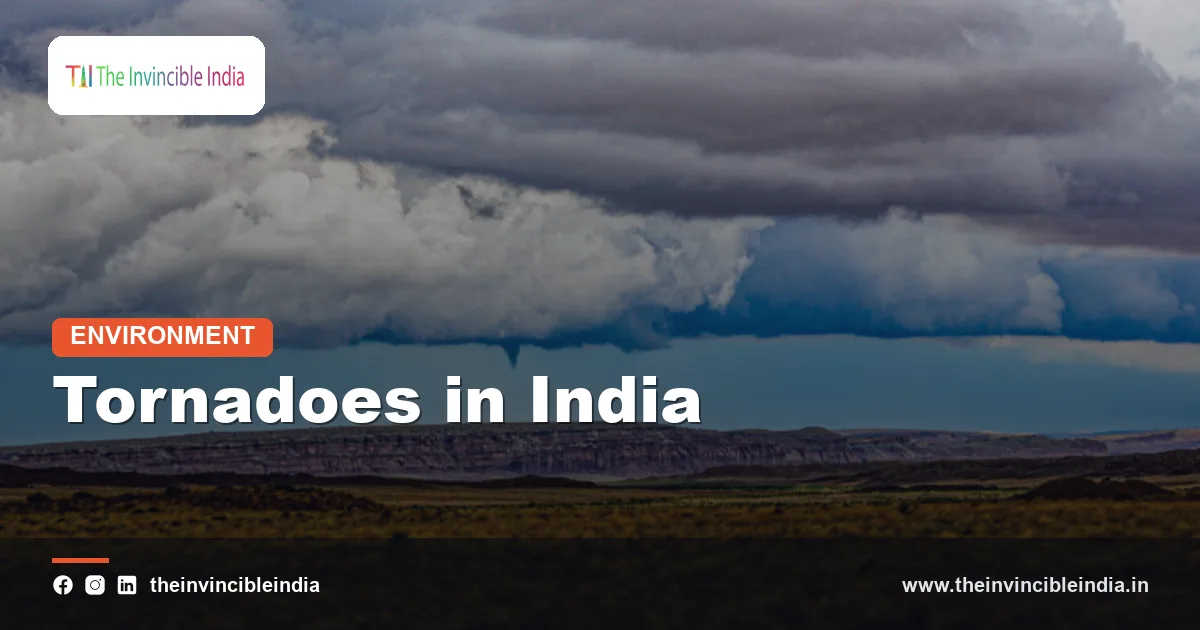
Tornadoes in India are rare but real: narrow, violently rotating columns of air that extend from a thunderstorm cloud to the ground, and they strike mostly the eastern and northern plains during the stormy pre-monsoon season. They are nothing like the giant, long-track twisters of the American Great Plains, and they rarely make national headlines, yet when one does touch down it can flatten a village in a matter of seconds. This article, last reviewed on 3 November 2026, explains how tornadoes form, where in India they occur, why they are often missed and how they differ from the dust devils and downbursts people commonly confuse them with.
The honest summary is that India has a modest but genuine tornado problem, concentrated in a belt that stretches from Odisha and West Bengal through Bihar and Uttar Pradesh and across into Bangladesh. Because the country has no dense network of trained storm spotters and no routine, nationwide damage-rating programme, much of what is known comes from news reports, local damage surveys and the work of a small community of researchers.
| Topic | Tornadoes in India |
|---|---|
| What it is | A rotating column of air in contact with both the ground and a thunderstorm cloud |
| Frequency | Rare; a handful of reports in most years, though under-reporting is likely |
| Main season | Pre-monsoon, roughly March to May, with some events in the monsoon and post-monsoon |
| Most affected areas | West Bengal, Odisha, Bihar, Jharkhand, eastern Uttar Pradesh, Assam and the northern plains |
| Typical strength | Usually weak to moderate, narrow and short-lived |
| Rating scale | Enhanced Fujita scale used internationally; no routine national rating system in India |
| Look-alikes | Dust devils, downbursts, Nor’wester squalls and waterspouts |
Key Takeaways
- A tornado is a rotating column of air that touches both a thunderstorm and the ground; a dust devil, a downburst or an ordinary squall is a different phenomenon even if it looks dramatic.
- Tornadoes in India are uncommon and are usually weaker and shorter-lived than the strongest American twisters, but they can still destroy homes, uproot trees and kill people along a narrow track.
- The most vulnerable zone is the eastern and northern plains, including Odisha, West Bengal, Bihar and neighbouring Bangladesh, mainly in the pre-monsoon months of March to May.
- Many events are probably under-reported or mislabelled as storms, whirlwinds or cyclones, because India lacks a dense spotter network and a standard damage-survey system.
- Tornadoes form from thunderstorms with rotating updrafts, so they are linked to the same Nor’wester conditions that bring hail, lightning and squalls, which means a severe storm warning is also a tornado risk signal.
- Personal safety rests on early warning, shelter in a sturdy interior room away from windows, and avoiding the temptation to film or chase a storm.
What exactly is a tornado?
A tornado is a violently rotating column of air that is in contact with the ground and extends up into a parent cloud, usually a cumulonimbus. The visible funnel is formed by condensation and by dust and debris drawn into the vortex, and the winds inside can reach speeds that rip roofs from buildings and hurl objects through the air. Most tornadoes are only a few tens to a few hundreds of metres wide and last for minutes, although the strongest can travel many kilometres.
The key phrase is contact with both the ground and a storm cloud. A swirl of dust on a hot day is not a tornado, and neither is a straight blast of wind from a collapsing storm. Meteorologists recognise two broad types. Supercell tornadoes grow from large rotating thunderstorms and are the strongest and longest lived. Non-supercell tornadoes, sometimes called landspouts, form when rotating air near the ground is stretched upward by a growing storm updraft, and they are generally weaker and brief.
How do tornadoes form?
Tornadoes form when a strong, rotating thunderstorm updraft stretches a spinning column of air tightly enough to concentrate its rotation near the ground. The recipe starts with the same ingredients as any severe thunderstorm: warm, moist air near the surface, an unstable atmosphere and something to trigger lift. The additional ingredient is wind shear, meaning that the wind changes in speed or direction with height. When the low-level wind blows from one direction and the upper-level wind blows faster from another, a horizontal rolling motion develops in the air.
A powerful updraft can tilt that rolling motion into the vertical, creating a rotating updraft called a mesocyclone. In some storms, the mesocyclone’s rotation tightens and descends toward the ground, and the interaction with the storm’s cold downdraft can focus the spin into a narrow vortex. Why one rotating storm produces a tornado while a similar one does not is still an active area of research, and forecasters can identify favourable conditions much better than they can predict a specific tornado.
In India the conditions are most often met during pre-monsoon Nor’westers. The mixture of hot, humid air near the surface, cooler dry air aloft and strong changes in wind with height can support rotating storms, especially over the eastern plains.
Do tornadoes really happen in India?
Yes, tornadoes do happen in India, although they are rare compared with the United States and are often poorly documented. Reports and damage surveys over the decades have described tornadoes or tornado-like vortices in West Bengal, Odisha, Bihar, Jharkhand, Uttar Pradesh, Assam, Haryana, Punjab, Delhi and parts of the south, including coastal areas. Some storms in the Kolkata region and in northern Bengal districts such as Jalpaiguri have been reported as tornadoes in recent years, and deadly events in neighbouring Bangladesh have drawn attention to the wider region.
India is not usually listed among the countries with the highest tornado counts, yet researchers studying South Asia have pointed to the area around Bangladesh and eastern India as one of the world’s more tornado-prone zones, owing to its warm, moist air, flat terrain and the clashes of air masses before the monsoon. The risk is amplified by very high population density, which means even a narrow tornado is likely to hit homes.
Because the numbers are uncertain, it is best to treat any precise annual count with caution. What can be said with confidence is that tornadoes are a recurring, if infrequent, feature of the country’s severe weather, not a myth.
Where and when are tornadoes most likely in India?
Tornadoes are most likely over the eastern and northern plains in the pre-monsoon months of March to May, during the afternoon and evening. The favoured states are West Bengal, Odisha, Bihar, Jharkhand and eastern Uttar Pradesh, with extension into Assam and the northeastern plains, and across the border into Bangladesh. Some events occur outside this core region, including in Punjab, Haryana, Delhi and parts of Gujarat and Rajasthan, usually when a strong thunderstorm line crosses.
The reasons are geographic. Hot, dry air from the northwest overrides or collides with humid air coming from the Bay of Bengal, creating strong contrasts and instability. The plains offer little to disrupt the storm’s inflow, and the typical afternoon heating helps to release that instability. Tornadoes are less common in the monsoon proper because the atmosphere is moister and less sheared, although occasional events do occur, particularly around monsoon depressions and low-pressure systems.
In the peninsular south and on the coasts, tornado-like vortices are sometimes linked with sea breeze fronts, cyclonic circulations and landfalling cyclones. These are generally smaller and short-lived, and can be hard to distinguish from other wind damage without a careful survey.
How strong are Indian tornadoes compared with American ones?
Indian tornadoes are generally weaker, narrower and shorter-lived than the strongest American twisters. Most documented events in India appear to fall in the lower to middle part of the Enhanced Fujita scale, which ranks tornadoes from the weakest to the most violent according to the damage they cause. That does not make them harmless: even a weaker tornado can tear off tin and asbestos roofs, topple brick walls, overturn vehicles and uproot large trees.
The difference in intensity comes from the typical storm environment. The American Great Plains regularly produce huge supercells in a landscape of strong shear and abundant energy, giving the long-track violent tornadoes the region is known for. Indian storms can be intense, but the setup that fuels the most extreme tornadoes occurs less often, and the strongest known tornadoes in South Asia are mostly reported from Bangladesh and the Bengal region rather than from the Indian interior.
It is worth stressing that damage depends on construction as well as wind. In regions where many homes are built of mud, thatch, tin or poorly reinforced masonry, a moderate wind can cause a disaster that a well-built house would withstand. The human toll of a tornado therefore does not map neatly onto its official strength.
| Feature | Tornado | Dust devil | Downburst |
|---|---|---|---|
| Parent | Thunderstorm cloud | No storm; clear, hot ground | Thunderstorm cloud |
| Wind pattern | Intense rotation, converging | Weak rotation, rising air | Straight-line outflow, spreading |
| Typical damage | Narrow, twisted, debris tossed in several directions | Little or none | Wide swath, debris pushed one way |
| Season | Mostly pre-monsoon | Hot, dry afternoons | Any thunderstorm season |
How is a tornado different from a dust devil or a cyclone?
A tornado differs from a dust devil because it hangs from a thunderstorm and is far more violent, while it differs from a cyclone because it is a small, short-lived vortex rather than a huge ocean storm system. A dust devil forms on hot, clear afternoons when the sun superheats a patch of ground and the air above rises in a spinning column. It rises from the surface up, has no connection to a storm cloud, and is usually weak enough to leave only swirled dust and a few scattered leaves.
A tropical cyclone is hundreds of kilometres across, forms over warm ocean water and lasts days. Tornadoes may occasionally spin off in the outer bands of a landfalling cyclone, but the cyclone and the tornado are entirely different in scale. Confusion between them can lead news reports to describe a local tornado as a cyclone or a whirlwind, which is partly why events are under-counted.
The easiest quick test is the cloud. If the rotating column is clearly attached to a dark storm cloud and the surrounding weather is violent, it is a tornado or a related vortex. If it is a slender swirl of dust under a blue or lightly clouded sky, it is almost certainly a dust devil.
Why are tornadoes under-reported in India?
Tornadoes are under-reported in India because there is no dense system for spotting, confirming and rating them. Most tornadoes in countries with long records are identified by trained spotters, radar signatures and systematic post-storm surveys. In India, a short-lived vortex that strikes a rural area at dusk may leave behind damage that local authorities attribute to a thunderstorm, a squall or a whirlwind, without anyone distinguishing the signature of a tornado.
Radar can help, since Doppler radars may detect rotation inside a storm, but a tornado is often too small and low to the ground for a radar beam to resolve, and the radar network does not cover every district densely. The India Meteorological Department does issue severe thunderstorm warnings and has, in some cases, confirmed tornadoes following field investigation, but a routine national tornado database comparable to those in other countries is not available to the public.
This gap matters because what is not recorded is not planned for. Better records would help show where the real hot spots are, support building guidelines and shape warning messages for districts that may face repeated danger.
What damage and risk do tornadoes cause?
Tornadoes cause damage in a narrow but intense path, destroying homes, crops and power lines and killing people through flying debris and building collapse. In the Indian setting, the greatest dangers come from tin and asbestos roofing sheets that become airborne, from mud or brick walls that fall inward and from trees and electric poles that topple. Livestock losses and damage to standing crops add to the economic impact on farming households.
The path of a tornado is typically only tens or hundreds of metres wide, which means that one house may be destroyed while the next is barely touched. That randomness can make the event feel mysterious and frightening for communities. Because tornadoes often accompany a broader severe thunderstorm, they combine with hail, lightning and heavy rain, and survivors may also face blocked roads and power failure in the aftermath.
Relief and recovery tend to be handled under the general framework for natural calamities, with state governments assessing losses and providing compensation. As with other hazards, quick evacuation of damaged houses and attention to injuries in the first hours save lives.
How can people protect themselves from a tornado?
People can protect themselves from a tornado by taking shelter in a sturdy building, moving to a low interior room away from windows and covering their head. If a severe thunderstorm warning is issued for the area, treat it as a potential tornado warning, particularly in the eastern plains during March to May. A dark greenish or very black sky, large hail, a sudden calm followed by a loud continuous roar and a visible rotating cloud are all danger signs.
In a kutcha house or hut, the best option is to move to a nearby pucca building, school or community shelter if there is time. Outdoors, people should not shelter under trees, in vehicles that can be tossed or in tin-roofed sheds. If caught in the open with no shelter, lying flat in a low ditch and covering the head is a last resort, though flooding must be watched.
Communities can lower the risk over time through better roof fastening, community shelters in vulnerable districts and public education. Tornado drills are not routine in India, but simple awareness of what to do in a severe storm can make a significant difference.
Is tornado activity in India changing with the climate?
It is not yet clear whether tornado activity in India is changing with the climate, because the records are too short and incomplete to show a trend. Scientists expect warming to alter the ingredients of severe storms in complex ways: a warmer atmosphere holds more moisture and can store more energy, which tends to favour stronger thunderstorms, while changes in wind shear could work in the opposite direction.
Studies elsewhere suggest that the frequency and location of tornado outbreaks may shift, but for South Asia the evidence is limited. The honest position is that the risk is real, the record is thin and the future pattern is uncertain. Improving observation and documentation is the most useful step towards answering the question properly.
Bottom Line
Tornadoes in India are uncommon, mostly weak to moderate and concentrated in the eastern and northern plains before the monsoon, but they can be deadly because of dense settlement and fragile housing. Many go unrecorded or are mislabelled, so the true picture is probably more active than the statistics suggest. Treating severe thunderstorm warnings seriously, knowing the difference between a tornado and a dust devil and sheltering early are the practical lessons.
Frequently Asked Questions
Do tornadoes occur in India?
Yes. Tornadoes occur in India but are rare, with most reports from West Bengal, Odisha, Bihar and the northern plains in the pre-monsoon months of March to May. They are usually weaker and shorter-lived than the strongest American tornadoes.
Which Indian states are most prone to tornadoes?
The eastern and northern plains, including West Bengal, Odisha, Bihar, Jharkhand and eastern Uttar Pradesh, are the most prone. Assam and the northeastern plains, and the neighbouring parts of Bangladesh, are also affected.
What is the difference between a tornado and a dust devil?
A tornado hangs from a thunderstorm cloud and can be violently destructive, whereas a dust devil forms from hot ground under clear or lightly clouded skies and is usually weak. The presence of a parent storm cloud is the easiest way to tell them apart.
Why are Indian tornadoes under-reported?
India lacks a dense network of trained storm spotters and a routine national damage-rating system, so many tornadoes are recorded simply as squalls, whirlwinds or storms. Narrow, short-lived vortices in rural areas can easily go unconfirmed.
Can the IMD predict tornadoes?
Forecasters can identify conditions favourable for severe thunderstorms and issue warnings, but predicting the exact location and time of a particular tornado is very difficult anywhere in the world. A severe thunderstorm warning should be treated as a possible tornado risk.
What should I do if a tornado is approaching?
Move quickly into a sturdy building and shelter in a low interior room away from windows, covering your head. Avoid trees, vehicles and tin-roofed structures, and take any official severe weather warning seriously.
{“@context”:”https://schema.org”,”@graph”:[{“@type”:”FAQPage”,”mainEntity”:[{“@type”:”Question”,”name”:”Do tornadoes occur in India?”,”acceptedAnswer”:{“@type”:”Answer”,”text”:”Yes. Tornadoes occur in India but are rare, with most reports from West Bengal, Odisha, Bihar and the northern plains in the pre-monsoon months of March to May. They are usually weaker and shorter-lived than the strongest American tornadoes.”}},{“@type”:”Question”,”name”:”Which Indian states are most prone to tornadoes?”,”acceptedAnswer”:{“@type”:”Answer”,”text”:”The eastern and northern plains, including West Bengal, Odisha, Bihar, Jharkhand and eastern Uttar Pradesh, are the most prone. Assam and the northeastern plains, and the neighbouring parts of Bangladesh, are also affected.”}},{“@type”:”Question”,”name”:”What is the difference between a tornado and a dust devil?”,”acceptedAnswer”:{“@type”:”Answer”,”text”:”A tornado hangs from a thunderstorm cloud and can be violently destructive, whereas a dust devil forms from hot ground under clear or lightly clouded skies and is usually weak. The presence of a parent storm cloud is the easiest way to tell them apart.”}},{“@type”:”Question”,”name”:”Why are Indian tornadoes under-reported?”,”acceptedAnswer”:{“@type”:”Answer”,”text”:”India lacks a dense network of trained storm spotters and a routine national damage-rating system, so many tornadoes are recorded simply as squalls, whirlwinds or storms. Narrow, short-lived vortices in rural areas can easily go unconfirmed.”}},{“@type”:”Question”,”name”:”Can the IMD predict tornadoes?”,”acceptedAnswer”:{“@type”:”Answer”,”text”:”Forecasters can identify conditions favourable for severe thunderstorms and issue warnings, but predicting the exact location and time of a particular tornado is very difficult anywhere in the world. A severe thunderstorm warning should be treated as a possible tornado risk.”}},{“@type”:”Question”,”name”:”What should I do if a tornado is approaching?”,”acceptedAnswer”:{“@type”:”Answer”,”text”:”Move quickly into a sturdy building and shelter in a low interior room away from windows, covering your head. Avoid trees, vehicles and tin-roofed structures, and take any official severe weather warning seriously.”}}]}]}


