

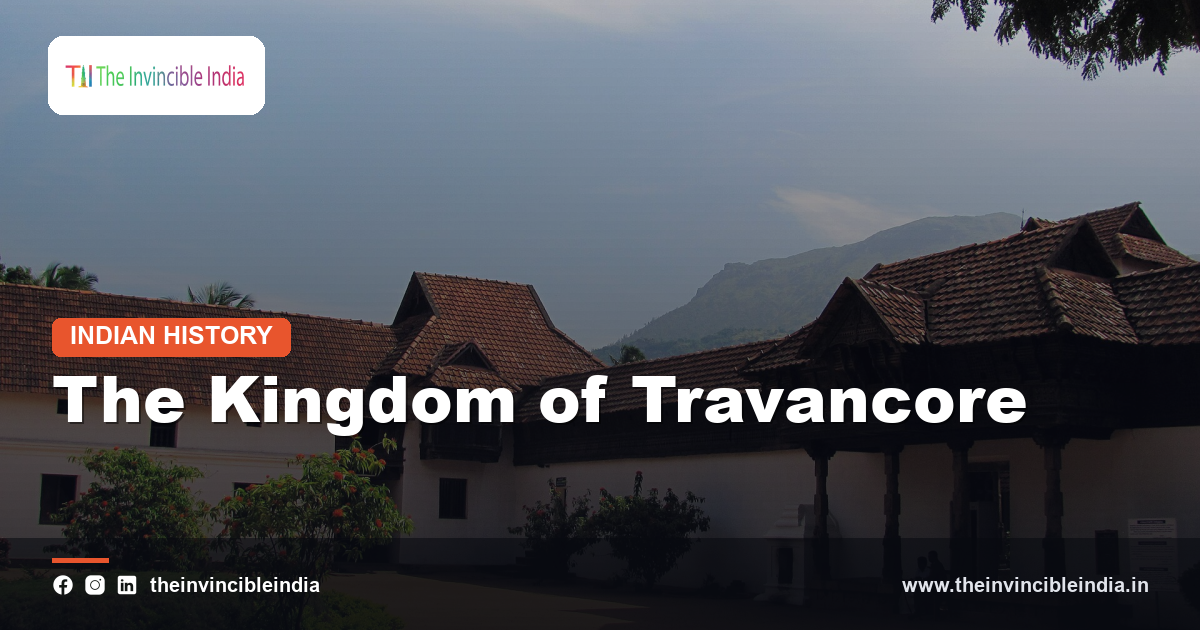
The Kingdom of Travancore was a major princely state in the far south of the Indian subcontinent, covering much of southern Kerala and a part of the neighboring Tamil country. Ruled by a dynasty whose kings regarded themselves as servants of the deity Padmanabha, it became known for strong centralized government, patronage of music and the arts, and an early reputation for education and social reform. Its capital, Thiruvananthapuram, still houses the great Padmanabhaswamy temple at the heart of the state’s identity. Like several southern powers discussed in our guide to the Chola dynasty, Travancore left a distinctive imprint on the cultural landscape of the peninsula.
Quick Facts
| Detail | Information |
|---|---|
| Region | Southern Kerala and parts of the southern Tamil country |
| Capital | Padmanabhapuram, later Thiruvananthapuram |
| Architect of the State | Marthanda Varma, who consolidated the kingdom |
| Presiding Deity | Sri Padmanabha, to whom the kingdom was dedicated |
| Known For | Temple traditions, arts patronage, and social reform |
| Later History | Merged into Travancore-Cochin and then the state of Kerala |
Geography and Early Setting
Travancore occupied the southern tip of the Malabar and Coromandel regions, a land of coastline, backwaters, fertile lowlands, and the forested slopes of the Western Ghats. This varied terrain supported spices, coconut, rice, and timber, and its long coast connected it to maritime trade with distant lands. In earlier centuries the area was divided among several small chiefdoms and principalities, each with its own local rulers. The lands of the south were shaped by the older traditions of the Chera and Ay kingdoms, and by the influence of neighboring Tamil powers. This setting of scattered authority and rich resources prepared the ground for the emergence of a single strong kingdom.
Origins of the Ruling Dynasty
The royal family of Travancore traced its heritage to older ruling houses of southern Kerala and was known in its early phase as the Venad kingdom. Venad was a modest principality whose rulers were often drawn into the shifting politics of the region, balancing neighboring powers and local chiefs. Over time the ruling house, whose members followed a matrilineal system of inheritance common among Kerala’s ruling families, gained in strength and ambition. Its later rulers expanded the realm and transformed a small chiefdom into a major state. The origins of Travancore thus lay in a small principality that grew through leadership and circumstance.
Marthanda Varma and the Making of Travancore
Marthanda Varma is celebrated as the founder of modern Travancore. Coming to power amid challenges from rival nobles and neighboring chiefs, he gradually strengthened the royal house and expanded its territory northward. He reduced the power of local lords who had long competed with the crown, built a disciplined army, and organized the administration on firmer lines. Through campaigns and diplomacy, he brought many smaller principalities under a single authority. His reign is widely regarded as the moment when Travancore became a unified and powerful state. Marthanda Varma’s achievements gave the kingdom its shape, its institutions, and its sense of purpose.
The Battle of Colachel
One of the best-known episodes of Marthanda Varma’s reign was the confrontation with the Dutch East India Company, which had established a strong commercial presence on the Kerala coast. The conflict culminated in the Battle of Colachel, in which the forces of Travancore defeated the Dutch. The result is often remembered as a notable instance of an Indian ruler overcoming a European trading power in battle. It weakened Dutch influence in the region and enhanced the prestige of the Travancore state. Remembered in local tradition and history, the victory remains a source of pride. Colachel thus stands as a defining moment in the story of Travancore.
Tripadidanam: Dedicating the Kingdom to Padmanabha
A distinctive feature of Travancore’s identity is the act known as Tripadidanam, in which Marthanda Varma dedicated the kingdom to the deity Sri Padmanabha. From that point, the rulers governed in the name of the god, styling themselves Padmanabha Dasa, the servants of Padmanabha. The king was thus a regent and servant of the deity rather than an absolute master of the land. This religious framing shaped the public image of the monarchy and bound the state closely to the temple at Thiruvananthapuram. It gave the dynasty a sacred legitimacy and a distinctive political culture. Tripadidanam remains one of the most remarkable features of the kingdom’s history.
The Padmanabhaswamy Temple
The Padmanabhaswamy temple in Thiruvananthapuram stands at the center of the history of Travancore. It is a major Vaishnava shrine, dedicated to Lord Vishnu reclining on the serpent Ananta, and its tall gopuram, carved corridors, and richly decorated halls reflect the fusion of Kerala and Dravidian architectural traditions. The temple has long been an important pilgrimage site and was closely tied to the royal family through the dedication of the kingdom. Its sanctum and rituals follow traditions preserved over many generations. The temple stands as the spiritual heart of the former kingdom and a landmark of South Indian heritage.
Padmanabhapuram Palace
Padmanabhapuram Palace is a remarkable wooden palace complex that once served as the seat of the Travancore rulers, and it lies in the area that is now part of Tamil Nadu. Built in the traditional architecture of Kerala, it features steeply pitched roofs, richly carved wooden ceilings, and elegant pillars arranged around courtyards. Its inner chambers contain ornate woodwork and murals that display exceptional craftsmanship. The palace is widely regarded as one of the finest surviving examples of traditional Kerala wooden architecture. It offers visitors a vivid glimpse of royal life in the old kingdom and the building skills of its artisans.
Administration and Statecraft
Travancore was known for an administration that was relatively well organized for its time. The kingdom was divided into administrative units overseen by officials responsible for revenue, justice, and public order. The role of the Dewan, or chief minister, was central in managing the daily business of government, and some Dewans left a lasting mark on the state. Land surveys, regular revenue systems, and a structured bureaucracy helped the state function with efficiency. Over time, representative bodies such as councils were introduced to give wider participation in governance. The administrative tradition of Travancore thus became one of the notable features of the state.
Relations with the British
As British influence expanded across India, Travancore entered into a subsidiary relationship with the East India Company, accepting a measure of British protection and oversight. The state retained its internal autonomy as a princely state, maintaining its own rulers, administration, and courts, while foreign affairs and defense were managed under British paramountcy. A Resident was posted to the court to represent British interests. This arrangement allowed Travancore to survive as a distinct political entity during the colonial period. It also meant that the kingdom operated within the broader framework of imperial power.
Swathi Thirunal and the Arts
Maharaja Swathi Thirunal is one of the most beloved figures in the cultural history of Travancore. Renowned as a ruler, scholar, and composer, he is remembered for numerous compositions in several languages, many of them devotional pieces that remain part of the repertoire of Carnatic music. His court attracted musicians, dancers, and scholars from across the south, creating a rich cultural atmosphere. He also supported learning and institutions of public benefit. Swathi Thirunal’s patronage and personal creativity made Travancore a vibrant center of music and the arts. His name is still honored in concerts and festivals held in his memory.
Art, Dance, and Craft Traditions
Kerala’s classical performing arts, such as Kathakali, Mohiniyattam, and Koodiyattam, flourished in the cultural environment that surrounded the Travancore court and its temples. Skilled artisans created fine woodwork, bronze casting, ivory carving, and murals that decorated palaces and shrines. The painter Raja Ravi Varma, who belonged to a family connected with the court circle, became one of the most famous artists of modern India. The kingdom’s patronage encouraged craftspeople and performers to refine their skills. These traditions, preserved and cherished, form a central part of Kerala’s cultural identity today.
Education and Social Reform
Travancore became widely known for its early attention to education, including opportunities for girls as well as boys, and its rulers supported schools, colleges, and public institutions. Missionary and local initiatives complemented the efforts of the state, contributing to rising levels of literacy. Social reformers such as Sree Narayana Guru, who emphasized the unity of humanity and challenged caste discrimination, shaped the climate of the region. The combination of state support and reformist movements helped make Kerala a leader in social development. The educational heritage of Travancore remains a source of pride and a key part of its legacy.
The Temple Entry Proclamation
In the twentieth century, Travancore took a landmark step in social reform through the Temple Entry Proclamation, which opened state-controlled temples to people of all castes. This decision came after years of agitation and debate led by reformers, and it was issued in the name of the reigning Maharaja. The proclamation was widely celebrated as a courageous and historic measure, and it drew the admiration of leaders across the country. It stands as a major example of reform undertaken by a princely state. The Temple Entry Proclamation remains one of the most important milestones in the social history of Travancore.
Economy, Trade, and Public Works
The economy of Travancore rested on agriculture, spices, coastal trade, and a range of crafts. Pepper, cardamom, coconut products, and rice were important commodities, and ports along the coast linked the kingdom to wider maritime networks. Over time the state invested in roads, canals, bridges, and other public works to improve communication and commerce. Backwater routes allowed boats to carry goods across the region. Such investments helped integrate the kingdom internally and support its prosperity. The economic foundations of Travancore thus combined natural resources, trade, and steady attention to infrastructure.
Integration into Independent India
When India became independent, the princely states faced the question of their future. Travancore, like other princely states, eventually joined the Indian Union, ending its separate political existence. It was first merged with the neighboring state of Cochin to form Travancore-Cochin, and later, with the reorganization of states on linguistic lines, became a major part of the new state of Kerala. The royal family retained its cultural and religious role in connection with the Padmanabhaswamy temple. The integration of Travancore illustrates the broader process by which many princely states became part of the Indian republic.
The Kingdom of Travancore Today
Today, the legacy of Travancore is visible across Kerala in its temples, palaces, music, and educational culture. The Padmanabhaswamy temple remains a major pilgrimage center, while Padmanabhapuram Palace and other royal buildings attract visitors from near and far. The compositions of Swathi Thirunal, the paintings of Raja Ravi Varma, and the traditions of reform continue to inspire. Travancore’s history shows how a regional kingdom could combine strong governance, devotion, artistic patronage, and social change. Its memory remains a vital part of the cultural heritage of southern India.
Sources & Further Reading
- Ministry of Culture, Government of India (indiaculture.gov.in).
- Archaeological Survey of India (asi.nic.in).
Frequently Asked Questions
Who founded modern Travancore?
Marthanda Varma is regarded as the founder of modern Travancore. He consolidated smaller principalities, strengthened the army and administration, and expanded the kingdom northward.
What is Tripadidanam?
Tripadidanam was the dedication of the kingdom to the deity Padmanabha by Marthanda Varma. Afterward the rulers governed as Padmanabha Dasa, servants of the god.
What is the Battle of Colachel?
It was a conflict in which Travancore forces under Marthanda Varma defeated the Dutch East India Company, an episode remembered as a notable local victory over a European power.
Who was Swathi Thirunal?
Swathi Thirunal was a Travancore Maharaja, scholar, and composer remembered for devotional compositions in Carnatic music and for his patronage of the arts.
What happened to Travancore after independence?
Travancore joined the Indian Union, merged with Cochin as Travancore-Cochin, and later became a major part of the state of Kerala when states were reorganized.


