

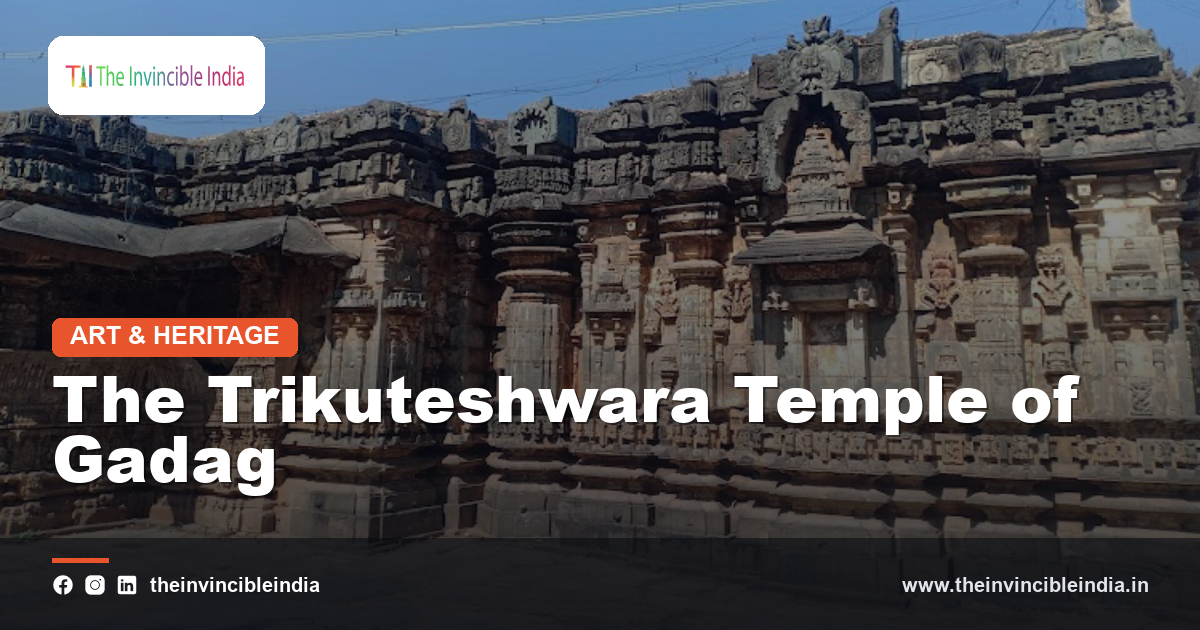
The Trikuteshwara temple at Gadag, also spelled Trikooteshwara or Trikuteshvara, is a Western Chalukya Shiva temple in the town of Gadag, Karnataka. Standing in a region that was an important centre of the Kalyani or Western Chalukya dynasty, it takes its name from its arrangement of three linked shrines, or trikuta, each honouring a form of Shiva. The temple complex is admired above all for the adjoining Saraswati temple, celebrated for its intricately carved pillars, which rank among the finest examples of Chalukya stonework. Its design belongs to the Western Chalukya tradition, part of the broader story told in the guide to Indian temple architecture. This article explains its location, history, architecture, sculpture and living significance within the rich heritage of northern Karnataka.
Quick answer: The Trikuteshwara temple is a Western Chalukya Shiva temple at Gadag in Karnataka, India. It takes its name from its trikuta arrangement of three linked sanctums dedicated to forms of Shiva. The complex is especially famous for the adjoining Saraswati temple, whose intricately carved pillars are regarded as masterpieces of Western Chalukya craftsmanship, and it remains an active place of worship.
Key Takeaways
- The Trikuteshwara temple is a Western Chalukya Shiva shrine in the town of Gadag, northern Karnataka.
- Its name comes from the trikuta plan, an arrangement of three linked sanctums dedicated to forms of Shiva.
- The complex was built in the Western or Kalyani Chalukya tradition of Deccan stone architecture.
- The adjoining Saraswati temple is celebrated for its intricately carved pillars.
- The shrine is built of fine-grained stone worked with the lathe-turned and deeply carved detail typical of the style.
- The temple remains a protected heritage monument and an active place of Shaiva worship.
The sections below explain where the temple stands, how it was built and what a visitor can still see today.
Quick Facts
| Detail | Information |
|---|---|
| Location | Gadag, Gadag district, Karnataka |
| Also known as | Trikooteshwara temple, Trikuteshvara |
| Dynasty | Western (Kalyani) Chalukya |
| Dedication | Shiva, in three linked shrines (trikuta) |
| Architectural style | Western Chalukya stone architecture |
| Material | Fine-grained stone, dressed and carved |
| Notable feature | Adjoining Saraswati temple with carved pillars |
| Nearest city | Gadag-Betageri, with Hubballi-Dharwad nearby |
What Is the Trikuteshwara Temple of Gadag?
The Trikuteshwara temple of Gadag is a Western Chalukya Shiva temple regarded as an important example of Deccan stone architecture. It stands in the town of Gadag in northern Karnataka and takes its name from the trikuta plan, an arrangement of three linked sanctums, each housing a linga, the aniconic form in which Shiva is worshipped. What distinguishes the complex is the refinement of its carving, especially in the adjoining Saraswati temple, whose pillars are admired across India. The design joins an ordered, multi-shrine plan to surfaces treated with great delicacy, showing the confidence of mature Chalukya craftsmanship. Though it has suffered the wear of centuries, the temple remains a valuable document of its age. The Trikuteshwara temple is therefore best understood as both a living Shaiva shrine and an important example for the study of Western Chalukya temple art in Karnataka.
Where Is Gadag Located?
Gadag is located in the northern part of Karnataka, as the headquarters of Gadag district on the Deccan plateau. The town, often paired with the neighbouring settlement of Betageri as Gadag-Betageri, lies in a region of dry farmland and historic towns within reach of the larger cities of Hubballi and Dharwad. This part of Karnataka was an important heartland of the Western or Kalyani Chalukya dynasty, and the area is dotted with temples of the period. The surrounding landscape reflects a long history of settlement, agriculture and devotion. Roads and railways connect Gadag with the major cities of the region, making it accessible to travellers. The location of Gadag places the Trikuteshwara temple in a district rich in Chalukya heritage, among the towns where the dynasty and its successors raised many of their finest shrines in northern Karnataka.
Who Were the Western Chalukyas?
The Western Chalukyas, also called the Kalyani Chalukyas after their capital at Kalyani, were a dynasty that ruled much of the Deccan during the later part of the early medieval period. They are remembered as great patrons of temple building, and under their rule a distinctive style of architecture developed in the region of present-day northern Karnataka. This style, sometimes seen as a bridge between earlier and later traditions, is marked by finely carved pillars, ornate ceilings, intricate doorways and the use of lathe-turning and deep relief. The Chalukyas and their contemporaries filled the Deccan with temples that remain among the treasures of Indian art. The Trikuteshwara temple at Gadag belongs to this tradition. Understanding the Western Chalukyas therefore helps explain the character of the temple, which reflects the devotion, resources and artistic ambition of one of the Deccan’s great medieval dynasties.
When Was the Temple Built?
The Trikuteshwara temple is attributed to the Western Chalukya period and belongs broadly to the era when the dynasty and its successors adorned northern Karnataka with temples. Precise dating of such monuments is difficult, since many were built, altered and added to over long periods, and inscriptions, where they survive, record particular gifts rather than the whole history of a building. For this reason the temple is best described as a work of the Chalukya tradition of the Deccan, rather than assigned to a single exact year. Its style, including the treatment of its pillars and carving, is consistent with the mature phase of Western Chalukya architecture. The complex also shows signs of a long history of worship and repair. The building of the Trikuteshwara temple therefore reflects the sustained patronage of the Chalukya age, when temple construction flourished across the northern Karnataka region.
Why Is It Called a Trikuta Temple?
The temple is called a trikuta temple because it is built on the trikuta plan, a term meaning three peaks or three shrines, referring to its arrangement of three linked sanctums. In this plan, three garbhagrihas are grouped together and joined to a common hall where worshippers gather, each sanctum honouring a form of the deity. At the Trikuteshwara temple the three shrines are dedicated to Shiva, giving the temple both its structure and its name. The three-shrine arrangement allowed several forms of worship to be brought together within a single temple, a feature found in a number of Deccan temples. The plan also creates a balanced composition, with towers rising above the grouped shrines. The trikuta form of the Trikuteshwara temple therefore defines its identity, placing it among the multi-shrine temples that are a notable feature of medieval architecture in the Karnataka region.
What Is the Saraswati Temple Known For?
The Saraswati temple adjoining the Trikuteshwara complex is known above all for its intricately carved pillars, which are counted among the finest examples of Western Chalukya stonework. These pillars display the lathe-turned profiles and deep, delicate carving characteristic of the tradition, with ornate bands, medallions and figurative detail worked into the hard stone. The quality of the workmanship has made the Saraswati temple a celebrated attraction, drawing visitors and scholars interested in the art of the Chalukya age. Dedicated to Saraswati, the goddess of learning and the arts, the temple is a fitting setting for such accomplished craftsmanship. The survival of this detailed carving allows close study of Chalukya techniques. The Saraswati temple therefore forms a highlight of the Gadag complex, and its carved pillars are among the reasons the Trikuteshwara temple is valued so highly by students of Indian temple architecture.
What Is the Layout of the Temple Complex?
The layout of the Trikuteshwara temple complex is organised around its three linked sanctums and the adjoining Saraswati temple, set within a precinct in the Western Chalukya manner. The three shrines of the Trikuteshwara temple share a common hall, or mandapa, carried on carved pillars, with each sanctum housing its linga. The Saraswati temple stands as a related structure within the same complex, celebrated for its own pillared hall. The buildings rest on moulded bases that lift them above the ground and provide surfaces for ornament. This arrangement allows worshippers to move between the sanctums and the adjoining shrine within a single sacred precinct. The grouping of structures reflects the way such complexes grew over time. The layout of the Trikuteshwara temple therefore demonstrates how Chalukya builders combined multiple shrines and halls into an ordered and harmonious whole in the heart of Gadag.
What Do the Carved Pillars Look Like?
The carved pillars of the Trikuteshwara complex, and especially those of the Saraswati temple, are among its most admired features, treated as showpieces of the stonemason’s art. In the Western Chalukya manner, many pillars were turned to smooth, rounded profiles, as if shaped on a lathe, and then carved with crisp bands, mouldings, medallions and figurative ornament. The fine-grained stone used by Chalukya craftsmen allowed sharp edges and delicate detail to be worked into hard material. The result is a series of columns whose polished and carved surfaces catch the light and give the halls a rich, ordered beauty. Such pillars demanded both suitable stone and great skill, since a single error could ruin a block. The carved pillars of the Trikuteshwara temple therefore stand at the heart of its appeal and reward the slow, attentive looking that the monument invites from lovers of Indian art.
What Materials and Techniques Were Used?
The Trikuteshwara temple was built of fine-grained stone worked in the manner characteristic of Western Chalukya craftsmen, who favoured lathe-turning and deep relief carving. The stone was dressed into blocks and assembled in the traditional Indian manner, with elements fitted closely together without mortar. Pillars were turned to their smooth, rounded profile before being set upright and carved further by hand, while masons worked the walls, ceilings and doorways with chisels to produce the layered ornament. The hard, even-grained stone allowed sharp edges and delicate detail, giving the carving its crispness. The process demanded careful planning, since each element had to match the whole structure. These methods have allowed the temple to survive for centuries while retaining much of its detail. The materials and techniques of the Trikuteshwara temple therefore demonstrate how suitable stone and skilled craftsmanship combined to produce a durable and beautiful monument in northern Karnataka.
Who Is Worshipped at the Temple?
The Trikuteshwara temple is dedicated to Shiva, worshipped in its three linked sanctums in the form of the linga, the aniconic emblem of the great god. The name Trikuteshwara itself reflects this dedication, uniting the idea of the three-shrine trikuta plan with the worship of Shiva as the lord of the temple. The adjoining Saraswati temple honours Saraswati, the goddess of learning, music and the arts, adding a second focus of devotion within the complex. Worship at the temple follows the customary rites of a Shaiva shrine, with offerings, lamps and the recitation of sacred formulas. The combination of shrines reflects the inclusive religious character of the Chalukya age. The dedication of the Trikuteshwara temple to Shiva, together with the worship of Saraswati in the adjoining shrine, therefore gives the complex a rich devotional character within the broad traditions of Hindu worship in the Deccan.
How Does the Temple Fit the Chalukya Tradition?
The Trikuteshwara temple fits the Western Chalukya tradition as a characteristic example of the dynasty’s distinctive architecture, which flourished across the Deccan in the early medieval period. Chalukya temples are known for their finely carved pillars, ornate ceilings, intricate doorways and the skilful use of lathe-turning and deep relief in hard stone. The Trikuteshwara temple shares these features, expressed in its trikuta plan and in the celebrated pillars of the adjoining Saraswati temple. The Chalukyas and their successors spread this manner across many towns and villages of the region, leaving a dense concentration of temples. Studying this complex alongside others reveals how the tradition developed through sustained patronage. The Trikuteshwara temple therefore serves as a clear illustration of Western Chalukya architectural principles, demonstrating the style’s blend of ordered, multi-shrine planning and lavish, precisely carved surface ornament in the setting of Gadag.
How Does It Compare With Other Chalukya Temples?
The Trikuteshwara temple compares with other Western Chalukya temples of the northern Karnataka region as a fine member of a rich family of monuments. The Chalukya and later Deccan traditions produced many celebrated temples across towns such as Lakkundi, Dambal and others, each displaying the carved pillars, ornate ceilings and intricate stonework for which the style is known. The Trikuteshwara temple, with its trikuta plan and its famous Saraswati shrine, holds its own place among these, admired especially for the quality of its carving. Comparing it with neighbouring temples shows the range and consistency of the tradition, which repeated its distinctive features across many sites. It also highlights the local variations that give each temple its character. The Trikuteshwara temple therefore complements the other Chalukya monuments of the region, forming part of one of the great concentrations of medieval temple art in India.
What Is the Setting of the Temple?
The setting of the Trikuteshwara temple adds to its interest, as it stands within the historic town of Gadag amid the dry farmland and old settlements of the northern Karnataka plateau. Part of the living fabric of the town rather than an isolated ruin, the temple remains connected to the daily life and devotion of the surrounding community. The area around Gadag is rich in Chalukya and later heritage, so the temple can be seen as one link in a chain of monuments. The precinct offers a dignified space for worship and for the study of its celebrated carving. The town setting means the temple is readily accessible to travellers passing through the region. The setting of the Trikuteshwara temple therefore combines architectural and artistic value with the atmosphere of a historic Deccan town, making it a rewarding stop for those exploring the heritage of northern Karnataka.
How Is the Temple Protected and Preserved?
The Trikuteshwara temple is preserved through official heritage protection together with local devotion, as with many historic monuments in Karnataka. Archaeological authorities are responsible for documenting, conserving and safeguarding notable temples, while worshippers and local committees maintain ritual and basic upkeep. Challenges include the weathering of the stone, moisture, the growth of vegetation and the wear caused by visitors and the passage of time. Conservation work aims to stabilise the structure and clean surfaces without altering the original design, using methods that respect historic materials. Because the precise arrangements and status of a monument can change, readers are advised to consult current information from official heritage bodies. Respectful visitor behaviour, including not touching the carvings, also helps protect the delicate stonework. The preservation of the Trikuteshwara temple depends on cooperation between officials, worshippers and visitors who value its place in the architectural record of the Deccan.
How Can Visitors Plan a Trip to Gadag?
Visitors can plan a trip to Gadag most easily by travelling to the town by road or rail, often as part of a wider tour of the Chalukya temples of northern Karnataka. The cooler months from about October to February are generally the most comfortable for travel, while the summer on the Deccan plateau is hot. Modest clothing is appropriate, and footwear is removed before entering the temple. It is wise to carry water and allow unhurried time to study the carving, since the pillars of the Saraswati temple reward close attention. Combining a visit with the nearby temple towns of the region makes for a rewarding heritage itinerary. Checking current timings in advance is sensible, as temples may follow set hours for visitors. A well prepared visit allows the Trikuteshwara temple and its celebrated Saraswati shrine to be enjoyed calmly and with respect.
The Trikuteshwara Temple Today
The Trikuteshwara temple of Gadag today remains both a working Shiva shrine and a valued monument of Western Chalukya art. Its trikuta plan of three linked sanctums, together with the celebrated carved pillars of the adjoining Saraswati temple, continues to draw devotees, art historians and travellers exploring the heritage of northern Karnataka. Though less widely known than some monuments of southern India, the complex is admired for the quality of its carving and its place in the Chalukya tradition. Continued conservation, respectful tourism and scholarly study help ensure that it endures for future generations. For those touring the temple towns of the Deccan, it makes a rewarding stop alongside the other Chalukya sites of the region. The Trikuteshwara temple thus stands as a lasting witness to the faith, skill and patronage of the Western Chalukya age in the heart of Gadag.
Sources & Further Reading
- Archaeological Survey of India (asi.nic.in).
- Department of Tourism, Government of Karnataka (karnatakatourism.org).
Frequently Asked Questions
Where is the Trikuteshwara temple located?
The Trikuteshwara temple is located in the town of Gadag, the headquarters of Gadag district in northern Karnataka. The town is reached by road and rail, with Hubballi and Dharwad the nearest large cities.
Why is it called the Trikuteshwara temple?
The temple is called Trikuteshwara because it is built on the trikuta plan, an arrangement of three linked sanctums, and is dedicated to Shiva. The name combines the three-shrine form with the worship of Shiva as lord of the temple.
What is the Saraswati temple at Gadag known for?
The adjoining Saraswati temple is known for its intricately carved pillars, among the finest examples of Western Chalukya stonework. Dedicated to the goddess of learning and the arts, it is a celebrated highlight of the complex.
Which dynasty built the Trikuteshwara temple?
The Trikuteshwara temple belongs to the Western or Kalyani Chalukya tradition, which flourished across the Deccan in the early medieval period. The dynasty was a great patron of temple building in northern Karnataka.
What is a trikuta temple?
A trikuta temple is a shrine with three sanctums, the term meaning three peaks or three shrines. The three sanctums are grouped around a common hall, allowing several forms of a deity to be honoured within one temple.
What is the best time to visit Gadag?
The best time to visit is the cooler season from about October to February. These months are more comfortable for travel than the hot summer on the Deccan plateau.


