

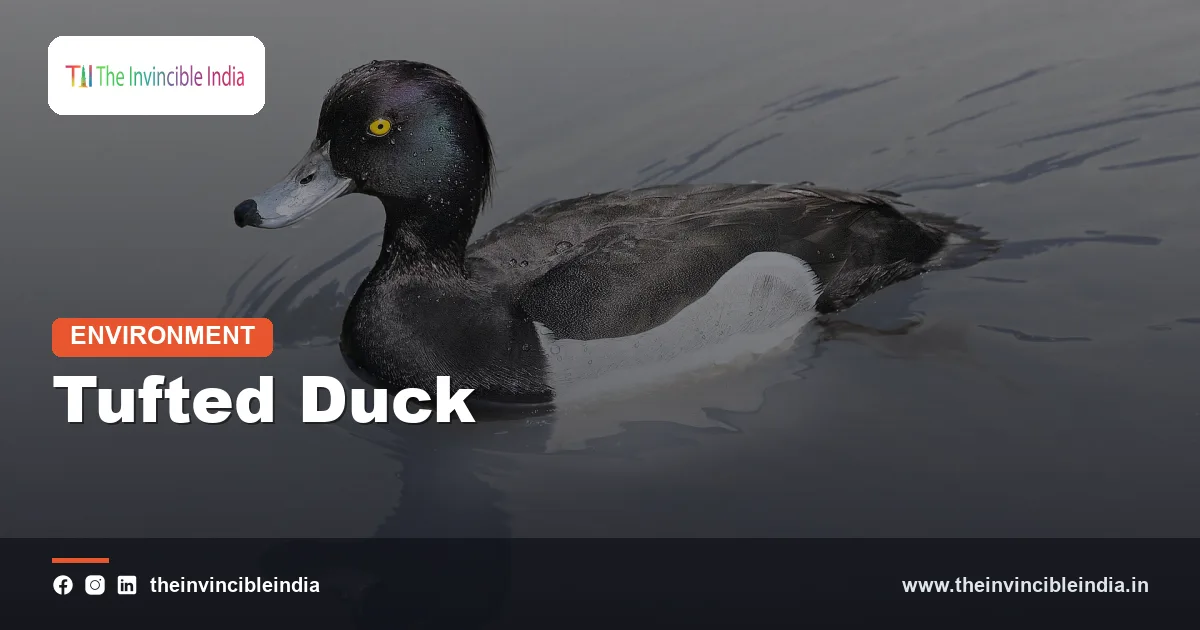
The tufted duck (Aythya fuligula) is a compact black-and-white diving duck with a drooping crest on the back of the head, and it is a regular winter visitor to lakes and reservoirs in India. The drake is glossy black with bright white flanks and a golden-yellow eye, while the female is dark brown with a shorter crest and a greyish-blue bill.
Unlike the surface-feeding ducks that dominate Indian wetlands, the tufted duck dives underwater to find its food. This guide explains how to identify the tufted duck, how it feeds, where and when it is seen in India, and what helps keep its wintering lakes healthy.
| Common name | Tufted duck |
|---|---|
| Scientific name | Aythya fuligula |
| Family | Anatidae (ducks, geese and swans) |
| Size | About 40 to 47 cm in length; wingspan roughly 67 to 73 cm |
| Range in India | Regular winter visitor to larger lakes, reservoirs and ponds, mainly in the north, west and east; more local in the south |
| Diet | Molluscs, crustaceans, insect larvae, aquatic plants and seeds, obtained by diving |
| Breeding and migration | Breeds across northern Europe and Asia; Indian birds arrive from about October or November and leave by March or April |
| Conservation status | Least Concern globally (IUCN); protected under India’s Wild Life (Protection) Act, 1972 |
Key Takeaways
- The tufted duck is a diving duck of the genus Aythya, and it feeds by plunging beneath the surface rather than dabbling or upending.
- The drake tufted duck is black with white flanks, a yellow eye, a blue-grey bill and a long drooping crest at the back of the head.
- Tufted ducks visit India in winter, usually from October or November until March or April, and prefer open, deeper water than dabbling ducks.
- The tufted duck eats mainly molluscs, crustaceans and insect larvae collected from the bottom of lakes and reservoirs.
- Both sexes of the tufted duck show a broad white stripe along the back of the wing in flight.
- The tufted duck is rated Least Concern by the IUCN, but it depends on clean, deep and undisturbed water that many Indian lakes struggle to retain.
What is the tufted duck?
The tufted duck is a medium-small diving duck of the family Anatidae, named for the tuft of long feathers that hangs from the back of the head. It breeds across the northern forests and lakes of Europe and Asia and migrates south for the winter, reaching India, other parts of South and Southeast Asia, Africa and the Mediterranean.
The tufted duck belongs to the genus Aythya, a group often called pochards or “bay ducks”. Relatives seen in India include the common pochard, the ferruginous duck, the red-crested pochard and Baer’s pochard, which is critically endangered. Diving ducks differ from dabbling ducks in having bigger feet set further back on the body, a heavier build and a need to run across the water to take off.
In India the tufted duck is a scarcer winter visitor than the northern pintail, shoveler or common teal, mainly because it requires deeper, more open water. Where it occurs, however, flocks can be large and conspicuous.
How do you identify a tufted duck?
A tufted duck is identified by its dumpy, rounded shape and, in the male, by the combination of black head and back, bright white sides and a drooping crest. The bird sits low in the water and is often seen in compact rafts far from the shore.
The drake
The adult male tufted duck has a black head with a purple gloss and a long, thin crest that droops down the nape. The breast, back and tail are black, the flanks are clean white and the belly is also white. The eye is golden yellow, and the bill is pale blue-grey with a black tip. The contrast between black and white is visible from a long way off.
The female
The female tufted duck is dark brown overall, with paler brown flanks, a yellow eye and a bluish bill edged with a thin pale band. The crest is short and may be barely visible. Some females have a pale patch at the base of the bill, which can cause confusion with other diving ducks such as the scaup.
In flight
In flight, both sexes of the tufted duck show a broad white bar running along the flight feathers on the back of the wing. This white stripe, together with the dark body, helps separate the species from the common pochard, whose wings look greyer. Flocks usually fly low over the water in tight groups.
Similar species
- Common pochard: the male has a chestnut head, a pale grey back and a black chest; there is no crest.
- Ferruginous duck: a rich chestnut-brown duck with a white undertail and no crest.
- Greater scaup: rarer in India, with a larger body and a grey back in the male.
How does the tufted duck feed?
The tufted duck feeds by diving, which means that it plunges under the water and swims down to pick or scoop food from the lake bed. A typical dive lasts less than half a minute, and the bird surfaces close to where it went down.
Diving ducks use their large webbed feet to propel themselves, and they carry less air in their plumage than dabblers, which helps them sink. The tufted duck usually feeds in water about one to several metres deep, but it can go deeper if the food supply is rich. It feeds both by day and during the night.
The food is usually swallowed underwater or just after surfacing. Hard-shelled prey such as small snails and mussels are crushed in the muscular gizzard, which contains grit. Because it needs to dive, the tufted duck requires a lake with clear water and a bed that supports animal life, and it does not do well in heavily polluted or silted water.
What does the tufted duck eat?
The tufted duck eats mainly animal food, including freshwater molluscs, crustaceans, insect larvae and small fish eggs, along with seeds and parts of aquatic plants. In many parts of Europe, small mussels form a large part of its winter diet, while in Indian lakes it also takes snails, midge larvae and plant material.
- Molluscs: small mussels and snails collected from the lake bed.
- Crustaceans and insects: freshwater shrimps, beetle and dragonfly larvae, caddisfly and midge larvae.
- Plant matter: seeds, tubers and pieces of water plants such as pondweed and stonewort.
The diet shifts with the season. Ducklings feed mostly on insects at the surface, and adults eat more plant food outside the breeding season when animal food is less available. This flexibility is one reason the tufted duck has spread widely and has become common in many European cities with artificial lakes.
Where is the tufted duck found in India?
The tufted duck is found in India in winter on larger lakes, reservoirs and ponds, particularly in the Himalayan foothills, the northern plains, Gujarat, Rajasthan and the eastern regions, with scattered records in the south. It favours open water with some depth and shelter, and it is much less common on small, muddy ponds.
| Region | Typical habitat | Notes |
|---|---|---|
| Jammu and Kashmir | Dal Lake, Wular Lake, Hokersar | Large lakes with cool, deep water |
| Himachal Pradesh and Punjab | Pong Dam Lake, Harike Wetland | Large reservoirs with open water |
| Rajasthan and Haryana | Keoladeo National Park, Sultanpur, city lakes | Smaller numbers than dabbling ducks |
| Gujarat | Nal Sarovar, Thol Lake, city reservoirs | Regular winter flocks in deeper pockets |
| Eastern India | Chilika Lake, floodplain wetlands of Assam | Records vary with water level |
| Peninsular India | Large reservoirs and tanks | Scarce and local |
Because the species likes deeper water, tufted ducks often occur on city lakes and large reservoirs, where they can be seen from the shore. Flocks often keep to the middle of the lake and may be hard to approach, so binoculars or a scope are very useful.
When does the tufted duck visit India?
The tufted duck visits India from about October or November until March or April, with the peak between December and February. It arrives somewhat later than dabbling ducks such as the northern pintail, and the first birds are generally seen in the north.
The migration route follows the Central Asian Flyway, and the birds cross the Himalaya and other high ranges to reach the lakes of the subcontinent. Diving ducks migrate mainly at night. They often stop on large lakes in Central Asia, and a number of birds winter in Pakistan, Nepal and northern India.
The departure begins in February and March, and most of the birds have left by April. In winter, tufted ducks may move between lakes as water levels change, and a lake that holds large numbers one season may have few the next.
How does the tufted duck behave?
The tufted duck is a social, often nocturnal-feeding duck that forms dense rafts on open water by day and spreads out to dive and feed in the evening and at night. Compared with dabbling ducks, it seems more energetic, constantly diving and bobbing back up.
The bird is a strong swimmer and diver, but on land it is clumsy, so it rarely leaves the water except to rest on a bank or island. When threatened, it dives or runs across the surface, flapping its wings, before it takes off. It takes off with a long pattering run, unlike the dabblers, which leap straight up.
Males give a soft, whistling call and females a harsh growl, but the species is generally quiet. Courtship begins in winter, and pairs are formed before the birds return north. Displays include head-throwing, neck-stretching and low, soft whistles.
How does the tufted duck breed?
The tufted duck breeds on the shores and islands of lakes and large ponds in northern Europe and Asia, and it does not breed regularly in India. The nest is a hollow on the ground lined with down, hidden in dense vegetation near water, and it is often placed in loose colonies near gull or tern colonies, which provide protection from predators.
The female lays about eight to eleven eggs and incubates them for around four weeks. The ducklings are precocial, leave the nest within a day and dive for insects almost immediately. They fledge at around six to seven weeks.
Breeding success depends on the supply of insects and on the stability of water levels. Predators such as crows, gulls, foxes and mink can take eggs and ducklings, and cold, wet springs can reduce survival.
Is the tufted duck threatened?
The tufted duck is not globally threatened and is classed as Least Concern by the IUCN, but diving ducks in India face problems linked to the quality of lakes. A species that relies on clean, deep water with abundant bottom life is quick to be affected when lakes silt up, fill with weeds or become polluted.
- Siltation and shrinking water bodies reduce the depth and food supply.
- Pollution from sewage, industry and farm runoff lowers water clarity and kills the invertebrates that tufted ducks eat.
- Invasive plants such as water hyacinth cover the surface and block diving.
- Illegal hunting and netting still occur in parts of the country.
- Disturbance from boating, fishing and tourism can push rafts off the best feeding areas.
- Entanglement in fishing nets is a hazard for all diving ducks.
The tufted duck is protected in India under the Wild Life (Protection) Act, 1972. Its wintering lakes also gain from Ramsar listing, and the species is counted in the January Asian Waterbird Census.
How can you watch tufted ducks?
The best way to watch tufted ducks is to visit a large lake or reservoir between December and February, scan the open water with binoculars or a scope and look for rafts of black-and-white ducks that dive repeatedly. Morning light usually gives the clearest view.
- Check the middle of the lake, away from the shore, where the birds rest in rafts.
- Look for the white flanks of the drakes, which stand out against dark water.
- Watch for ducks that vanish and pop up again, a sign of diving feeders.
- Compare the birds with pochards in the same flock, noting crest, back colour and head shape.
- Do not use boats or drones to approach the flock, since this causes disturbance.
Bottom Line
The tufted duck is a distinctive diving duck whose black-and-white plumage and drooping crest make it easy to recognise on Indian winter lakes. It depends on deeper, clean, undisturbed water, and the health of the lakes and reservoirs where it appears is a good measure of how well India is looking after its freshwater habitats.
Frequently Asked Questions
What is a tufted duck?
A tufted duck is a compact diving duck (Aythya fuligula) with a drooping crest at the back of the head. It breeds in northern Europe and Asia and winters on lakes and reservoirs in India. The drake is black with white flanks and a yellow eye.
Is the tufted duck found in India?
Yes, the tufted duck is a regular winter visitor to India. It is seen mainly on larger lakes and reservoirs in the north, west and east, and is more local in the south. It does not breed in India.
When do tufted ducks come to India?
Tufted ducks come to India from about October or November and stay until March or April. The best months to see them are December to February. They usually arrive a little later than dabbling ducks such as the northern pintail.
What is the difference between a tufted duck and a dabbling duck?
A tufted duck dives under the water to feed, whereas a dabbling duck feeds at the surface or by tipping forward. Diving ducks have heavier bodies and larger feet set farther back, and they run across the water to take off. Dabbling ducks spring straight into the air.
What does the tufted duck eat?
The tufted duck eats mainly molluscs, crustaceans and insect larvae, along with seeds and parts of aquatic plants. It dives to collect this food from the lake bed. Its diet changes with the season and the water body.
How can you tell a tufted duck from a common pochard?
The male tufted duck is black with white sides and a drooping crest, while the male common pochard has a chestnut head, a grey back and no crest. In flight, the tufted duck shows a bold white wing stripe. The female tufted duck is dark brown, and the female pochard is greyer.
{“@context”:”https://schema.org”,”@graph”:[{“@type”:”FAQPage”,”mainEntity”:[{“@type”:”Question”,”name”:”What is a tufted duck?”,”acceptedAnswer”:{“@type”:”Answer”,”text”:”A tufted duck is a compact diving duck (Aythya fuligula) with a drooping crest at the back of the head. It breeds in northern Europe and Asia and winters on lakes and reservoirs in India. The drake is black with white flanks and a yellow eye.”}},{“@type”:”Question”,”name”:”Is the tufted duck found in India?”,”acceptedAnswer”:{“@type”:”Answer”,”text”:”Yes, the tufted duck is a regular winter visitor to India. It is seen mainly on larger lakes and reservoirs in the north, west and east, and is more local in the south. It does not breed in India.”}},{“@type”:”Question”,”name”:”When do tufted ducks come to India?”,”acceptedAnswer”:{“@type”:”Answer”,”text”:”Tufted ducks come to India from about October or November and stay until March or April. The best months to see them are December to February. They usually arrive a little later than dabbling ducks such as the northern pintail.”}},{“@type”:”Question”,”name”:”What is the difference between a tufted duck and a dabbling duck?”,”acceptedAnswer”:{“@type”:”Answer”,”text”:”A tufted duck dives under the water to feed, whereas a dabbling duck feeds at the surface or by tipping forward. Diving ducks have heavier bodies and larger feet set farther back, and they run across the water to take off. Dabbling ducks spring straight into the air.”}},{“@type”:”Question”,”name”:”What does the tufted duck eat?”,”acceptedAnswer”:{“@type”:”Answer”,”text”:”The tufted duck eats mainly molluscs, crustaceans and insect larvae, along with seeds and parts of aquatic plants. It dives to collect this food from the lake bed. Its diet changes with the season and the water body.”}},{“@type”:”Question”,”name”:”How can you tell a tufted duck from a common pochard?”,”acceptedAnswer”:{“@type”:”Answer”,”text”:”The male tufted duck is black with white sides and a drooping crest, while the male common pochard has a chestnut head, a grey back and no crest. In flight, the tufted duck shows a bold white wing stripe. The female tufted duck is dark brown, and the female pochard is greyer.”}}]}]}


