


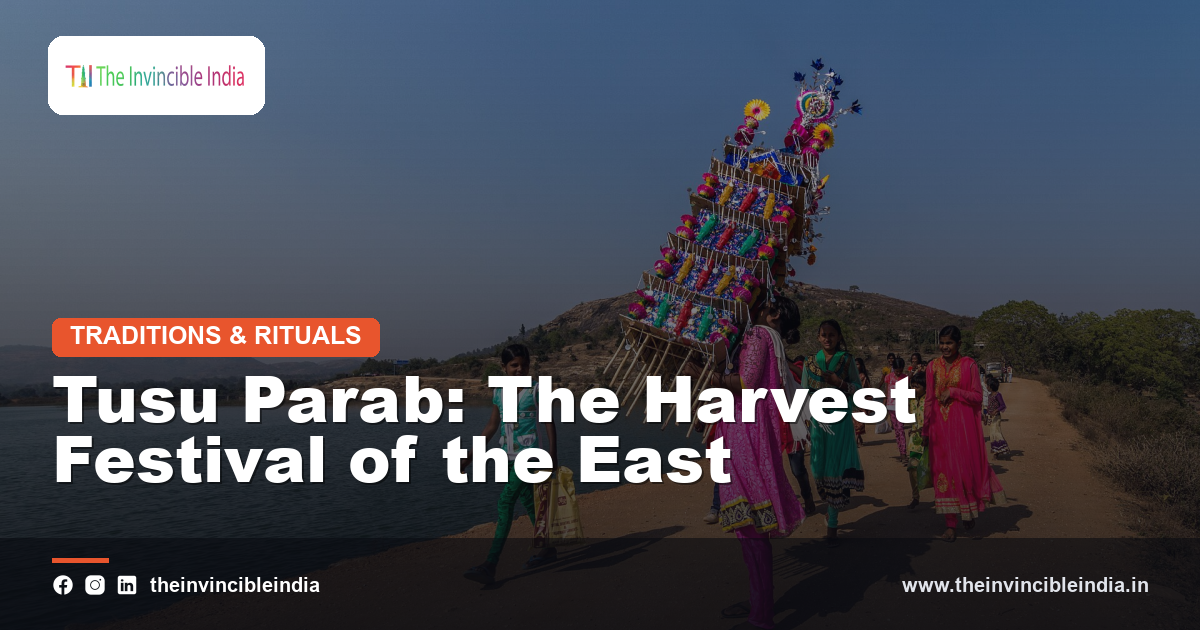
Tusu Parab is a folk harvest festival observed across rural communities in Jharkhand, West Bengal, and Odisha, centred on the devotion of Tusu, a folk deity honoured as a young goddess of purity and prosperity, a seasonal celebration that shares its agrarian spirit with Durga Puja’s autumn festivities in the wider Bengal region. Young unmarried women lead the festival’s daily worship, singing traditional Tusu songs over an extended period before larger community gatherings mark its culmination. The festival concludes with the ceremonial immersion of the Tusu image in a river or pond, accompanied by continued singing and communal celebration. Rooted in oral tradition rather than classical scripture, Tusu Parab remains a vivid expression of rural folk culture in the region.
Quick Facts
| Detail | Information |
|---|---|
| Festival Type | Folk harvest festival |
| Primary Region | Jharkhand, West Bengal, and Odisha border areas |
| Central Figure | Tusu, a folk deity personified as a young goddess |
| Season | Winter, around the month of Poush |
| Main Participants | Rural agrarian communities, especially young women |
| Associated Practices | Tusu songs, community gatherings, and immersion rituals |
Origins as a Folk Tradition
Tusu Parab is a folk festival observed primarily in parts of Jharkhand, West Bengal, and neighbouring Odisha, closely associated with rural agrarian communities and their seasonal harvest cycle. Unlike festivals rooted in classical Hindu scripture, Tusu Parab developed as a folk tradition, shaped by oral custom, regional song, and community practice rather than formal religious texts. The festival centres on Tusu, a folk figure widely regarded as a young goddess symbolising purity, prosperity, and the abundance of the harvest season. Its folk origins give Tusu Parab a distinctive character within the broader landscape of Indian regional festivals, reflecting the lived traditions of farming communities across the eastern Indian plateau region rather than pan-Indian religious narratives.
Tusu as a Folk Deity
At the heart of the festival is Tusu, venerated as a folk deity typically represented through a small clay or decorated image rather than an established iconographic form found in mainstream Hindu worship. Tusu is generally regarded as a young, unmarried goddess associated with purity, fertility, and the wellbeing of the household and community. Unlike deities from the broader Hindu pantheon, Tusu’s identity and associated stories are transmitted primarily through oral tradition and regional folk song, reflecting the community-specific character of her worship. This folk conception of divinity, rooted in local custom rather than scriptural authority, situates Tusu Parab within a rich tradition of regional deity worship found across many parts of rural India.
Connection to Agrarian Communities
Tusu Parab is deeply connected to the agricultural rhythms of the communities that observe it, particularly those engaged in rice cultivation across the plateau regions of Jharkhand, West Bengal, and Odisha. The festival traditionally falls at a point in the winter season associated with the conclusion of certain harvest activities, allowing agrarian households a period for celebration and communal gathering. This agricultural connection reflects the festival’s origins among farming communities, for whom seasonal transitions in the crop cycle have long provided natural occasions for religious and social observance. The continued association between Tusu Parab and rural agricultural life remains an important aspect of the festival’s identity, even as broader economic changes affect farming communities in the region.
The Central Role of Young Women
Young unmarried women play a particularly prominent role in the observance of Tusu Parab, taking primary responsibility for the daily worship of the Tusu image throughout the festival period. Girls gather each evening to sing traditional Tusu songs and perform simple rituals honouring the deity, often continuing this practice over an extended period leading up to the festival’s culmination. This central role for young women reflects broader themes found in various regional Indian festivals, where unmarried women are frequently entrusted with specific ritual responsibilities tied to purity, prosperity, and future household wellbeing. The prominence of young women in Tusu Parab has helped sustain intergenerational transmission of the festival’s songs and customs within participating communities.
Tusu Songs and Oral Tradition
Music forms a central and defining element of Tusu Parab, expressed through a rich tradition of Tusu songs composed and sung in local dialects by women throughout the festival period. These songs cover a wide range of themes, including devotion to Tusu, commentary on daily rural life, and reflections on social and family relationships, making them a valuable repository of local oral culture. Passed down through generations primarily through practice and memory rather than written record, Tusu songs represent an important element of the region’s folk literary heritage. The continued singing of these songs during the festival not only honours the deity but also preserves linguistic and cultural traditions specific to the communities that observe Tusu Parab.
Daily Worship Leading to the Festival
In the period leading up to the main day of Tusu Parab, households maintain a small image or symbolic representation of Tusu, offering evening prayers and songs on a daily basis over an extended span of time. This sustained period of worship allows the festival’s devotional practices to become woven into the daily routine of participating families, rather than being confined to a single day of observance. Young women typically lead these daily rituals, gathering with family members or neighbours each evening to sing and offer simple prayers before the Tusu image. This extended preparatory period reflects a pattern found in several Indian folk festivals, where sustained ritual observance builds toward a culminating public celebration.
Community Gatherings and Local Fairs
As Tusu Parab approaches its culmination, communities often organise larger gatherings, sometimes referred to locally by regional terms, where multiple households and neighbourhoods come together for shared celebration, music, and festivity. These gatherings provide an opportunity for wider social interaction beyond the household-level worship practised in the preceding weeks, drawing extended family, friends, and neighbours into a collective celebration. Traditional games, communal singing, and shared meals often accompany these larger gatherings, reflecting the festival’s broader social function within rural community life. This progression from private household worship to public communal celebration mirrors patterns found in various other regional harvest festivals observed across India.
The Immersion Ritual
Tusu Parab traditionally culminates in the ceremonial immersion of the Tusu image in a nearby river, pond, or other body of water, marking the conclusion of the festival period. This immersion ritual, accompanied by singing and communal participation, follows a pattern found in several other Indian festivals involving the temporary worship and eventual ritual disposal of a deity’s image. Communities often process together to the water’s edge, continuing to sing Tusu songs as the image is carried and finally immersed, marking an emotional close to the extended period of worship and celebration. This shared ritual act reinforces the communal bonds built throughout the preceding weeks of the festival’s observance.
Regional Names and Variations
Tusu Parab is known by various related names and observed with some local variation across the different regions where it is celebrated, reflecting the diverse linguistic and cultural landscape of the eastern Indian plateau area. While the core elements of Tusu worship, song, and eventual immersion remain broadly consistent, specific customs, timing, and associated practices can differ somewhat between communities in Jharkhand, West Bengal, and Odisha. This regional variation reflects the folk nature of the festival, which has developed organically within local communities rather than following a standardised set of practices dictated by a central religious authority. Such diversity is a common feature of folk festivals rooted in localised oral tradition across India.
Timing in the Winter Season
Tusu Parab is generally observed around the Bengali and regional month of Poush, placing the festival firmly within the winter season in eastern India. This timing situates the observance at a point in the agricultural calendar associated with certain harvest-related activities in the plateau regions where the festival is most prevalent. The winter timing also shapes certain practical aspects of the festival’s observance, including the outdoor gatherings and processions that form part of its culminating celebrations. This seasonal placement reflects the broader pattern common to many Indian folk and harvest festivals, in which the timing of celebration is closely tied to the specific agricultural and climatic rhythms of the region in which it developed.
Social Cohesion and Community Bonds
Beyond its religious and agricultural dimensions, Tusu Parab plays an important role in strengthening social cohesion within participating rural communities, bringing together households, neighbourhoods, and extended family networks through shared ritual and celebration. The sustained period of daily worship, followed by larger communal gatherings, provides repeated opportunities for social interaction and collective activity over several weeks. This extended process of community engagement distinguishes Tusu Parab from festivals confined to a single day, allowing for deeper and more sustained social bonding throughout the observance. Such cohesion has historically played an important role in supporting mutual assistance and cooperation within agrarian communities in the region.
Observance Among Tribal and Rural Communities
Tusu Parab is observed by a range of rural and tribal communities across its region of prevalence, including groups such as the Kurmi community and various other agrarian populations of the eastern Indian plateau. While specific customs and emphasis may vary between these different communities, the shared observance of Tusu Parab reflects broader cultural connections across the region’s rural population, transcending some degree of ethnic and linguistic diversity. This widespread observance across multiple communities illustrates how folk festivals can serve as unifying cultural practices within a broader regional identity, even where specific community traditions and backgrounds differ in other respects.
Crafts and Festive Decorations
The preparation of the Tusu image and associated decorative items involves traditional craft skills passed down within participating communities, including simple clay modelling and decorative work using locally available materials. Households and communities often take considerable care in decorating the Tusu image and the space used for its daily worship, reflecting the devotional significance attached to its presentation. These craft practices, while modest in scale compared to some other festival traditions, represent an important expression of local artistic skill and creativity within rural communities. The continuation of these practices through each year’s observance helps sustain simple traditional craft knowledge alongside the festival’s religious and social functions.
Modern Changes and Continuity
As with many rural folk festivals, Tusu Parab has experienced certain changes over recent generations, influenced by migration, changing agricultural practices, and broader social transformation within the communities that observe it. Despite these changes, the festival’s core elements, including daily worship by young women, the singing of Tusu songs, and the culminating immersion ritual, have generally persisted within communities that maintain strong ties to their rural and agricultural heritage. Some urban and diaspora communities with roots in the festival’s traditional region continue to observe modified versions of Tusu Parab, reflecting efforts to maintain cultural connection despite changed circumstances. This blend of continuity and adaptation reflects the resilience of folk traditions within evolving social contexts.
Growing Cultural Recognition
In recent years, Tusu Parab has received growing recognition as an important element of the folk cultural heritage of Jharkhand, West Bengal, and Odisha, with local cultural organisations and, at times, government bodies taking steps to document and promote the festival’s traditions. This recognition has included efforts to record traditional Tusu songs and to encourage awareness of the festival among younger generations and audiences outside its traditional region of observance. Such recognition reflects a broader interest in preserving India’s diverse folk traditions, many of which have historically received less formal documentation than festivals rooted in classical religious tradition. This growing attention has helped raise the profile of Tusu Parab within regional cultural heritage discussions.
Tusu Parab Today
Today, Tusu Parab continues to be observed across rural communities in Jharkhand, West Bengal, and Odisha, retaining its distinctive folk character centred on the devotion of young women, traditional song, and the culminating immersion ritual. While broader social and economic changes have affected some aspects of rural life in the region, the festival’s core traditions remain actively practised by communities that continue to value their agrarian and cultural heritage. Growing documentation and cultural recognition have helped introduce the festival to wider audiences, even as its primary significance remains rooted in local community celebration. As a living folk tradition, Tusu Parab continues to reflect the enduring connection between rural community life, agricultural rhythm, and cultural expression in eastern India.
Sources & Further Reading
- Ministry of Culture, Government of India (indiaculture.gov.in).
- Jharkhand Tourism, Government of Jharkhand (jharkhandtourism.gov.in).
Frequently Asked Questions
What is Tusu Parab?
Tusu Parab is a folk harvest festival observed in parts of Jharkhand, West Bengal, and Odisha, centred on the worship of Tusu, a folk deity honoured as a young goddess.
Who observes Tusu Parab?
Tusu Parab is observed mainly by rural agrarian communities, with young unmarried women taking the leading role in its daily worship and songs.
What happens at the end of Tusu Parab?
The festival culminates in the ceremonial immersion of the Tusu image in a river or pond, accompanied by communal singing and celebration.
When is Tusu Parab celebrated?
Tusu Parab is generally observed around the winter month of Poush, coinciding with the seasonal rhythms of the region’s agricultural calendar.
What are Tusu songs?
Tusu songs are traditional folk songs sung by women during the festival, covering themes of devotion, rural life, and community relationships passed down orally.