

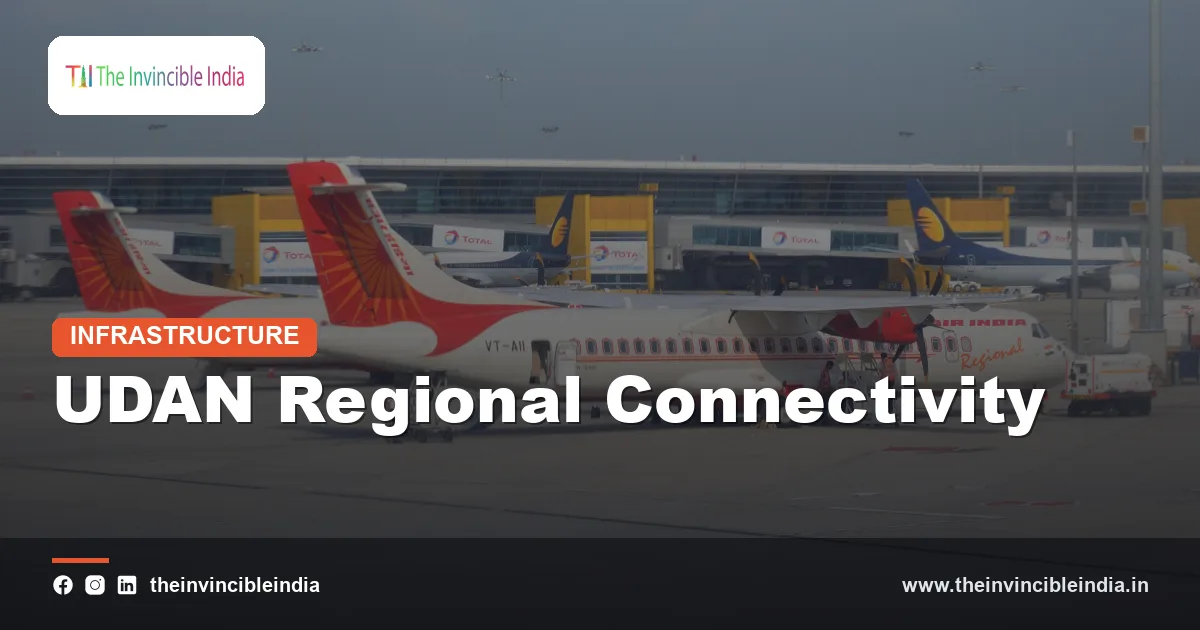
UDAN, short for Ude Desh ka Aam Naagrik (“let the common citizen fly”), is India’s Regional Connectivity Scheme, launched in October 2016 under the National Civil Aviation Policy to make air travel affordable and to connect unserved and underserved airports. The scheme caps fares on a share of seats on selected routes, and the government supports airlines with Viability Gap Funding and a package of concessions so that flights remain commercially workable.
UDAN is run by the Ministry of Civil Aviation with the Airports Authority of India (AAI) as the implementing agency. It is one of the most distinctive aviation policies in the world, because it combines a consumer price cap with a competitive bidding system for routes. This explainer covers how the scheme works, how it is funded, what it has achieved and where it has struggled, and was last reviewed on 15 October 2026.
Quick Facts: UDAN at a Glance
| Full name | Ude Desh ka Aam Naagrik (UDAN), also called the Regional Connectivity Scheme (RCS) |
|---|---|
| Launched | October 2016, under the National Civil Aviation Policy (NCAP) 2016 |
| Ministry | Ministry of Civil Aviation, Government of India |
| Implementing agency | Airports Authority of India (AAI) |
| First UDAN flight | Shimla to Delhi, April 2017 |
| Fare cap | About Rs 2,500 for a flight of around one hour or 500 km, adjusted for shorter and longer sectors |
| Seats under the cap | Up to half of the seats on each flight, subject to a minimum of 9 seats and a maximum of 40 |
| Funding | Regional Connectivity Fund, financed by a levy on certain domestic flights, plus state contributions |
| Route duration | Each awarded route enjoys three years of support and exclusivity |
Key Takeaways
- UDAN was launched in October 2016 as part of the National Civil Aviation Policy to connect unserved and underserved airports across India.
- The first UDAN flight operated from Shimla to Delhi in April 2017, and the scheme has since been expanded through several rounds of route bidding.
- Under UDAN, fares for roughly one hour of flying on a regional route are capped at about Rs 2,500 on a share of seats, and the fare for shorter or longer sectors is adjusted proportionately.
- Airlines receive Viability Gap Funding for operating UDAN routes, financed by the Regional Connectivity Fund, which draws on a levy on certain domestic flights.
- UDAN has extended beyond fixed-wing aircraft to helicopters, helipads and seaplanes, and has helped revive or build airports in smaller towns and remote regions.
- The main weakness of UDAN is sustainability, since some routes have stopped operating after the support period ended.
What Is UDAN and Why Was It Launched?
UDAN is a government scheme that supports regional flights on short routes so that small towns can get affordable and scheduled air services. It was introduced because India had a large number of airports and airstrips that were unused, while air travel was concentrated in a handful of large cities.
Before UDAN, most scheduled flying took place between metropolitan airports and the larger state capitals. Dozens of smaller airports built over the decades, many of them dating back to the colonial or princely period, had little or no commercial traffic. Airlines found it uneconomic to fly small aircraft on thin routes with high costs and low demand, and passengers in smaller cities usually relied on long road or rail journeys.
The government’s goal was to turn these dormant airports into regional hubs, to create jobs and tourism, and to bring flying within reach of ordinary citizens. The scheme’s slogan, often summarised as getting the wearer of the rubber slipper into an aeroplane, captured this democratising aim. UDAN also aligns with national objectives such as improving connectivity for the North-East, hill states and island regions, where roads can be slow or disrupted.
What Is the National Civil Aviation Policy of 2016?
The National Civil Aviation Policy (NCAP) 2016 is the policy framework released by the Ministry of Civil Aviation in June 2016 that set long-term goals for Indian aviation, including regional connectivity. It was the first comprehensive civil aviation policy to emphasise growth beyond the major cities.
The policy aimed to make flying affordable, to expand the number of operational airports, to improve safety and to promote domestic manufacturing and maintenance. The Regional Connectivity Scheme was one of its flagship measures, and UDAN was the name given to its operational version, with the scheme document released in October 2016.
The policy also set the principle that the support would be market-based. Instead of the government fixing which airline flies where, airlines propose routes and bid for the support they need, which encourages cost discipline.
How Does the UDAN Fare Cap Work?
The UDAN fare cap limits the price of a defined share of seats on each regional flight to about Rs 2,500 for a one-hour flight of roughly 500 km, with proportionate adjustment for other distances. The cap applies to up to 50 per cent of the seats on the aircraft, and the airline can sell the remaining seats at market prices.
The details follow a few simple rules:
- Fixed-wing aircraft taking part in the scheme have between 9 and 40 seats, and a minimum number of seats must be reserved at the capped fare.
- For helicopters, the equivalent cap is for a flight of about 30 minutes.
- Routes in the North-East, hill states and island areas have special relaxations on minimum distance.
- The remaining seats follow dynamic pricing, so the average fare on a UDAN flight may be higher than the cap.
The cap guarantees that at least some seats on each flight are priced within reach of lower-income passengers. For airlines, selling the rest of the seats at higher prices helps recover some of the cost. Without that mix, the subsidy needed would be much larger.
How Is UDAN Funded Through Viability Gap Funding and the Regional Connectivity Fund?
UDAN is funded by Viability Gap Funding (VGF), which is a subsidy paid to airlines to cover the difference between the cost of operating an RCS flight and the revenue earned from it. The money comes from the Regional Connectivity Fund (RCF), which is built up from a levy imposed on certain domestic flights, mainly those on busier trunk routes.
The levy was designed so that the aviation sector itself contributes to regional connectivity, rather than relying wholly on the general budget. The amount charged per departure has been modest in comparison with the ticket price, and the proceeds are held in a dedicated fund.
The sharing of VGF between governments follows a general pattern. The Centre bears the larger share, while the state government concerned contributes the remainder, with a lower state share for the North-East and some hilly states. This arrangement gives states a stake in the success of local routes and encourages them to provide concessions.
| Support provider | Typical support |
|---|---|
| Central government | Larger part of the Viability Gap Funding through the Regional Connectivity Fund; reduced excise on fuel at RCS airports |
| State government | Smaller share of VGF; low tax on aviation turbine fuel; free land; security and fire services; utilities at concessional rates |
| Airport operators | Waiver or reduction of landing, parking and related charges at RCS airports |
| Airlines | Operate the route at the capped fare for the specified seats and for a minimum period |
How Does the Bidding for UDAN Routes Work?
The bidding for UDAN routes is a competitive process in which airlines propose routes between a chosen origin and destination and bid for the lowest level of VGF per seat they need to operate them. The airline offering the lowest subsidy for a route generally wins it, and the winning bidder gets exclusive rights on that route for three years.
AAI manages the process through a reverse-bidding mechanism, in which the bidder asks for support rather than offering to pay. Airlines may also propose routes that are not in any government list, which allows them to identify the places where there is likely to be demand. After the award, the airline must begin operations within a fixed timeline or risk losing the route.
The three-year exclusivity is an important feature. It protects the winning airline from competition while it builds demand on a new route, and it ends when the VGF period ends. After that, the route can continue commercially or be dropped, and the airline or others can bid again.
The system allows several types of operators, including established airlines, regional carriers and helicopter operators. Aircraft such as the 70-seat turboprop are used on longer stages, while smaller 19-seat or 9-seat planes serve the thinnest routes.
What Are the Different Rounds and Versions of UDAN?
UDAN has progressed through successive rounds, each widening the scope of the scheme. The early rounds focused on connecting airports that already existed, and later versions added helicopters, water aerodromes, remote regions and tourism routes.
| Version | Approximate period | Main emphasis |
|---|---|---|
| UDAN 1 | 2016-2017 | First bidding round; routes between existing airports and the first flights, including Shimla to Delhi |
| UDAN 2 | 2018 | Inclusion of many unserved airports and helipads; wider geographic coverage |
| UDAN 3 | 2019 | Tourism routes, the North-East and the first water aerodromes for seaplanes |
| UDAN 4 | 2020-2021 | Helicopters, small aircraft, remote hill and island regions |
| UDAN 5 | 2022-2023 | Further rounds for smaller aircraft and helicopters, with more flexible bidding |
| Revamped UDAN | Announced in the 2025 Union Budget | New phase to link additional destinations, with a focus on hilly, aspirational and North-Eastern regions |
The specific numbers of routes and airports in each round have varied. For accuracy, it is best to say that the scheme has produced several hundred approved routes over the years, and that a smaller number have been operating at a given time.
How Has UDAN Revived Airports, Helipads and Seaplanes?
UDAN has revived airports by providing a commercial reason to restore or upgrade runways, terminals and navigation aids at airports that previously had little traffic. It has also supported helipads, heliports and water aerodromes, which allow aviation to reach places without a conventional airport.
Revived and new airports
Dozens of airports have been brought into scheduled use as part of UDAN, including smaller airports in states such as Karnataka, Gujarat, Maharashtra, Odisha and the North-East. Pakyong Airport in Sikkim, which opened in 2018, was the first airport in that state and was widely linked to the push for connectivity in difficult terrain. The overall number of operational airports in India roughly doubled in the decade after 2014, with UDAN as one of several contributing factors alongside general airport development.
Helicopters and helipads
Helicopter services connect places such as hill towns, pilgrimage sites and island clusters where roads are long or vulnerable to landslides and snow. Pawan Hans and private operators have flown such routes, and the scheme has supported the building of helipads.
Seaplanes and water aerodromes
The seaplane service between the Statue of Unity at Kevadia and the Sabarmati Riverfront in Ahmedabad began in October 2020 as the first of its kind under UDAN. Seaplane operations have faced difficulties with licences, aircraft availability and economics, and some services have been paused. The concept remains of interest for island territories, lakes and rivers.
What Has Been the Impact of UDAN?
The impact of UDAN has been to widen the map of scheduled flying in India, to bring first-time passengers into aviation and to demonstrate that regional routes can be offered at capped prices with a public-private model. Millions of passengers have travelled on UDAN flights since 2017.
Benefits seen in different regions include:
- Faster access to medical care, education and business centres from small towns and remote areas.
- Growth in tourism to hill stations, pilgrimage sites and heritage towns reached by new connections.
- Employment in airport operations, ground handling, hospitality and local transport.
- Better integration of the North-East and island territories with the rest of the country.
- Higher use of previously idle airport infrastructure.
UDAN has also affected the airline industry. Smaller regional carriers and the regional arm of the national carrier have used the scheme to build networks, and manufacturers of small aircraft have seen interest in the Indian market. In some places, cheap air travel has created new patterns, such as day trips for business or medical visits that were previously impractical.
What Challenges Does UDAN Face?
UDAN faces challenges of route sustainability, airline finances, infrastructure gaps and fund management, and these have limited its long-term results. The most frequently cited problem is that a number of routes stopped operating once the three-year support period ended.
The main challenges can be summarised as follows:
- Discontinuation after the support period: some routes were not commercially viable without VGF and were dropped.
- Airline viability: several small operators struggled with high fuel costs, maintenance, limited aircraft supply and thin demand, and a few stopped flying.
- Airport readiness: some airports lacked night-landing facilities, adequate fire services, weather instrumentation or terminal capacity.
- Weather and terrain: fog, monsoon rain and mountain winds affect reliability, particularly in hill regions.
- Fund pressure: demand for VGF payments puts pressure on the Regional Connectivity Fund, and delays in payment can hurt airlines.
- Low load factors: small towns do not always generate enough daily passengers to fill a flight, especially at higher fares.
These problems are not unusual for regional air policies in other countries, where subsidies are often needed to keep small-community routes alive. The question for policymakers is whether to support such routes for longer, to focus on a smaller number of the most promising ones, or to rely more on helicopters and smaller aircraft.
What Is Next for UDAN?
The next phase of UDAN is a revamped version announced in the Union Budget of 2025, which aims to extend regional connectivity over the coming decade, with an emphasis on hilly and North-Eastern regions and on helipads and smaller airports. The announcement indicated a target of connecting around 120 additional destinations and carrying tens of millions of passengers over ten years.
Policy discussions have focused on a few design changes: longer support periods for difficult routes, better targeting of subsidies, closer cooperation with states and improved airport readiness before routes begin. Supporters of the scheme argue that regional aviation should be treated as a social and developmental investment, much like rural roads or railways, and not only as a business.
Bottom Line
UDAN has opened air travel to many smaller towns, revived dormant airports and introduced helicopters and seaplanes into the national network, using fare caps, competitive bidding and Viability Gap Funding. Its lasting success depends on whether routes can survive without subsidy, which is why the revamped phase focuses on better targeting and stronger airports.
Frequently Asked Questions
What does UDAN stand for?
UDAN stands for Ude Desh ka Aam Naagrik, which can be translated as “let the common citizen fly”. It is the name of India’s Regional Connectivity Scheme, launched in October 2016 under the National Civil Aviation Policy. The scheme aims to make air travel affordable and to connect smaller cities.
When was UDAN launched and when did the first flight take place?
UDAN was launched in October 2016 and the first flight under the scheme operated in April 2017. That flight ran between Shimla and Delhi. The scheme was introduced under the National Civil Aviation Policy released in June 2016.
How much does a UDAN ticket cost?
A UDAN ticket on the capped seats costs about Rs 2,500 for a flight of roughly one hour or 500 km, with proportionate adjustments for different distances. The cap applies to a share of the seats, up to half, on each flight. Remaining seats can be sold at market prices, so the average fare may be higher.
Who pays for the subsidy under UDAN?
The subsidy is paid from the Regional Connectivity Fund, which is financed by a levy on certain domestic flights, and by contributions from the state governments. This payment is called Viability Gap Funding. States also provide concessions such as low fuel tax and free land, while airport operators waive certain charges.
How are routes selected under UDAN?
Routes are selected through competitive bidding run by the Airports Authority of India. Airlines propose routes and bid for the lowest subsidy per seat that they need. The winning airline gets exclusive rights and VGF support for three years on that route.
Has UDAN been successful?
UDAN has been successful in expanding the number of airports and routes and in bringing many first-time passengers to flying, but it has also faced problems with sustainability. Some routes stopped operating after the support period ended, and several small airlines struggled financially. The revamped version announced in 2025 aims to address these gaps.
{“@context”:”https://schema.org”,”@graph”:[{“@type”:”FAQPage”,”mainEntity”:[{“@type”:”Question”,”name”:”What does UDAN stand for?”,”acceptedAnswer”:{“@type”:”Answer”,”text”:”UDAN stands for Ude Desh ka Aam Naagrik, which can be translated as “let the common citizen fly”. It is the name of India’s Regional Connectivity Scheme, launched in October 2016 under the National Civil Aviation Policy. The scheme aims to make air travel affordable and to connect smaller cities.”}},{“@type”:”Question”,”name”:”When was UDAN launched and when did the first flight take place?”,”acceptedAnswer”:{“@type”:”Answer”,”text”:”UDAN was launched in October 2016 and the first flight under the scheme operated in April 2017. That flight ran between Shimla and Delhi. The scheme was introduced under the National Civil Aviation Policy released in June 2016.”}},{“@type”:”Question”,”name”:”How much does a UDAN ticket cost?”,”acceptedAnswer”:{“@type”:”Answer”,”text”:”A UDAN ticket on the capped seats costs about Rs 2,500 for a flight of roughly one hour or 500 km, with proportionate adjustments for different distances. The cap applies to a share of the seats, up to half, on each flight. Remaining seats can be sold at market prices, so the average fare may be higher.”}},{“@type”:”Question”,”name”:”Who pays for the subsidy under UDAN?”,”acceptedAnswer”:{“@type”:”Answer”,”text”:”The subsidy is paid from the Regional Connectivity Fund, which is financed by a levy on certain domestic flights, and by contributions from the state governments. This payment is called Viability Gap Funding. States also provide concessions such as low fuel tax and free land, while airport operators waive certain charges.”}},{“@type”:”Question”,”name”:”How are routes selected under UDAN?”,”acceptedAnswer”:{“@type”:”Answer”,”text”:”Routes are selected through competitive bidding run by the Airports Authority of India. Airlines propose routes and bid for the lowest subsidy per seat that they need. The winning airline gets exclusive rights and VGF support for three years on that route.”}},{“@type”:”Question”,”name”:”Has UDAN been successful?”,”acceptedAnswer”:{“@type”:”Answer”,”text”:”UDAN has been successful in expanding the number of airports and routes and in bringing many first-time passengers to flying, but it has also faced problems with sustainability. Some routes stopped operating after the support period ended, and several small airlines struggled financially. The revamped version announced in 2025 aims to address these gaps.”}}]}]}


