

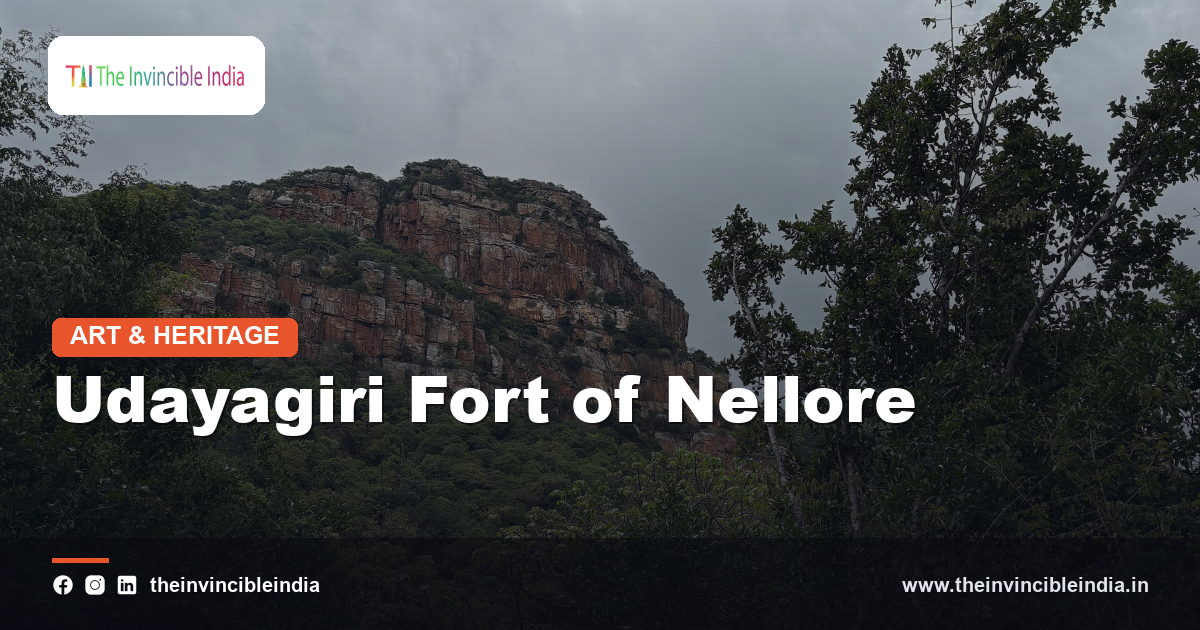
Udayagiri fort, in Nellore district of Andhra Pradesh, is a hill fort whose ruined walls, gateways and temples are spread across and around a steep hill. Held over the centuries by a succession of powers, it is associated with the Reddi kingdom, the Gajapatis of Odisha and the Vijayanagara empire, including the campaigns of the great king Krishnadevaraya. Today it survives as an atmospheric ruin, its scattered remains recalling its long role as a contested stronghold in the eastern Deccan. The fort belongs to the wider story of Indian military architecture, part of the broader account given in the guide to the great forts of India. This article explains its location, history, architecture and living significance, and clarifies that it is quite distinct from the famous Udayagiri cave sites in Odisha and Madhya Pradesh.
Quick answer: Udayagiri fort is a hill fort in Nellore district, Andhra Pradesh, India, whose ruined walls, gateways and temples are spread across a steep hill. Held in turn by the Reddi kingdom, the Gajapatis and the Vijayanagara empire, including the campaigns of Krishnadevaraya, it survives today as an atmospheric ruin. It is distinct from the Udayagiri cave sites in Odisha and Madhya Pradesh.
Key Takeaways
- Udayagiri fort is a hill fort in Nellore district, Andhra Pradesh, now surviving as a ruin.
- Its walls, gateways and ruined temples are spread across and around a steep hill.
- It was held in turn by the Reddi kingdom, the Gajapatis and the Vijayanagara empire.
- It is associated with the campaigns of the Vijayanagara king Krishnadevaraya.
- It is distinct from the Udayagiri cave sites in Odisha and Madhya Pradesh.
- The fort is a protected heritage site valued for its history and its hill setting.
The sections below explain where the fort stands, how it developed and what a visitor can still see today.
Quick Facts
| Detail | Information |
|---|---|
| Location | Udayagiri, Nellore district, Andhra Pradesh |
| Type | Hill fort (now largely in ruins) |
| Associated powers | Reddi kingdom, Gajapatis, Vijayanagara empire |
| Associated ruler | Linked to campaigns of Krishnadevaraya |
| Surviving remains | Walls, gateways and ruined temples |
| Not to be confused with | Udayagiri caves in Odisha and Madhya Pradesh |
| Protected status | Recognised heritage site |
| Nearest city | Nellore, in southern Andhra Pradesh |
What Is Udayagiri Fort?
Udayagiri fort is a hill fort in Nellore district, Andhra Pradesh, regarded as a historic stronghold whose ruins recall its long and contested past. Its walls, gateways and ruined temples are spread across and around a steep hill, which gave the fort its defensive strength. What distinguishes Udayagiri is its history as a prize held in turn by several powers, including the Reddi kingdom, the Gajapatis of Odisha and the Vijayanagara empire. The fort is associated with the campaigns of the great Vijayanagara king Krishnadevaraya, who was active in the eastern Deccan. Today the site survives chiefly as an atmospheric ruin rather than a complete fort. Udayagiri fort is therefore best understood as a historic hill stronghold whose scattered remains illustrate the military history of the eastern Deccan, and it should not be confused with the quite separate Udayagiri cave sites elsewhere in India.
Where Is Udayagiri Fort Located?
Udayagiri fort is located in Nellore district in the southern part of Andhra Pradesh, set on and around a steep hill that gives the site its name and its defensive strength. The fort lies in a landscape of hills and plains in the eastern Deccan, within the wider region historically contested by the powers of southern and eastern India. The city of Nellore serves as the usual base for reaching the site, which is approached by road. The hill setting places the fort above the surrounding country, commanding the approaches in the manner of the hill forts of the region. The area has a long history linked to the Reddi kingdom, the Gajapatis and the Vijayanagara empire. The location of Udayagiri fort therefore places it among the hill strongholds of the eastern Deccan, in a region whose control was long disputed between the kingdoms of the south and the east.
Which Powers Held Udayagiri Fort?
Udayagiri fort was held over the centuries by a succession of powers, reflecting its importance as a contested stronghold in the eastern Deccan. It is associated with the Reddi kingdom, a regional power of the medieval period, and with the Gajapatis, the rulers of Odisha whose influence extended southward into this region. In time the fort came under the Vijayanagara empire, one of the most powerful kingdoms of southern India, and it is linked to the campaigns of the great king Krishnadevaraya. The repeated changes of control reflect the strategic value of the hill and its position on a frontier between competing kingdoms. Each power left its mark on the fort and the surrounding region. The succession of powers that held Udayagiri fort therefore mirrors the shifting political history of the eastern Deccan, where the Reddis, the Gajapatis and the Vijayanagara empire contested control of the land.
How Is the Fort Linked to Krishnadevaraya?
Udayagiri fort is linked to Krishnadevaraya, the celebrated king of the Vijayanagara empire, through his military campaigns in the eastern Deccan, during which the fort figured among the strongholds involved in the contests of the age. Krishnadevaraya is remembered as one of the greatest rulers of Vijayanagara, who extended the power of the empire and led campaigns against rival kingdoms, including the Gajapatis of Odisha whose influence reached into this region. Udayagiri, as a hill fort on the contested frontier, was among the places caught up in these campaigns. The association with so renowned a king adds to the historical interest of the fort. As with many such accounts, the details rest on historical tradition and record. The link between Udayagiri fort and Krishnadevaraya therefore connects this hill stronghold to one of the great figures of southern Indian history and to the expansion of the Vijayanagara empire in the eastern Deccan.
How Is Udayagiri Fort Different from the Udayagiri Caves?
Udayagiri fort is quite different from the famous Udayagiri cave sites, and the shared name can cause confusion that is worth clearing up. The fort discussed here is a hill stronghold in Nellore district of Andhra Pradesh, with ruined walls, gateways and temples. The Udayagiri caves, by contrast, are two separate and well-known sites elsewhere in India: one in Odisha, near Bhubaneswar, famous for its early rock-cut Jain caves, and another in Madhya Pradesh, known for its early rock-cut Hindu and Jain shrines. These cave sites belong to a quite different category of monument and a different part of the country. The name Udayagiri, meaning the hill of sunrise, is simply shared by several places. Recognising that Udayagiri fort in Andhra Pradesh is distinct from the Udayagiri caves of Odisha and Madhya Pradesh therefore avoids a common and understandable confusion.
What Remains at the Fort Today?
What remains at Udayagiri fort today is chiefly a scattering of ruins across and around the steep hill, including fragments of walls, gateways and ruined temples. The fortifications, which once enclosed and defended the site, survive in part, tracing the lines of the old defences up the hillside. Among the remains are temples that served the religious life of those who held the fort, now mostly ruined but still recalling the devotion of the past. Gateways and other structures mark the approaches and the enclosures of the stronghold. Though much has been lost to time, the surviving remains give a vivid sense of the fort’s former strength and extent. The climb up the hill rewards visitors with both the ruins and the views. What remains at Udayagiri fort therefore offers an atmospheric record of a historic hill stronghold, its scattered walls, gateways and temples recalling its long and contested past.
What Was the Military Importance of the Fort?
The military importance of Udayagiri fort lay in its position on a steep hill in a contested frontier region of the eastern Deccan, which made it a valuable stronghold for whichever power held it. Hill forts of this kind used the natural strength of the terrain, with walls and gateways guarding the approaches, so that a determined garrison could hold out against an attacking force. Udayagiri commanded the surrounding country and guarded routes through the region, giving it strategic value in the wars between the Reddis, the Gajapatis and the Vijayanagara empire. Its repeated changes of control reflect the prize that it represented. The campaigns of Krishnadevaraya in the region underline its importance. The military importance of Udayagiri fort therefore explains why it was so often contested, as rulers of the eastern Deccan sought to hold a hill stronghold that controlled the land around it.
What Is the Architecture of the Fort Like?
The architecture of Udayagiri fort is that of a hill stronghold of the eastern Deccan, with fortifications that followed the natural contours of the steep hill and enclosed the site in stages up the slope. Walls of stone, pierced by gateways, defended the approaches, while within the enclosures stood temples and other structures that served those who held the fort. The builders made use of the rock and terrain to strengthen the defences, a common practice in the hill forts of southern and eastern India. The temples, now ruined, reflect the architectural and religious traditions of the powers that held the site. Though much survives only in fragments, the overall plan can still be traced across the hill. The architecture of Udayagiri fort therefore illustrates the design of the hill forts of the region, in which military defence and religious building were combined within a single commanding stronghold.
How Did the Fort Develop Over Time?
Udayagiri fort developed over a long period as it passed through the hands of successive powers, each of which strengthened and used the hill stronghold in its turn. The fort rose to importance under the regional kingdoms of the medieval eastern Deccan, including the Reddi kingdom, and later came under the influence of the Gajapatis of Odisha. With the expansion of the Vijayanagara empire, and the campaigns of Krishnadevaraya, the fort was drawn into the wider contests of the age and came under Vijayanagara control. In later centuries, as the great powers of the region declined, the fort gradually lost its strategic role and fell into the ruin seen today. The buildings and defences that survive reflect this long and layered history. The development of Udayagiri fort therefore mirrors the shifting fortunes of the eastern Deccan, rising as a contested prize and declining as its holders gave way to new powers.
Why Was the Hill Setting Important?
The hill setting of Udayagiri was important because it gave the fort natural defensive strength, the key consideration in the choice of sites for strongholds in medieval India. The steep hill made the approaches difficult for an attacking force, while the walls and gateways built up its slopes enclosed and defended the site. From the heights the garrison could command the surrounding country and guard the routes through the region. Such hill forts were common across the eastern Deccan and the south, where rulers used the terrain to strengthen their defences against rivals. The elevation also gave the fort a commanding and striking setting above the plains. The hill provided security in a contested frontier region fought over by several powers. The hill setting of Udayagiri fort therefore combined military advantage with a dramatic landscape, explaining why the site was chosen, fortified and contested through its long history in the eastern Deccan.
How Does Udayagiri Fit Among Indian Forts?
Udayagiri fits among Indian forts as a notable example of the hill fort of the eastern Deccan, a type that used the natural strength of a steep hill to create a commanding stronghold. India preserves a great many forts, from the hill forts of the Deccan and the south to the massive walled strongholds of the north and west, each reflecting the needs and traditions of its region and age. Udayagiri, with its hillside fortifications, gateways and ruined temples, illustrates how such a fort combined defence with the religious and daily life of those who held it. Its history as a contested prize of the Reddis, the Gajapatis and the Vijayanagara empire gives it particular interest. Comparing it with other forts shows the range of Indian military architecture. Udayagiri fort therefore holds a place among the forts of India, illustrating the hill strongholds of the eastern Deccan in the medieval period.
What Is the Setting of the Fort Today?
The setting of Udayagiri fort today combines its ruins with the steep hill and the surrounding landscape of Nellore district in southern Andhra Pradesh. The scattered walls, gateways and ruined temples stand across and around the hill, open to visitors who make the climb to explore the remains and to enjoy the views over the country below. The city of Nellore serves as the usual base for reaching the site. The atmospheric ruins, set against the natural strength of the hill, give a vivid sense of the fort’s contested past. The site rewards those who appreciate historic ruins and dramatic landscapes rather than complete and restored monuments. The surrounding region retains the character of the eastern Deccan. The setting of Udayagiri fort today therefore combines historical interest with the scenery of the Andhra hills, making it a rewarding destination for travellers drawn to the old hill strongholds of southern India.
How Is the Fort Protected and Preserved?
Udayagiri fort is preserved as a protected heritage site, cared for by the authorities responsible for safeguarding historic monuments in India. Conservation involves documenting, maintaining and stabilising the surviving walls, gateways and ruined temples, which face the challenges of weathering, vegetation growth and the wear caused by visitors and the passage of time. Ruined hill forts present particular difficulties, since their remains are exposed and spread across steep ground. Because the precise arrangements and status of a monument can change, readers are advised to consult current information from official heritage bodies before planning a visit. Respectful visitor behaviour, including care on the climb and among the ruins, helps protect the historic fabric of the site. The preservation of Udayagiri fort therefore depends on the work of heritage authorities together with the care of visitors who value its place in the military history and architectural record of the eastern Deccan.
How Can Visitors Plan a Trip to Udayagiri?
Visitors can plan a trip to Udayagiri fort most easily by basing themselves in the city of Nellore and travelling by road to the site, often as part of a wider exploration of the region. The cooler months from about October to February are generally the most comfortable for travel and for the climb, while the summer in southern Andhra Pradesh is hot. Sturdy footwear and comfortable clothing are advisable, since reaching the ruins involves walking and climbing on the steep hill. It is wise to carry water, to start early in the day to avoid the heat, and to allow unhurried time to explore the walls, gateways and temple remains. Caution is needed on the uneven and rocky ground. Checking current conditions and local advice before setting out is sensible. A well prepared visit allows the fort and its commanding views to be enjoyed safely and with respect.
Udayagiri Fort Today
Udayagiri fort today stands as an atmospheric ruin recalling the contested history of the eastern Deccan, its scattered walls, gateways and temple remains spread across a steep hill in Nellore district of Andhra Pradesh. Held in turn by the Reddi kingdom, the Gajapatis and the Vijayanagara empire, and linked to the campaigns of the great king Krishnadevaraya, it preserves the memory of a stronghold long fought over by the powers of southern and eastern India. Distinct from the famous Udayagiri caves of Odisha and Madhya Pradesh, it rewards travellers drawn to historic hill forts and dramatic landscapes. Continued conservation, respectful tourism and scholarly study help ensure that its remains endure for future generations. For those exploring the forts of the south, it makes a rewarding destination. Udayagiri fort thus stands as a lasting witness to the military history of the eastern Deccan and the strongholds of medieval India.
Sources & Further Reading
- Archaeological Survey of India (asi.nic.in).
- Department of Tourism, Government of Andhra Pradesh (tourism.ap.gov.in).
Frequently Asked Questions
Where is Udayagiri fort located?
Udayagiri fort is located in Nellore district of southern Andhra Pradesh, set on and around a steep hill. The city of Nellore is the usual base for reaching the site, which is approached by road.
Which powers held Udayagiri fort?
Udayagiri fort was held over the centuries by the Reddi kingdom, the Gajapatis of Odisha and the Vijayanagara empire. Its repeated changes of control reflect its value as a contested hill stronghold in the eastern Deccan.
How is Udayagiri fort linked to Krishnadevaraya?
Udayagiri fort is linked to the campaigns of the Vijayanagara king Krishnadevaraya in the eastern Deccan, during which the fort figured among the contested strongholds. The association connects the fort to one of the great rulers of southern India.
Is Udayagiri fort the same as the Udayagiri caves?
No. Udayagiri fort in Andhra Pradesh is a hill stronghold and is quite distinct from the famous Udayagiri caves, which are separate rock-cut sites in Odisha, near Bhubaneswar, and in Madhya Pradesh. The places simply share the name Udayagiri.
What can visitors see at Udayagiri fort today?
Visitors can see the scattered ruins of the fort, including fragments of walls, gateways and ruined temples spread across the steep hill. The site survives chiefly as an atmospheric ruin, rewarding those who make the climb.
What is the best time to visit Udayagiri fort?
The best time to visit is the cooler season from about October to February, which is most comfortable for travel and for the climb. The summer in southern Andhra Pradesh is hot, so an early start and plenty of water are advisable.


