

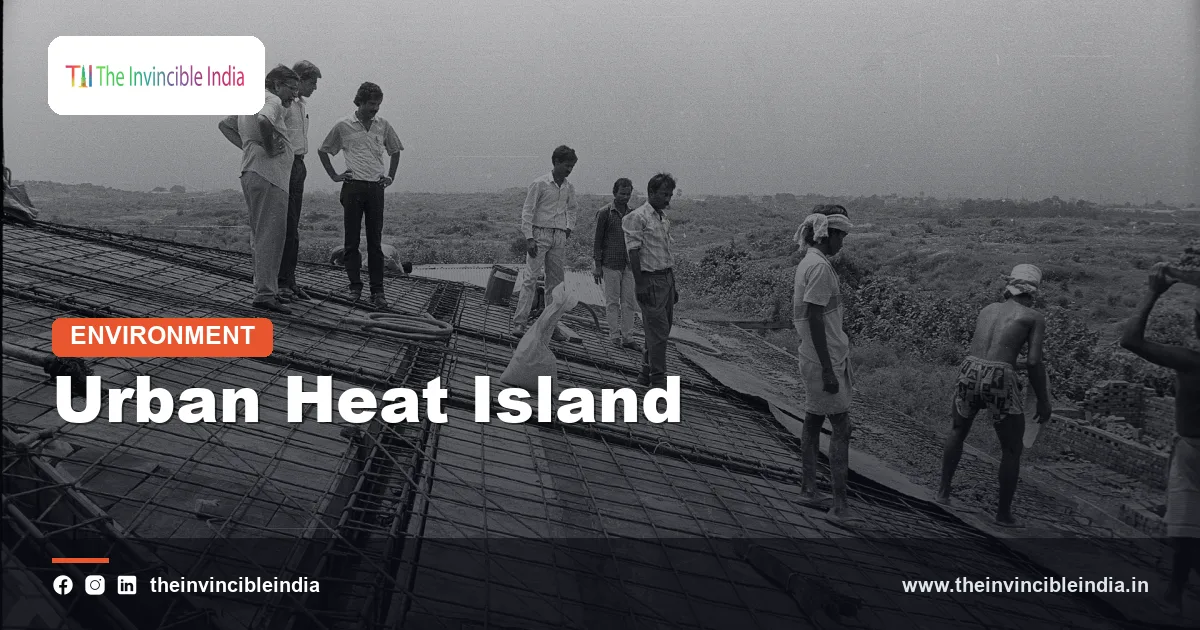
The urban heat island effect is the way a city stays noticeably warmer than the surrounding countryside because concrete, asphalt, traffic and a lack of vegetation trap and release heat, and in India an urban heat island can raise a big city’s temperature by several degrees, especially at night. It makes already hot Indian summers harder to bear in places where the most people live.
The effect is not a weather event but a lasting feature of how cities are built. Last updated: 2 November 2026. This explainer covers what causes the urban heat island, why nights are affected most, what it means for health and electricity demand in Indian cities, and which design and planning measures, from cool roofs to trees, can bring temperatures down.
| Attribute | Detail |
|---|---|
| Definition | A city area that is warmer than nearby rural areas because of human land use |
| How it is measured | Difference between urban and rural air or surface temperature, often called heat island intensity |
| Typical size | A few degrees Celsius on average, and more in some conditions |
| Strongest at | Night, and in calm, clear weather |
| Main causes | Dark paved surfaces, tall buildings, loss of trees and water, waste heat from air conditioners and vehicles |
| Types | Surface heat island and atmospheric (air temperature) heat island |
| Main impacts | Heat illness, poorer sleep, higher cooling demand, worse air quality |
| Common fixes | Trees and parks, cool roofs, reflective pavements, water bodies, better building design |
Key Takeaways
- The urban heat island effect makes cities warmer than their surroundings, mainly because dark, dense materials absorb heat by day and give it back slowly after sunset.
- The effect is usually strongest at night, so people in cities get less relief when the sun goes down, which matters a great deal during a heatwave.
- Loss of trees, soil and water bodies removes evaporation and shade, which are nature’s cooling system, and so adds to heating.
- Heat from air conditioners, vehicles, industry and cooking is released into city air, creating a feedback loop in which hotter cities need more cooling, and cooling in turn heats the street.
- Outdoor workers, children, older adults and residents of crowded homes with tin or concrete roofs are the most exposed to the extra heat.
- Trees, parks, lakes, cool roofs, lighter pavements and smarter building layouts can all cut urban temperatures, and several Indian cities have begun to use them.
What is the urban heat island effect?
The urban heat island effect is the temperature difference between a built-up city and the cooler rural land around it, caused by the way human construction changes how land absorbs, stores and releases heat. The “island” refers to how a map of temperatures shows the city as a warm patch rising above a cooler surrounding sea.
Scientists measure it as the difference between the temperature in a city and that at a nearby rural site, and call the gap the heat island intensity. The gap changes with the time of day, the season, the weather and the size and shape of the city. It is generally biggest on calm, clear nights, and smaller on windy or cloudy days.
The idea is not new, since the English scientist Luke Howard described London’s warmth relative to the countryside in the early nineteenth century. In India, studies of cities including Delhi, Mumbai, Chennai, Kolkata, Bengaluru and Ahmedabad using weather stations and satellite images have shown similar patterns.
What causes the urban heat island?
The urban heat island is caused by a combination of heat-absorbing materials, a lack of vegetation, the geometry of buildings, waste heat and air pollution, all of which push up city temperatures. Each factor adds a little, but together they make a difference of several degrees.
- Dark, dense surfaces: asphalt roads, concrete, brick and dark roofs absorb a large share of incoming sunlight and store it, while many natural surfaces reflect more or evaporate water.
- Less vegetation and water: trees cool the air by shading the ground and by releasing water vapour, a process called evapotranspiration. Paved cities have far less of both.
- Urban canyons: tall buildings along narrow streets trap heat by reflecting sunlight between walls and by blocking the wind and the escape of heat to the night sky.
- Waste heat: air conditioners, refrigerators, vehicles, power plants and factories release heat directly into the air around them.
- Air pollution: haze and particles can hold warmth near the ground in some conditions and alter how heat leaves the city.
- Quick drainage: because rain runs off sealed surfaces into drains, the soil dries out and less moisture is left to evaporate and cool the surroundings.
Why are nights getting hotter in Indian cities?
Indian cities are getting hotter at night because concrete and brick that soaked up the day’s heat release it slowly after dark, while tall buildings and low wind keep the warm air in place. Rural land, with open ground and plants, loses heat faster and cools down more at night.
This is why the urban heat island is mostly a night-time effect. In the afternoon, a shaded park and a paved road may differ by a few degrees at ground level, but after sunset the city and countryside diverge, because the countryside radiates heat to the sky while the city keeps releasing stored heat. The result is a smaller drop in the night’s minimum temperature.
High night temperatures matter for health. The body uses cooler nights to recover from daytime heat, and when nights stay hot, people sleep badly and their risk of heat stress rises. Studies of Indian heatwaves have highlighted warm nights in cities as a particular concern, and meteorologists now report night-time minimums alongside daytime maximums when they issue heat warnings.
How big is the urban heat island in India?
The urban heat island in India is typically a few degrees Celsius for large cities, and it varies by city, season and measurement method. Satellite studies show land-surface temperatures in dense neighbourhoods that are much higher than in parks or rural fields nearby.
Surface temperatures, measured from space, can differ by far more than air temperatures. A tin-roofed slum or a bare concrete rooftop can be tens of degrees hotter than a tree-lined street at midday. Air temperature differences are smaller, since air mixes, but they are still significant for comfort and for health.
Research suggests that the heat island is growing as Indian cities expand quickly, absorbing farmland and open land, and as the climate warms. Cities in the dry interior and north, such as Delhi, Jaipur and Nagpur, and humid coastal cities such as Mumbai and Chennai, all show the effect, though the mix of causes differs. In humid places, the added heat is more dangerous because the air is already damp and sweat does not evaporate easily.
What does the urban heat island mean for health?
The urban heat island raises the risk of heat exhaustion, heatstroke, dehydration, poor sleep and worsening of heart, lung and kidney disease, especially for people who cannot escape the heat. It acts as a multiplier on heatwaves, which are already becoming more frequent and intense in India.
The people at greatest risk include outdoor workers such as construction labourers, street vendors, delivery riders and traffic police. Children, older adults, pregnant women and people with chronic illness are also vulnerable. Poor households in crowded neighbourhoods often live under tin or asbestos sheet roofs, with little ventilation and no air conditioning, which makes indoor temperatures even higher than outside.
The 2010 heatwave in Ahmedabad, which was linked to a surge of heat-related deaths, prompted the city to prepare the first Heat Action Plan in South Asia, launched in 2013. It combined early warnings, public awareness, training of health workers and cool-roof measures, and it has been studied as a model. Many Indian states and cities have since adopted heat action plans, with guidance from the National Disaster Management Authority.
How does the urban heat island raise electricity demand?
The urban heat island raises electricity demand because hotter cities run more fans, coolers and air conditioners, and cooling demand rises sharply with each degree of extra heat. This feeds back on itself, because air conditioners pump heat outdoors, which warms the streets further.
India’s peak electricity demand has been setting new records in summer, driven by rising incomes, more air-conditioner ownership and hotter weather. Cooling is one of the fastest-growing uses of power in Indian cities, and it often coincides with the evening peak, when the strain on the grid is greatest.
Planners have long warned of a cooling trap. If cities rely on mechanical cooling alone, energy use and emissions will climb, and poorer households will be unable to afford relief. Passive cooling through shade, reflective roofs and ventilation, combined with efficient equipment, lowers both the heat and the bills.
How does the heat island connect to air pollution and rainfall?
The heat island connects to air pollution and rainfall because higher temperatures speed up the chemical reactions that form ozone, and warm city air can change local wind and cloud patterns. The effect on rain varies, but some studies find heavier downpours downwind of large cities.
On hot, sunny days, pollutants from vehicles and industry react in the heat to form ground-level ozone, which harms the lungs. A hotter city can therefore have worse air quality as well as higher temperatures, and the two stresses together are more harmful than either alone.
Warm, rising air over a city can also draw in moist air and trigger short, intense thunderstorms, which in turn can flood streets if the drains are weak. The heat island is thus linked to other urban problems, including flooding and pollution, and solutions often help with several at once.
Which materials and designs make cities hotter or cooler?
Dark, dry and impermeable materials make cities hotter, while light-coloured, reflective, porous or planted surfaces keep them cooler. The key property is albedo, the share of sunlight a surface reflects instead of absorbing.
| Surface or design | Effect on heat |
|---|---|
| Dark asphalt and tar roads | Absorb most sunlight and stay hot into the night |
| Bare concrete and dark roofs | Store heat during the day and release it slowly |
| Tin and asbestos sheet roofs | Heat up quickly and make indoor rooms very hot |
| White or reflective roof coatings (cool roofs) | Reflect more sunlight and can lower indoor temperatures |
| Trees and green roofs | Provide shade and evaporative cooling |
| Lakes, ponds and fountains | Cool the surrounding air through evaporation |
| Narrow streets with shaded walkways | Limit direct sun, a long-used design in many Indian old towns |
| Wind corridors and open spaces | Let breezes carry heat away |
Traditional Indian architecture used many of these ideas, including thick walls, courtyards, jaalis (lattice screens), shaded verandahs, stepwells and lime-washed white roofs. Modern glass-fronted towers and sealed concrete blocks often discard them and depend on air conditioning instead.
What are cool roofs and how do they work?
Cool roofs are roofs finished with reflective paint, tiles or membranes that bounce most of the sunlight back into the sky, which keeps the roof surface and the rooms beneath it cooler. They are among the cheapest and fastest ways to reduce heat in dense Indian neighbourhoods.
A dark or bare concrete roof can heat up enough to make the top-floor rooms uncomfortably warm. A white or lime-based reflective coating on the same roof may keep it far cooler, and studies from Ahmedabad and other cities report indoor temperature falls of a few degrees in homes with cool roofs. This helps especially in low-income housing without air conditioning.
Ahmedabad promoted cool roofs under its Heat Action Plan, and the idea has spread to other cities. Telangana has adopted a state cool roof policy, and building codes such as the Energy Conservation Building Code encourage reflective roofs and better insulation. When many roofs in a neighbourhood are changed, the combined effect can help to lower the temperature of the whole street.
How can trees, parks and water bodies cool a city?
Trees, parks and water bodies cool a city by shading surfaces and by evaporating water, which absorbs heat from the air. A tree-lined street can be several degrees cooler than a bare one, and a large park can cool nearby blocks too.
The benefit depends on the quality and spread of the greenery, not only on the total number of trees. Shade trees with large canopies, planted along streets and near homes and bus stops, do more for comfort than small ornamental plants. Native species suited to local rainfall need less water and support birds and insects.
Indian cities have been losing green space and water bodies to construction. Protecting existing trees, restoring lakes and ponds, planting along roads, creating pocket parks and adding green roofs and walls are all part of an urban cooling strategy. Dense Miyawaki-style plantations have become popular for small plots, though they work best as a supplement to protecting older trees, not a replacement.
What can city planners and residents do?
City planners can cut the urban heat island by mapping hot spots, protecting green and blue spaces, requiring cool roofs and shade, and reducing waste heat, while residents can add shade, reflective roofs and plants at home. The aim is cooler streets that do not need more energy.
- Map land-surface temperature with satellite data to find the hottest neighbourhoods and target action there first.
- Plant street trees and shade at bus stops, schools and markets, and keep parks and lakes protected from encroachment.
- Use cool roofs and reflective or permeable paving, particularly in low-income and high-density areas.
- Design buildings with shading, cross-ventilation and insulation, and avoid unnecessary glass facades in hot climates.
- Expand public transport, walking and cycling to reduce vehicle heat and pollution.
- Prepare heat action plans with early warnings, cooling centres, drinking water points and changed working hours for outdoor workers.
Bottom Line
The urban heat island is the price of building cities from heat-trapping materials with few trees and little water. In India, where cities are growing fast and heatwaves are intensifying, it makes nights hotter, raises health risks and pushes up electricity use. The cure is not complicated: more trees and open water, reflective roofs and pavements, better building design and heat action plans, all of which make cities cooler and fairer at the same time.
Frequently Asked Questions
What is the urban heat island effect?
The urban heat island effect is the way a city becomes warmer than the nearby countryside because concrete, asphalt, buildings, traffic and a lack of vegetation trap and release heat. The difference is usually a few degrees Celsius and is greatest at night.
Why are cities hotter than villages in India?
Cities are hotter because dark paved surfaces absorb and store heat, trees and water bodies are fewer, tall buildings block wind, and air conditioners and vehicles add waste heat. Villages have more open land and plants that cool the air.
Why is the urban heat island stronger at night?
It is stronger at night because concrete and brick release stored daytime heat slowly, while open countryside cools quickly. Tall buildings and low wind also keep warm air trapped in the city.
What is a cool roof?
A cool roof is a roof treated with reflective paint, tiles or membranes that reflect most sunlight instead of absorbing it. It keeps the roof and the rooms below cooler and can reduce the need for fans and air conditioning.
How does the urban heat island affect health?
It increases the risk of heat exhaustion, heatstroke, dehydration and poor sleep, and it can worsen heart, lung and kidney conditions. Outdoor workers, children, older adults and people in crowded homes face the greatest risk.
How can Indian cities reduce the urban heat island?
Cities can plant street trees, protect lakes and parks, use cool roofs and reflective pavements, design buildings for shade and ventilation, and prepare heat action plans. Together these steps lower temperatures and cut electricity demand.
{“@context”:”https://schema.org”,”@graph”:[{“@type”:”FAQPage”,”mainEntity”:[{“@type”:”Question”,”name”:”What is the urban heat island effect?”,”acceptedAnswer”:{“@type”:”Answer”,”text”:”The urban heat island effect is the way a city becomes warmer than the nearby countryside because concrete, asphalt, buildings, traffic and a lack of vegetation trap and release heat. The difference is usually a few degrees Celsius and is greatest at night.”}},{“@type”:”Question”,”name”:”Why are cities hotter than villages in India?”,”acceptedAnswer”:{“@type”:”Answer”,”text”:”Cities are hotter because dark paved surfaces absorb and store heat, trees and water bodies are fewer, tall buildings block wind, and air conditioners and vehicles add waste heat. Villages have more open land and plants that cool the air.”}},{“@type”:”Question”,”name”:”Why is the urban heat island stronger at night?”,”acceptedAnswer”:{“@type”:”Answer”,”text”:”It is stronger at night because concrete and brick release stored daytime heat slowly, while open countryside cools quickly. Tall buildings and low wind also keep warm air trapped in the city.”}},{“@type”:”Question”,”name”:”What is a cool roof?”,”acceptedAnswer”:{“@type”:”Answer”,”text”:”A cool roof is a roof treated with reflective paint, tiles or membranes that reflect most sunlight instead of absorbing it. It keeps the roof and the rooms below cooler and can reduce the need for fans and air conditioning.”}},{“@type”:”Question”,”name”:”How does the urban heat island affect health?”,”acceptedAnswer”:{“@type”:”Answer”,”text”:”It increases the risk of heat exhaustion, heatstroke, dehydration and poor sleep, and it can worsen heart, lung and kidney conditions. Outdoor workers, children, older adults and people in crowded homes face the greatest risk.”}},{“@type”:”Question”,”name”:”How can Indian cities reduce the urban heat island?”,”acceptedAnswer”:{“@type”:”Answer”,”text”:”Cities can plant street trees, protect lakes and parks, use cool roofs and reflective pavements, design buildings for shade and ventilation, and prepare heat action plans. Together these steps lower temperatures and cut electricity demand.”}}]}]}


