

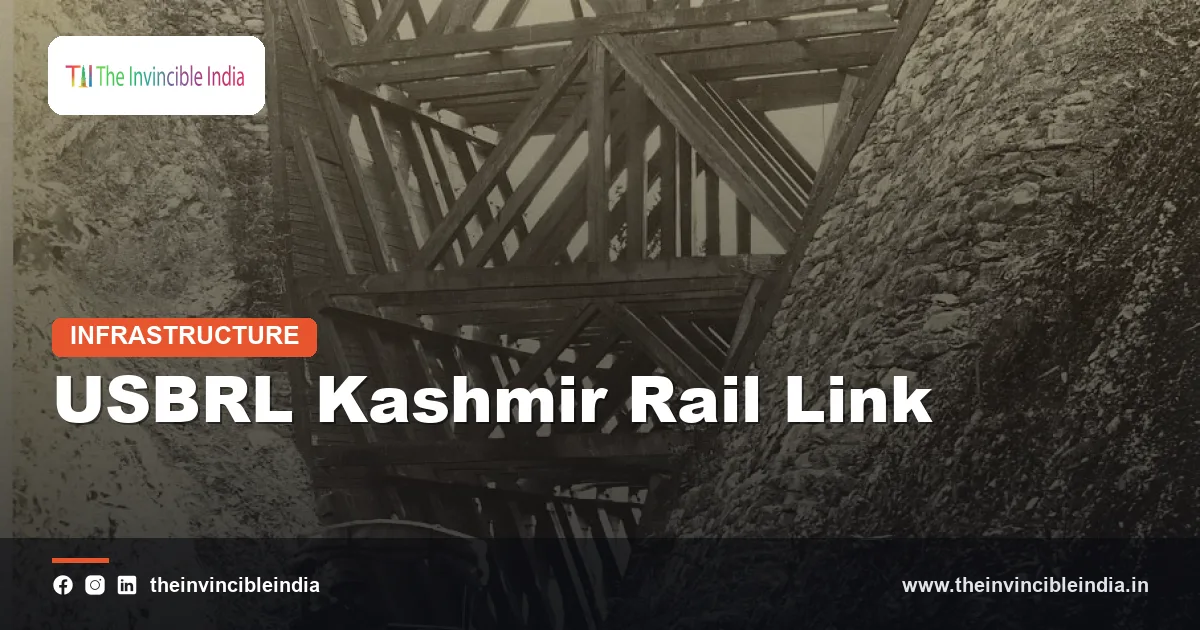
The Udhampur-Srinagar-Baramulla Rail Link (USBRL) is a national-project railway of roughly 270 kilometres that connects the Kashmir Valley to the rest of the Indian rail network, built through the young and unstable terrain of the Pir Panjal range in Jammu and Kashmir. The project, declared a national project in 2002, includes some of the most demanding structures on any Indian railway, notably the Chenab Bridge, which is described as the world’s highest railway arch bridge, and the Anji Khad Bridge, India’s first cable-stayed railway bridge.
After decades of survey, planning, delays and construction in difficult conditions, the through connection between Katra in Jammu and Srinagar in the Valley was opened in 2025, and Vande Bharat Express services began on the route. This explainer describes how the USBRL was built in phases, what its principal bridges and tunnels are, why it matters strategically and economically, and what engineering challenges it faced, with exact heights, lengths and dates qualified where sources vary.
Quick Facts: Udhampur-Srinagar-Baramulla Rail Link
| Attribute | Detail |
|---|---|
| Full name | Udhampur-Srinagar-Baramulla Rail Link (USBRL) |
| Status | Declared a national project in 2002 |
| Approximate length | About 272 km, from Udhampur through Katra, Banihal, Qazigund and Srinagar to Baramulla |
| Principal implementing agencies | Indian Railways, with Konkan Railway Corporation and other contractors, and the Ministry of Railways |
| Landmark bridge | Chenab Bridge, about 359 metres above the river bed (world’s highest railway arch bridge, as commonly reported) |
| Cable-stayed bridge | Anji Khad Bridge, India’s first cable-stayed railway bridge |
| Longest tunnel | Tunnel T-49 between Sumber and Arpinchalla, about 12.75 km, the longest transport tunnel in India |
| Major tunnel under Pir Panjal | Banihal-Qazigund tunnel, about 11 km |
| Through connection | Katra to Srinagar through service launched in 2025 |
Key Takeaways
- The Udhampur-Srinagar-Baramulla Rail Link is a roughly 272-kilometre railway project that connects the Kashmir Valley to the Indian rail network and was declared a national project in 2002.
- The Chenab Bridge on the USBRL is reported to be the world’s highest railway arch bridge, rising about 359 metres above the river bed, which is taller than the Eiffel Tower.
- The Anji Khad Bridge is India’s first cable-stayed railway bridge, and it supports the Katra-Banihal section of the project.
- Tunnel T-49 is about 12.75 kilometres long and is described as the longest transport tunnel in India.
- The railway was built in phases, with the Baramulla-Srinagar-Banihal-Qazigund section opening first and the Udhampur-Katra and Katra-Banihal sections completing the through link later.
- Vande Bharat Express services between Katra and Srinagar began in June 2025, providing all-weather rail travel to the Valley.
What is the Udhampur-Srinagar-Baramulla Rail Link?
The Udhampur-Srinagar-Baramulla Rail Link is a railway line of about 272 kilometres that runs from Udhampur in the Jammu region through the Pir Panjal range to Srinagar and onward to Baramulla in the north of the Kashmir Valley. It is the northernmost major railway project in India and was built to give the Valley a dependable year-round connection with the rest of the country.
Before the project, the only reliable land route into the Valley was the national highway through the Banihal pass and the Jawahar Tunnel, which is often closed by snow and landslides in winter. A railway offers a mode of transport that can operate in poor weather and carry bulk goods such as fruit, cement and fuel, and passengers, at lower cost.
The USBRL is also called by variants such as the Kashmir Rail Link, and it forms part of a larger plan to connect Jammu and Kashmir through the Northern Railway network with Delhi and the rest of the country. The railway line from Jammu to Udhampur was built earlier, so the USBRL begins where that line ends.
Why was the USBRL declared a national project?
The USBRL was declared a national project in 2002 because of its strategic importance, its development value for a remote region and the high cost and technical difficulty of building it. National project status allowed the central government to give the project priority and to provide large-scale funding.
The idea of a railway to Kashmir is old, with proposals in the colonial period under the Dogra rulers, but those schemes never reached completion. The modern project was sanctioned in the mid-1990s, and early work was slowed by geology, security conditions, funding constraints and the need to redesign alignments. Following the 2002 decision, the Ministry of Railways accelerated the work, and the project was divided into sections that could be opened as they were completed.
The cost rose substantially over the years as the scope increased, the alignment was refined and the engineering challenges became clearer. The total expenditure is in the range of tens of thousands of crores of rupees, though readers should consult official Railway Ministry statements for current figures.
How was the USBRL built in phases?
The USBRL was built in phases, with sections opened as they were completed rather than waiting for the entire link, and the final stage was the difficult Katra-Banihal section, which required the most complex bridges and tunnels. The phased approach let the Valley section start serving passengers years before the through connection was completed.
| Section | Approximate length | Opening (as commonly reported) | Notes |
|---|---|---|---|
| Jammu-Udhampur | About 53 km | 2005 | Built before the USBRL proper; provides the base connection |
| Qazigund-Baramulla | About 119 km | Opened in stages, roughly 2008 to 2009 | Valley section, built first; connected the Valley’s towns by rail |
| Banihal-Qazigund | About 18 km | 2013 | Includes the long Pir Panjal tunnel under the mountain |
| Udhampur-Katra | About 25 km | 2014 | Opened rail access to the Mata Vaishno Devi pilgrimage base |
| Katra-Banihal | About 111 km | Completed in the mid-2020s | Includes the Chenab Bridge, Anji Khad Bridge and Tunnel T-49 |
Because of the phased approach, trains ran within the Valley long before the through link existed, and passengers had to change modes at Banihal. The completion of the Katra-Banihal section closed the gap, and a through rail service from Katra to Srinagar began in June 2025.
What is the Chenab Bridge?
The Chenab Bridge is a steel arch railway bridge over the Chenab River near Reasi in Jammu and Kashmir, widely reported as the world’s highest railway arch bridge, with its deck rising around 359 metres above the river bed. It is about 1,315 metres long, with a main arch span of about 467 metres.
The bridge is notable for several reasons:
- Height: the deck is commonly described as higher than the Eiffel Tower, although comparisons depend on what is measured.
- Design: the bridge was designed to withstand strong winds, seismic activity in a high-risk zone and blast loads, and it was subjected to extensive wind-tunnel and structural testing.
- Construction method: steel arch segments were built out from both sides using cable cranes, because the gorge made conventional scaffolding impractical.
- Access: new roads and a cable system had to be built to deliver materials to the site.
The bridge was formally inaugurated in June 2025 as part of the opening of the Katra-Srinagar through link. Exact measurements are often quoted with slight variation in sources, so rounded figures are used here.
What is the Anji Khad Bridge?
The Anji Khad Bridge is India’s first cable-stayed railway bridge, spanning the Anji Khad stream on the Katra-Banihal section, with a single tall pylon that carries cables supporting the deck. The bridge is about 725 metres long, and its pylon rises roughly 190 metres above the foundation, according to commonly cited figures.
A cable-stayed design was chosen because the valley is deep and steep, which makes it difficult to place many piers in the gorge. The bridge also demonstrates a type of engineering new to Indian railways, where cables fan out from the tower to the deck, as in some famous road bridges.
Both the Chenab and Anji Khad bridges are examples of how the USBRL became a testing ground for new techniques, including advanced geological investigation, cable-stayed construction and long-span steel structures.
Which are the long tunnels of the USBRL?
The long tunnels of the USBRL include Tunnel T-49 between Sumber and Arpinchalla, at about 12.75 kilometres the longest transport tunnel in India, and the Pir Panjal tunnel between Banihal and Qazigund, at about 11 kilometres. These tunnels allow the railway to pass under high ridges rather than climb them.
The project as a whole includes dozens of tunnels and hundreds of bridges, and a large share of the alignment is underground or on structures. Commonly cited totals are on the order of three dozen main tunnels and several hundred bridges and viaducts, though figures differ by source and by whether minor structures are counted.
Why is tunnelling so difficult here?
Tunnelling is difficult in the Pir Panjal and lower Himalaya because the rock is young, folded and fractured, with weak zones, thrust faults, water ingress and squeezing ground. Engineers used the New Austrian Tunnelling Method, which treats the surrounding rock as a structural element and adapts the support to conditions, along with parallel escape tunnels in some sections for safety and ventilation.
What engineering challenges did the project face?
The project faced geological, climatic, logistical and security challenges, and these challenges explain why it took decades to complete. The Himalayas are geologically young and seismically active, and the alignment crosses several fault zones.
- Geology: weak and fractured rock, landslide-prone slopes and unexpected cavities required repeated design changes.
- Weather: heavy snow, rain, cloudbursts and freezing temperatures restricted work seasons and damaged access roads.
- Access: remote sites had no roads, so builders had to construct hundreds of kilometres of temporary and permanent access tracks.
- Seismic risk: the region lies in a high seismic zone, requiring structures designed for strong ground motion.
- Security and administration: local conditions in the region periodically affected the pace of work.
In addition to these, the project had to manage the ecological and social effects of construction, including slope stabilisation, muck disposal and compensation to affected communities.
Why is the USBRL strategically and economically significant?
The USBRL is significant because it gives Jammu and Kashmir an all-weather rail connection to the rest of India, supports the movement of civil and defence supplies, and lowers the cost of transport for the Valley’s economy. Strategic assessments emphasise its role in reducing dependence on a single highway that is vulnerable to snow and landslides.
Economic benefits generally cited include:
- cheaper and faster movement of apples, other horticultural produce, handicrafts and carpets to national markets,
- lower cost of bringing in construction materials, food grains and fuel,
- greater access for tourists and pilgrims, since Katra, the base for the Vaishno Devi shrine, is on the line,
- employment during construction and in related services.
Social and political observers hold varied opinions on the broader effect of the railway. Supporters see it as a means of integration and development, while others emphasise the need for the benefits to reach local communities and for environmental safeguards. Both views are part of the public debate, and the long-term impact will depend on how well the railway is operated and connected with local economies.
What is the Vande Bharat service on the Kashmir line?
The Vande Bharat service on the Kashmir line is a semi-high-speed train service introduced in June 2025 between Katra and Srinagar, using trains modified for cold-weather operation. The rolling stock includes features for sub-zero temperatures, such as heating of key components, insulated systems and heated water and bio-vacuum facilities.
The service allows passengers to travel between the Jammu region and Srinagar in a few hours instead of a longer road journey, and it is intended to connect with services from Delhi and other cities through Katra. The details of train schedules, frequency and further connections may change over time, so travellers should consult current Indian Railways notices.
Bottom Line
The Udhampur-Srinagar-Baramulla Rail Link is one of India’s most ambitious infrastructure projects, combining the Chenab Bridge, the Anji Khad Bridge and extremely long tunnels to link the Kashmir Valley with the national network. Completed in phases over about two decades, it provides all-weather connectivity of high strategic and economic importance, and it stands as a major achievement in Himalayan railway engineering.
Frequently Asked Questions
What is the USBRL project?
The USBRL, or Udhampur-Srinagar-Baramulla Rail Link, is a railway of about 272 kilometres that connects the Kashmir Valley with the Indian rail network. It was declared a national project in 2002. It includes major bridges and some of India’s longest tunnels.
Which is the world’s highest railway arch bridge?
The Chenab Bridge in Jammu and Kashmir is widely reported as the world’s highest railway arch bridge. Its deck is about 359 metres above the river bed, and its main arch span is about 467 metres. It is a part of the Katra-Banihal section of the USBRL.
What is special about the Anji Khad Bridge?
The Anji Khad Bridge is India’s first cable-stayed railway bridge. It is about 725 metres long, with a tall pylon that supports the deck through cables. It was built because the steep valley made conventional piers impractical.
Which is the longest tunnel on the Kashmir rail link?
Tunnel T-49, between Sumber and Arpinchalla, is the longest tunnel on the link at about 12.75 kilometres. It is described as the longest transport tunnel in India. The Pir Panjal tunnel between Banihal and Qazigund is also long, at around 11 kilometres.
When did the Vande Bharat start running to Kashmir?
Vande Bharat Express services between Katra and Srinagar began in June 2025, after the through connection was inaugurated. The trains are adapted for cold-weather operation. Current timetables should be checked with Indian Railways.
Why was the USBRL so difficult to build?
The USBRL was difficult to build because it crosses young, fractured Himalayan rock, deep gorges, heavy snow and a high seismic zone. Remote sites lacked roads, so access had to be built first. These conditions led to repeated redesigns and long delays.
{“@context”:”https://schema.org”,”@graph”:[{“@type”:”FAQPage”,”mainEntity”:[{“@type”:”Question”,”name”:”What is the USBRL project?”,”acceptedAnswer”:{“@type”:”Answer”,”text”:”The USBRL, or Udhampur-Srinagar-Baramulla Rail Link, is a railway of about 272 kilometres that connects the Kashmir Valley with the Indian rail network. It was declared a national project in 2002. It includes major bridges and some of India’s longest tunnels.”}},{“@type”:”Question”,”name”:”Which is the world’s highest railway arch bridge?”,”acceptedAnswer”:{“@type”:”Answer”,”text”:”The Chenab Bridge in Jammu and Kashmir is widely reported as the world’s highest railway arch bridge. Its deck is about 359 metres above the river bed, and its main arch span is about 467 metres. It is a part of the Katra-Banihal section of the USBRL.”}},{“@type”:”Question”,”name”:”What is special about the Anji Khad Bridge?”,”acceptedAnswer”:{“@type”:”Answer”,”text”:”The Anji Khad Bridge is India’s first cable-stayed railway bridge. It is about 725 metres long, with a tall pylon that supports the deck through cables. It was built because the steep valley made conventional piers impractical.”}},{“@type”:”Question”,”name”:”Which is the longest tunnel on the Kashmir rail link?”,”acceptedAnswer”:{“@type”:”Answer”,”text”:”Tunnel T-49, between Sumber and Arpinchalla, is the longest tunnel on the link at about 12.75 kilometres. It is described as the longest transport tunnel in India. The Pir Panjal tunnel between Banihal and Qazigund is also long, at around 11 kilometres.”}},{“@type”:”Question”,”name”:”When did the Vande Bharat start running to Kashmir?”,”acceptedAnswer”:{“@type”:”Answer”,”text”:”Vande Bharat Express services between Katra and Srinagar began in June 2025, after the through connection was inaugurated. The trains are adapted for cold-weather operation. Current timetables should be checked with Indian Railways.”}},{“@type”:”Question”,”name”:”Why was the USBRL so difficult to build?”,”acceptedAnswer”:{“@type”:”Answer”,”text”:”The USBRL was difficult to build because it crosses young, fractured Himalayan rock, deep gorges, heavy snow and a high seismic zone. Remote sites lacked roads, so access had to be built first. These conditions led to repeated redesigns and long delays.”}}]}]}


