

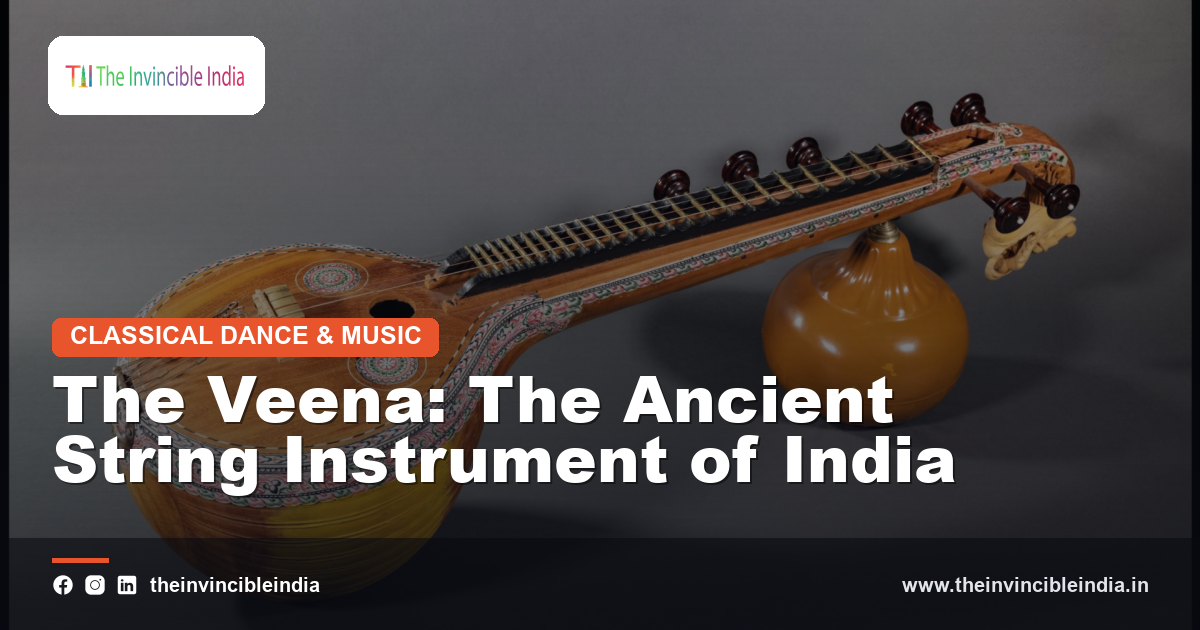
The veena is among the oldest and most revered of India’s musical instruments, a name that in ancient texts once referred broadly to stringed instruments but today most often denotes the graceful, long-necked lute central to Carnatic classical music. Sacred as the instrument held by Saraswati, the goddess of knowledge, music and the arts, the veena carries a spiritual prestige matched by few other instruments in Indian culture. With its deep, resonant tone, its large gourd resonators and its capacity for the smooth glides essential to Indian melody, the veena occupies an honoured place in both classical performance and religious symbolism. This guide explores the veena’s ancient origins, its structure and varieties, its association with Saraswati, its playing technique and its role in Carnatic music today.
Quick Facts
| Detail | Information |
|---|---|
| Type | An ancient plucked string instrument (lute) |
| Association | The instrument of Saraswati, goddess of music and knowledge |
| Main tradition | Central to South Indian Carnatic classical music |
| Construction | A long wooden neck with one or two gourd resonators |
| Sound | Deep, resonant and capable of smooth melodic glides |
| Notable form | The Saraswati veena, most common in concert use today |
An Ancient and Sacred Name
The word veena has an extremely long history in Indian musical thought, appearing in ancient texts as a broad term for stringed instruments in general, long before the specific instrument known by that name today took its current form. Over many centuries, the term gradually came to be associated with particular refined lutes cultivated at royal courts and temples, until it settled on the graceful and dignified instrument most commonly recognised as the veena in the present day. This deep historical lineage gives the veena an unmatched sense of antiquity among Indian instruments, and its name alone evokes the whole long history of stringed music on the subcontinent, stretching back into the earliest periods of Indian civilisation.
The Instrument of Saraswati
No instrument in Indian culture carries greater spiritual and symbolic weight than the veena, sacred as the instrument held by Saraswati, the goddess of knowledge, learning, speech and the arts. In countless images and sculptures, Saraswati is depicted seated gracefully with a veena resting across her lap, her fingers poised upon its strings, an image that has shaped how generations of Indians perceive the instrument itself. This divine association elevates the veena beyond a mere musical tool, casting it as a symbol of wisdom, refinement and artistic accomplishment, and lending its player a certain dignity and reverence not always accorded to performers of other instruments.
The Structure of the Veena
The veena is a substantial and elegant instrument, typically featuring a long wooden neck attached to a large body, often carved from a single block of wood, that serves as the primary resonator, with a second, smaller gourd resonator frequently fixed near the top of the neck to balance the instrument and enrich its tone. The neck is fitted with broad, raised frets set into wax, and the strings run from tuning pegs at the top, over the frets, to the base of the main resonator. This combination of a long fretted neck and substantial resonating chambers gives the veena both its distinctive visual elegance and its deep, sustained sound.
The Saraswati Veena
The most widely played form of the veena in concert use today is the Saraswati veena, associated particularly with South Indian Carnatic music and named, fittingly, after the goddess herself. It features the characteristic long neck, broad frets and large gourd-shaped resonators of the classical veena, and is prized for its warm, deep tone, well suited to the elaborate melodic exploration central to Carnatic performance. Skilled craftsmen who build these instruments follow traditions passed down over generations, carefully selecting wood and shaping each component to achieve the resonance and tonal beauty expected of a fine concert instrument, a craft as respected as the musicianship it serves.
Other Veena Traditions
Beyond the Saraswati veena, the broader veena family historically encompassed a number of related instruments used in different regions and periods, some now rare or largely historical, reflecting the term’s older, more general application to stringed instruments. Certain forms developed within North Indian traditions before other instruments such as the sitar and sarod rose to greater prominence in Hindustani concert music, while other regional string traditions across India have also drawn on the veena name and lineage. This diversity underlines how the veena, in its broadest historical sense, stands as an ancestral root from which many of India’s later stringed instruments ultimately descend.
How the Veena Is Played
The veena is played seated, with the instrument resting horizontally, the larger resonator typically placed on the floor or the player’s lap and the smaller resonator supported near the shoulder. The player plucks the strings with the fingers of one hand, often using metal picks worn on the fingertips, while the other hand presses the strings against the broad frets, sliding along them to produce the smooth glides between notes so essential to Indian melody. This technique demands considerable strength and precision, since pressing firmly enough to sound a clear note while sliding smoothly along the frets requires years of dedicated practice to master fully.
Sympathetic and Drone Strings
Like many classical Indian instruments, the veena is strung with more than just the strings used for playing melody, typically including additional strings used to maintain rhythm and drone alongside the main melodic strings. These supplementary strings, plucked periodically to reinforce the underlying pulse and tonal centre, enrich the overall texture of the instrument’s sound, giving even a solo veena performance a fuller, more orchestral quality. The careful balance between melodic playing and the rhythmic and tonal support provided by these additional strings is a hallmark of skilled veena performance, contributing significantly to the instrument’s characteristically rich and layered sound.
The Veena in Carnatic Music
Within Carnatic classical music, the veena holds a position of particular honour, considered by many musicians and scholars to be uniquely capable of expressing the full subtlety of the raga system due to its wide range, sustained resonance and capacity for expressive gliding between notes. Veena performances typically follow the same broad structure as vocal Carnatic concerts, exploring a raga through an improvised alapana before proceeding to composed pieces, with the instrument’s technique closely modelled on vocal styles of ornamentation. This close relationship to the voice, combined with its ancient prestige, secures the veena’s continuing importance within the Carnatic tradition even as other instruments have gained wider popularity.
The Veena and the Voice
Much of veena technique is deliberately oriented towards imitating the human singing voice, reflecting the broader principle in Indian classical music that instrumental playing should aspire to the expressive subtlety of vocal performance. The instrument’s frets, though fixed in position, are set wide enough and are pressed firmly enough that a skilled player can bend pitch considerably, achieving the continuous slides, or meend, that are essential to conveying a raga’s character convincingly. This vocal quality of the veena’s sound is frequently singled out for praise by knowledgeable listeners, who regard its capacity to sing through strings as one of the instrument’s most remarkable and admired qualities.
Learning the Veena
Learning the veena is a long and demanding undertaking, traditionally pursued under the guidance of an experienced teacher within the guru-shishya framework common to Indian classical music education. Students begin by developing basic finger strength and coordination, gradually progressing to simple melodic exercises before advancing to full ragas and compositions, a process that typically spans many years of disciplined daily practice. The physical demands of pressing strings against the frets while sliding smoothly between notes make early training particularly challenging, and sustained commitment over a long period is considered essential before a student can hope to perform the instrument’s full expressive range convincingly.
Craftsmanship and Care
Building a fine veena is a specialised craft, requiring careful selection of well-seasoned wood for the resonators and neck, precise fret placement to ensure accurate tuning, and skilled finishing to achieve the instrument’s characteristic tone and appearance. Certain regions of South India have long been particularly associated with veena making, with craftsmen passing their skills down through generations of family workshops. Once built, a veena requires careful maintenance, including occasional adjustment of the wax beneath the frets and protection from extremes of humidity and temperature that could affect the wood, reflecting the considerable investment of skill and care embodied in every instrument.
The Veena in Iconography and Culture
Beyond its musical role, the veena occupies a prominent place in Indian visual art, religious iconography and cultural symbolism, appearing in temple sculpture, painting and literature as an emblem of refinement, learning and artistic devotion. Its association with Saraswati has made it a recurring motif in depictions of scholarly and artistic pursuits more broadly, sometimes invoked as a symbol for music and the arts as a whole rather than referring specifically to the instrument itself. This rich symbolic life, running alongside its practical use in performance, has helped preserve the veena’s prestige across centuries, even during periods when other instruments gained greater popularity in concert settings.
The Veena in Modern Concerts
In contemporary Carnatic music, the veena continues to be performed regularly in solo recitals and ensemble settings, with dedicated performers maintaining and developing the instrument’s technical and expressive tradition for modern audiences. Concert veena players are held in particularly high esteem within the Carnatic world, their performances valued for the instrument’s distinctive combination of technical demand, deep resonance and close approximation to vocal music. While it may not enjoy quite the same broad popular visibility as instruments such as the violin or the flute within Carnatic ensembles, the veena retains a devoted following among connoisseurs who prize its ancient lineage and unique sonic character.
Notable Veena Traditions and Styles
Over the centuries, distinct schools and stylistic lineages of veena playing have developed within the Carnatic tradition, each cultivating particular approaches to technique, repertoire and interpretation, passed down through successive generations of teachers and disciples. These lineages have preserved and refined specific compositions and playing methods associated with their founding masters, contributing to the instrument’s rich and varied performance practice today. The existence of these distinguishable styles reflects the depth and seriousness with which the veena tradition has been cultivated, ensuring that the instrument’s full expressive and technical possibilities continue to be explored and transmitted rather than reduced to a single uniform approach.
The Veena Today
Today the veena endures as one of India’s most venerable and respected instruments, sustained by dedicated performers, craftsmen and teachers who continue its ancient tradition within the living practice of Carnatic classical music. Though its concert audience may be smaller than that of some more widely popular instruments, the veena’s association with Saraswati and its deep historical roots ensure it remains held in special regard across Indian musical culture. As both a sacred symbol and a demanding, deeply expressive musical instrument, the veena continues to embody the union of artistic refinement and spiritual reverence that has defined its place in Indian civilisation for many centuries.
Sources & Further Reading
- Sangeet Natak Akademi, national academy for music, dance and drama, on Indian classical instruments (sangeetnatak.gov.in).
- Ministry of Culture, Government of India, on the classical music heritage of India (indiaculture.gov.in).
Frequently Asked Questions
What is a veena?
The veena is one of India’s oldest string instruments, a long-necked plucked lute with large gourd resonators, most commonly known today as the Saraswati veena and central to South Indian Carnatic classical music.
Why is the veena associated with Saraswati?
The veena is sacred as the instrument held by Saraswati, the goddess of knowledge, learning and the arts, who is traditionally depicted seated with a veena across her lap, making the instrument a symbol of wisdom and artistic refinement.
How is the veena played?
The veena is played seated, plucked with the fingers of one hand, often using metal picks, while the other hand presses the strings against broad frets and slides along them to produce the smooth glides essential to Indian melody.
Is the veena used mainly in Carnatic or Hindustani music?
The veena in its most common modern form, the Saraswati veena, is primarily associated with South Indian Carnatic classical music, though the broader veena name historically applied to various stringed instruments across India.
What makes the veena's sound distinctive?
The veena’s sound is deep and resonant, produced by its large gourd resonators, and it is prized for its close imitation of the human singing voice through smooth slides and expressive ornamentation between notes.


