

Vikram Sarabhai is widely regarded as the father of the Indian space programme. A physicist from a prominent Ahmedabad family, he saw very early that space technology could be a tool for national development rather than a prestige contest between great powers. Under his leadership India began its first rocket experiments, set up a national space committee in 1962 and, in 1969, founded the Indian Space Research Organisation (ISRO).
Sarabhai’s influence reaches well beyond rockets. He helped create research institutions, management schools, science centres and industrial enterprises, and he was among the first to argue that satellites could carry education and communication to remote villages. His career was cut short by his sudden death in 1971 at the age of 52, but the institutions he nurtured carried his ideas forward. This explainer traces his life, his vision and the legacy he left behind.
| Fact | Detail |
|---|---|
| Full name | Vikram Ambalal Sarabhai |
| Born | 12 August 1919, Ahmedabad |
| Died | 30 December 1971, Kovalam, near Thiruvananthapuram |
| Field | Cosmic-ray physics and space science |
| Founded | Physical Research Laboratory (1947) |
| Space milestones | INCOSPAR (1962), first Thumba rocket launch (1963), ISRO (1969) |
| Other institutions | ATIRA, IIM Ahmedabad, Darpana Academy and others |
| Honours | Padma Bhushan (1966), Padma Vibhushan (posthumous, 1972) |
Early Life and Education
Vikram Sarabhai was born on 12 August 1919 into a wealthy, progressive family of industrialists in Ahmedabad. His father, Ambalal Sarabhai, ran cotton mills and other businesses, and his mother, Sarla Devi, was deeply involved in education. The family home, The Retreat, was a meeting place for leading figures of the freedom movement, artists and scientists. Visits by Rabindranath Tagore and Mahatma Gandhi, and encounters with writers and scholars, shaped an environment that encouraged curiosity.
Sarabhai did not attend a conventional school. A school founded by the family, based on the ideas of Maria Montessori, gave him an early taste of independent learning. He later studied at Gujarat College in Ahmedabad before proceeding to St John’s College, Cambridge, where he completed the Natural Sciences Tripos.
The Years in Bengaluru and Cambridge
- When the Second World War began, he returned to India and worked at the Indian Institute of Science in Bengaluru under Sir C. V. Raman.
- During this time he carried out studies of cosmic rays, which would define his scientific career.
- He returned to Cambridge after the war and was awarded his doctorate in 1947 for his work on cosmic-ray investigations in tropical latitudes.
In 1942 he married Mrinalini, a classical dancer who went on to establish the Darpana Academy of Performing Arts in Ahmedabad.
The Physical Research Laboratory
On his return to Ahmedabad in 1947, Sarabhai set about building a research institution that would study cosmic rays and, later, a wide range of space and atmospheric sciences. The Physical Research Laboratory (PRL) was founded on 11 November 1947, at first in modest rooms of the M. G. Science Institute. Funding came from the Karmakshetra Educational Foundation and the Ahmedabad Education Society, along with support from the family and the industrial community.
The PRL soon became a centre for research on cosmic rays, the upper atmosphere, ionosphere physics and later astronomy and planetary science. Its early work on cosmic radiation at high altitudes created a community of scientists who would form the backbone of the space programme. Today the PRL is a unit of the Department of Space and one of the foremost institutions in the field.
Why It Mattered
The PRL showed that a private initiative combined with government support could build a first-rate research institution. It also gave Sarabhai a base from which to experiment with ideas on science and development that he later applied in space policy.
From Cosmic Rays to Space: INCOSPAR
When the Soviet Union launched Sputnik in 1957, Sarabhai quickly recognised that the space age had begun, and that India should not remain a bystander. He argued that satellites could provide communication, weather information and resource surveys, services that a developing country needed urgently. He began discussions with Prime Minister Jawaharlal Nehru and with Dr Homi Bhabha, the head of the Department of Atomic Energy.
In 1962, the Government of India set up the Indian National Committee for Space Research (INCOSPAR) under the Department of Atomic Energy, with Sarabhai as chairman. Its responsibilities included planning India’s space activities, developing the necessary facilities and training personnel. The creation of INCOSPAR marks the formal start of the Indian space programme.
Key Early Decisions
- Develop a launching station near the geomagnetic equator, where upper-atmosphere studies are especially valuable.
- Train scientists and engineers by sending them to partner institutions abroad and building laboratories at home.
- Use space research to serve concrete national needs rather than prestige alone.
The Thumba Launch Station and the First Rocket
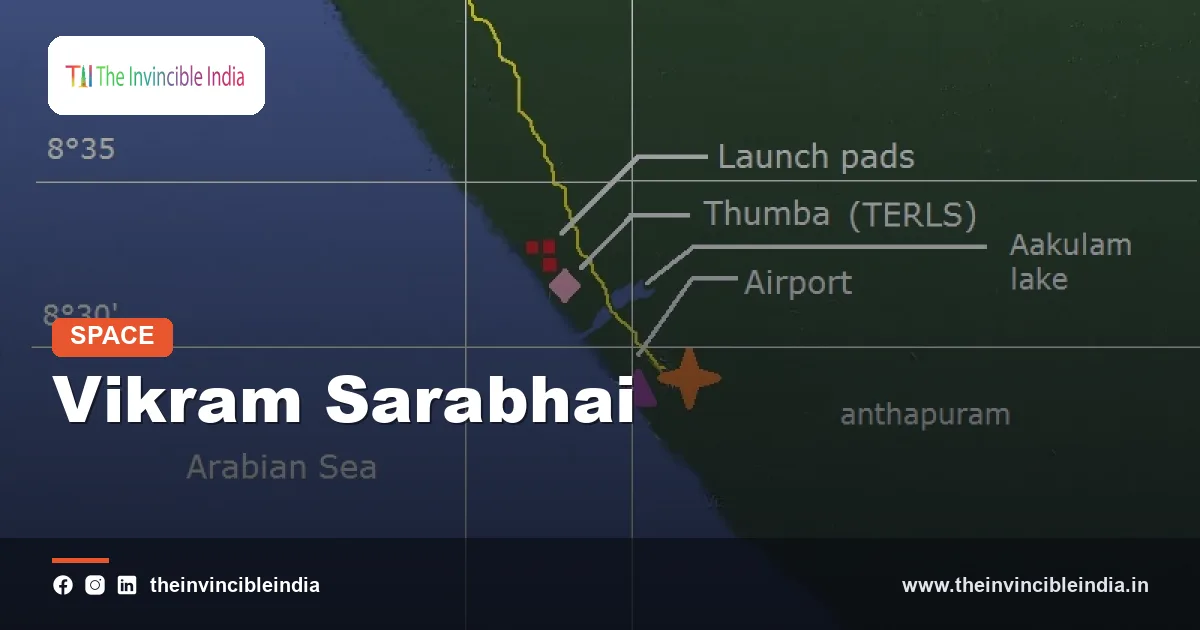
The magnetic equator passes close to the southern tip of India, near Thumba, a coastal village outside Thiruvananthapuram in Kerala. This made it an ideal site for studying the equatorial electrojet, a current of charged particles in the upper atmosphere. After surveys of possible sites, Sarabhai and his colleagues chose Thumba for the Thumba Equatorial Rocket Launching Station (TERLS).
The local community and church authorities helped make the site available. The church of St Mary Magdalene, a short distance from the beach, served as the first office and a workshop, and the bishop’s house became a laboratory. Local fishing families moved to new accommodation, a gesture still remembered by space historians.
21 November 1963
On 21 November 1963, a Nike-Apache sounding rocket, obtained from NASA, lifted off from Thumba carrying a sodium-vapour payload to study the upper atmosphere. It was India’s first rocket launch. Photographs of components being carried on a bicycle and a bullock cart have become icons of the frugal beginnings of the programme.
In 1968 the station was dedicated to the United Nations, and it became a facility for international scientific collaboration. Rocket flights from Thumba also included Russian and French sounding rockets, and Indian-built Rohini rockets soon followed.
The Founding of ISRO in 1969
By the end of the 1960s, the space effort had outgrown its structure under the Department of Atomic Energy. Sarabhai proposed a distinct organisation with greater autonomy, and on 15 August 1969 the Indian Space Research Organisation was established, replacing INCOSPAR. It operated initially under the Department of Atomic Energy, and after Sarabhai’s death the government created the Space Commission and the Department of Space in 1972, with ISRO placed under the new department.
Setting Up the Infrastructure
- The Thumba facility grew into a larger space research centre, now named the Vikram Sarabhai Space Centre.
- The Space Science and Technology Centre and the Experimental Satellite Communication Earth Station in Ahmedabad were created, forming the nucleus of what became the Space Applications Centre.
- A larger launch range was identified at Sriharikota, which later became the country’s main spaceport.
- Plans for India’s first satellite, later named Aryabhata, were put in motion.
Aryabhata was launched in April 1975 on a Soviet rocket, a few years after Sarabhai’s death, and fulfilled his plan for an indigenous satellite.
Space for National Development
The distinctive feature of Sarabhai’s approach was its purpose. Many nations of the time saw space primarily as a field of competition. Sarabhai argued that India should not aim to compete with advanced countries in lunar or planetary exploration at that stage. Instead, he said, the country should apply advanced technology to the problems of ordinary people, including communication, education, weather forecasting, agriculture and natural resource management.
Applications He Championed
- Satellite broadcasting: Reaching remote villages with educational and developmental programmes.
- Meteorology: Better forecasts of cyclones and monsoons.
- Remote sensing: Mapping crops, forests, water and minerals.
- Telecommunications: Linking distant parts of a vast country.
This philosophy has remained a guiding thread in the Indian programme. Even as ISRO took on lunar and Mars missions, it continued to underline the societal uses of space.
Education Through Satellite: The SITE Experiment
One of Sarabhai’s most cherished ideas was using a satellite to broadcast educational television directly to villages. He worked with NASA to plan an experiment that would test this concept at scale. Although he did not live to see it, the Satellite Instructional Television Experiment (SITE) began in 1975 and ran for about a year.
Using a NASA satellite, ATS-6, positioned over the Indian Ocean region, SITE broadcast programmes on health, agriculture, family planning and education to several thousand villages across a number of states. Simple community television sets and dish antennas were installed in villages, and programmes were produced by All India Radio and Doordarshan staff with support from the space agency.
What SITE Achieved
- It demonstrated that satellite television could reach remote communities.
- It trained Indian engineers in satellite communication and ground-segment operations.
- It laid the groundwork for the INSAT series of communication satellites in the 1980s.
- It influenced later distance-education and telemedicine programmes.
Institution Builder Beyond Space
Sarabhai’s energy was extraordinary, and he founded or helped found a long list of institutions in different fields. Many of them survive and thrive today.
| Institution | Focus | Remark |
|---|---|---|
| Physical Research Laboratory | Space and atmospheric science | Founded in 1947 |
| ATIRA (Ahmedabad Textile Industry’s Research Association) | Textile research | Set up in 1947 to help the local mill industry |
| Indian Institute of Management, Ahmedabad | Management education | Established in 1961 with support from the state and industry |
| Operations Research Group | Market and operations research | Early consultancy in India |
| Darpana Academy | Performing arts | Co-founded with Mrinalini Sarabhai |
| Community Science Centre | Science popularisation | Founded in Ahmedabad |
| Electronics Corporation of India Limited | Electronics manufacture | Based in Hyderabad, linked to atomic energy programme |
He also played a role in the development of industries such as pharmaceuticals and in the early years of the Atomic Energy programme. After Homi Bhabha’s death in a plane accident in 1966, Sarabhai was appointed chairman of the Atomic Energy Commission, balancing this responsibility with his space work.
The Final Years and Death
In the last years of his life, Sarabhai balanced a heavy workload: leading the Atomic Energy Commission, guiding ISRO’s expansion, advising on industrial and educational policy and travelling widely. He pressed ahead with plans for a satellite programme and for launch vehicles, and he encouraged young scientists to take bold decisions.
On 30 December 1971, while in Thiruvananthapuram to review preparations for a Soviet-assisted rocket launch from Thumba, he died suddenly at Kovalam. He was only 52. His death was a shock for the scientific community and for the nation. Prime Minister Indira Gandhi and many colleagues paid tribute to his contribution, and the Thumba facility was renamed the Vikram Sarabhai Space Centre in his memory.
Honours
- Padma Bhushan in 1966.
- Padma Vibhushan, conferred posthumously in 1972.
- A lunar crater, Sarabhai, named after him by the International Astronomical Union.
Legacy: A Space Agency Built on His Ideas
The Indian space programme has grown enormously since 1971, but its direction still reflects Sarabhai’s thinking. ISRO continues to develop communication, navigation and Earth-observation satellites that support farmers, fishermen, disaster managers and planners. Its lunar and Mars missions, Chandrayaan and Mangalyaan, are among the most cost-efficient in the world, in keeping with his belief in affordability and purpose.
Where His Name Lives On
- The Vikram Sarabhai Space Centre in Thiruvananthapuram, ISRO’s lead centre for launch vehicles.
- The lander of Chandrayaan-2, named Vikram in his honour.
- The Vikram Sarabhai Community Science Centre and other academic programmes.
- Annual lectures, fellowships and awards named for him.
His centenary in 2019 was marked by events across the country, including special exhibitions and educational programmes for schools.
Conclusion
Vikram Sarabhai combined scientific ability with a gift for institution-building and a clear sense of social purpose. He understood that a poor but ambitious nation could use cutting-edge technology to improve everyday life, and he created the structures to do so. Every Indian satellite launch, from small experiments to interplanetary missions, rests on the foundation laid by him and his colleagues, last reviewed in 2 October 2026.
Frequently Asked Questions
Why is Vikram Sarabhai called the father of the Indian space programme?
He founded the Physical Research Laboratory, convinced the government to create INCOSPAR in 1962, set up the Thumba rocket launching station and led the creation of ISRO in 1969. His vision gave the programme both its structure and its development-oriented purpose.
When was the first rocket launched from Thumba?
The first rocket, a Nike-Apache sounding rocket carrying a sodium-vapour payload, was launched from Thumba on 21 November 1963. It was meant to study the upper atmosphere near the magnetic equator.
What was INCOSPAR?
The Indian National Committee for Space Research was formed in 1962 under the Department of Atomic Energy, with Vikram Sarabhai as chairman. It coordinated early space research and was replaced by ISRO on 15 August 1969.
What was the SITE experiment?
The Satellite Instructional Television Experiment, held in 1975 and 1976, used a NASA satellite to broadcast educational programmes to several thousand villages. It was the realisation of Sarabhai’s idea of using space technology for education and development.
Which other institutions did Sarabhai help establish?
Apart from the Physical Research Laboratory, he helped set up ATIRA, the Indian Institute of Management Ahmedabad, the Darpana Academy, the Community Science Centre and several other organisations in industry, science and the arts.
When and how did Vikram Sarabhai die?
He died suddenly on 30 December 1971 at Kovalam, near Thiruvananthapuram, at the age of 52. He had gone there to review preparations for a rocket launch at Thumba. The Thumba space centre was later named after him.


