


Vishu marks the astronomical new year in the Malayalam calendar and is celebrated in Kerala as a day of fresh beginnings, much like Makar Sankranti, which similarly marks a solar transition elsewhere in India. The festival is best known for the Vishukkani, an auspicious first sight arranged the night before and viewed upon waking, believed to set the tone for the year ahead. Families gather for a festive meal, exchange gifts, and mark the day with prayer and celebration. This guide explores the meaning, rituals and regional character of Vishu.
Quick Facts
| Detail | Information |
|---|---|
| Also Known As | Malayalam New Year, Vishu Sankranti |
| Marks | Astronomical new year in the Malayalam calendar |
| Type of Observance | Regional cultural and New Year festival |
| General Timing | Mid-April (first day of Medam) |
| Key Practices | Vishukkani viewing, Vishu Sadya feast, kaineettam |
| Region of Prominence | Kerala and Malayali communities worldwide |
Meaning and Significance
Vishu marks the astronomical new year according to the traditional Malayalam solar calendar, celebrated primarily in Kerala as a day of renewal, prosperity and fresh beginnings. The festival is closely tied to the belief that the first sight one views upon waking on this day shapes the fortune of the year to come.
This emphasis on auspicious beginnings gives Vishu a distinctly forward-looking character, focused less on commemorating a past event and more on setting a positive tone for the year ahead. Families take particular care in preparing for the day’s central ritual, reflecting the importance placed on this first, carefully arranged sight.
Position in the Malayalam Calendar
Vishu falls on the first day of the Malayalam month of Medam, marking the sun’s transition into the zodiac sign of Aries according to traditional solar reckoning, and generally corresponds to mid-April in the Gregorian calendar. Because it follows a solar rather than lunar calendar, its Gregorian date remains relatively consistent from year to year.
This solar positioning aligns Vishu with other regional new year festivals observed around the same time across India, each following a similar astronomical transition but marked through distinct local customs, reflecting a broader shared pattern of solar new year observance across several Indian regions.
The Vishukkani: Auspicious First Sight
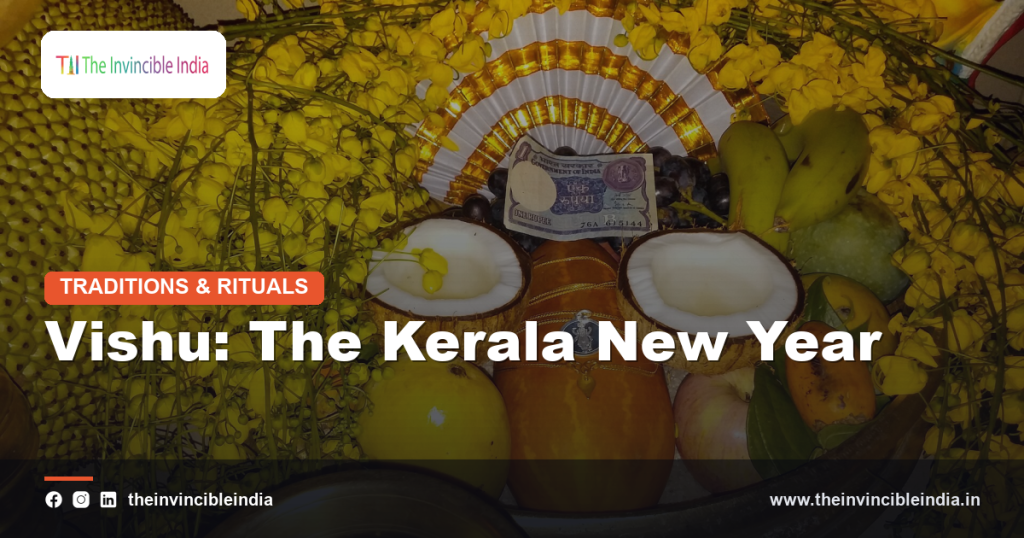
The Vishukkani, meaning “the first sight of Vishu”, is the central ritual of the festival, involving a carefully arranged display of auspicious items that family members view immediately upon waking on the morning of Vishu. The arrangement typically includes items associated with prosperity and abundance, viewed by tradition as capable of influencing the fortunes of the coming year.
Care is taken to ensure that the Vishukkani is the very first thing seen upon waking, often with a family elder guiding younger members to the arrangement with eyes closed. This carefully staged ritual moment is considered the most significant part of the day’s observance.
Preparing the Vishukkani
The Vishukkani arrangement is prepared the night before Vishu, typically placed in the household’s prayer room or a designated corner of the home, and includes items such as rice, fresh fruits and vegetables, flowers, a mirror, a lit lamp and an image of a deity, most commonly Krishna in Kerala tradition. Golden-hued items, particularly the konna flower, are especially favoured for their association with prosperity.
Family members, particularly the household’s senior woman, generally take responsibility for arranging the display with care, reflecting the importance placed on getting every element of the auspicious first sight exactly right for the year ahead.
Vishu Kaineettam (Gifts of Money)
Following the viewing of the Vishukkani, elders in the family traditionally give kaineettam, small gifts of money, to younger family members as a token of blessing and good fortune for the year ahead. This custom is broadly similar in spirit to money-gifting traditions observed during other Indian festivals, adapted here to Vishu’s specific context.
Kaineettam is often given alongside a spoken blessing, and children in particular look forward to this part of the celebration. The practice reinforces intergenerational bonds within the family, translating the day’s broader themes of prosperity into a direct and personal household gesture.
Vishu Sadya: The Festival Feast
A festive vegetarian meal known as Vishu Sadya is prepared and shared among family on the day, typically served on a banana leaf and featuring a wide variety of traditional Kerala dishes, similar in style to feasts prepared for other major Kerala festivals. The meal is considered an important part of the day’s celebration, bringing family members together around a shared table.
Preparation of the Sadya often begins early in the day, involving considerable effort from household members, and the meal’s variety and abundance are themselves seen as symbolic of the prosperity the festival hopes to invite for the year ahead.
Fireworks and Vishu Vedi
Fireworks, known locally as Vishu Vedi, are traditionally set off on the eve and morning of Vishu, adding a festive and celebratory dimension to the observance. This practice, while not central to the festival’s ritual meaning in the way the Vishukkani is, has become a popular and widely recognised feature of Vishu celebrations in Kerala.
Households, particularly those with children, often look forward to this part of the celebration as a joyful counterpart to the more contemplative morning ritual, illustrating how the festival combines quiet ritual observance with lively, communal festivity over the course of the day.
Temple Worship and Rituals
Temples across Kerala, particularly those dedicated to Krishna, hold special prayers and rituals on Vishu, with many devotees visiting to view a large-scale Vishukkani arranged at the temple itself, considered especially auspicious. The Guruvayur temple is particularly well known for its elaborate Vishukkani display and the large crowds it draws on this day.
Temple visits on Vishu often take place early in the morning, allowing devotees to combine the auspicious first sight of the temple’s arrangement with formal worship, reflecting the day’s blending of domestic ritual and public devotional practice within a single occasion.
Agricultural Associations
Vishu has traditional associations with the agricultural calendar in Kerala, marking a period connected to the harvest season and the beginning of preparations for the next cycle of cultivation. Its placement at this particular point in the solar year links the festival to broader seasonal rhythms observed across the region’s farming communities.
This agricultural dimension situates Vishu among a number of Indian festivals whose timing and themes are closely connected to seasonal and farming cycles, reflecting a broader pattern in which religious and cultural observance is intertwined with the practical realities of agrarian life.
Regional Variations Within Kerala
While the core elements of Vishu, the Vishukkani, kaineettam and the festive Sadya, are broadly consistent across Kerala, specific customs and the exact composition of the Vishukkani arrangement can vary somewhat between regions and communities within the state. Certain temples and localities are known for particularly elaborate versions of the festival’s rituals.
These regional variations reflect the broader diversity found within Kerala’s cultural landscape, in which shared festival themes are adapted to local custom, much as similar variation appears across other major festivals celebrated throughout the wider Indian subcontinent.
Vishu in Tulu Nadu and Karnataka
Vishu, or closely related solar new year observances, is also marked by some communities in Tulu Nadu and other neighbouring regions of Karnataka that share cultural and historical ties with Kerala, reflecting the broader diffusion of this solar new year tradition beyond Kerala’s own state boundaries.
These neighbouring observances typically share core elements with Kerala’s Vishu, including an emphasis on an auspicious first sight and a festive family meal, while incorporating their own regional variations, illustrating how shared calendrical traditions extend and adapt across culturally connected regions.
Family Traditions and Gatherings
Vishu is fundamentally a family-centred festival, with the day’s rituals, from the arrangement of the Vishukkani to the giving of kaineettam and the preparation of the Sadya, all built around collective family participation. Extended family members often travel to gather together for the occasion, reinforcing its role as an occasion for family reunion.
This emphasis on family gathering situates Vishu alongside numerous other Indian festivals in which domestic ritual and family togetherness form the emotional core of the celebration, even as public and temple-based elements of the festival also play a meaningful role.
Comparisons with Other Regional New Year Festivals
Vishu shares its general timing and spirit with several other regional new year festivals observed around mid-April across India, including Poila Boishakh in Bengal and similar observances in other states, each marking a solar transition according to its own local calendar. These festivals share themes of renewal, festive food and family gathering, even as specific rituals differ considerably.
This broader pattern highlights the rich diversity of India’s regional calendrical traditions, in which the marking of a new year is expressed through numerous distinct cultural lenses rather than a single unified national observance, each carrying its own historical and regional character.
Vishu Among the Malayali Diaspora
Malayali communities living outside Kerala, including significant diaspora populations in other parts of India and abroad, continue to observe Vishu through community gatherings, cultural programs and festive meals organised by local Malayali associations. These celebrations help maintain a connection to Kerala’s cultural traditions among communities living at a distance from their region of origin.
Such diaspora observances often adapt practical details, such as timing gatherings around a nearby weekend, while preserving the core elements of the Vishukkani, festive food and family gathering that define the festival’s celebration back home in Kerala.
Cultural and Artistic Elements
Vishu is accompanied by various cultural expressions in Kerala, including traditional songs and performances associated with the festival season, as well as decorative practices such as the use of the golden konna flower, which blooms conveniently around this time of year and has become closely associated with the festival’s visual identity.
These cultural and artistic elements reinforce the festival’s broader themes of renewal and prosperity, contributing to a distinct seasonal atmosphere in Kerala each year that extends beyond the specific rituals of the Vishukkani into the wider visual and cultural life of the state during this period.
Public Celebrations and Tourism
In recent years, Vishu has also become an occasion for public celebration and cultural tourism in Kerala, with the state’s tourism department and cultural organisations organising events, exhibitions and performances timed to coincide with the festival period. These initiatives aim to showcase Kerala’s traditions to a wider audience, including visitors from other parts of India and abroad.
Such public celebrations exist alongside, rather than in place of, the festival’s core household rituals, adding a further layer of visibility to Vishu beyond its traditional domestic setting. This growing public dimension reflects a broader pattern seen across many Indian regional festivals, in which local cultural tourism increasingly complements long-standing private and community observance.
Vishu Today
In contemporary Kerala, Vishu continues to be celebrated with its traditional core intact, from the careful arrangement of the Vishukkani to the shared Sadya feast and the giving of kaineettam, even as some households adapt certain practical details to modern urban life. Cultural programs and temple celebrations continue to draw large public participation each year.
The continued observance of Vishu, blending domestic ritual with public celebration, reflects the enduring appeal of its central idea, that a carefully chosen first sight and a day spent in family togetherness can set a positive tone for the year to come.
Sources & Further Reading
- Ministry of Culture, Government of India (indiaculture.gov.in).
- Sangeet Natak Akademi (sangeetnatak.gov.in).
Frequently Asked Questions
What is Vishu?
Vishu is the Malayalam New Year, celebrated in Kerala as a day of renewal centred on the Vishukkani, an auspicious first sight viewed upon waking.
What is included in the Vishukkani?
The Vishukkani typically includes rice, fruits, vegetables, flowers, a mirror, a lit lamp and an image of a deity, arranged the night before Vishu.
What is kaineettam?
Kaineettam refers to small gifts of money given by elders to younger family members on Vishu as a token of blessing for the year ahead.
What is Vishu Sadya?
Vishu Sadya is a festive vegetarian meal served on a banana leaf, featuring a variety of traditional Kerala dishes shared among family on the day.
When is Vishu celebrated?
Vishu falls on the first day of the Malayalam month of Medam, generally in mid-April, marking the sun’s transition into Aries in the traditional solar calendar.