

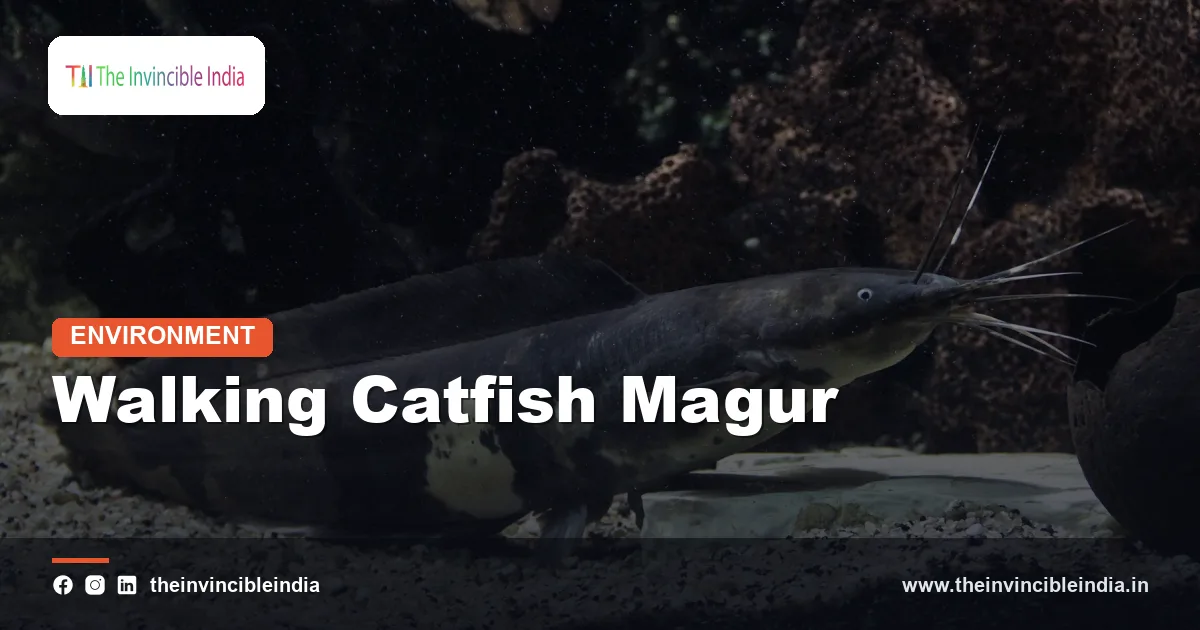
The walking catfish (Clarias batrachus), known as magur in Hindi, Bengali and Assamese, is a hardy, air-breathing freshwater catfish of South and Southeast Asia that can survive in oxygen-poor water and even wriggle across wet land from one pond to another. It is native to India’s ponds, swamps, paddy fields and slow rivers, and it is one of the most valued freshwater food fishes of eastern and north-eastern India.
The name “walking” is slightly misleading, because the fish does not truly walk. Instead, it twists its snake-like body and pushes with its stiff pectoral spines, a movement that carries it short distances on land, especially after rain. This explainer covers how the walking catfish looks, breathes and feeds, where it lives, how it is bred and farmed, and why it matters to Indian diets and livelihoods.
Quick Facts: Walking Catfish at a Glance
| Scientific name | Clarias batrachus (the Indian form is treated by some authors as Clarias magur) |
|---|---|
| Common names | Walking catfish, magur (Hindi, Bengali, Assamese), mangur |
| Family | Clariidae (airbreathing catfishes) |
| Typical size | Commonly 20 to 40 cm and a few hundred grams; large fish can approach 50 cm and weigh around a kilogram |
| Habitat and range in India | Ponds, swamps, ditches, paddy fields, beels and slow-moving rivers, especially in eastern, north-eastern and southern India |
| Diet | Omnivore and scavenger: insects, worms, snails, small fish, detritus and plant matter |
| Breeding | Breeds in the monsoon in shallow, weedy waters; hatcheries use induced breeding with hormones |
| Economic importance | High-priced food and health-food fish; widely cultured in small ponds and tanks |
| Status | Widely farmed; wild populations of the Indian form have declined in places due to habitat loss and overfishing |
Key Takeaways
- The walking catfish (Clarias batrachus) is an air-breathing catfish that can gulp air at the surface and survive in stagnant, oxygen-poor water.
- Magur is the Indian name of the walking catfish, and the fish is popular in West Bengal, Assam, Bihar, Odisha and other states, where it is believed to be a nourishing food for people recovering from illness.
- The walking catfish moves overland by wriggling its elongated body and using its stiff pectoral spines, usually on wet nights after rain.
- Walking catfish can be cultured at high densities in small ponds and tanks because of their ability to breathe air.
- The African catfish (Clarias gariepinus), a related fish sometimes called “Thai magur”, is banned for culture in India because it can harm native fish.
- The pectoral and dorsal spines of the walking catfish can cause painful stings, so the fish must be handled with care.
What does the walking catfish look like?
The walking catfish has an elongated, eel-like body with a flattened head, a wide mouth, four pairs of whisker-like barbels and long dorsal and anal fins that run most of the length of the body. The skin is smooth and scaleless, with a dark olive, grey-brown or blackish colour and often small whitish spots along the sides.
The eyes are small, and the barbels help the fish locate food in muddy or dark water. Each pectoral fin carries a strong, serrated spine that can be locked in place and used for defence. These spines are also used for propping the body when the fish moves on land.
The fish is mostly active at night. It hides during the day under vegetation, in burrows in the mud or among roots and debris, and emerges to forage after dusk.
How does the walking catfish breathe air?
The walking catfish breathes air through a special organ above its gills called the suprabranchial or arborescent organ, a branched, tree-like structure with a rich blood supply that works like a simple lung. The fish rises to the surface, gulps air into the chamber and absorbs oxygen directly into its blood.
This ability lets the walking catfish live in places that would suffocate most other fish, such as shrinking ponds, muddy ditches, waterlogged fields and stagnant pools with very little dissolved oxygen. It still uses its gills for part of its breathing, but air-breathing becomes essential when water quality drops.
The same adaptation allows the fish to survive out of water for hours as long as its skin and gills stay moist. It is also why traders in India can carry live magur in small containers with little water, and why markets often sell them alive.
- Gills: used for normal breathing in well-oxygenated water.
- Air-breathing organ: used when oxygen is low or when the fish is out of water.
- Moist skin: helps the fish survive short land journeys.
Can the walking catfish really walk on land?
Yes, the walking catfish can travel short distances over land, but it does so by wriggling its body from side to side and pushing against the ground with its pectoral spines rather than by walking on legs. This behaviour is most common on wet nights, especially during the monsoon.
The movement helps the fish move between ponds, ditches and flooded fields when one water body dries up or becomes crowded. It can cover tens of metres in a night when the ground is damp. On dry, hot surfaces the fish does not travel far, because its skin dries out.
This behaviour explains how magur can appear in newly formed ponds and paddy fields and why they escape from poorly fenced culture ponds. In countries where the species has been introduced, such as the United States, this ability has helped it spread, and it is considered an invasive species there. In India, where it is native, it is part of the normal aquatic ecosystem.
Where is the walking catfish found in India?
The walking catfish is found in ponds, swamps, marshes, canals, paddy fields and slow rivers across much of India, with strongest populations and demand in the eastern and north-eastern regions. The floodplain wetlands of Assam, called beels, and the village ponds of West Bengal, Bihar and Odisha are classic habitats.
It also occurs in southern states and in other low-lying areas where seasonal waters form. The fish prefers shallow, weedy, muddy water with a soft bottom, and it tolerates temperature swings, low oxygen and moderate pollution better than most other freshwater fishes.
Elsewhere, the species is native to Bangladesh, Sri Lanka, Myanmar, Thailand and other countries of South and Southeast Asia. Related air-breathing catfishes also occur in India, including the singhi or stinging catfish (Heteropneustes fossilis), which shares a similar habitat and market role.
What does the walking catfish eat?
The walking catfish eats almost anything it can swallow, including insects, worms, snails, tadpoles, small fish, decaying matter and plant material. It is an opportunistic omnivore and scavenger, feeding mainly at night.
The wide mouth and the sensitive barbels allow it to sweep the pond bottom and grab prey. In farms, it accepts a variety of feeds, including fish meal, oil cakes, rice bran and commercial pellets with a high protein content. Because the fish is a hardy feeder, farmers can use locally available feed ingredients.
Its eating habits make it both an efficient scavenger and, in some settings, a predator of young fish. In mixed ponds, magur can prey on small fish, so farmers usually raise them separately or with carefully chosen companions.
How does the walking catfish breed?
The walking catfish breeds during the monsoon, when rain fills shallow ponds and flooded fields, and the pair lay eggs in a shallow nest or depression in the mud or among aquatic plants. The male and female may excavate a hollow in the bank, and the parents often guard the eggs and young.
Eggs hatch in about a day under warm conditions, and the larvae soon begin to feed. Growth is steady, and many fish reach maturity within about a year.
Induced breeding in hatcheries
Natural breeding was long the only source of seed, but Indian scientists later developed induced breeding. Hatcheries select healthy brood fish, inject them with hormone preparations and strip or allow them to spawn in controlled tanks. The eggs are then fertilised and hatched in trays or tanks, and the larvae are reared into fingerlings for farmers.
This process makes year-round or extended-season seed supply possible and reduces pressure on wild stocks. Some farmers also use selected strains to obtain faster growth.
How is the walking catfish farmed in India?
The walking catfish is farmed in small ponds, tanks, cement cisterns and even household pits, using high stocking densities made possible by its air-breathing ability. It is popular among small and marginal farmers in eastern and north-eastern India.
Typical practices include the following:
- Preparing the pond by drying, liming and filling it with water to a modest depth.
- Stocking fingerlings at a density that matches the pond size and the farmer’s management ability.
- Feeding with protein-rich supplementary feed once or twice a day.
- Covering or fencing the pond edge, because the fish tries to escape on wet nights.
- Harvesting after about six to nine months, when most fish reach market size.
The price per kilogram of magur is usually higher than that of common carps, which makes the crop attractive for small farmers. Returns, however, depend on seed quality, feed cost and disease management. Because the fish is resilient, mortality in good conditions is relatively low, but poor water and overcrowding can still cause stress and infections.
| Aspect | Walking catfish (magur) | Indian major carps (rohu, catla, mrigal) |
|---|---|---|
| Breathing | Gills plus air-breathing organ | Gills only |
| Typical pond type | Small, shallow, even low-oxygen ponds | Larger, well-aerated ponds |
| Stocking density | Can be high | Moderate |
| Feed | Protein-rich, omnivorous | Mix of natural food and supplementary feed |
| Market price | Generally higher | Generally lower |
Why is magur popular as food and tonic?
Magur is popular as food because its flesh is tender, relatively free of fine bones and considered nourishing, and in many households it is traditionally given to the sick, the elderly, new mothers and convalescents. The belief that magur strengthens the body is widespread, though people should rely on a doctor for medical advice.
The fish is cooked in light curries with ginger, turmeric and garlic, in mustard-based gravies in Bengal and Assam, or fried. In north-eastern cuisine it often features in simple, aromatic stews. It is sold alive in many markets, which buyers prefer as a sign of freshness.
Nutritionally, catfish provide protein, and magur is a source of minerals and fats. Claims that magur has special healing properties are not backed by strong scientific evidence, but its cultural reputation keeps demand high and prices steady.
What problems affect the walking catfish?
The walking catfish is affected by habitat loss, overfishing, pollution, pesticide use in paddy fields and competition or hybridisation with introduced catfish. Wetland drainage and conversion of ponds and beels into land for farming or building have shrunk its natural habitat.
Wild stocks of the Indian form have declined in some regions, and conservation assessments have flagged the need for protection of native genetic stocks. Farming helps meet demand, but the escape or release of non-native catfish can threaten wild populations.
The African catfish issue
The African catfish (Clarias gariepinus) grows faster than the native magur and was introduced in some places, popularly known as Thai magur. Indian authorities banned its culture because it can escape into natural waters, prey on native fish and compete with them. Farmers are advised to use only native magur from reputable hatcheries.
Handling and safety
The sharp spines of the walking catfish can cause painful wounds. Handlers should grip the fish carefully behind the head or use gloves and tools, and treat any sting by cleaning the wound and seeking medical advice if swelling or infection develops.
Bottom Line
The walking catfish is a tough, air-breathing native fish that suits small ponds and commands good prices in Indian markets. Its farming can support rural incomes, provided that native stocks are protected and non-native catfish are kept out. Conserving wetlands remains the long-term key to keeping wild magur in Indian waters.
Frequently Asked Questions
What is a walking catfish?
A walking catfish (Clarias batrachus) is an air-breathing freshwater catfish that can move short distances over land by wriggling. In India it is called magur. It lives in ponds, swamps and paddy fields and is a prized food fish.
Can the walking catfish really walk?
The walking catfish does not truly walk, but it can travel over wet ground by twisting its body and pushing with its pectoral spines. It does this mainly on rainy nights to move between water bodies. It cannot go far on hot, dry surfaces.
How does magur breathe out of water?
Magur breathes out of water using an air-breathing organ located above its gills. The organ is a branched, richly supplied chamber that absorbs oxygen from gulped air. The fish survives for hours out of water if its skin stays moist.
Is magur fish good for health?
Magur is a nutritious fish that provides protein and minerals and is traditionally eaten by people recovering from illness. Scientific evidence for special healing powers is limited. As with any food, a balanced diet and medical advice matter more than a single fish.
Why is Thai magur banned in India?
Thai magur, the African catfish (Clarias gariepinus), is banned for culture in India because it can escape into natural waters, prey on native fish and spread disease. It can also interbreed or compete with native catfish. The ban aims to protect native fish and biodiversity.
Can you farm walking catfish in small ponds?
Yes, walking catfish can be farmed in small ponds and tanks because they breathe air and tolerate crowded, low-oxygen water. Farmers must provide protein-rich feed, secure fencing and good seed from hatcheries. Harvest usually takes several months.
{“@context”:”https://schema.org”,”@graph”:[{“@type”:”FAQPage”,”mainEntity”:[{“@type”:”Question”,”name”:”What is a walking catfish?”,”acceptedAnswer”:{“@type”:”Answer”,”text”:”A walking catfish (Clarias batrachus) is an air-breathing freshwater catfish that can move short distances over land by wriggling. In India it is called magur. It lives in ponds, swamps and paddy fields and is a prized food fish.”}},{“@type”:”Question”,”name”:”Can the walking catfish really walk?”,”acceptedAnswer”:{“@type”:”Answer”,”text”:”The walking catfish does not truly walk, but it can travel over wet ground by twisting its body and pushing with its pectoral spines. It does this mainly on rainy nights to move between water bodies. It cannot go far on hot, dry surfaces.”}},{“@type”:”Question”,”name”:”How does magur breathe out of water?”,”acceptedAnswer”:{“@type”:”Answer”,”text”:”Magur breathes out of water using an air-breathing organ located above its gills. The organ is a branched, richly supplied chamber that absorbs oxygen from gulped air. The fish survives for hours out of water if its skin stays moist.”}},{“@type”:”Question”,”name”:”Is magur fish good for health?”,”acceptedAnswer”:{“@type”:”Answer”,”text”:”Magur is a nutritious fish that provides protein and minerals and is traditionally eaten by people recovering from illness. Scientific evidence for special healing powers is limited. As with any food, a balanced diet and medical advice matter more than a single fish.”}},{“@type”:”Question”,”name”:”Why is Thai magur banned in India?”,”acceptedAnswer”:{“@type”:”Answer”,”text”:”Thai magur, the African catfish (Clarias gariepinus), is banned for culture in India because it can escape into natural waters, prey on native fish and spread disease. It can also interbreed or compete with native catfish. The ban aims to protect native fish and biodiversity.”}},{“@type”:”Question”,”name”:”Can you farm walking catfish in small ponds?”,”acceptedAnswer”:{“@type”:”Answer”,”text”:”Yes, walking catfish can be farmed in small ponds and tanks because they breathe air and tolerate crowded, low-oxygen water. Farmers must provide protein-rich feed, secure fencing and good seed from hatcheries. Harvest usually takes several months.”}}]}]}


