

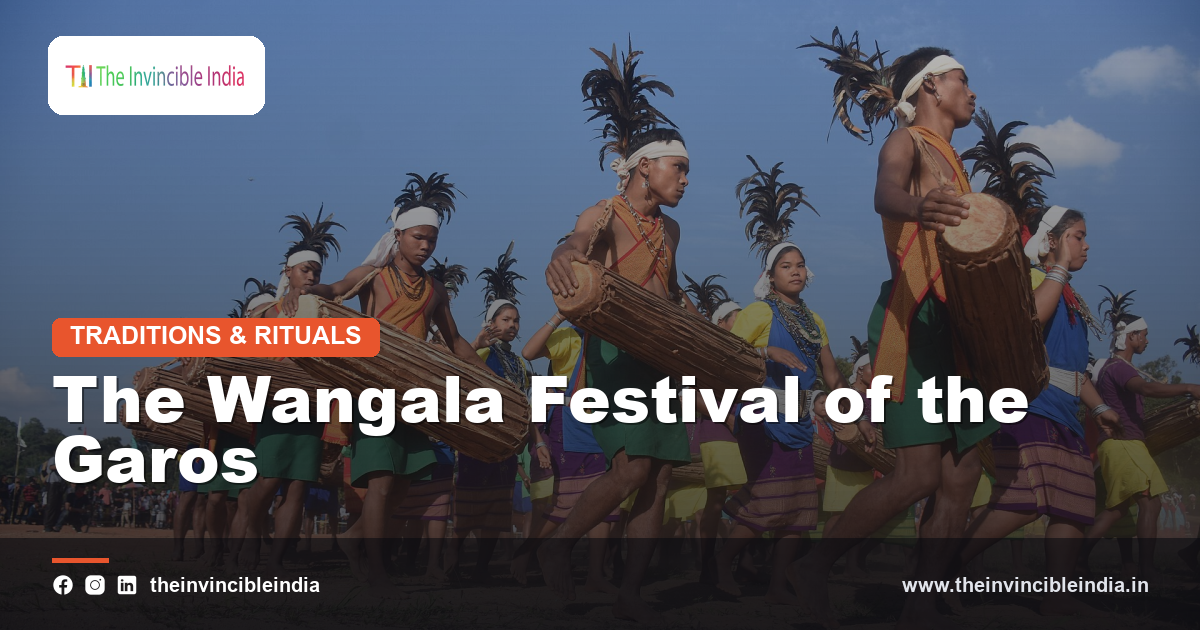
Wangala is a traditional harvest festival of the Garo people of Meghalaya, celebrated in thanksgiving for a successful agricultural season and honouring Saljong, the sun god associated with fertility in traditional Garo belief, a spirit of harvest gratitude shared with Onam’s celebration of abundance in Kerala. The festival is best known for its vibrant drumming and dance performances, brought together on a grand scale during the Hundred Drums Wangala Festival, where performers from across the Garo Hills gather to showcase traditional music and choreography. Communal feasting, traditional attire, and craft traditions associated with drum-making and textiles further enrich the celebration. Though many Garo communities today practise Christianity, Wangala endures as a vital expression of cultural identity and communal gratitude.
Quick Facts
| Detail | Information |
|---|---|
| Festival Type | Garo harvest festival |
| Primary Region | Garo Hills, Meghalaya |
| Presiding Deity | Saljong, the sun god of fertility |
| Season | Post-harvest, generally in autumn |
| Signature Event | Hundred Drums Wangala Festival |
| Associated Practices | Drumming, traditional dance, and community feasting |
Origins Among the Garo People
Wangala is a traditional harvest festival celebrated by the Garo community, one of the prominent tribal groups inhabiting the Garo Hills region of Meghalaya in northeastern India. The festival marks the conclusion of the agricultural year and expresses gratitude for a successful harvest, reflecting the deep connection between Garo cultural life and the region’s agricultural rhythms. Traditionally observed at the household and village level, Wangala has long served as an occasion for communities to give thanks following months of agricultural labour. Its origins are closely tied to the animist and agrarian belief systems historically practised among the Garo people, situating the festival within a broader pattern of harvest celebrations found among agricultural communities across India and beyond.
Saljong: The Sun God of Fertility
Central to the religious meaning of Wangala is Saljong, revered in traditional Garo belief as the sun god associated with fertility and agricultural abundance. The festival is understood as an act of thanksgiving directed toward Saljong for the successful completion of the harvest, reflecting a broader Garo cosmology in which agricultural success was closely linked to the favour of specific deities associated with the natural world. Rituals performed during Wangala traditionally included offerings intended to honour Saljong and to seek continued blessings for future harvests. This deity-centred understanding situates Wangala firmly within the framework of traditional Garo religious belief, even as many Garo communities today practise other faiths, with the festival continuing to be observed primarily as a cultural celebration.
Connection to the Agricultural Cycle
Wangala is timed to coincide with the completion of the harvest season among the Garo community, typically observed in the autumn months following the gathering of crops from the fields. This timing situates the festival at a natural point of transition in the agricultural calendar, when the labour of planting and harvesting has concluded and communities can turn their attention to celebration and communal gathering. The festival’s association with this specific agricultural milestone reflects patterns found in harvest festivals across many farming societies, where the completion of a demanding agricultural cycle is marked by dedicated periods of thanksgiving and celebration. This connection to the land remains a defining characteristic of Wangala’s cultural identity.
The Hundred Drums Wangala Festival
Among the most prominent expressions of the festival is the Hundred Drums Wangala Festival, a large public celebration in which numerous traditional Garo drums, known as dama, are played together by performers from across the Garo Hills. This grand performance, involving coordinated drumming alongside traditional dance, has become one of the most recognisable representations of Garo cultural heritage, drawing performers and spectators from across the region. The event typically features participants from multiple villages, each contributing their own drumming and dance traditions to a unified public celebration. The scale and coordination required for the Hundred Drums Wangala Festival reflect significant organisational effort and cultural pride, positioning the event as a flagship celebration of Garo identity within Meghalaya’s broader festival calendar.
Traditional Drums and Musical Instruments
Music plays a central role in Wangala celebrations, with the dama, a traditional long drum, serving as the primary instrument associated with the festival’s performances. Skilled drummers, often trained from a young age within their communities, perform intricate rhythms that accompany traditional dances during the festival. Other traditional instruments, including wind instruments specific to Garo musical tradition, may also feature in festival performances, adding further texture to the celebration’s musical character. The prominence of these instruments during Wangala reflects the broader importance of music within Garo cultural expression, with festival performances serving as an important occasion for showcasing and preserving traditional musical skills across generations.
Traditional Garo Dance
Dance forms an integral part of Wangala celebrations, performed by groups of men and women in traditional Garo attire, moving in coordinated patterns to the rhythm of drums and other instruments. These dances often depict themes related to agricultural life, community cooperation, and celebration, reflecting the festival’s roots in harvest thanksgiving. Group choreography, requiring practised coordination among performers, is a notable feature of many Wangala dance presentations, particularly during large public events such as the Hundred Drums Wangala Festival. The continued practice and performance of these traditional dances plays an important role in preserving Garo cultural heritage, providing younger generations with direct exposure to movements and traditions passed down through their communities.
Costumes and Traditional Ornaments
Participants in Wangala festivities, particularly dancers and drummers, wear traditional Garo attire that includes distinctive woven garments, headgear, and ornaments specific to the community’s cultural heritage. These costumes often feature vibrant colours and patterns associated with traditional Garo textile craftsmanship, adding visual richness to the festival’s public performances. Ornaments made from natural materials, including beads and feathers, may also form part of traditional festival dress, reflecting historical craft practices within Garo culture. The preparation of these costumes for Wangala performances supports the continuation of traditional textile and craft skills within Garo communities, linking the festival’s visual presentation to broader efforts at cultural preservation.
Community Feasting
As with many harvest festivals, communal feasting forms an important part of Wangala celebrations, with families and villages preparing traditional Garo dishes to mark the occasion. Rice, a staple of the Garo diet and the primary crop associated with the harvest being celebrated, features prominently in festive meals prepared during this period. Sharing food among family, neighbours, and visiting guests is considered an important expression of hospitality and community spirit during Wangala, reinforcing social bonds strengthened through the shared labour of the preceding agricultural season. These communal meals, often accompanying music and dance performances, contribute to the overall atmosphere of gratitude and celebration that characterises the festival.
Social Organisation and Village Participation
Wangala celebrations traditionally involve significant coordination at the village level, with community leaders and elders often playing a role in organising rituals, performances, and communal gatherings associated with the festival. This collective organisation reflects the broader social structure of Garo villages, where community cooperation has historically been important for both agricultural work and cultural celebration. Larger festival events, such as those held at district or state level, require coordination among multiple villages and cultural organisations to bring together performers and resources for a unified celebration. This layered organisational structure, spanning household, village, and regional levels, illustrates the various scales at which Wangala is observed across the Garo Hills.
Wangala Amid Religious Change
While traditional Garo religious belief historically centred on deities such as Saljong, the majority of Garo people today practise Christianity, a significant shift that has occurred over recent generations. Despite this change in religious affiliation, Wangala has largely persisted as an important cultural celebration, retaining its traditional dances, music, and communal feasting even as its specifically religious dimensions have become less central for many contemporary participants. This adaptation reflects a broader pattern in which cultural festivals can continue to hold significance as expressions of ethnic and community identity, even as the specific religious beliefs that originally shaped them evolve over time within a community’s history.
Cultural Role Within Meghalaya
Wangala holds an important place within the broader cultural landscape of Meghalaya, representing one of the state’s most significant tribal festivals alongside celebrations observed by other communities such as the Khasi and Jaintia. The festival’s prominence has contributed to wider recognition of Garo cultural heritage within Meghalaya and across northeastern India more broadly. State cultural bodies and tourism authorities often highlight Wangala, and particularly the Hundred Drums Wangala Festival, as a signature representation of the region’s diverse tribal traditions. This cultural prominence has helped position Wangala as an important symbol of Garo identity within the wider mosaic of Meghalaya’s multicultural society.
Tourism and Public Promotion
In recent years, Wangala, particularly its large-scale Hundred Drums celebration, has attracted growing interest from visitors and cultural tourists seeking to experience Northeast Indian tribal traditions firsthand. State tourism promotion has increasingly highlighted the festival’s vibrant drumming, dance, and traditional costume as key attractions, encouraging domestic and international visitors to attend. This growing public interest has brought increased visibility to Garo culture beyond Meghalaya, contributing to broader awareness of the region’s diverse tribal heritage. While tourism has added a new dimension to the festival’s public profile, the core celebration retains its meaning as a community-centred expression of gratitude and cultural continuity among the Garo people.
Youth Engagement and Cultural Continuity
Wangala plays a significant role in engaging younger generations of Garo people with their traditional culture, particularly through participation in drumming and dance performances that require sustained practice and mentorship from experienced community members. Schools and cultural organisations within the Garo Hills often support youth involvement in preparing for Wangala celebrations, helping ensure the transmission of traditional skills and knowledge. This active participation of young people helps sustain the festival’s traditions for future generations, even as broader social and economic changes continue to reshape daily life within Garo communities. Such youth engagement reflects the wider importance placed on cultural continuity through active participation rather than passive observance alone.
Crafts and Artisan Traditions
Wangala celebrations support various traditional craft practices among the Garo community, including the making of drums, traditional textiles, and ornaments used during festival performances. Artisans skilled in these crafts often see increased demand for their work in the period leading up to major Wangala celebrations, sustaining traditional livelihoods tied to the festival’s cultural requirements. This relationship between festival celebration and craft production illustrates how cultural events can play a supporting role in the preservation of traditional skills that might otherwise decline without a sustained occasion for their practical application. The continuation of these craft traditions remains closely linked to the ongoing observance of Wangala each year.
Regional Variations Across the Garo Hills
While the Hundred Drums Wangala Festival represents the most publicised version of the celebration, Wangala is observed with local variation across numerous villages throughout the Garo Hills, each bringing its own customs and scale to the occasion. Smaller village-level celebrations may focus more closely on family and community gatherings, traditional dance, and feasting, without the large coordinated performances seen at major public events. This regional diversity reflects the broader pattern common to many Indian festivals, in which a shared cultural tradition accommodates significant local variation in practice and emphasis. Understanding this diversity provides a fuller picture of how Wangala is experienced across the varied communities of the Garo Hills.
Wangala Today
Today, Wangala continues to be celebrated across the Garo Hills of Meghalaya, with the Hundred Drums Wangala Festival serving as its most prominent and widely recognised public expression. The festival retains its core elements of traditional drumming, dance, and communal feasting, even as its religious associations have evolved alongside broader changes within Garo society. Growing tourism interest and cultural promotion have brought increased visibility to the festival in recent years, introducing wider audiences to Garo traditions. Despite these changes, Wangala remains fundamentally an expression of gratitude for the harvest and a celebration of community and cultural identity, continuing to hold deep significance for the Garo people each year.
Sources & Further Reading
- Ministry of Culture, Government of India (indiaculture.gov.in).
- Meghalaya Tourism, Government of Meghalaya (meghalayatourism.in).
Frequently Asked Questions
What is the Wangala festival?
Wangala is a traditional Garo harvest festival celebrated in the Garo Hills of Meghalaya, marked by drumming, dance, and communal feasting in thanksgiving for the harvest.
Who is Saljong?
Saljong is the sun god associated with fertility in traditional Garo belief, honoured during Wangala as part of the festival’s harvest thanksgiving.
What is the Hundred Drums Wangala Festival?
The Hundred Drums Wangala Festival is a large public celebration bringing together drummers and dancers from across the Garo Hills for a coordinated cultural performance.
When is Wangala celebrated?
Wangala is generally celebrated in autumn, following the completion of the harvest season among Garo agricultural communities.
Is Wangala still religious in nature?
While rooted in traditional belief in Saljong, Wangala today is observed mainly as a cultural celebration, as most Garo people now practise Christianity.


