

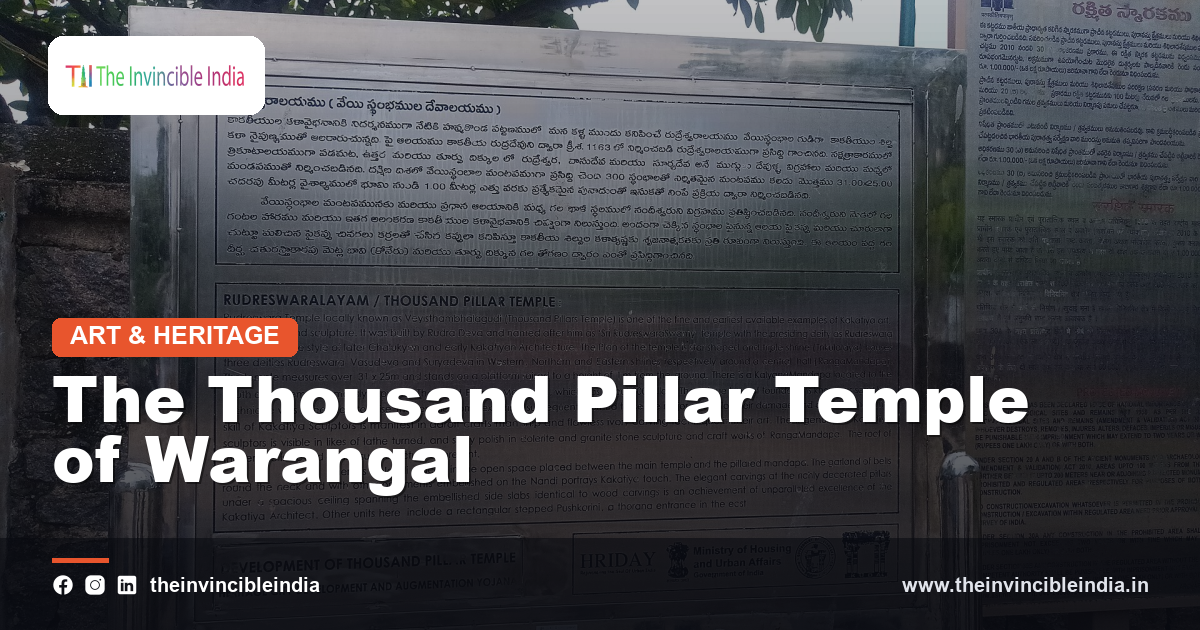
The Thousand Pillar Temple, also known as the Rudreshwara Swamy temple, is a celebrated Kakatiya-era Hindu temple at Hanamkonda in the city of Warangal, in Telangana, in southern India. It is a star-shaped, triple-shrine (trikuta) temple dedicated to three deities, Shiva, Vishnu and Surya, the sun god, and is famous for the fine stone craftsmanship of the Kakatiya dynasty who built it. An inscription records its building in 1163 CE under the Kakatiya ruler Rudradeva, also known as Prataparudra, and the temple is noted for its many carved pillars, its polished black stone and its detached Nandi pavilion, or mandapa, facing the Shiva shrine. Set amid gardens at Hanamkonda, the temple is one of the great monuments of the Kakatiya age and a prime example of the regional style of the Deccan. Part of the wider story told in the guide to Indian temple architecture, this article explains its location, history, plan, craft and living significance.
Quick answer: The Thousand Pillar Temple, or Rudreshwara Swamy temple, is a Kakatiya-era Hindu temple at Hanamkonda in Warangal, Telangana, India. It is a star-shaped, triple-shrine (trikuta) temple dedicated to Shiva, Vishnu and Surya, built by the Kakatiya dynasty; an inscription records its building in 1163 CE under the ruler Rudradeva (Prataparudra). It is famous for its many carved pillars, its polished black stone and its detached Nandi pavilion, and ranks among the great monuments of the Kakatiya age in the Deccan.
Key Takeaways
- The Thousand Pillar Temple (Rudreshwara Swamy temple) stands at Hanamkonda in Warangal, Telangana, southern India.
- It is a star-shaped, triple-shrine (trikuta) temple dedicated to Shiva, Vishnu and Surya.
- It was built by the Kakatiya dynasty; an inscription records its building in 1163 CE.
- It is associated with the Kakatiya ruler Rudradeva, also known as Prataparudra.
- It is famous for its many carved pillars, polished black stone and fine Kakatiya craftsmanship.
- It has a detached Nandi pavilion (mandapa) facing the Shiva shrine.
The sections below explain where the temple stands, how it was built and what a visitor can still see today.
Quick Facts
| Detail | Information |
|---|---|
| Location | Hanamkonda, Warangal, Telangana |
| Also known as | Rudreshwara Swamy temple |
| Dynasty / Period | Kakatiya dynasty; inscription records 1163 CE |
| Dedication | Shiva, Vishnu and Surya (triple shrine) |
| Architectural style | Kakatiya; star-shaped trikuta plan |
| Material | Dressed stone with polished black basalt |
| Key feature | Carved pillars; detached Nandi pavilion |
| Protected status | ASI-protected heritage monument |
| Nearest city | Warangal, Telangana |
What Is the Thousand Pillar Temple of Warangal?
The Thousand Pillar Temple of Warangal is a celebrated Kakatiya-era Hindu temple at Hanamkonda in Telangana, also known as the Rudreshwara Swamy temple and famous for its fine stone craftsmanship. It is a star-shaped, triple-shrine temple, or trikuta, meaning it has three sanctums, dedicated to the deities Shiva, Vishnu and Surya, the sun god, united in a single harmonious design. What distinguishes the temple is the quality of its Kakatiya workmanship, seen in its many carved pillars, its polished black stone and its detached Nandi pavilion facing the Shiva shrine. An inscription records its building in 1163 CE under the Kakatiya ruler Rudradeva, also called Prataparudra, giving the temple a secure place in history. Because its story is known from inscription and scholarship, it can be described with confidence while legend is kept apart. The Thousand Pillar Temple is therefore best understood as both a living shrine and a masterpiece of Kakatiya art in the Deccan.
Where Is the Thousand Pillar Temple Located?
The Thousand Pillar Temple is located at Hanamkonda, a part of the city of Warangal in the state of Telangana, in southern India, in the Deccan region. Warangal was the capital of the Kakatiya dynasty, and the area preserves several of their great monuments, of which the Thousand Pillar Temple at Hanamkonda is among the most celebrated. The temple stands amid gardens in the city, making it an accessible and much-visited site. Warangal is well connected by road and rail to the major cities of Telangana, including the state capital, so the temple lies within easy reach of travellers. The surrounding region is the dry, open country characteristic of much of the Deccan plateau. The location of the Thousand Pillar Temple therefore places it at the heart of the old Kakatiya capital, among the monuments that record the power and artistry of the dynasty, making Hanamkonda an important destination for those exploring the heritage of Telangana and the Deccan.
Who Were the Kakatiyas?
The Kakatiyas were a medieval dynasty that ruled much of the Telugu-speaking country from their capital at Warangal in the Deccan, and who are remembered as great builders and patrons of temples, forts and tanks. Rising to power in the region, they created an important kingdom and left a rich legacy of architecture, including the great fort of Warangal, the temples of Hanamkonda and Palampet, and major works of irrigation. The Kakatiyas are especially celebrated for their distinctive style of temple building, marked by fine carving, polished stone and elegant design, of which the Thousand Pillar Temple is a prime example. Their age was one of cultural achievement in the Deccan before the dynasty fell amid the upheavals of the period. As with many medieval dynasties, details come from inscriptions and scholarship. The Kakatiyas therefore hold an honoured place in Indian history as the builders under whom the Thousand Pillar Temple and other monuments of the Warangal region were raised.
When Was the Temple Built?
The Thousand Pillar Temple was built in the twelfth century, and an inscription records its building in 1163 CE under the Kakatiya ruler Rudradeva, also known as Prataparudra, so that its date is known with unusual security for a temple of its age. This firm dating, resting on an inscription at the site, places the temple in the flourishing period of the Kakatiya dynasty, when Warangal was a centre of power and culture in the Deccan. The building of so fine a temple by a Kakatiya ruler reflects the custom of the age, in which kings expressed their devotion and displayed their power through great works of architecture. The inscription allows the temple to be described with confidence rather than in general terms alone. Its style is fully consistent with the Kakatiya architecture of the period. The building of the Thousand Pillar Temple in 1163 CE therefore marks a secure point in the history of the Kakatiyas and a high achievement of their temple building at Hanamkonda.
Why Is It Called the Thousand Pillar Temple?
The temple is called the Thousand Pillar Temple because of the great number of carved stone pillars that fill its halls, the expression thousand pillars being a traditional way of conveying an abundance of columns rather than an exact count. The many pillars, finely worked in the Kakatiya manner, are among the most striking features of the temple and give it its popular name. They support the halls that lead toward the shrines and create a sense of richness and depth within the building. The craftsmanship of the pillars, like that of the temple as a whole, is admired for its skill and elegance. The name celebrates this profusion of carved columns, which is the temple’s most memorable characteristic for many visitors. The description of the shrine as the Thousand Pillar Temple therefore captures its defining feature, a wealth of beautifully carved pillars that together form one of the great displays of Kakatiya stone craft in the Deccan.
What Is a Trikuta, or Triple-Shrine, Temple?
A trikuta, or triple-shrine, temple is one that has three sanctums, usually arranged so that they open toward a shared central hall, and the Thousand Pillar Temple is a celebrated example of this form. In such a temple, the three shrines allow the worship of more than one deity within a single harmonious building, uniting different forms of devotion in one design. At the Thousand Pillar Temple the three sanctums are dedicated to Shiva, Vishnu and Surya, the sun god, bringing together three great objects of Hindu worship. The star-shaped plan of the temple is well suited to this triple arrangement, giving the building its distinctive and balanced form. The trikuta design is a notable feature of the Kakatiya and related traditions of the Deccan. The triple-shrine, or trikuta, form therefore defines the plan of the Thousand Pillar Temple, uniting the worship of three deities in a single elegant building and marking it as a fine example of this distinctive type of Indian temple.
Which Deities Are Worshipped at the Temple?
The Thousand Pillar Temple is dedicated to three deities, Shiva, Vishnu and Surya, each honoured in one of the three sanctums of its triple-shrine design. Shiva, worshipped here under the name Rudreshwara, which gives the temple its alternative name of Rudreshwara Swamy temple, is central to the shrine, with the detached Nandi pavilion facing his sanctum. Vishnu, the preserver, and Surya, the sun god, are honoured in the other two sanctums, so that three great forms of Hindu worship are united in one temple. This bringing together of Shiva, Vishnu and Surya reflects the inclusive devotional traditions of the age and the wish to honour several deities in a single foundation. The worship of the three deities shapes the religious life of the temple. The dedication of the Thousand Pillar Temple to Shiva, Vishnu and Surya therefore defines its devotional character, uniting three strands of Hindu worship within the harmonious triple-shrine design of this great Kakatiya temple.
What Is Special About the Nandi Pavilion?
The Nandi pavilion, or mandapa, of the Thousand Pillar Temple is a detached hall standing before the Shiva shrine and housing the image of Nandi, the sacred bull who is the mount and devoted attendant of Shiva. In temples of Shiva, Nandi is traditionally placed facing the sanctum, and here the bull is sheltered in its own pavilion, carved from stone in the fine Kakatiya manner. The Nandi of the Thousand Pillar Temple is admired for the quality of its carving and its polished finish, and it forms one of the most notable features of the complex. Its position, facing the shrine of Shiva as Rudreshwara, reflects the traditional arrangement of a Shiva temple. The detached pavilion gives the Nandi a dignified setting of its own. The Nandi pavilion of the Thousand Pillar Temple therefore stands among its treasures, a finely carved expression of the worship of Shiva and of the skill of the Kakatiya craftsmen who made it.
What Materials and Techniques Were Used?
The Thousand Pillar Temple was built of dressed stone, including the hard, dark basalt that the Kakatiya craftsmen worked and polished to a fine, smooth finish, giving the temple its distinctive look. The use of polished black stone is a hallmark of Kakatiya architecture, allowing the pillars, the Nandi and the carved details to be finished with remarkable sharpness and sheen. The stone was quarried, dressed and assembled in the traditional Indian manner, with pillars shaped and set to carry the halls and the shrines raised on a firm base. The star-shaped, triple-shrine plan demanded careful planning so that the three sanctums and the halls formed a balanced whole. These techniques, characteristic of the Kakatiya age, produced a temple of great elegance and durability. The materials and techniques of the Thousand Pillar Temple therefore demonstrate the mastery of the Kakatiya builders, who turned the hard stone of the Deccan into one of the most refined temples of their age at Hanamkonda.
What Are the Main Features of the Temple?
The main features of the Thousand Pillar Temple include its star-shaped plan, its three sanctums dedicated to Shiva, Vishnu and Surya, its many carved pillars and its detached Nandi pavilion, all worked in the fine Kakatiya manner. The star shape gives the building its distinctive outline, while the triple-shrine, or trikuta, arrangement unites the worship of three deities in one harmonious design. The pillared halls, filled with carved columns, lead toward the shrines and give the temple its popular name. The polished black stone, the elegant carving and the Nandi pavilion are among its most admired elements. Together these features make the temple a prime example of Kakatiya art. The main features of the Thousand Pillar Temple therefore unite architectural ingenuity with fine craftsmanship, creating a building whose star-shaped plan, triple shrines, carved pillars and polished stone together express the elegance and devotion of the Kakatiya age in the Deccan.
How Does It Compare With Other Kakatiya Temples?
The Thousand Pillar Temple compares closely with the other great temples of the Kakatiya age, above all the celebrated Ramappa temple at Palampet, with which it shares the fine craftsmanship, polished stone and elegant design of the dynasty. The Kakatiyas built a number of distinguished temples in the Warangal region, and together these form a recognisable regional school marked by star-shaped plans, carved pillars and skilful stonework. Compared with the Ramappa temple, famous for its sculpture and its lightweight tower, the Thousand Pillar Temple is distinguished by its triple-shrine design and its wealth of pillars. Studying them together reveals the shared character and the variety of Kakatiya architecture. Both rank among the finest achievements of temple building in the Deccan. The Thousand Pillar Temple therefore holds an important place among the Kakatiya temples, representing, alongside the Ramappa temple, the elegance and artistry of a dynasty celebrated for its contribution to Indian temple architecture.
How Is the Temple Protected and Preserved?
The Thousand Pillar Temple is protected as a monument of the Archaeological Survey of India, with authorities responsible for documenting, conserving and safeguarding the shrine, its pillars and its Nandi pavilion. The age of the temple, the delicacy of its carving and the effects of time and climate all make conservation an ongoing task, and parts of the temple have required careful restoration over the years. Conservation work aims to stabilise the structures and protect the carved and polished stone without altering their historic character, using methods that respect original materials. The temple remains a living shrine as well as a protected monument, so its care must balance worship and preservation. Because the arrangements and status of a monument can change over time, visitors are advised to consult current information before a visit. The preservation of the Thousand Pillar Temple therefore depends on cooperation between heritage authorities, the local community and respectful visitors who value its place in the Kakatiya heritage of Telangana.
How Can Visitors Experience the Temple?
Visitors can experience the Thousand Pillar Temple by travelling to Hanamkonda in the city of Warangal in Telangana, which is well connected by road and rail to the major cities of the state, including the capital. The cooler, drier months from about October to February are generally the most comfortable for travel, while the Deccan summer is hot. The temple stands amid gardens and is readily accessible, and visitors can admire its star-shaped plan, carved pillars and finely worked Nandi pavilion. As a living shrine, the temple expects modest dress, the removal of footwear where required and respectful behaviour. Combining the visit with the great Warangal fort and the Ramappa temple at Palampet makes for a rich exploration of Kakatiya heritage. A well prepared trip therefore allows visitors to appreciate the elegance and craftsmanship of the Thousand Pillar Temple as one of the finest monuments of the Kakatiya age in the Deccan.
Why Does the Thousand Pillar Temple Matter Today?
The Thousand Pillar Temple matters today as a masterpiece of Kakatiya architecture and as one of the great monuments of the old capital of Warangal in Telangana. Its star-shaped plan, its triple shrines dedicated to Shiva, Vishnu and Surya, its many carved pillars and its finely worked Nandi pavilion preserve the devotion, artistry and ingenuity of the Kakatiya dynasty. Securely dated by inscription to 1163 CE under the ruler Rudradeva, it offers scholars a firm point in the history of the dynasty and a splendid example of its style. For pilgrims it remains a living shrine, and for travellers a beautiful and accessible destination. The temple stands alongside the Warangal fort and the Ramappa temple as part of the Kakatiya legacy. The Thousand Pillar Temple therefore matters as both a historical monument and a living place of worship, deserving of study, conservation and respect in the present day as a treasure of the heritage of the Deccan.
The Thousand Pillar Temple Today
The Thousand Pillar Temple today remains one of the finest monuments of the Kakatiya age, standing amid gardens at Hanamkonda in the city of Warangal in Telangana. Its star-shaped plan, its three shrines dedicated to Shiva, Vishnu and Surya, its wealth of carved pillars and its detached Nandi pavilion, together with its secure dating to 1163 CE under the Kakatiya ruler Rudradeva, continue to draw pilgrims, art historians and travellers exploring the heritage of the Deccan. The temple preserves, in its polished stone and elegant carving, the devotion and artistry of a celebrated dynasty. Continued conservation, respectful visits and scholarly study help ensure that it endures for future generations. For those exploring the monuments of Warangal, including the fort and the Ramappa temple, it makes a rewarding and beautiful destination. The Thousand Pillar Temple thus stands as a lasting witness to the art, faith and ingenuity of the Kakatiyas at their capital in southern India.
Sources & Further Reading
- Archaeological Survey of India (asi.nic.in).
- Department of Tourism, Government of Telangana (tourism.telangana.gov.in).
Frequently Asked Questions
Where is the Thousand Pillar Temple located?
The Thousand Pillar Temple is located at Hanamkonda in the city of Warangal in Telangana, in southern India. Warangal was the capital of the Kakatiya dynasty, and the temple stands amid gardens and is well connected by road and rail.
Who built the Thousand Pillar Temple?
The temple was built by the Kakatiya dynasty, and an inscription records its building in 1163 CE under the ruler Rudradeva, also known as Prataparudra. It is a prime example of the fine Kakatiya style of temple architecture.
Which deities are worshipped at the temple?
The Thousand Pillar Temple is a triple-shrine temple dedicated to three deities: Shiva (worshipped as Rudreshwara), Vishnu and Surya, the sun god. Each is honoured in one of the three sanctums of its star-shaped design.
Why is it called the Thousand Pillar Temple?
It is called the Thousand Pillar Temple because of the great number of carved stone pillars that fill its halls, the phrase conveying an abundance of columns rather than an exact count. The finely worked pillars are among its most striking features.
What is a trikuta temple?
A trikuta, or triple-shrine, temple is one that has three sanctums, usually opening toward a shared hall. The Thousand Pillar Temple is a celebrated example, with its three shrines dedicated to Shiva, Vishnu and Surya.
What is the best time to visit the Thousand Pillar Temple?
The best time to visit is the cooler, drier season from about October to February, as the Deccan summer is hot. The temple is readily accessible at Hanamkonda in Warangal and can be combined with the Warangal fort and the Ramappa temple.


