

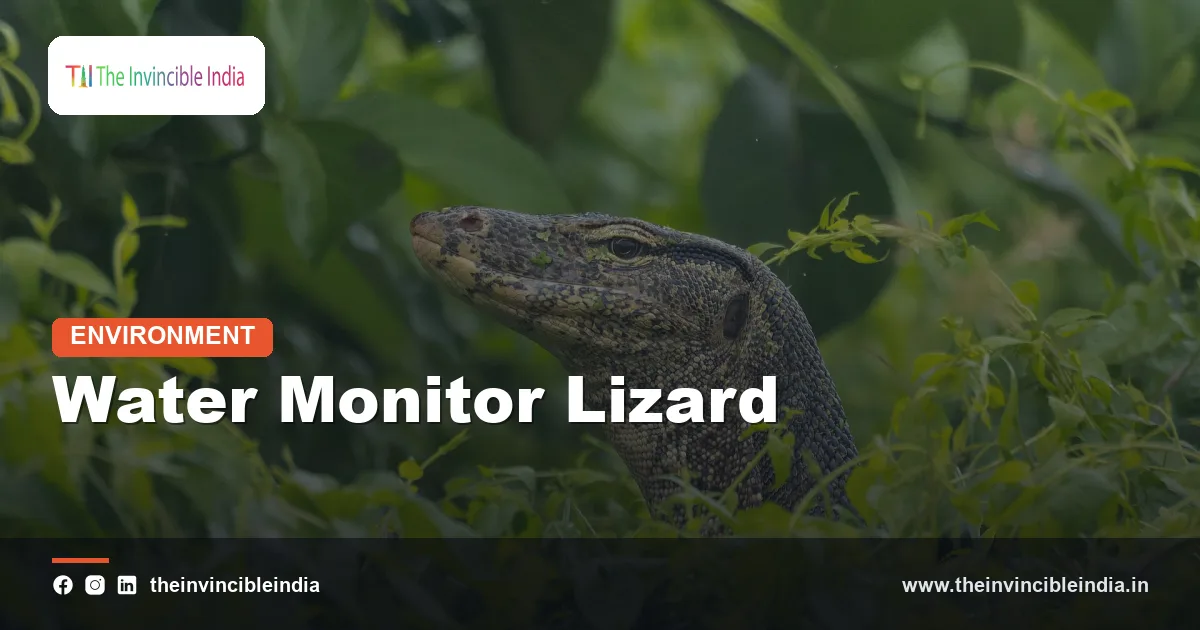
The water monitor (Varanus salvator) is a large, semi-aquatic lizard of the monitor family that lives along rivers, mangroves, marshes and coasts, and it is one of the biggest lizards found in India. It is a strong swimmer with a long, muscular tail, a forked tongue and a powerful sense of smell, and it feeds on fish, crabs, frogs, birds, eggs and carrion.
In India the water monitor is mainly a lizard of the east and the islands, from the Sundarbans and the Odisha coast to north-eastern India and the Andaman and Nicobar Islands. It is a protected wild animal under Indian wildlife law, and it is often confused with the more widespread Bengal monitor.
Quick Facts: Water Monitor
| Common name | Water monitor (also called Asian water monitor) |
|---|---|
| Scientific name | Varanus salvator |
| Family | Varanidae (monitor lizards) |
| Size | Commonly 1.5 to 2.5 metres in total length; large males can approach 3 metres, with the tail making up more than half the length |
| Range in India | Eastern and north-eastern India, including the Sundarbans, coastal Odisha, Assam, and the Andaman and Nicobar Islands |
| Habitat | Mangroves, riverbanks, swamps, wetlands, ponds and coastal forests |
| Diet | Carnivorous: fish, crabs, frogs, snakes, birds, eggs, small mammals and carrion |
| Breeding | Egg-laying; females bury a clutch of roughly 15 to 30 eggs in a nest or a termite mound |
| Status | Least Concern (IUCN); protected under the Wildlife (Protection) Act, 1972; listed in CITES Appendix II |
Key Takeaways
- The water monitor (Varanus salvator) is a large semi-aquatic lizard of the family Varanidae and is among the longest lizards in India.
- The water monitor has a laterally flattened tail that works like a paddle, which makes it a much better swimmer than the Bengal monitor.
- In India the water monitor is found mainly in eastern and north-eastern regions and on the Andaman and Nicobar Islands, often around mangroves and rivers.
- The water monitor is an opportunistic carnivore that eats fish, crabs, frogs, eggs, birds and carrion, and so helps clean up wetland habitats.
- All monitor lizards in India, including the water monitor, are protected by the Wildlife (Protection) Act, 1972, and hunting or trading them is illegal.
- The water monitor is shy and not a threat to people, but it can bite and lash its tail if it is cornered or handled.
What Is the Water Monitor and How Big Does It Grow?
The water monitor is a heavy-bodied lizard of the genus Varanus that spends much of its life in or near water, and it can reach about 2.5 to 3 metres in total length in the largest individuals. Only the Komodo dragon and a few other monitors in the wider region grow bigger, so the water monitor is counted among the giants of the lizard world.
Most animals seen in India are smaller than the record sizes, usually between one and two metres. Adult males grow larger and heavier than females. The body is stocky, the head is long and narrow, and the neck is thick and loose-skinned. The tail is long and strong and takes up more than half of the total length.
The water monitor belongs to the family Varanidae, a group of about eighty living species found in Africa, Asia and Australia. Monitors are active, intelligent hunters with good eyesight, strong claws and a keen sense of smell. They are not close relatives of the small garden lizards or geckos that people see around houses.
How Can You Identify a Water Monitor?
A water monitor can be identified by its dark brown to blackish body with scattered pale yellow or cream spots, its long snout and its flattened tail. Young animals are more brightly marked, with strong yellow bands or spots on a darker background, and older animals tend to fade to a plain, dull olive or brown.
Several features help to separate it from other lizards in the field.
- Tail shape: the tail is flattened from side to side and has a low ridge on top, an adaptation for swimming.
- Nostrils: the nostrils are slit-like and set high on the snout, which helps the animal breathe while most of its head is under water.
- Tongue: the tongue is long, forked and yellowish to pink, and it is flicked in and out constantly to pick up scent particles.
- Skin: the scales are small and rough, and the skin is loose around the neck.
- Behaviour: the animal often basks on riverbanks or logs and slides into the water when disturbed.
Where Does the Water Monitor Live in India?
The water monitor lives in the wetter eastern parts of India, along the coast and the river systems, and on the Andaman and Nicobar Islands. Records come from the mangrove forests of the Sundarbans in West Bengal, the Bhitarkanika region of Odisha, the floodplains of Assam and other parts of the north-east.
Outside India the species has a very wide range across South and South-East Asia, from Sri Lanka and Bangladesh to Myanmar, Thailand, Malaysia and Indonesia. Populations in different areas differ in size and colour, and some island forms are treated as separate subspecies. The animals on the Andaman and Nicobar Islands are generally considered a distinct island population.
Preferred habitats
The water monitor is rarely found far from water. It prefers mangrove creeks, tidal rivers, reed beds, village ponds, canals, paddy fields and swampy forest. It also enters coastal villages and fish ponds, where it can come into contact with people and poultry.
What Does the Water Monitor Eat?
The water monitor eats almost any animal it can catch or find, including fish, crabs, frogs, snakes, lizards, birds, eggs, small mammals and dead animals. It is an opportunistic carnivore, which means it takes whatever food is easiest to get in its surroundings.
Young water monitors eat mainly insects, crabs, snails and small fish. Adults move on to larger prey such as waterbirds, rats, fish and the eggs of turtles and crocodiles. The animal also feeds on carrion, and this scavenging habit helps to remove dead fish and animal remains from wetlands.
The forked tongue carries scent to a pair of organs in the roof of the mouth, called the Jacobson’s organs. This lets the lizard follow a trail much as a snake does, and it can locate a buried egg clutch or a dead fish from some distance.
How Does the Water Monitor Swim and Hunt?
The water monitor swims by sweeping its flattened tail from side to side while holding its legs against its body. It can stay under water for a considerable time and can dive to escape danger, and it is also a capable climber that scales tree trunks and riverbank roots.
When hunting, the water monitor combines patience with sudden bursts of speed. It may wait at the edge of a pool, ambush fish in shallow water, or search along the bank, flicking its tongue to find scent. Powerful jaws and sharp, backward-curved teeth hold the prey, which is then swallowed in large pieces. Small animals are often swallowed whole.
The water monitor is a cold-blooded animal and depends on the sun for body heat. It basks in the morning, forages through the warm part of the day and retreats into a burrow, hollow log or dense vegetation to rest at night.
How Does the Water Monitor Breed?
The water monitor breeds by laying eggs, and the female buries a clutch of roughly 15 to 30 eggs, although larger clutches have been reported in big females. The eggs are laid in a hole dug in soft soil, in a riverbank, under leaf litter or sometimes inside a termite mound, where warmth and humidity stay steady.
The female guards the nest area for a time and then leaves the eggs to develop on their own. The eggs take several months to hatch, and timing differs with temperature and rainfall. Hatchlings are small, brightly marked and fully independent from the first day. They are vulnerable to birds, snakes and other predators, so they spend a lot of time hiding in dense cover and in trees.
Males compete for females in the breeding season, and they sometimes rear up and wrestle each other with their forelimbs. A healthy water monitor in the wild can live for many years, and large adults have few natural enemies apart from crocodiles and humans.
How Is the Water Monitor Different From the Bengal Monitor?
The water monitor differs from the Bengal monitor (Varanus bengalensis) mainly in its semi-aquatic lifestyle, flattened tail, darker colour and different range. Both are large monitor lizards found in India, and both are protected, but they are easy to tell apart once the main features are known.
| Feature | Water monitor | Bengal monitor |
|---|---|---|
| Scientific name | Varanus salvator | Varanus bengalensis |
| Habitat | Mangroves, rivers, swamps, coasts | Scrub, forest, farmland, villages across much of India |
| Tail | Flattened sideways, paddle-like | Rounded and whip-like |
| Colour | Dark brown or black with pale yellow spots | Brown or grey with fine dark and light markings |
| Body build | Heavier and longer, with a long neck and snout | More slender and lighter, with a shorter snout |
| Swimming | Excellent swimmer and diver | Swims well when needed but is mainly terrestrial |
| Range in India | East, north-east and the islands | Widespread across most of the country |
A third Indian species, the yellow monitor (Varanus flavescens), is found in parts of northern and eastern India, and a fourth, the desert monitor (Varanus griseus), lives in the dry north-west.
Is the Water Monitor Protected in India?
Yes, the water monitor is a protected species in India under the Wildlife (Protection) Act, 1972, which prohibits hunting, capturing, keeping or trading wild monitor lizards. Monitor lizards have long been placed under the strictest level of protection in the schedules of the Act, and the schedules were reorganised by the 2022 amendment.
The species is also listed in Appendix II of CITES, the international convention that regulates trade in wildlife, and its overall global status on the IUCN Red List is Least Concern. The water monitor is still common in many parts of Asia, but local populations can fall quickly where hunting and wetland loss are heavy.
Unauthorised possession can lead to penalties under the Act. Anyone who finds an injured or trapped monitor is advised to contact the local forest department or a trained wildlife rescue group rather than handling the animal.
Is the Water Monitor Dangerous to Humans?
No, the water monitor is not dangerous to humans when left alone, because it is shy and tends to flee into water or cover as soon as it senses a person. It can bite hard and scratch with long claws if it is cornered, and it may lash its tail defensively, so it should never be handled.
The bite is not a medical emergency of the kind linked to venomous snakes, but monitor bites can bleed heavily and become infected, since the mouth carries many bacteria. A bitten person should clean the wound well and see a doctor. The main risk to people is usually to poultry and fish in village ponds, which can lead to conflict and to the animals being killed.
Simple precautions reduce trouble: keeping poultry sheds closed at night, covering fish ponds and not leaving food waste near water.
What Threats Does the Water Monitor Face?
The water monitor faces threats from hunting, wetland destruction, pollution and road deaths, even though it remains widespread across Asia. In India the biggest pressures are the loss of mangroves and wetlands, the killing of animals as a pest around villages, and illegal use of body parts in superstition-based trade.
- Habitat loss: drainage of wetlands, conversion of mangroves for aquaculture and construction along rivers.
- Illegal hunting: poaching for meat, skin and supposed medicinal or magical uses, none of which have any scientific basis.
- Persecution: killing of animals that enter villages and raid poultry.
- Pollution and plastic: contaminated water and waste in rivers and creeks harm both the animals and their prey.
Protecting mangroves and river corridors is the most practical way to protect the species, and community awareness helps to cut down on unnecessary killing.
Bottom Line
The water monitor is a large, harmless-if-unprovoked lizard that plays a useful role as a predator and scavenger in eastern India’s wetlands. Learning to recognise it, and to tell it from the Bengal monitor, helps to avoid needless fear and supports its legal protection.
Frequently Asked Questions
What is a water monitor?
A water monitor is a large, semi-aquatic lizard (Varanus salvator) of the monitor family Varanidae. It lives near rivers, mangroves and wetlands and can grow to around 2.5 metres or more. In India it is found mainly in the east, the north-east and the Andaman and Nicobar Islands.
Is the water monitor poisonous or venomous?
No, the water monitor is not poisonous, and it is not dangerous in the way that venomous snakes are. It does have strong jaws, sharp teeth and claws, so a bite can cause deep wounds and infection. It should never be handled, and a bite needs proper cleaning and medical attention.
Can a water monitor swim?
Yes, the water monitor is an excellent swimmer and spends much of its time in or near water. It propels itself with a flattened, paddle-like tail and can dive and stay submerged for some time. This helps it hunt fish and crabs and escape from danger.
What does a water monitor eat?
A water monitor eats fish, crabs, frogs, snakes, birds, eggs, small mammals and carrion. It is an opportunistic carnivore that takes whatever food is available. Young animals eat more insects, snails and small crustaceans.
Is it illegal to keep a water monitor in India?
Yes, keeping, capturing or trading a wild water monitor is illegal in India under the Wildlife (Protection) Act, 1972. Monitor lizards are protected wild animals, and the offence can lead to fines and imprisonment. Injured animals should be reported to the forest department or a licensed rescue group.
How is a water monitor different from a Bengal monitor?
The water monitor is darker, lives close to water and has a flattened, paddle-like tail, while the Bengal monitor is a more land-living lizard with a rounder tail. The Bengal monitor is also much more widespread across India. Both species are protected by law.
{“@context”:”https://schema.org”,”@graph”:[{“@type”:”FAQPage”,”mainEntity”:[{“@type”:”Question”,”name”:”What is a water monitor?”,”acceptedAnswer”:{“@type”:”Answer”,”text”:”A water monitor is a large, semi-aquatic lizard (Varanus salvator) of the monitor family Varanidae. It lives near rivers, mangroves and wetlands and can grow to around 2.5 metres or more. In India it is found mainly in the east, the north-east and the Andaman and Nicobar Islands.”}},{“@type”:”Question”,”name”:”Is the water monitor poisonous or venomous?”,”acceptedAnswer”:{“@type”:”Answer”,”text”:”No, the water monitor is not poisonous, and it is not dangerous in the way that venomous snakes are. It does have strong jaws, sharp teeth and claws, so a bite can cause deep wounds and infection. It should never be handled, and a bite needs proper cleaning and medical attention.”}},{“@type”:”Question”,”name”:”Can a water monitor swim?”,”acceptedAnswer”:{“@type”:”Answer”,”text”:”Yes, the water monitor is an excellent swimmer and spends much of its time in or near water. It propels itself with a flattened, paddle-like tail and can dive and stay submerged for some time. This helps it hunt fish and crabs and escape from danger.”}},{“@type”:”Question”,”name”:”What does a water monitor eat?”,”acceptedAnswer”:{“@type”:”Answer”,”text”:”A water monitor eats fish, crabs, frogs, snakes, birds, eggs, small mammals and carrion. It is an opportunistic carnivore that takes whatever food is available. Young animals eat more insects, snails and small crustaceans.”}},{“@type”:”Question”,”name”:”Is it illegal to keep a water monitor in India?”,”acceptedAnswer”:{“@type”:”Answer”,”text”:”Yes, keeping, capturing or trading a wild water monitor is illegal in India under the Wildlife (Protection) Act, 1972. Monitor lizards are protected wild animals, and the offence can lead to fines and imprisonment. Injured animals should be reported to the forest department or a licensed rescue group.”}},{“@type”:”Question”,”name”:”How is a water monitor different from a Bengal monitor?”,”acceptedAnswer”:{“@type”:”Answer”,”text”:”The water monitor is darker, lives close to water and has a flattened, paddle-like tail, while the Bengal monitor is a more land-living lizard with a rounder tail. The Bengal monitor is also much more widespread across India. Both species are protected by law.”}}]}]}


