

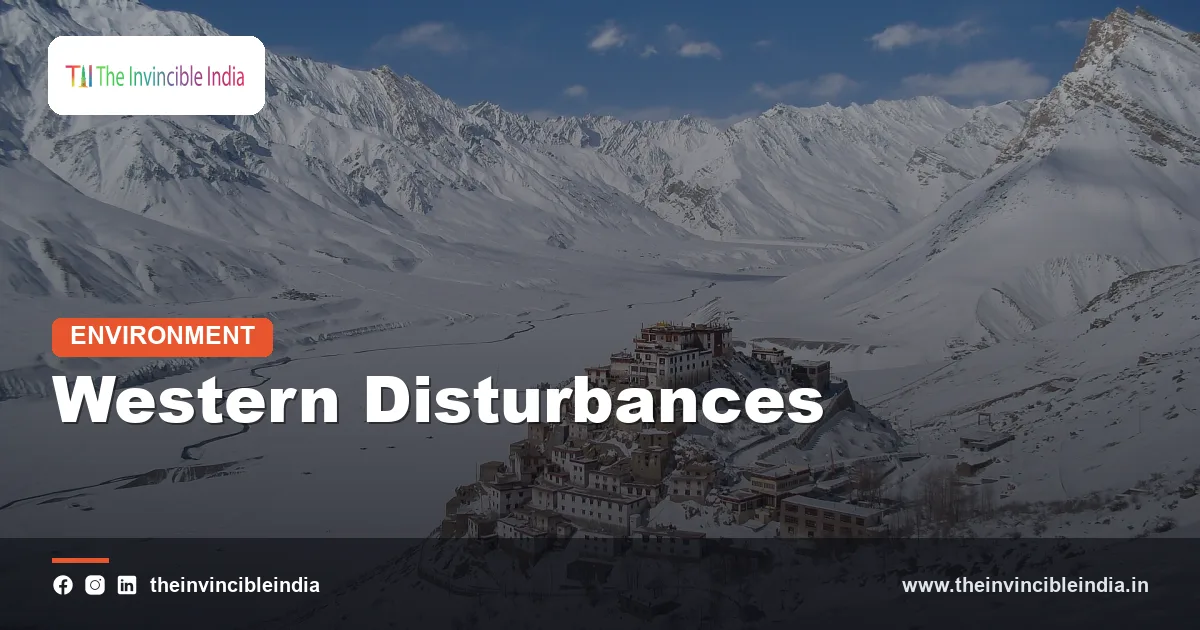
In Indian meteorology, western disturbances are extratropical storm systems that form over the Mediterranean and Caspian regions and are carried east by the subtropical westerly jet stream to bring winter and spring rain to north India and heavy snow to the western Himalaya. They are the main source of precipitation for the north Indian plains between December and March, and a crucial source of moisture for the rabi wheat crop.
The name reflects both their origin and their behaviour: they arrive from the west and “disturb” the otherwise dry, settled winter weather of the region. Their effects range from a gentle drizzle in Delhi to blizzards in Kashmir, and in unlucky cases hailstorms, floods and cloudbursts.
| Quick Fact | Detail |
|---|---|
| Type of system | Extratropical cyclonic storm and upper-air trough |
| Place of origin | Mediterranean Sea, Black Sea and Caspian Sea region |
| Steering mechanism | Subtropical westerly jet stream |
| Main season over India | December to March, with activity also in late autumn and pre-monsoon months |
| Regions most affected | Jammu and Kashmir, Ladakh, Himachal Pradesh, Uttarakhand, Punjab, Haryana, Delhi, Rajasthan, western Uttar Pradesh |
| Typical effects | Winter rain, Himalayan snowfall, cloud cover, fog relief, occasional hail and cold waves |
| Crop significance | Supports rabi crops, especially wheat, mustard and gram |
| Monitoring agency | India Meteorological Department (IMD), Ministry of Earth Sciences |
Key Takeaways
- Western disturbances are extratropical storms that originate over the Mediterranean and Caspian regions and travel east towards north India.
- The subtropical westerly jet stream steers western disturbances across West Asia and Pakistan into the Indian Himalaya and the northern plains.
- Western disturbances supply most of the winter rain of north India and are the main source of snowfall in the western Himalaya.
- Winter rain from western disturbances is vital for rabi wheat, but intense spells with hail can flatten standing crops close to harvest.
- Western disturbances that interact with the monsoon can trigger extreme rain and cloudbursts, as happened in the June 2013 Uttarakhand disaster.
- Snowfall from western disturbances feeds the Himalayan glaciers and rivers, linking a winter weather system to year-round water supply.
What Are Western Disturbances?
Western disturbances are low-pressure systems in the middle and upper atmosphere that move from west to east across Eurasia and reach the Indian subcontinent in the cooler half of the year. The India Meteorological Department (IMD) describes them as extratropical storms that originate in the Mediterranean region and bring sudden winter rain to the northwestern parts of the subcontinent.
Unlike a tropical cyclone, a western disturbance draws its energy from temperature contrasts between cold polar air and warmer subtropical air rather than from a warm ocean surface. It usually appears on weather charts as a trough, or dip, in the upper-level winds, often with a surface low-pressure area beneath it. It rarely has the compact spiral of a cyclone, and its rainfall is spread over a wide area.
Western disturbances occur throughout the year across West Asia, but they affect India most strongly in winter, when the jet stream is positioned far enough south to carry them over the Himalaya. During the summer and monsoon, the jet moves north of the Tibetan Plateau, and western disturbances are pushed to higher latitudes.
How Do Western Disturbances Form?
Western disturbances form when cold air from higher latitudes dips southward over the Mediterranean or Caspian region and meets warmer, moister air from the sea, creating a deepening low-pressure system. These conditions are most common in winter, when the temperature contrast between the pole and the subtropics is greatest and the sea surface is still relatively warm compared with the land around it.
The key steps in their formation can be summarised as follows:
- Cold air from the north collides with warm, moist air over the Mediterranean, and a trough develops in the upper atmosphere.
- The upper-level trough strengthens a surface low, which draws moisture from the Mediterranean, the Black Sea and the Caspian Sea.
- The jet stream carries the system east over Turkey, Iraq, Iran, Afghanistan and Pakistan, picking up additional moisture on the way, including from the Persian Gulf and the Arabian Sea.
- When the system reaches the Himalaya, rising air over the mountains cools and condenses the moisture, producing snow at height and rain on the foothills and plains.
Western disturbances are therefore a long-distance weather chain. A storm that begins over the Mediterranean may take several days to reach India, and forecasters can track it for much of that journey, which is one reason Indian winter rain is often predicted well in advance.
What Role Does the Jet Stream Play?
The subtropical westerly jet stream acts as the conveyor belt for western disturbances, steering them from the Mediterranean towards India along a path of fast upper-air winds. This jet is a narrow ribbon of strong winds flowing from west to east at heights of roughly 10 to 15 kilometres above the surface.
In winter, the subtropical westerly jet lies south of the Himalaya and the Tibetan Plateau, with part of it splitting around the plateau. This is the position that lets storms from West Asia cross northern Pakistan and enter India across Jammu and Kashmir, Himachal Pradesh and Punjab. By late spring the jet shifts north of the Tibetan Plateau, and this northward movement is one of the factors linked to the arrival of the Indian summer monsoon.
The strength and position of the jet explain why western disturbances vary from year to year. A stronger or more southerly jet tends to bring more frequent and more intense storms, while a weak or displaced jet can leave north India with a dry winter. Researchers also study how phenomena such as the Arctic Oscillation and the North Atlantic Oscillation influence the jet, and through it the winter rainfall of the Himalaya.
When Do Western Disturbances Occur in India?
Western disturbances occur in India mainly between December and March, with activity peaking in the heart of winter and extending into the spring. This is the period when the jet stream lies close enough to India to steer storms into the region.
Each winter, a series of disturbances passes over north India, and each one typically lasts a few days. Between them, clear skies return and temperatures fall, which is why north India often experiences alternating cycles of cloudy, rainy weather and sharp cold. The following pattern is common:
- Before a western disturbance arrives, humid southwesterly winds raise cloud cover and night temperatures.
- During its passage, rain falls over the plains and snow over the mountains, sometimes accompanied by thunder and hail.
- After the disturbance moves away, cold northwesterly winds blow down from the snow-covered mountains, bringing a cold wave and, at times, dense fog.
Western disturbances also appear outside winter. In the pre-monsoon months of April and May they can trigger thunderstorms, hail and dust storms over northwest India. In late autumn and early summer, they sometimes interact with other weather systems to produce unseasonal rain.
Which Parts of India Do Western Disturbances Affect?
Western disturbances mainly affect northern and northwestern India, from the Himalayan states of Jammu and Kashmir, Ladakh, Himachal Pradesh and Uttarakhand to the plains of Punjab, Haryana, Delhi, Rajasthan and western Uttar Pradesh. Their influence weakens as they move east and south, and rain in central India is less common and lighter.
Occasionally, a strong western disturbance can extend as far as Bihar, West Bengal and the northeastern states, and in some winters it interacts with moisture from the Bay of Bengal to cause rain over a wider area. Sometimes the influence is felt farther south in the form of cold winds and cloud cover.
| Region | Typical effect of western disturbances |
|---|---|
| Jammu and Kashmir, Ladakh | Heavy snowfall, road closures, replenishment of glaciers and snowpack |
| Himachal Pradesh, Uttarakhand | Snow at height, rain in the valleys, landslide risk |
| Punjab, Haryana, Delhi | Winter rain, hail in some spells, cloud cover that eases fog and cold |
| Rajasthan, western Uttar Pradesh | Light to moderate rain, thunderstorms in spring |
| Bihar, Bengal, northeast India | Occasional rain and cloud when a strong system extends east |
Why Do Western Disturbances Matter for Agriculture?
Western disturbances matter for agriculture because their winter rain is a free, well-timed irrigation for rabi crops such as wheat, mustard, gram, barley and peas across the north Indian plains. These crops are sown in October and November and harvested in March and April, so they grow almost entirely in the season when the monsoon is absent.
Wheat in particular benefits from light to moderate rain in January and February, which supports tillering and grain filling and reduces the need for tube-well irrigation. Farmers in Punjab, Haryana and western Uttar Pradesh, the heart of the wheat belt, often speak of such rain as beneficial for yield. Winter rain also recharges soil moisture and reduces irrigation costs and groundwater use.
The same systems can also harm crops. Heavy rain, strong winds and hail in March, when wheat is ripening, can cause lodging, where the crop falls flat, and may reduce grain quality. Orchards in Himachal Pradesh and Jammu and Kashmir can suffer when hail or unseasonal snow arrives during the flowering of apples and other fruit. The effect of a western disturbance on agriculture therefore depends heavily on its timing and intensity.
How Do Western Disturbances Feed Himalayan Rivers and Glaciers?
Western disturbances feed Himalayan rivers and glaciers by depositing snow on the western Himalaya and the Karakoram, which melts through spring and summer to sustain the flow of the Indus, Ganga and Yamuna systems. Winter snowfall is, in effect, a water store that releases its contents months later.
The western Himalaya receives a large share of its annual precipitation from western disturbances, in contrast with the eastern Himalaya, which depends more on the summer monsoon. In the Karakoram, scientists have noted that some glaciers have been relatively stable compared with glaciers elsewhere in the Himalaya, and winter snowfall from western disturbances is one of the explanations they study.
This link makes the behaviour of western disturbances important for long-term water planning. If the frequency or intensity of these systems changes, the snowpack, spring river flows and hydropower generation in the Himalayan states may change with them. Researchers are still working to understand how warming is altering the balance between snow and rain.
Can Western Disturbances Cause Floods and Cloudbursts?
Yes, western disturbances can contribute to floods, cloudbursts and landslides, especially when they interact with moist monsoon air or with other weather systems over the Himalaya. The best-known example is the June 2013 disaster in Uttarakhand, when a western disturbance interacted with the advancing monsoon and produced extremely heavy rain in the Kedarnath region.
Several features make such interactions dangerous:
- A western disturbance can push cold, dry air into a region where warm, moist monsoon winds are already present, forcing intense lifting of the moist air.
- The steep Himalayan terrain concentrates rainfall in narrow valleys and speeds the runoff.
- Rain falling on snow or on the edges of glaciers can add meltwater to swollen streams.
- Landslides and debris flows can block rivers and cause sudden flooding downstream.
Winter spells can also be destructive. Heavy snow can cut off valleys, cause avalanches and damage power lines, while sudden hail can harm crops. The IMD issues warnings for heavy rain, snow and thunderstorms when a western disturbance approaches, and state disaster agencies use them to prepare for road closures and avalanche risks.
How Are Western Disturbances Changing With Climate Change?
Western disturbances are changing in ways that scientists are still working to pin down, with research pointing to shifts in their frequency, intensity and timing as the climate warms. This is an active area of study, and the findings differ by region and by method, so conclusions should be treated with caution.
Some points that studies commonly discuss include:
- Warmer air holds more moisture, which can make individual storms wetter and raise the risk of extreme rain and snow in short bursts.
- Changes in the Arctic and in the jet stream may alter the paths that western disturbances take and the number that reach India.
- A rise in the number of intense western disturbances late in the season has been linked in some studies to more frequent hail and unseasonal rain in March and April, with consequences for wheat.
- Warmer winters may cause more precipitation to fall as rain instead of snow at lower elevations, reducing the snowpack that feeds rivers in summer.
Because the western Himalaya depends so heavily on these storms, even small changes can matter. Better satellite observation, high-resolution forecast models and long-term records are helping the IMD and research institutes improve forecasts for winter storms.
How Are Western Disturbances Forecast and Monitored?
Western disturbances are forecast and monitored by the India Meteorological Department using satellite imagery, upper-air observations, weather radar and numerical weather prediction models. Because these systems can be tracked from the Mediterranean region days before they reach India, forecasters can usually give reasonable advance notice.
The IMD issues bulletins describing the passage of a western disturbance, the expected spread of rain and snow, and the likelihood of thunderstorms, hail and cold wave conditions. It also issues colour-coded warnings for districts in the affected states, which authorities and farmers use to plan harvests, travel and relief measures. Farm advisories under the agrometeorological service of the IMD advise farmers on irrigation, spraying and harvest timing around expected rain.
Western Disturbances and Other Indian Weather Systems
Western disturbances differ from India’s other major rain-bearing systems in origin, season and mechanism. The table below compares them with the southwest monsoon and the northeast monsoon.
| Feature | Western disturbances | Southwest monsoon | Northeast monsoon |
|---|---|---|---|
| Source of moisture | Mediterranean, Black Sea, Caspian, Arabian Sea | Arabian Sea and Bay of Bengal | Bay of Bengal |
| Main season | December to March | June to September | October to December |
| Main area | North and northwest India, Himalaya | Most of India | Tamil Nadu, coastal Andhra Pradesh, south Karnataka, Kerala |
| Type of rain | Frontal and stratiform, with some thunderstorms | Convective and orographic | Cyclonic and convective |
| Main crop link | Rabi wheat and other winter crops | Kharif crops | Rabi and late rice in the south |
Bottom Line
Western disturbances are the winter storms that link the Mediterranean to the Himalaya, and they provide the rain and snow on which the wheat belt, the mountain rivers and much of north India’s water security depend. They bring benefit and risk together, and their behaviour in a warming climate is one of the key questions in Indian weather science.
Frequently Asked Questions
What are western disturbances in simple words?
Western disturbances are winter storm systems that begin over the Mediterranean and Caspian regions and travel east to India. They bring rain to the north Indian plains and snow to the western Himalaya. They are named for the direction from which they arrive.
Why are western disturbances important for wheat?
Western disturbances are important for wheat because their winter rain supplies moisture during the crop’s main growing period. Light to moderate rain in January and February supports tillering and grain filling and reduces irrigation needs. Heavy rain or hail near harvest, however, can damage the crop.
Which months do western disturbances affect India?
Western disturbances affect India mainly from December to March. They can also occur in late autumn and in the pre-monsoon months of April and May, when they may cause thunderstorms, hail and dust storms over northwest India.
Do western disturbances cause snowfall in Kashmir and Himachal Pradesh?
Yes, western disturbances cause most of the winter snowfall in Jammu and Kashmir, Ladakh, Himachal Pradesh and Uttarakhand. As the moist air is forced up the mountains, it cools and falls as snow at height. This snow feeds glaciers and rivers through the following months.
Can western disturbances cause floods or cloudbursts?
Yes, western disturbances can contribute to floods and cloudbursts, particularly when they interact with monsoon moisture over the Himalaya. The June 2013 Uttarakhand disaster is the best-known example. In winter, they can also cause heavy snow, avalanches and hail damage.
How is a western disturbance different from a cyclone?
A western disturbance is an extratropical system that draws energy from temperature contrasts and usually appears as an upper-air trough, while a tropical cyclone forms over warm tropical seas and has a compact, spiralling core. Western disturbances bring widespread rain and snow, whereas cyclones bring intense winds and storm surges to coasts.
{“@context”:”https://schema.org”,”@graph”:[{“@type”:”FAQPage”,”mainEntity”:[{“@type”:”Question”,”name”:”What are western disturbances in simple words?”,”acceptedAnswer”:{“@type”:”Answer”,”text”:”Western disturbances are winter storm systems that begin over the Mediterranean and Caspian regions and travel east to India. They bring rain to the north Indian plains and snow to the western Himalaya. They are named for the direction from which they arrive.”}},{“@type”:”Question”,”name”:”Why are western disturbances important for wheat?”,”acceptedAnswer”:{“@type”:”Answer”,”text”:”Western disturbances are important for wheat because their winter rain supplies moisture during the crop’s main growing period. Light to moderate rain in January and February supports tillering and grain filling and reduces irrigation needs. Heavy rain or hail near harvest, however, can damage the crop.”}},{“@type”:”Question”,”name”:”Which months do western disturbances affect India?”,”acceptedAnswer”:{“@type”:”Answer”,”text”:”Western disturbances affect India mainly from December to March. They can also occur in late autumn and in the pre-monsoon months of April and May, when they may cause thunderstorms, hail and dust storms over northwest India.”}},{“@type”:”Question”,”name”:”Do western disturbances cause snowfall in Kashmir and Himachal Pradesh?”,”acceptedAnswer”:{“@type”:”Answer”,”text”:”Yes, western disturbances cause most of the winter snowfall in Jammu and Kashmir, Ladakh, Himachal Pradesh and Uttarakhand. As the moist air is forced up the mountains, it cools and falls as snow at height. This snow feeds glaciers and rivers through the following months.”}},{“@type”:”Question”,”name”:”Can western disturbances cause floods or cloudbursts?”,”acceptedAnswer”:{“@type”:”Answer”,”text”:”Yes, western disturbances can contribute to floods and cloudbursts, particularly when they interact with monsoon moisture over the Himalaya. The June 2013 Uttarakhand disaster is the best-known example. In winter, they can also cause heavy snow, avalanches and hail damage.”}},{“@type”:”Question”,”name”:”How is a western disturbance different from a cyclone?”,”acceptedAnswer”:{“@type”:”Answer”,”text”:”A western disturbance is an extratropical system that draws energy from temperature contrasts and usually appears as an upper-air trough, while a tropical cyclone forms over warm tropical seas and has a compact, spiralling core. Western disturbances bring widespread rain and snow, whereas cyclones bring intense winds and storm surges to coasts.”}}]}]}


