

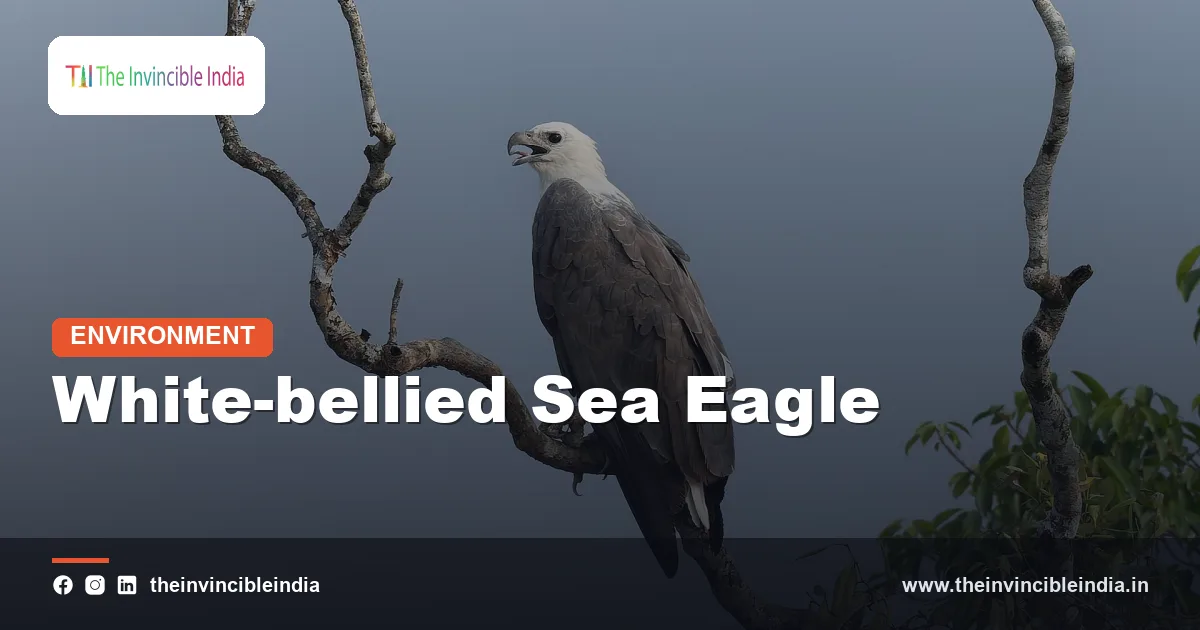
The white-bellied sea eagle (Haliaeetus leucogaster) is a large grey-and-white eagle that lives along the coasts, estuaries, mangroves, islands and big reservoirs of India and the wider Indo-Pacific, hunting fish, sea snakes and other animals from the water’s edge. It is the most widely seen sea eagle on the Indian coastline and one of the most impressive raptors of the Bay of Bengal, the Arabian Sea and the Andaman and Nicobar islands.
The white-bellied sea eagle is an apex predator of coastal ecosystems and an indicator of healthy waterways. Its pale head and underparts, wedge-shaped tail and loud, goose-like call make it unmistakable once seen. This article explains how to identify the bird, where it lives in India, what it eats, how a pair builds its huge nest and what threatens it.
Quick Facts
| Common name | White-bellied sea eagle (also called white-bellied fish eagle) |
|---|---|
| Scientific name | Haliaeetus leucogaster |
| Family | Accipitridae (hawks, eagles, kites and harriers) |
| Size | About 70 to 85 cm long, with a wingspan of roughly 1.8 to 2.2 metres |
| Range and habitat in India | Coasts, estuaries, mangroves, offshore islands and some large inland reservoirs, from the west coast to the Bay of Bengal and the Andaman and Nicobar Islands |
| Diet | Fish, sea snakes, waterbirds, crabs and carrion |
| Breeding and movement | Mostly resident; monogamous pairs build a very large stick nest in a tall tree or on a cliff and usually raise one or two young |
| Conservation status | Least Concern on the IUCN Red List, but declining in places where coastal habitat is lost |
Key Takeaways
- The white-bellied sea eagle is a large Indo-Pacific eagle with a white head and underparts, a grey back and a short, wedge-shaped white tail.
- The white-bellied sea eagle lives in India along coasts, estuaries, mangroves and island shores, and also at some large inland lakes and reservoirs.
- The white-bellied sea eagle hunts mainly fish and sea snakes, usually by swooping from a perch or a soaring flight and snatching prey from the surface with its talons.
- Pairs of white-bellied sea eagles are monogamous and build one of the largest nests of any Indian bird, which they reuse and add to for many years.
- Young white-bellied sea eagles are mottled brown and take about four to five years to acquire the adult plumage.
- The species is rated Least Concern globally, but destruction of mangroves, pollution, disturbance and loss of nest trees threaten local populations.
What does the white-bellied sea eagle look like?
The white-bellied sea eagle is a large, powerful raptor with a white head, neck, breast and belly, a pale grey back and wings and a short white tail shaped like a wedge. In flight, the dark grey-black flight feathers contrast sharply with the white underbody and the white wing linings.
The adult bird has a hooked grey bill, yellowish-white feet and strong, black talons. Males and females look alike, although females are noticeably larger. The wings are long and broad, and when the bird soars they are held in a gentle upward curve. The short tail is a good field mark that separates this species from many larger eagles with long tails.
Juveniles are mostly brown with buff and cream mottling, a pale head and a pale tail with a dark tip. Over four to five years, they gradually acquire patches of white on the head, belly and tail until the adult plumage is complete. A dull, pale immature can be confused with other brown eagles, but the short tail and the coastal setting are helpful clues.
Where does the white-bellied sea eagle live in India?
The white-bellied sea eagle lives mostly along the Indian coast, in estuaries, mangrove forests, tidal creeks and on islands, and it also uses some large inland lakes and reservoirs, especially in the south. It is rarely found far from water.
On the east coast it occurs in the mangrove and lagoon systems of Odisha and West Bengal, including the Sundarbans, Bhitarkanika and the Chilika lagoon. It is also found along the Andhra Pradesh and Tamil Nadu coasts and, on the west coast, in Kerala, Karnataka, Goa, Maharashtra and Gujarat. The Andaman and Nicobar Islands are a particularly good habitat, with remote shores, mangroves and plenty of tall trees.
Beyond India, the white-bellied sea eagle ranges through Sri Lanka, Bangladesh, Myanmar, Southeast Asia, southern China, New Guinea and Australia. The same species therefore occurs across a huge arc of tropical coastline.
How is the white-bellied sea eagle different from other fish eagles in India?
The white-bellied sea eagle differs from other Indian fish-eating eagles mainly in its white underparts, short wedge-shaped tail and coastal habit. India has several large eagles that depend on fish, and a quick comparison avoids confusion.
| Species | Typical habitat | Distinguishing features |
|---|---|---|
| White-bellied sea eagle | Coasts, islands, mangroves, reservoirs | White head and belly, grey back, short wedge-shaped white tail |
| Pallas’s fish eagle | Large rivers and lakes, mostly in the north and east | Buff head, dark brown body, a broad white band on the tail |
| Grey-headed fish eagle | Forested rivers and lakes | Grey head, brown upperparts and a white lower belly; a bird of wooded lakes and rivers |
| Lesser fish eagle | Forest rivers and ponds | Smaller than the others, with a grey head and mostly brown body |
The word “sea eagle” applies to the genus Haliaeetus, whose members are built for taking prey from water. They have powerful feet with rough pads on the soles that help hold slippery fish.
What does the white-bellied sea eagle eat?
The white-bellied sea eagle eats mainly fish and sea snakes, but it also takes waterbirds, crabs, turtle hatchlings, small mammals and carrion when the opportunity arises. It is an opportunistic hunter and scavenger.
Its diet depends on the habitat. Along the coast, fish and sea snakes make up a large part of the food. Beside reservoirs, it takes freshwater fish and waterbirds such as coots and ducks. On islands, it may also catch seabirds, flying foxes and the young of ground nesting birds. Dead fish and other carrion washed ashore are readily eaten.
Sea snakes are an especially notable prey. The eagle seizes them near the surface and carries them to a perch to be eaten. Taking venomous prey shows how well equipped the species is as a hunter, and the habit makes the white-bellied sea eagle a recognised predator of marine reptiles.
How does the white-bellied sea eagle hunt?
The white-bellied sea eagle hunts by watching from a high perch or soaring over water, then gliding down in a shallow swoop to snatch prey from just below the surface with its talons. It seldom plunges completely under water.
- Perch hunting: the bird sits on a tall tree, rock or pole and waits for movement in the water below.
- Soaring and gliding: pairs patrol the shoreline on broad wings, riding thermals and sea breezes.
- Piracy: the eagle sometimes chases other birds, such as ospreys and gulls, to steal their catch.
- Carrion feeding: the bird picks up dead fish or animals along beaches and tidal flats.
After a successful catch, the eagle usually flies to a favourite feeding perch and tears the prey apart. Pairs often hunt in view of each other, and a bird carrying food may call to its mate.
How does the white-bellied sea eagle breed?
The white-bellied sea eagle breeds as a monogamous pair that builds a very large stick nest in a tall tree, on a cliff or sometimes on the ground of an island, and it usually lays one to three eggs, most often two. Pairs are thought to stay together for life and defend a stretch of coast or shoreline all year.
The nest is a bulky platform of sticks lined with green leaves and seaweed. It can grow to well over a metre across and become very deep as the pair adds material year after year. Breeding takes place in the cooler months in most of India. The female does most of the incubation, which lasts a little over a month, while the male brings food, and both parents feed the young.
Often only one chick survives to leave the nest, because the older chick may dominate the younger one when food is scarce. The young eagle stays near the nest for a period after fledging and remains dependent on its parents for some weeks. The long time taken to reach adult plumage means that immature birds are common around coastal waters.
What is the call of the white-bellied sea eagle?
The call of the white-bellied sea eagle is a loud, far-carrying, goose-like honking or cackling, given most often by a pair near the nest or when defending territory. The sound is much more powerful than the thin whistling cries of many other eagles.
Pairs often duet, with the male and female calling together from adjacent perches. Calling increases at the start of the breeding season, when pairs advertise ownership of a nest site and strengthen their bond. For birdwatchers, the call is often the first sign that a sea eagle is nearby, long before the bird comes into view.
What threatens the white-bellied sea eagle in India?
The main threats to the white-bellied sea eagle in India are the loss of mangroves and coastal forest, the felling of large nest trees, water pollution and disturbance from fishing, tourism and construction near nests. These pressures reduce nest sites and prey.
The species is rated Least Concern on the IUCN Red List, because it has a very wide range, but regional declines have been reported in parts of Southeast Asia and elsewhere. In India, coastal development, the conversion of mangroves to aquaculture or salt pans and overfishing all reduce food and nesting habitat. Entanglement in fishing gear and the persecution of birds near fish farms can add further risk.
Like other birds of prey in India, the white-bellied sea eagle is protected by the Wildlife (Protection) Act, 1972. Conservation of mangroves, protection of known nest trees and responsible tourism around nesting sites are the most effective measures.
Where can you see the white-bellied sea eagle in India?
You can see the white-bellied sea eagle at coastal wetlands and protected mangrove areas such as the Sundarbans, Bhitarkanika and Chilika, along the Kerala and Karnataka coasts and on the Andaman and Nicobar Islands. Boat trips along estuaries and creeks give some of the best views.
- Best time: the cooler months from November to March, when pairs are active and breeding.
- Best method: a quiet boat trip in the early morning or late afternoon.
- What to look for: a large pale eagle perched on a dead tree or soaring over water.
- Etiquette: keep a distance from nests and never disturb a pair at its nest.
Bottom Line
The white-bellied sea eagle is the great raptor of the Indian shoreline, a bird that depends on healthy coasts, mangroves and fish stocks. Its presence is a sign of an intact coastal ecosystem, and protecting its nest trees and mangrove habitat benefits many other species.
Frequently Asked Questions
Is the white-bellied sea eagle found in India?
Yes, the white-bellied sea eagle is found along the Indian coast, in mangroves and estuaries, on the Andaman and Nicobar Islands and at some large inland reservoirs. It is mostly a resident bird. It is regularly seen at places such as the Sundarbans, Bhitarkanika and Chilika.
What does the white-bellied sea eagle eat?
The white-bellied sea eagle eats mainly fish and sea snakes, along with waterbirds, crabs and carrion. It usually swoops down from a perch or from soaring flight and snatches prey from the water’s surface with its talons. Its diet changes with the local habitat.
How big is the white-bellied sea eagle?
The white-bellied sea eagle is about 70 to 85 cm long and has a wingspan of roughly 1.8 to 2.2 metres. Females are larger than males. It is one of the largest eagles seen on the Indian coast.
How can you tell a white-bellied sea eagle from other eagles?
A white-bellied sea eagle is told apart by its white head and underparts, grey back and short wedge-shaped white tail. Its coastal habitat is also a clue. Other fish eagles in India have brown bodies and darker or longer tails.
Where does the white-bellied sea eagle nest?
The white-bellied sea eagle nests in tall trees, on cliffs or on island ground, building a very large platform of sticks lined with green leaves. Pairs reuse the nest and add to it each year. They usually raise one or two chicks.
Is the white-bellied sea eagle endangered?
No, the white-bellied sea eagle is rated Least Concern on the IUCN Red List because of its wide range. However, local populations are under pressure from the loss of mangroves, nest trees and clean water. It is legally protected in India under the Wildlife (Protection) Act, 1972.
{“@context”:”https://schema.org”,”@graph”:[{“@type”:”FAQPage”,”mainEntity”:[{“@type”:”Question”,”name”:”Is the white-bellied sea eagle found in India?”,”acceptedAnswer”:{“@type”:”Answer”,”text”:”Yes, the white-bellied sea eagle is found along the Indian coast, in mangroves and estuaries, on the Andaman and Nicobar Islands and at some large inland reservoirs. It is mostly a resident bird. It is regularly seen at places such as the Sundarbans, Bhitarkanika and Chilika.”}},{“@type”:”Question”,”name”:”What does the white-bellied sea eagle eat?”,”acceptedAnswer”:{“@type”:”Answer”,”text”:”The white-bellied sea eagle eats mainly fish and sea snakes, along with waterbirds, crabs and carrion. It usually swoops down from a perch or from soaring flight and snatches prey from the water’s surface with its talons. Its diet changes with the local habitat.”}},{“@type”:”Question”,”name”:”How big is the white-bellied sea eagle?”,”acceptedAnswer”:{“@type”:”Answer”,”text”:”The white-bellied sea eagle is about 70 to 85 cm long and has a wingspan of roughly 1.8 to 2.2 metres. Females are larger than males. It is one of the largest eagles seen on the Indian coast.”}},{“@type”:”Question”,”name”:”How can you tell a white-bellied sea eagle from other eagles?”,”acceptedAnswer”:{“@type”:”Answer”,”text”:”A white-bellied sea eagle is told apart by its white head and underparts, grey back and short wedge-shaped white tail. Its coastal habitat is also a clue. Other fish eagles in India have brown bodies and darker or longer tails.”}},{“@type”:”Question”,”name”:”Where does the white-bellied sea eagle nest?”,”acceptedAnswer”:{“@type”:”Answer”,”text”:”The white-bellied sea eagle nests in tall trees, on cliffs or on island ground, building a very large platform of sticks lined with green leaves. Pairs reuse the nest and add to it each year. They usually raise one or two chicks.”}},{“@type”:”Question”,”name”:”Is the white-bellied sea eagle endangered?”,”acceptedAnswer”:{“@type”:”Answer”,”text”:”No, the white-bellied sea eagle is rated Least Concern on the IUCN Red List because of its wide range. However, local populations are under pressure from the loss of mangroves, nest trees and clean water. It is legally protected in India under the Wildlife (Protection) Act, 1972.”}}]}]}


