

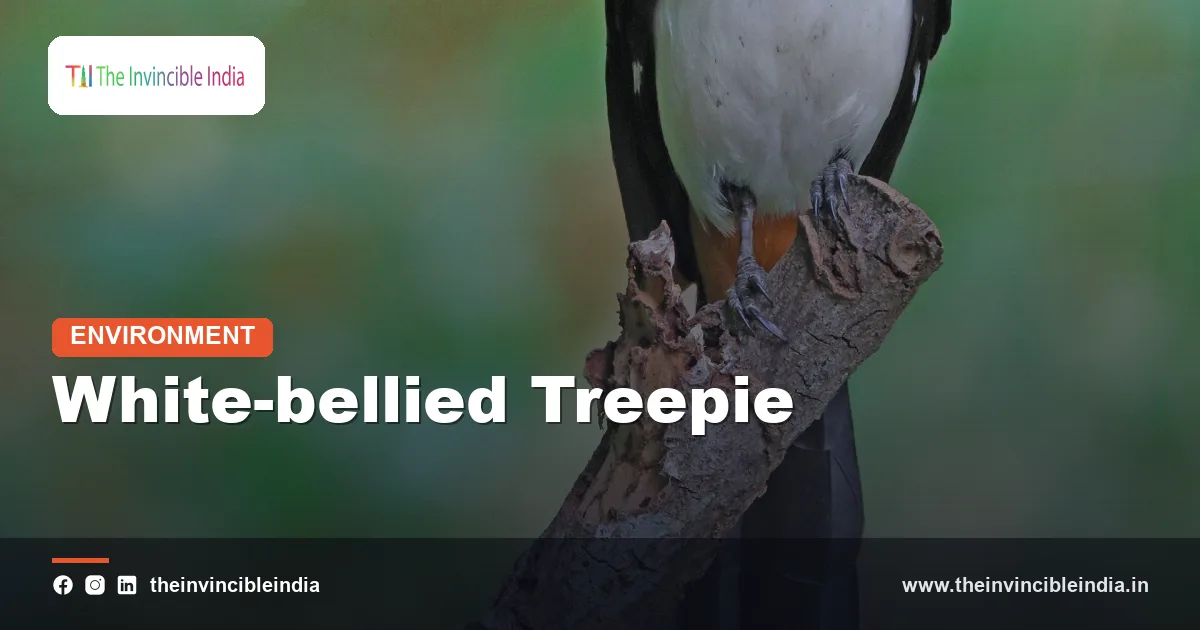
The white-bellied treepie (Dendrocitta leucogastra) is a long-tailed, black-white-and-chestnut member of the crow family that is found only in the Western Ghats of peninsular India, where it lives in the canopy of wet evergreen and moist deciduous forests. Because its entire world range lies inside one mountain chain, the white-bellied treepie is counted among the endemic birds of the Western Ghats and is a useful marker of healthy hill forest.
This article explains what the white-bellied treepie looks like, where it lives, what it eats, how it breeds, what its loud calls mean and how it differs from the more widespread rufous treepie. It also covers its conservation status and the practical points that help a birdwatcher find and identify it in the field.
| Common name | White-bellied treepie |
|---|---|
| Scientific name | Dendrocitta leucogastra |
| Family | Corvidae (crows, jays, magpies and treepies) |
| Size | About 40 to 50 cm in total length, more than half of it tail |
| Range in India | Endemic to the Western Ghats, mainly the central and southern parts of the range |
| Habitat | Evergreen and moist deciduous forest, forest edges, and shaded plantations such as coffee and cardamom |
| Diet | Omnivore: fruit, seeds, nectar, large insects, small reptiles, and the eggs and chicks of other birds |
| Breeding | Resident; builds a twig nest in a tree, typically in the dry season before the monsoon |
| Conservation status | Least Concern on the IUCN Red List, with a restricted range and dependence on forest cover |
Key Takeaways
- The white-bellied treepie is a corvid, a relative of crows and jays, that is endemic to the Western Ghats of India and occurs nowhere else in the world.
- An adult white-bellied treepie has a black head, neck and breast, a chestnut back, a white belly, white rump and a long black tail.
- The white-bellied treepie is an omnivore that eats fruit, insects, small vertebrates and sometimes the eggs or nestlings of other birds.
- The white-bellied treepie is noisy and conspicuous, giving loud rattling, whistling and metallic calls from the forest canopy.
- The white-bellied treepie is classified as Least Concern, but its fortunes depend on continuous forest cover in the Western Ghats.
- The white-bellied treepie is easily separated from the rufous treepie by its white underparts, black head and restriction to wet forest.
What is the white-bellied treepie?
The white-bellied treepie is a medium-sized, long-tailed forest bird in the family Corvidae, the same family that includes crows, rooks, jays and magpies. Its scientific name, Dendrocitta leucogastra, comes from Greek roots that roughly mean “tree jay” and “white belly”, an apt description of a bird that lives in trees and has pale underparts.
Treepies are a group of Asian corvids in the genus Dendrocitta. Unlike the crows seen around towns and villages, they are birds of woodland and forest, spending most of their time off the ground. Around seven treepie species are recognised across South and Southeast Asia. India holds several of them, including the widespread rufous treepie, the grey treepie of the Himalayan foothills and north-east, the collared treepie of the north-east, and the Andaman treepie. The white-bellied treepie is the one tied to the Western Ghats.
Like other corvids, the white-bellied treepie is intelligent, adaptable and vocal. It is not a shy bird by the standards of rainforest species, and its calls often announce its presence long before a birdwatcher sees it moving through the canopy.
What does the white-bellied treepie look like?
The white-bellied treepie is a strikingly patterned bird with a black head and breast, a rich chestnut or cinnamon-brown back, a white belly and a long, graduated black tail. In flight the white lower back and rump and a pale patch on the wing become obvious against the darker body, which helps in identification when the bird crosses a forest clearing.
The main features are easy to remember.
- Head, neck and upper breast: glossy black, giving the bird a hooded look.
- Back and mantle: warm chestnut to brown, in contrast with the black front.
- Belly and undertail: white or very pale, which gives the species its name.
- Rump and wing patch: whitish, visible mainly in flight.
- Tail: very long, black and tapering, usually carried held out behind the body.
- Bill, legs and eye: bill black and stout, legs dark, eye dark.
Males and females look alike, and juveniles are duller with less clean contrast. The tail alone accounts for well over half of the bird’s length, so in the field the white-bellied treepie often looks larger and more slender than its body weight would suggest. Its weight is only a few hundred grams at most, comparable to a small crow.
Where is the white-bellied treepie found in India?
The white-bellied treepie is found only in the Western Ghats, the long mountain chain running parallel to India’s west coast, and it is most frequently recorded in the central and southern parts of that range. Its distribution therefore spans portions of Karnataka, Kerala and Tamil Nadu, with its range thinning out towards the northern end of the chain.
The Western Ghats are one of the world’s recognised biodiversity hotspots, and the white-bellied treepie is one of a long list of species restricted to them. Altitude matters, because the bird is most common from the foothills up to mid-elevations, and it is less often seen in the highest shola-grassland country. Within this belt it uses the following habitats.
- Tall evergreen and semi-evergreen rainforest.
- Moist deciduous forest on the drier, inland slopes.
- Forest edges, clearings and road-cuts where fruiting trees are easy to reach.
- Shaded plantations, particularly coffee and cardamom estates that retain tall native canopy trees.
The white-bellied treepie does not generally occur in open scrub, dry thorn forest or the plains. Where its habitat disappears completely, the bird disappears with it. That close link to wooded country is why its presence is often taken as a sign that a tract of forest still has a reasonably intact canopy.
What does the white-bellied treepie eat?
The white-bellied treepie is an omnivore that feeds on a wide mix of fruit, seeds, nectar, insects and small animals, and it will take eggs and nestlings from the nests of other birds when it finds them. This flexible diet is typical of corvids and is a large part of why treepies manage to survive in modified forest and plantations.
The usual food items include the following.
- Fruit and berries: figs and other wild fruits from forest trees are important, and the bird helps to spread seeds as a result.
- Insects: beetles, caterpillars, grasshoppers, cicadas and other large insects, picked from bark and foliage.
- Nectar: flowers such as those of the silk-cotton and coral trees attract treepies, which probe them for nectar and sometimes carry pollen.
- Small vertebrates: lizards, geckos, frogs and occasionally small mammals.
- Eggs and chicks: nest contents of smaller forest birds, a habit that can make treepies unpopular with other species, which often mob them.
Feeding usually takes place in the mid-storey and canopy. The bird hops along branches, peers into crevices, tugs at bark and lifts leaves, using its strong bill much as a crow would. It rarely forages on the ground. This diet gives the white-bellied treepie two ecological roles: it is a seed disperser of forest fruiting trees and a predator of insects and small animals.
What does the white-bellied treepie sound like?
The white-bellied treepie has a loud, varied voice made up of rattling, whistling and harsh metallic notes, and it is often heard before it is seen. Calls carry well through dense forest, which is useful for birds that move around in the canopy where visibility is limited.
Observers commonly describe a repeated, ringing “ki-ki-ki” or rattle, along with drawn-out whistles, harsher alarm calls and quieter chattering notes made by pairs and small groups keeping in touch. Like many corvids, treepies are capable of imitating other sounds, and a bird in a forest edge may include notes borrowed from other species. The loudest calling tends to be in the early morning and again in the late afternoon.
The call is also a good field tool. When a rattling treepie call comes from high in a tree, birdwatchers often wait quietly nearby, because the bird frequently moves across an opening within a few minutes, offering a clear view of its white rump and long tail.
How does the white-bellied treepie breed?
The white-bellied treepie is a resident breeder, building a shallow cup nest of twigs high in a forest tree, and in the Western Ghats it nests mostly in the drier part of the year before the monsoon rains arrive. Pairs defend a territory around the nest and may be helped by other birds in the group, a pattern seen in several corvids.
The general breeding pattern is as follows.
- The nest is a loose but sturdy cup of twigs, often lined with finer rootlets or fibres, and placed on a branch fork well above the ground.
- The clutch is usually small, with a few eggs that are pale and marked with fine speckles.
- Incubation and feeding of the young are shared, and fledglings stay with the parents for some time after leaving the nest.
Exact timing, clutch size and success rates vary between localities and years, and the species has not been studied as intensively as some better-known Indian birds. The white-bellied treepie is therefore a good example of a common-looking forest species whose detailed life history still offers room for careful field observation by amateur and professional birdwatchers alike.
How is the white-bellied treepie different from the rufous treepie?
The white-bellied treepie differs from the rufous treepie (Dendrocitta vagabunda) mainly in its white belly, black upper breast and its restriction to the Western Ghats forests, whereas the rufous treepie has buff to rufous underparts and lives across much of India in drier and more open habitats. The two can overlap along the edges of the Ghats, where wet forest meets drier woodland, so it helps to compare them directly.
| Feature | White-bellied treepie | Rufous treepie |
|---|---|---|
| Scientific name | Dendrocitta leucogastra | Dendrocitta vagabunda |
| Underparts | White belly | Buff to rufous belly |
| Head and breast | Glossy black head and breast | Sooty-brown to blackish hood, merging into buff-rufous below |
| Back | Chestnut mantle, white rump | Cinnamon-rufous back, grey rump |
| Range | Western Ghats only | Widespread across the Indian subcontinent |
| Habitat | Wet evergreen and moist forest | Open woodland, scrub, gardens and farmland |
| Habit | Canopy forest dweller | Common in towns, orchards and cultivation |
For most observers the quickest clue is simply the belly colour: a clean white belly in a forest of the Western Ghats points to the white-bellied treepie, while a buff-bellied treepie seen in a village or scrubland is almost always the rufous treepie.
Why is the white-bellied treepie called an endemic bird?
The white-bellied treepie is called an endemic bird because its entire natural range is restricted to a single region, the Western Ghats of India, and it is not found in any other part of the world. Endemic species are of special interest to conservationists because the loss of their habitat cannot be compensated for by populations elsewhere.
The Western Ghats are home to many endemic plants, amphibians, reptiles, mammals and birds, partly because the mountains have been isolated from other forest regions by dry country for a long time. Birds such as the Malabar grey hornbill, the Malabar parakeet, the Nilgiri wood pigeon and the white-bellied treepie are all species that birdwatchers hope to see on a trip to the region.
For a person studying the region, the white-bellied treepie is helpful for another reason: it is easier to see than many other endemics. Because it is large, noisy and tolerant of shade-grown plantations, it gives visitors a realistic chance of seeing a true Western Ghats specialist without a long trek into remote forest.
Is the white-bellied treepie threatened?
The white-bellied treepie is not currently classified as globally threatened, as the IUCN Red List treats it as a species of Least Concern, but its dependence on Western Ghats forest means that habitat loss is the main long-term risk. A bird confined to one mountain chain is more vulnerable to regional change than a species spread across a continent.
The main pressures on forests in its range include the following.
- Conversion of forest to plantations, agriculture and settlement.
- Fragmentation by roads, reservoirs, power lines and mining.
- Selective felling of large canopy and fruit trees.
- Pressure from invasive plants and from changing rainfall patterns.
Several protected areas along the Western Ghats safeguard good habitat for the white-bellied treepie. Shade-grown coffee and cardamom plantations that keep native canopy trees can also act as supplementary habitat, which shows that conservation outcomes depend on how land outside parks is managed as well as on the parks themselves.
Where and how can you watch the white-bellied treepie?
The best way to watch the white-bellied treepie is to visit forest edges, clearings and shaded plantations in the Western Ghats in the morning, listen for loud rattling calls, and scan the canopy and tall fruiting trees. Patience matters, because the bird moves quickly between trees but often returns to the same fruiting or flowering branch.
A few practical suggestions help.
- Go early, when the birds are most vocal and active.
- Stand beside a fruiting fig or flowering tree and wait for visits.
- Look for the long tail and white rump when a bird crosses an opening.
- Watch mixed-species flocks, because treepies often join other canopy birds.
- Keep a respectful distance from nests and avoid playing recorded calls repeatedly, which can stress birds.
Binoculars with a wide field of view make it easier to follow a fast-moving treepie through foliage, and a field guide that shows the rufous treepie alongside it helps to avoid confusion at forest boundaries.
What role does the white-bellied treepie play in the forest?
The white-bellied treepie plays several roles in the Western Ghats forest ecosystem: it disperses seeds of fruiting trees, controls insect numbers, and acts as an alarm-caller whose loud calls can alert other animals to danger. These functions are typical of omnivorous corvids and are seldom noticed by casual visitors.
Seed dispersal is probably the most important. When a treepie eats a fig or a berry and flies on, it may drop or excrete the seeds some distance from the parent tree, helping the forest to regenerate and trees to colonise new gaps. At the same time, its habit of eating the eggs of smaller birds reminds us that every forest bird sits in a web of predators and prey, and that a balanced forest holds all of them.
Bottom Line
The white-bellied treepie is a handsome, loud and adaptable corvid that exists only in the Western Ghats. It is not currently threatened globally, but it depends on the continued survival of the forests of the mountain chain it calls home. Learning to recognise it by its white belly, black hood and long tail is one of the simplest ways to connect with the wildlife of the Western Ghats.
Frequently Asked Questions
Where is the white-bellied treepie found?
The white-bellied treepie is found only in the Western Ghats of India. It lives mostly in the central and southern parts of the range, in evergreen and moist deciduous forests and shaded plantations. It does not occur outside India.
What does the white-bellied treepie look like?
The white-bellied treepie has a black head and breast, a chestnut back, a white belly and rump, and a long black tail. Males and females look alike. In flight, its white rump and pale wing patch stand out against the darker plumage.
What does the white-bellied treepie eat?
The white-bellied treepie is an omnivore. It eats fruit, seeds, nectar, large insects and small reptiles, and it will take the eggs and chicks of other birds. This varied diet helps it survive in modified forest and plantations.
Is the white-bellied treepie endangered?
No, the white-bellied treepie is listed as Least Concern by the IUCN. However, its range is confined to the Western Ghats, so loss and fragmentation of forest there is the main long-term threat to the species.
How can I tell the white-bellied treepie from the rufous treepie?
The white-bellied treepie has a white belly and a black head and breast, while the rufous treepie has buff to rufous underparts. The white-bellied species is restricted to Western Ghats forests, whereas the rufous treepie is widespread in open woodland, farmland and towns across India.
Why is the white-bellied treepie so noisy?
The white-bellied treepie is noisy because loud calls help pairs and groups keep in touch in dense forest canopy where they cannot easily see each other. Its rattling, whistling and metallic calls also warn of danger and mark territory.
{“@context”:”https://schema.org”,”@graph”:[{“@type”:”FAQPage”,”mainEntity”:[{“@type”:”Question”,”name”:”Where is the white-bellied treepie found?”,”acceptedAnswer”:{“@type”:”Answer”,”text”:”The white-bellied treepie is found only in the Western Ghats of India. It lives mostly in the central and southern parts of the range, in evergreen and moist deciduous forests and shaded plantations. It does not occur outside India.”}},{“@type”:”Question”,”name”:”What does the white-bellied treepie look like?”,”acceptedAnswer”:{“@type”:”Answer”,”text”:”The white-bellied treepie has a black head and breast, a chestnut back, a white belly and rump, and a long black tail. Males and females look alike. In flight, its white rump and pale wing patch stand out against the darker plumage.”}},{“@type”:”Question”,”name”:”What does the white-bellied treepie eat?”,”acceptedAnswer”:{“@type”:”Answer”,”text”:”The white-bellied treepie is an omnivore. It eats fruit, seeds, nectar, large insects and small reptiles, and it will take the eggs and chicks of other birds. This varied diet helps it survive in modified forest and plantations.”}},{“@type”:”Question”,”name”:”Is the white-bellied treepie endangered?”,”acceptedAnswer”:{“@type”:”Answer”,”text”:”No, the white-bellied treepie is listed as Least Concern by the IUCN. However, its range is confined to the Western Ghats, so loss and fragmentation of forest there is the main long-term threat to the species.”}},{“@type”:”Question”,”name”:”How can I tell the white-bellied treepie from the rufous treepie?”,”acceptedAnswer”:{“@type”:”Answer”,”text”:”The white-bellied treepie has a white belly and a black head and breast, while the rufous treepie has buff to rufous underparts. The white-bellied species is restricted to Western Ghats forests, whereas the rufous treepie is widespread in open woodland, farmland and towns across India.”}},{“@type”:”Question”,”name”:”Why is the white-bellied treepie so noisy?”,”acceptedAnswer”:{“@type”:”Answer”,”text”:”The white-bellied treepie is noisy because loud calls help pairs and groups keep in touch in dense forest canopy where they cannot easily see each other. Its rattling, whistling and metallic calls also warn of danger and mark territory.”}}]}]}


