

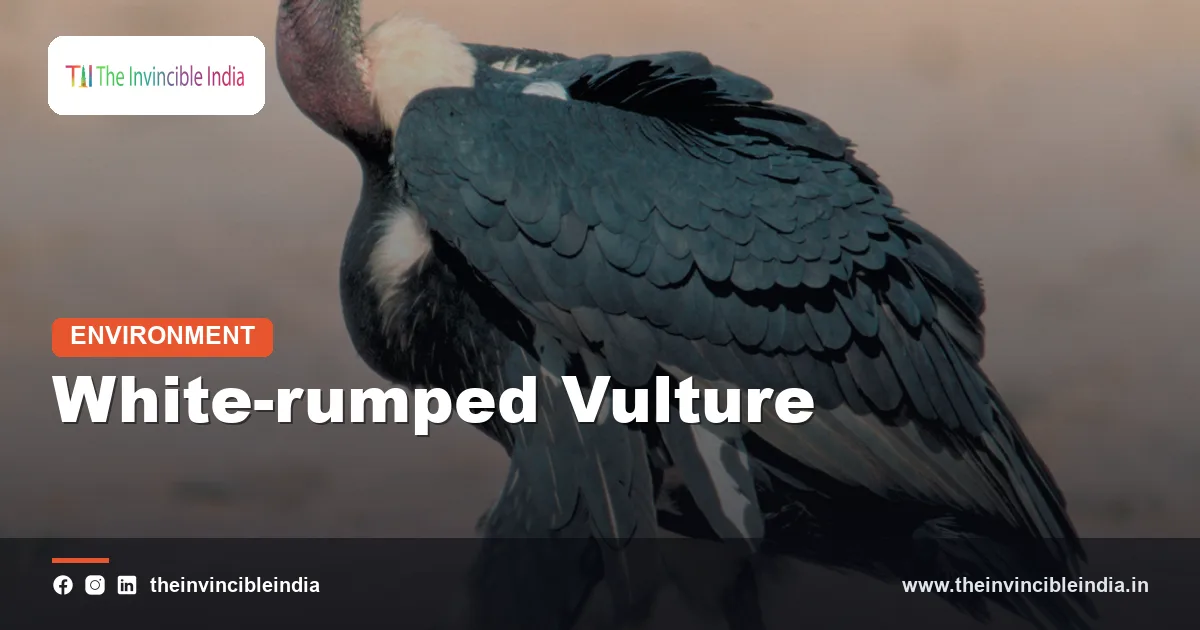
The white-rumped vulture (Gyps bengalensis) is a medium-large scavenging bird of prey, recognised by the white patch on its lower back, which was once among the most abundant large raptors in the world and is now Critically Endangered across India and South Asia. Its population fell by well over 99 per cent from the early 1990s, mainly because of the veterinary painkiller diclofenac, and the species is now the focus of breeding and protection programmes.
This explainer covers what the white-rumped vulture is, how to identify it, where it lives and nests, what it eats, why its numbers collapsed, what has been done to help it, and whether it can recover.
Quick Facts
| Common names | White-rumped vulture, Oriental white-backed vulture, white-backed vulture (Asia) |
|---|---|
| Scientific name | Gyps bengalensis |
| Family | Accipitridae (hawks, eagles, kites and Old World vultures) |
| Size | About 75 to 93 cm long, with a wingspan of roughly 2 metres and a weight of about 3.5 to 7.5 kg |
| India range and habitat | Resident across much of the Indian plains and peninsula, near villages, farmland and open woodland with large trees |
| Diet | Carrion, mainly the carcasses of cattle and other large domestic animals |
| Breeding | Nests in colonies in tall trees; lays one egg a year, typically in the cooler months |
| Conservation status | Critically Endangered on the IUCN Red List; protected under the Wildlife (Protection) Act, 1972 |
Key Takeaways
- The white-rumped vulture (Gyps bengalensis) is an Old World vulture named for the white patch on its lower back and rump.
- The white-rumped vulture was once considered one of the most abundant large birds of prey in the world, with a population running into millions across South Asia.
- The white-rumped vulture declined by more than 99 per cent between the early 1990s and the late 2000s, one of the fastest declines recorded for any bird.
- The main cause of the white-rumped vulture crash was fatal kidney failure after the birds ate livestock carcasses containing the painkiller diclofenac.
- Unlike the cliff-nesting Indian vulture, the white-rumped vulture builds its nest in tall trees, often in loose colonies.
- India banned veterinary diclofenac in 2006, and captive breeding, vulture safe zones and safer drug alternatives now form the core of recovery work for the white-rumped vulture.
What is the white-rumped vulture?
The white-rumped vulture is a large, scavenging bird of prey in the genus Gyps that eats dead animals and is widely distributed in South and Southeast Asia, including most of India. It belongs to the family Accipitridae, which also contains eagles, hawks and kites.
It is also called the Oriental white-backed vulture, and in older Indian writing, it was simply known as the white-backed vulture. The Asian species is closely related to the African white-backed vulture (Gyps africanus), which has a similar white back but is a separate species found in Africa. For this reason, the name “white-rumped” is often preferred in South Asia.
Like other vultures, the white-rumped vulture is an obligate scavenger, meaning it does not hunt living prey. Its bare head and neck, powerful hooked bill and extremely acidic stomach are adaptations that allow it to feed on carcasses and tolerate bacteria that would harm other animals.
Until the 1980s, the white-rumped vulture was extremely common. Flocks gathered at carcass dumps near towns and villages in numbers that surprised many observers, and the bird was a familiar sight in the Indian countryside. Its rapid decline during the 1990s therefore came as a shock to ornithologists.
How can you identify the white-rumped vulture?
The white-rumped vulture can be identified by its dark body, its bare dark head and neck, and the white lower back and rump that show clearly when the bird is seen from above or from behind. In flight from below, it has a pale, whitish underwing lining that contrasts with dark flight feathers.
- Adults: dark brown to blackish body, with a white ruff at the base of the neck and a bright white patch on the lower back and rump.
- Head and neck: bare, covered with a thin layer of whitish down, with dark skin showing through.
- Juveniles: mostly dark brown with pale streaks and a dark rump; the white patch appears as they mature over several years.
- In flight: broad wings, a short tail and a stable soaring posture on rising warm air.
The juvenile can be confused with other young Gyps vultures, and many species are hard to tell apart at a distance. The adult white-rumped vulture is usually the easiest to recognise when it turns away from the observer or banks in flight, showing its pale back.
Where does the white-rumped vulture live in India?
The white-rumped vulture lives in the Indian plains and peninsula, often near villages, farmland, river valleys and open woodland with tall trees for nesting. It is a resident bird that does not migrate, though individuals may travel long distances to find food.
Historically, its range extended across much of South Asia, including India, Pakistan, Nepal and Bangladesh, and into mainland Southeast Asia as far as Myanmar and beyond. Within India, it was widespread in the Gangetic plains, central India, Gujarat, and parts of the south.
The bird prefers lower elevations and warm plains rather than high mountains. Because it nests in trees, it needs large, mature trees, which may be found along roads, in old orchards, near temples and in protected forest patches.
Today, remaining populations in India are concentrated in a few strongholds, particularly in parts of Assam and the north-east, some central and western regions, and several protected areas and tiger reserves. The exact distribution changes with surveys and conservation efforts, so current figures should be checked against recent reports.
What does the white-rumped vulture eat?
The white-rumped vulture eats carrion, especially the soft tissues and internal organs of dead cattle, buffalo and other large domestic animals. It does not kill prey and relies on animals that have died naturally or from disease.
It locates food by soaring on thermals and watching the ground or other vultures. When a bird spots a carcass and descends, others follow, so crowds can assemble in a short time. Within a feeding group, the white-rumped vulture is often one of the more numerous species and tends to feed on softer tissues, leaving tougher parts to other scavengers.
This feeding habit is what made the bird so vulnerable to diclofenac. A single treated carcass could be consumed by dozens of vultures, and each of them would take in a dose of the drug. As a result, even when only a small share of carcasses was contaminated, large numbers of birds could be affected.
How does the white-rumped vulture breed?
The white-rumped vulture breeds in tall trees, building a stick nest high in the canopy and laying a single egg once a year, typically in the cooler months. Pairs often nest close together in loose colonies.
The nest is a platform of sticks lined with leaves. Both parents share incubation, which lasts about seven weeks, and both feed the chick. The young bird remains in the nest for roughly three to four months before it fledges. It may depend on its parents for food for some time after leaving the nest.
Vultures are slow breeders. They reach breeding age after several years, and each pair raises at most one chick annually. This low reproductive rate means that when adult birds die in large numbers, the population cannot rebound quickly, and recovery takes many years even when the original threat is removed.
Why did the white-rumped vulture population crash?
The white-rumped vulture population crashed mainly because the birds ate carcasses of livestock that had been treated with diclofenac, a non-steroidal anti-inflammatory drug (NSAID), which causes fatal kidney damage in vultures. Surveys showed declines of well over 99 per cent between the early 1990s and about 2007.
Researchers first noticed the problem when vultures were found dead or dying from visceral gout, a condition associated with kidney failure. Investigations in the early 2000s, including work in Pakistan and India, linked the deaths to diclofenac residues in cattle carcasses. Even very small amounts proved lethal to the birds.
Diclofenac was widely used in veterinary medicine because it was cheap, effective and available. It had real benefits for farmers whose working animals were in pain, and the harm to vultures was an unintended consequence discovered only later. Even-handed accounts emphasise this point: the fault lay in an unforeseen interaction between a useful drug and a scavenging species, not in any intention to harm wildlife.
Other pressures may have added to the problem, such as loss of nesting trees, disturbance, and the toxicity of some other veterinary drugs. Nevertheless, scientists generally agree that diclofenac was the principal driver of the collapse.
| Period | Development |
|---|---|
| Before the 1980s | White-rumped vultures are abundant and widespread across South Asia |
| Early 1990s | Population surveys begin to record a rapid decline |
| Early 2000s | Species listed as Critically Endangered; diclofenac identified as the cause |
| 2006 | India bans veterinary use of diclofenac |
| Late 2000s onwards | Captive breeding, safe zones and monitoring expand |
Why does the white-rumped vulture matter?
The white-rumped vulture matters because it removes carcasses quickly and efficiently, which helps prevent the spread of disease and keeps water, soil and village surroundings cleaner. For decades, it provided this service at no cost.
When vultures disappeared from many areas, carcasses remained uneaten for longer, and scavenging by feral dogs and rats increased. Researchers and public health bodies have raised concerns about possible consequences, including more disease risk and more contact between people, dogs and carcass sites. The size of these effects is still debated and studied, but the broad lesson is that scavengers perform an ecological service that is difficult and costly to replace.
The white-rumped vulture also has cultural value in India. It appears in folklore and religious stories, and its decline has been widely noted by naturalists, writers and local communities.
What is being done to save the white-rumped vulture?
The main actions to save the white-rumped vulture are the ban on veterinary diclofenac, safer drug alternatives, vulture safe zones and captive breeding, all supported by monitoring and public awareness. These steps are described in national vulture action plans.
- Drug controls: India banned veterinary diclofenac in 2006 and later restricted the packaging of human diclofenac so that it was harder to divert to livestock.
- Safer alternatives: the drug meloxicam has been tested and shown to be safe for vultures, and its use is promoted among veterinarians.
- Vulture safe zones: areas where veterinary use of harmful drugs is monitored so that carcasses are safe for vultures.
- Captive breeding: centres such as the one at Pinjore in Haryana, run with the Bombay Natural History Society (BNHS) and state authorities, maintain captive populations of white-rumped vultures for future release.
- Monitoring and awareness: counts of surviving colonies and engagement with farmers, vets and pharmacists.
Some drugs other than diclofenac, such as certain other NSAIDs, have also been found harmful to vultures, so checking the safety of new veterinary medicines remains an ongoing task.
Can the white-rumped vulture recover?
The white-rumped vulture can recover, but recovery is expected to be slow because the species breeds slowly and its numbers are still very low. Evidence of a stabilising trend in some surveyed areas after the diclofenac ban is encouraging, though it does not mean the bird is safe.
Several conditions will decide the outcome. Carcass food must remain free of toxic drugs. Nesting trees must be kept standing. Captive-bred birds, when released, need protected areas with safe food and monitoring. And the local community, from farmers to pharmacists, must continue to support safe veterinary practices.
Conservationists generally describe the situation as one of cautious hope. The cause of the crash is known and has been addressed through law and practice, which is not the case for many threatened species, but the population remains fragile.
Bottom Line
The white-rumped vulture went from being one of the most numerous large raptors in the world to a Critically Endangered species within a generation. Its story shows how a useful drug can have hidden costs, and how coordinated science, regulation and community action can begin to reverse them.
Frequently Asked Questions
What is a white-rumped vulture?
A white-rumped vulture is a scavenging bird of prey, scientifically named Gyps bengalensis, with a white patch on its lower back. It lives in South and Southeast Asia, including much of India, and feeds mainly on dead cattle.
Is the white-rumped vulture endangered?
Yes, the white-rumped vulture is classified as Critically Endangered on the IUCN Red List. Its population fell by more than 99 per cent from the early 1990s to the late 2000s, and it remains at very low numbers.
Why did white-rumped vultures die out?
White-rumped vultures died in large numbers because they ate carcasses of cattle treated with the painkiller diclofenac, which causes fatal kidney failure in vultures. Habitat loss and other drugs may have added smaller pressures.
Where does the white-rumped vulture nest?
The white-rumped vulture nests in tall trees, often in loose colonies. This is different from the Indian vulture, which usually nests on cliff ledges.
When did India ban diclofenac for veterinary use?
India banned veterinary diclofenac in 2006. Since then, the country has also limited the sale of large vials of human diclofenac and promoted safer alternatives such as meloxicam.
Can the white-rumped vulture recover?
Yes, the white-rumped vulture can recover, but slowly. Each pair raises one chick a year, so recovery depends on safe food, protected nest trees and continued captive breeding and monitoring.
{“@context”:”https://schema.org”,”@graph”:[{“@type”:”FAQPage”,”mainEntity”:[{“@type”:”Question”,”name”:”What is a white-rumped vulture?”,”acceptedAnswer”:{“@type”:”Answer”,”text”:”A white-rumped vulture is a scavenging bird of prey, scientifically named Gyps bengalensis, with a white patch on its lower back. It lives in South and Southeast Asia, including much of India, and feeds mainly on dead cattle.”}},{“@type”:”Question”,”name”:”Is the white-rumped vulture endangered?”,”acceptedAnswer”:{“@type”:”Answer”,”text”:”Yes, the white-rumped vulture is classified as Critically Endangered on the IUCN Red List. Its population fell by more than 99 per cent from the early 1990s to the late 2000s, and it remains at very low numbers.”}},{“@type”:”Question”,”name”:”Why did white-rumped vultures die out?”,”acceptedAnswer”:{“@type”:”Answer”,”text”:”White-rumped vultures died in large numbers because they ate carcasses of cattle treated with the painkiller diclofenac, which causes fatal kidney failure in vultures. Habitat loss and other drugs may have added smaller pressures.”}},{“@type”:”Question”,”name”:”Where does the white-rumped vulture nest?”,”acceptedAnswer”:{“@type”:”Answer”,”text”:”The white-rumped vulture nests in tall trees, often in loose colonies. This is different from the Indian vulture, which usually nests on cliff ledges.”}},{“@type”:”Question”,”name”:”When did India ban diclofenac for veterinary use?”,”acceptedAnswer”:{“@type”:”Answer”,”text”:”India banned veterinary diclofenac in 2006. Since then, the country has also limited the sale of large vials of human diclofenac and promoted safer alternatives such as meloxicam.”}},{“@type”:”Question”,”name”:”Can the white-rumped vulture recover?”,”acceptedAnswer”:{“@type”:”Answer”,”text”:”Yes, the white-rumped vulture can recover, but slowly. Each pair raises one chick a year, so recovery depends on safe food, protected nest trees and continued captive breeding and monitoring.”}}]}]}


